admin's blog

Strategic SMC-AAE Certification Journey: Complete Planning Guide

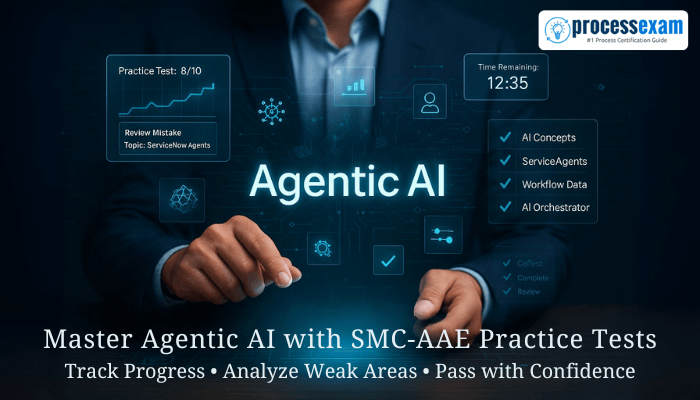
A business professional interacts with a glowing Agentic AI dashboard featuring practice test scores, a timer, checklist

The ServiceNow Micro-Certification Agentic AI Executive (SMC-AAE) represents the cutting edge of AI-driven enterprise solutions. This specialized certification validates your expertise in ServiceNow's revolutionary agentic AI capabilities, positioning you as a leader in the rapidly evolving landscape of intelligent automation and AI orchestration.

Professional success in today's AI-first business environment demands more than theoretical knowledge - it requires strategic certification planning that maximizes your investment in learning while accelerating career advancement. The SMC-AAE certification offers a unique opportunity to demonstrate mastery of ServiceNow's most innovative AI technologies, but achieving success requires a methodical approach that addresses every aspect of exam preparation.

This comprehensive guide provides a proven framework for conquering your SMC-AAE certification journey. You'll discover actionable strategies for mastering complex AI concepts, optimizing study efficiency, and translating certification success into tangible career outcomes. Whether you're advancing your ServiceNow expertise or entering the AI executive space, this blueprint ensures your certification efforts deliver maximum professional impact.

ServiceNow CPOA vs Other Certifications: Which Path Fits Your Career?

The ServiceNow CPOA (Certified Platform Owner Associate) certification proves you can run the Now Platform as a business asset: strategy, people, process, technology, data and governance. It differs from the CSA, CIS and CAD exams, which test configuration and build skills. The exam has 70 questions in 90 minutes, costs USD $300 and is scored Pass / Fail.

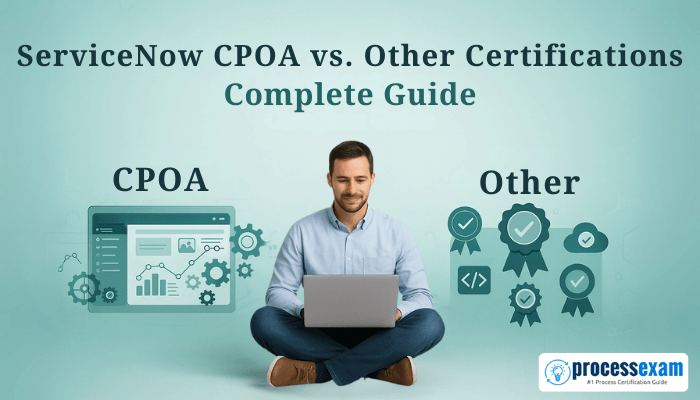
ServiceNow CPOA vs other certifications guide showing a professional with a laptop between CPOA and certification badges

Most ServiceNow credentials ask whether you can configure or build something. The Certified Platform Owner Associate asks a different question: can you decide what the platform should do next, who should do it, how it should be released and how its value is shown to the business? That is why many experienced administrators, business analysts and ServiceNow programme leads look at the CPOA once they have spent a few years on the platform.

This guide compares the ServiceNow CPOA with the other mainstream ServiceNow certifications, walks through all six syllabus domains, explains how the exam is run and how difficult it is, and sets out a five-step preparation plan, the mistakes to avoid and the career value of the credential.

ASQ CMDA Certification Guide: 2026 BoK, Eligibility and Exam Day

Updated on 19 September 2026. What’s new: CMDA exam fees corrected, and the syllabus moved to ASQ's 2026 Body of Knowledge.

To earn the ASQ Certified Medical Device Auditor (CMDA) certification, you need five years of relevant experience (one in a decision-making role, with degree waivers), then pass one open-book exam of 145 multiple-choice questions in 258 minutes with a score of 550/750. From the November 2026 testing window, ASQ tests the new 2026 CMDA Body of Knowledge, so study from the 2026 BoK.

Want to see how ready you are today? Take a timed CMDA practice exam built on the same 145-question format.
Medical device auditors with equipment and reference books, illustrating the ASQ CMDA certification path

The medical device industry runs on evidence. Every design decision, supplier approval, sterilization cycle and complaint investigation has to be documented, reviewed and defensible in front of a regulator or a notified body. The people who test whether that evidence holds up are auditors, and the ASQ CMDA credential is the one that proves an auditor understands both the auditing craft and the medical device rules behind it.

This guide takes you from the first question, whether you are eligible, to the last one, what to do in the exam room. It covers the exam facts, what changed in the 2026 Body of Knowledge, what each of the five domains asks of you, a preparation plan, the mistakes that cost candidates the most marks, and how the credential helps your career.

APMP AI Micro-Certification: Exam Format, Cost and How to Prepare

The APMP AI Micro-Certification (AI-M APMP) is a 30-question, 30-minute multiple-choice exam that checks whether you can use artificial intelligence sensibly in bid and proposal work. You need 73% to pass, which is 22 correct answers. The fee is $165 for APMP members and $300 for nonmembers, and most working proposal people can prepare in two to three weeks.

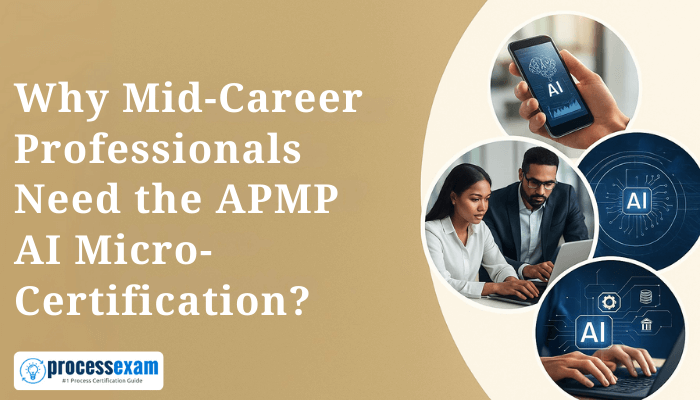
Banner reading Why Mid-Career Professionals Need the APMP AI Micro-Certification with professionals and AI visuals

If you have been in bids for ten years or more, you probably do not need someone to tell you that AI has arrived in your team. Your colleagues are pasting requirements into chat tools, your sales director has asked whether a model can write the executive summary, and your security lead has asked you to stop. This credential exists for exactly that moment: it tests judgement about where AI helps a proposal, where it does harm, and who stays accountable for the words that go to the customer.

This guide covers what the credential is and whether the details are current, how the paper is built, what it costs, what the seven topic areas ask, who gains most from it, a three-week preparation plan and the mistakes that cost marks. The exam figures come from our exam data and match what APMP and its training providers publish; we checked them in September 2026.

ASQ CQA: 7 Essential Resources to Pass the Quality Auditor Exam

Updated on 21 September 2026. What’s new: CQA exam fees corrected to $450, $550 and $350 for retakes, and the syllabus updated to ASQ's 2026 Body of Knowledge.

You have been running internal audits for six years, your manager has started saying you should have the CQA after your name, and the ASQ application page is open on your screen with three different fees on it. Is the credential worth the money and the paperwork, and if it is, what do you actually read first? For anyone who audits for a living the answer to the first question is yes, and the answer to the second is the 2026 Body of Knowledge, not a textbook.

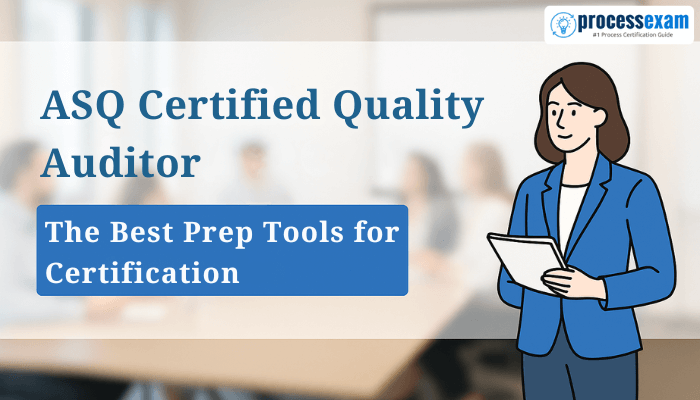
ASQ Certified Quality Auditor guide cover showing the best CQA certification prep tools

That order matters more than most candidates expect. The ASQ Certified Quality Auditor exam is an open-book test built from a published outline, which means the outline tells you what to buy, what to read closely and what to leave alone. This guide keeps the seven resources that matter, puts them in the order a working auditor should use them, and ties each one to the domain it is supposed to cover.

Is the ASQ CQA certification worth the fee and the experience it demands?

The ASQ Certified Quality Auditor credential makes a narrow and useful claim on your behalf: that you can plan an audit, select the right criteria, gather objective evidence, group observations into findings that survive challenge, and follow corrective action through to closure. That is a different skill from knowing a quality management system well. Plenty of excellent quality engineers make poor auditors, and the CQA exists precisely to separate the two.

SRE Foundation Certification: Career Value, Cost and Study Plan

Updated on 10 October 2026. What’s new: exam fee corrected to $257 and the vendor's page lists the exam as open book, not closed book

If you carry a pager for servers someone else designed, a credential will not make you an SRE, but it can show a hiring manager that you already speak the language: service level objectives, error budgets, toil, blameless reviews. SRE Foundation from DevOps Institute is the entry paper for that language. It has 40 questions, runs 60 minutes, needs 65% and costs $257, and this guide explains what it is worth to your career and how to prepare for it.

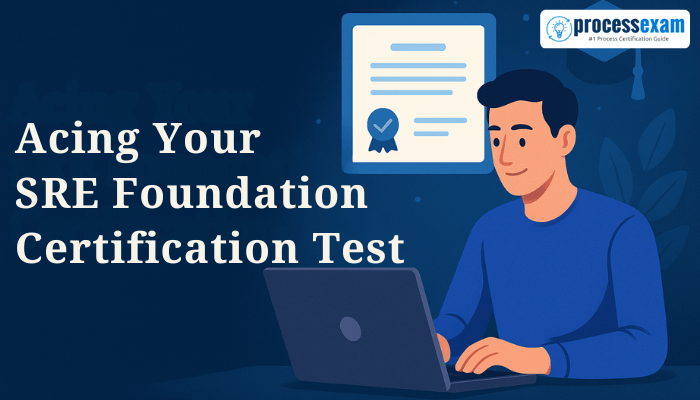
Professional studying on a laptop beside a certificate on the SRE Foundation banner

DevOps Institute, which created the exam, is now part of the PeopleCert group. The vendor's exam page says so in a footnote, and its purchase button hands you over to PeopleCert's platform to pay. I read both the DevOps Institute page and PeopleCert's listing in October 2026. The exam is still on sale, and neither page shows a version number, so there is no newer edition to chase.

What does this credential tell a hiring manager about an ops engineer?

It tells them three modest things. First, that you have studied the vocabulary of reliability work in a structured way rather than picking it up from incident chatter. Second, that you can separate ideas that sound alike, such as an indicator, an objective and an agreement. Third, that you chose to spend evenings on this instead of waiting for your employer to send you on a course.

GInI AGVA Certification: Cost, Requirements and Career Value

Becoming a GInI Authorized Growth Venture Assessor costs USD $250 for GInI members or USD $350 for non-members, and that is only the second payment: GInI will not register you until you already hold its CInP, CInS or CCInO certificate. So the real question is not the exam fee but what the credential lets you earn afterwards. This guide puts the costs, the rules and the work side by side.

Notepad with a Career sticky note and a title card for GInI AGVA certification career benefits

The AGVA is a narrow credential. It authorizes you to assess small and medium-sized business ventures for GInI's Certified Innovative Growth Venture (CInGV) accreditation, and nothing else. Whether it pays back depends on whether that one job exists near you, which is why we start with the money and the restrictions rather than the usual list of career perks.

Exam detail AGVA
Full name GInI Authorized Growth Venture Assessor
Exam code AGVA
Vendor GInI (Global Innovation Institute)
Exam fee GInI Member USD $250; Non-Member USD $350
Questions 50, multiple choice
Duration 60 minutes
Passing score 75%

All of these details were checked against GInI's own AGVA certification page in October 2026, and the exam is still on sale there with the same figures.

CInA Certificate for Students: Cost, Eligibility and Syllabus

Picture a final-year business student with a degree on the way, a society role and one summer internship, wondering whether a $300 or $350 certificate adds anything to that CV. For the GInI Certified Innovation Associate it can, provided you are the audience it was built for: a junior, senior or graduate student with no professional experience yet. The exam is 90 multiple-choice questions in 90 minutes with a 60% pass mark.

Three students share a laptop beside a banner on how CInA certification helps them lead innovation projects

This guide is written for that student. It covers who is allowed to sit the exam, what the whole route costs once the compulsory reference book is counted, how the 90 questions are spread across eleven sections, what a realistic study route looks like beside coursework, and what happens after you pass. Every rule and fee comes from GInI's own CInA page and its guidebook, checked in October 2026.

Is the CInA certificate worth it for a student about to graduate?

It is worth it when you want a recognised, innovation-specific line on a CV that otherwise looks like every other graduate's. GInI describes the credential as its recognition of university students, usually those nearing graduation, who understand the basics of business innovation and of working as a contributing innovator inside a company. It is an entry-level credential, and it is priced and examined as one.

What the certificate does and does not do is worth stating plainly.

PSM I vs PSM II: From Running Scrum to Defending It

Two years into the Scrum Master role, your events run smoothly and the team trusts you. Then a director asks why the Sprint Goal cannot absorb one urgent request, and you answer with a rule instead of a reason. The argument is lost. That moment marks the line between the two credentials: PSM I proves you know Scrum as the Scrum Guide defines it, while PSM II proves you can apply it, and defend it, when real people push back.

PSM I and PSM II certification badges beside a laptop, about leveling up Scrum Master skills

Both certifications come from Scrum.org, both are passed online without a mandatory class, and both carry the same 85% pass mark. After that, almost everything changes: the number of questions, the time you get for each one, the focus areas, the way answers are scored and, above all, the kind of thinking the questions reward. This article sets the two side by side, explains what the advanced exam adds, and helps you decide when the step up is worth taking.

What really separates PSM I from PSM II?

Scrum.org describes PSM I as evidence of a fundamental level of Scrum mastery: you understand Scrum as written in the Scrum Guide and share a consistent vocabulary with other practitioners. PSM II is described as an advanced level, for Scrum Masters who can support Scrum Teams and solve complex problems in the real world, and Scrum.org says candidates should bring in-depth Scrum Master experience before attempting it.

SMC-PE Exam Guide: 7 Crucial Topics to Master for Guaranteed Success

A professional woman stands beside a checklist clipboard in an office setting with the title ServiceNow SMC-PE Exam

Becoming the go-to expert for process automation on the ServiceNow platform starts with a single, powerful credential. For professionals aiming to validate their skills, passing the SMC-PE Exam is a critical milestone that demonstrates mastery over streamlined, automated, and highly efficient business processes. But how do you conquer an exam where a staggering 70% is focused on a single, dense topic like Playbook Development?

The SMC-PE Certification is not just another badge; it's a testament to your ability to transform complex, multi-departmental processes into simple, guided experiences. The pressure to pass is real, as is the challenge of mastering the material. Many professionals feel overwhelmed by the depth required and are unsure how to allocate their study time for the SMC-Playbooks Essentials Exam.

This guide is designed to alleviate that stress. We will dissect the official exam blueprint, provide a comprehensive roadmap through the seven most critical areas, and offer expert strategies to ensure you walk into the SMC-PE Exam with confidence and walk out with a passing grade.

Syndicate content