admin's blog

APICS CLTD Certification: The Nine Modules and a Study Plan

Updated on 23 September 2026. What’s new: CLTD now follows ASCM's exam content manual version 3.0, the basis of the 2026 CLTD Learning System, in place of the 2024 version named before.

Everything in the CLTD exam comes down to one number: 300 out of 350. To reach it you answer 150 multiple-choice questions in 210 minutes, for an exam fee of USD $1,100, across the nine modules ASCM sets out in its CLTD content outline. This guide reads those nine modules one by one, says plainly who the credential suits, and turns the outline into a study plan you can hold yourself to.

Logistics professional overlooking a distribution centre from a mezzanine with a tablet in hand

One thing you will not find here is a success statistic. ProcessExam has never run a controlled study of CLTD pass rates, so this article quotes none, and it gives no salary figure that cannot be traced to a published survey. What it does give you is the exam as ASCM publishes it today, the content outline read section by section, and preparation advice that follows from how the paper is actually built.

Here are the numbers to plan around.

ISTQB CTAL-TAE v2.0 Syllabus: What Changed Since the 2016 Edition

Updated on 12 October 2026. What’s new: the current pass mark is 43 points out of 66, across 40 questions, on ISTQB's exam page

ISTQB did not patch the Test Automation Engineering syllabus for version 2.0. It rewrote it. The May 2024 release replaced the 2016 edition, kept the engineer's own work (architecture, pipelines, upkeep) and moved the strategy material into a separate CT-TAS syllabus. The paper is 40 questions in 90 minutes, and you need 43 of the 66 points to pass.

ISTQB CTAL-TAE v2.0 cover for the Test Automation Engineering syllabus article

Many articles about this exam still describe it as a light refresh with "AI and DevOps added". That is not what the syllabus says about itself. Below is what ISTQB actually changed, what each chapter now examines, how the six scripting approaches differ, and a study route that fits someone who already writes automation code. Everything about the syllabus comes from ISTQB's own v2.0 PDF, and everything about the exam from the vendor's exam page, both read in October 2026.

What did ISTQB change when it replaced the 2016 syllabus?

The syllabus's own revision history lists two releases: the general availability release of 21 October 2016 and the v2.0 release of 3 May 2024. Its release-notes appendix is short and unusually frank. It calls the 2024 text "a major update and rewrite of release 2016", says that for this reason there are no release notes chapter by chapter, and gives two reasons: the content has been "significantly enhanced for the test automation engineering role", and strategic content has moved to the new Test Automation Strategy syllabus.

Achieve Global Recognition with CIPM Certification

Updated on 23 September 2026. What’s new: cipm exam fee corrected to USD $599, the amount IAPM works out from the candidate's citizenship rather than charging one flat price worldwide

Two organisations issue a certificate abbreviated CIPM, and they have nothing to do with one another. One sits in the privacy profession. The other is the subject of this guide: the Certified International Project Manager (IAPM), awarded by the International Association of Project Managers to people who deliver projects across borders. It asks 80 questions in 60 minutes, needs 65% to pass, and refuses to let you sit it until you already hold an IAPM project management certificate.

Project team reviewing charts beside the title Take Your Project Management Career International with CIPM Certification

That entry condition is the part most candidates find out about late, and it changes how you should plan. The CIPM is not a starting point and not a rung above the senior level; it is a specialisation bolted onto a certificate you already own. Everything below follows from that: who the credential is built for, what IAPM tests in its 60 minutes, what it costs when the price is set by your passport, and how a certified project manager can get ready in about four weeks.

Certified Business Architect (CBA) Level 1 Exam Guide: BAGUILD-CBA-LVL1-100

Updated on 29 September 2026. What’s new: the exam covers ten domains whose content has stayed consistent since the current exam launched in 2020, with BIZBOK Guide 8.5 or later as its reference

The BAGUILD-CBA-LVL1-100 exam is the Business Architecture Guild's Certified Business Architect Level 1 test, and it is still the same exam you may have read about last year: 150 questions in 150 minutes, a 70% pass mark and a US$375 fee. What changed is only the calendar. This guide replaces the old year-based trend list with what the Guild and Pearson VUE publish today.

Business architect mapping capabilities on a whiteboard with a colleague

Everything here was checked in September 2026 against the Guild's certification page, its self-study page and the Pearson VUE exam page, plus the figures ProcessExam holds for the exam. Where a source could not be reached or does not state something, the article says so instead of guessing, because a certification guide that invents a passing rate or a salary is worse than none.

SPS Exam Prep: Ace Scaled Professional Scrum Certification

SPS Mastery guide banner with a woman studying, titled 'How to Excel in Scaled Professional Scrum Exam?' on a purple and

The Scaled Professional Scrum (SPS) certification, offered by Scrum.org, is your gateway to mastering large-scale Agile practices. Designed for professionals who aim to excel in managing multiple Scrum teams, the SPS certification validates your expertise in the Nexus framework. Achieving this credential isn’t just a milestone - it’s a career-defining achievement.

This step-by-step guide will empower you with actionable insights, resources, and strategies to ace the SPS exam and kickstart your journey to becoming an expert in scaling Scrum practices.

Why Pursue the SPS Certification?

The Scaled Professional Scrum (SPS) certification is a globally recognized credential designed to validate your ability to scale Scrum using the Nexus framework. For professionals aiming to excel in managing large, complex projects involving multiple Scrum teams, this certification is indispensable.

Key Reasons to Pursue SPS Certification

1. Career Advancement

Earning the SPS certification sets you apart in competitive job markets. Organizations globally seek professionals with proven expertise in scaled Scrum practices, making the SPS certification a stepping stone to leadership roles.

2. Improved Skills in Scaling Scrum

CT-TAE Certification: Must-Know Industry Updates

Laptop with test automation icons and CT-TAE certification updates text.

The ISTQB Certified Tester Test Automation Engineer (CT-TAE) certification has gained substantial traction among professionals aiming to master test automation frameworks and methodologies. Staying updated with the latest industry trends and exam-related updates is vital for CT-TAE certification aspirants. Whether you are preparing for the CT-TAE exam or planning to transition to an automated testing role, this guide will provide insights and practical advice to stay ahead.

CT-TAE Certification: Why It Matters More Than Ever

The ISTQB Certified Tester Test Automation Engineer (CT-TAE) certification is more than just a qualification - it is a gateway to becoming a proficient test automation expert. In a world where digital transformation drives software development, automation testing is no longer optional. It is a necessity for organizations seeking agility, efficiency, and cost-effectiveness in their software lifecycle.

The CT-TAE certification equips candidates with the skills to design, develop, and manage automation solutions, making them indispensable to QA teams. With automated testing tools evolving rapidly, this certification ensures you stay ahead of the curve by mastering modern frameworks and technologies.

CPLSA Certification: Pega Lead System Architect Exam and Build Route

Updated on 3 October 2026. What’s new: the Pega Platform '25 exam now has four topics weighted 30%, 30%, 30% and 10%, and the exam fee is USD $190.

Passing the CPLSA exam does not make you a Pega Lead System Architect. Pega treats it as step one of two: a 60-question architecture exam (120 minutes, 65% to pass, USD $190), then a hands-on Design and Build assessment in which you get 14 days to submit a working application. This guide covers both steps, the Pega Platform '25 topic weights and a study plan.

Three colleagues discussing the CPLSA certification journey around a laptop

Most people who search for CPLSA expect a single sitting. That expectation is the first thing to fix, because it changes how long the route takes, what it costs and what you practise. The architecture exam is multiple choice and tests judgement. The second step is closer to a small consulting engagement: Pega hands you business requirements and you design, build and document a solution.

The sections below follow the order a candidate meets things: who may start, what the first exam measures, what each topic asks you to decide, how the build assessment works, how to prepare, and what happens when an attempt goes wrong. Everything about Pega's rules comes from the Pega Academy pages linked in the text, read in October 2026.

Is the CJAPM Certification Worth Sitting With No Experience?

Student celebrating with a notebook beside the title Effective Study Plan for CJAPM Certification

Yes, with one condition: you want proof of Scrum basics before anyone has handed you a Scrum team. The IAPM Certified Junior Agile Project Manager (CJAPM) asks for no project experience, takes 40 questions in 35 minutes, needs 65% and never expires. It will not make you a Scrum Master overnight, but it is a cheap, honest first line on a CV, and it works best for people who have not yet worked in a sprint.

Who gains from a junior Scrum certificate, and who gains little?

The CJAPM is built for a narrow audience, and IAPM says so plainly on its own page for the certificate: agile project management novices, students and people interested in a future career in agile project management. Project experience is not required. That makes the certificate a poor fit for a ten-year delivery lead and a good fit for almost everyone else standing at the door of an agile team.

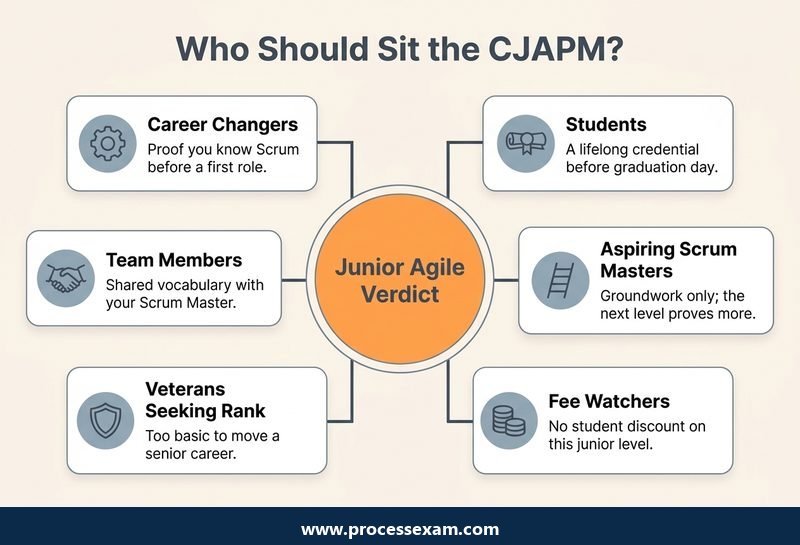
Hub infographic of six reader types and whether the CJAPM suits each, from career changers to fee watchers

Career changers

If you are moving from teaching, operations, support or testing into agile delivery, the hardest part of the first interview is vocabulary. Recruiters screening for a junior Scrum role want to hear that you know what a Product Backlog is and who owns it. A certificate does not replace a story about a team you supported, but it tells the reader that you have already spent time with the terms and passed an independent test on them.

IAPM CSPM Certification: Achieve Excellence

Updated on 22 September 2026. What’s new: exam fee updated to USD $711 with IAPM's citizenship-based pricing, and the senior entry rule of five years' experience, three of them leading, added.

The IAPM Certified Senior Project Manager (CSPM) is not a harder paper than IAPM's Certified Project Manager exam. It is the same kind of test with a gate in front of it. You answer 120 questions in 80 minutes and need 65% to pass, but IAPM admits you to the senior level only after it scores the projects you have run over the last five years, three of them in a leading role.
Project manager studying a Gantt chart beside the title Sharpen Your Skills with IAPM CSPM Certification

That gate is what this guide is about. Most of what is written about the CSPM treats it as a study problem, yet the first decision a candidate faces is an administrative one: will IAPM accept my experience, and if not, what then? Below you will find how the experience score works, what the certificate costs, what the exam asks of you, how to choose between the senior and the standard level, and how a working manager can prepare without losing weeks to material they already know.

Which CSPM is this, and who is the IAPM senior level built for?

The letters CSPM are shared by more than one field. In cloud computing they stand for Cloud Security Posture Management, a category of security tooling. If you arrived here looking for cloud security, this is not that credential. The CSPM covered here is issued by the International Association of Project Managers (IAPM), and its full name is Certified Senior Project Manager (IAPM). It belongs to traditional, plan-driven project management.

ICLE Certification: IASSC Lean Expert Exam, Topics and Cost

IASSC describes a Lean Expert as the person who drives and leads Lean efforts across an organisation, often full time, working with management on direction while Lean Leaders and Practitioners carry out the improvements. That is a different signal from a Six Sigma belt, which mostly says you can use statistics inside a project. The ICLE exam behind it is 110 questions in 180 minutes, with a 70% pass mark and a USD $350 voucher fee.

Stack of wooden blocks being placed with care, a picture for the IASSC Lean Expert ICLE certification

Where does a Lean Expert sit beside a Six Sigma belt?

Start with how IASSC itself places the credential. On its Lean Expert certification page the title is marked Advanced Level, and IASSC adds that Lean Experts are also called Lean Black Belt, Lean Gold or Lean Master. Below it sit the Lean Practitioner and Lean Leader levels, each with its own Body of Knowledge. So the Lean Expert is the top of a Lean-only ladder, and it exists next to the Yellow, Green and Black Belt exams in the Lean Six Sigma ladder rather than inside it.

The practical difference is the kind of problem each credential is built for. A Green or Black Belt exam spends much of its time on DMAIC and statistics: sampling, hypothesis tests, regression, control charts. The Lean Expert Body of Knowledge has almost none of that. Its 38 topics are about flow, waste, standard work, equipment losses and how an organisation keeps improvement alive after the workshop ends. A belt holder answers "is this difference real?" A Lean Expert answers "where does work wait, why, and who has to change what to fix it?"

Syndicate content