
Certified Business Architect (CBA) Level 1 Exam Guide: BAGUILD-CBA-LVL1-100
Updated on 29 September 2026. What’s new: the exam covers ten domains whose content has stayed consistent since the current exam launched in 2020, with BIZBOK Guide 8.5 or later as its reference
The BAGUILD-CBA-LVL1-100 exam is the Business Architecture Guild's Certified Business Architect Level 1 test, and it is still the same exam you may have read about last year: 150 questions in 150 minutes, a 70% pass mark and a US$375 fee. What changed is only the calendar. This guide replaces the old year-based trend list with what the Guild and Pearson VUE publish today.

Everything here was checked in September 2026 against the Guild's certification page, its self-study page and the Pearson VUE exam page, plus the figures ProcessExam holds for the exam. Where a source could not be reached or does not state something, the article says so instead of guessing, because a certification guide that invents a passing rate or a salary is worse than none.
Is the Certified Business Architect exam still the same one you read about in 2025?
Yes. The Guild's own self-study page says the current exam was introduced in 2020 and that the domain content has stayed consistent since. That matters because older write-ups on this exam, including an earlier version of this very article, spoke of a wave of new topics arriving with a particular year. The evidence does not support that. The exam is organised around ten domains, and what moves over time is the reference book behind them rather than the list of domains.
That reference book is A Guide to the Business Architecture Body of Knowledge, known as the BIZBOK Guide. Pearson VUE's exam page recommends version 8.5 or later, and ProcessExam's records list the exam under version 8.5, so the two agree. The Guide is a member benefit, which is the first practical point: the reading list sits behind a membership, so budget for that before you budget for the exam itself.
The figures below come from ProcessExam's exam records, checked against the Pearson VUE page for the question count and time limit.
| Exam detail | Certified Business Architect Level 1 |
|---|---|
| Exam code | BAGUILD-CBA-LVL1-100 |
| Certification name | OMG Certified Business Architect (CBA) Level 1 Exam |
| Version | version 8.5 |
| Exam fee | US$375 |
| Number of questions | 150 multiple-choice |
| Duration | 150 minutes |
| Passing score | 70% |
| Domains | 10 |
| Who may sit it | Business Architecture Guild members in good standing |
| Delivery | Pearson VUE, at a test centre or online with OnVUE |
One line in that table shapes your pace more than any other. A hundred and fifty questions in a hundred and fifty minutes is exactly one minute a question with nothing spare, so any question you spend three minutes on has to be paid for by three you answer in thirty seconds. The domains below are worth learning for that reason too: the ones you know cold are the ones that fund your slow questions.
A word on the older claims. Earlier editions of this article talked about a projected annual growth rate for business architects, a salary above a round figure and a wholesale redesign of the question format. None of those can be traced to a Guild or Pearson VUE page, so they are gone. If you meet them elsewhere, ask where the number comes from.
What do the ten CBA domains actually ask of you?
The Guild lists the ten domains on its self-study page, and the order it uses is a sensible order of study. Read them as four clusters rather than ten separate lists, because the questions constantly cross from one domain into its neighbour. The Guild does not publish a percentage weight for each domain on the pages that could be read, and ProcessExam holds none either, so treat all ten as examinable and do not build a plan around a weighting you have been told secondhand.
Foundations and the maps: domains 1 to 3
The first domain, Foundational Concepts, is the vocabulary of the discipline: what business architecture is, what it is not, what its artefacts are for and how it differs from IT architecture. It reads as easy, and it is the domain where careless candidates lose marks, because later domains reuse its terms with precision.
Domain 2, Core Mapping Knowledge, covers the four maps that the Guild treats as the backbone of the practice: the capability map, the value stream map, the organisation map and the information map. A capability map shows what a business does, independent of how or who does it. A value stream map shows the end-to-end sequence of stages that delivers something a stakeholder values. The organisation map shows who is involved, and the information map shows the business concepts that matter and how they relate. The exam expects you to know what each one is for and, more usefully, which one to reach for when a scenario describes a problem.
Domain 3, Extended Mapping Knowledge, adds the maps that hang off that core: strategy, stakeholder, initiative, product and service mapping. The reasoning is layered. If the core maps describe the business as it is, the extended ones describe what it is trying to do, who cares, what work is under way and what it sells or provides.
Neighbours and performance: domains 4 and 5
Domain 4 is Alignment with Related Business Disciplines. Business architecture does not stand alone, and the Guild lists business model, process management, case management and requirements analysis as the neighbours you must place correctly. A useful test is to ask what each discipline would take from a capability map and what it would give back.
Domain 5 is Business Architecture and Business Performance Analysis: metrics, assessments and portfolio planning. It is about using the maps to say where the business is strong or weak and which investments deserve priority. Expect questions that hand you a situation and ask which assessment, or which view of the portfolio, would answer it.
The role and its governance: domains 6 and 7
Domain 6, the Business Architect Role, covers the architect's responsibilities, the competencies the role needs and how it interacts with related roles. Domain 7, Business Architecture Governance, covers program deployment, maturity, measurement and sustainability. Together they are the most practice-flavoured pair on the list, and candidates who have run or supported an architecture team answer them from experience rather than memory.
Working with IT, scenarios and tooling: domains 8 to 10
Domain 8 is Business Architecture and IT Architecture Alignment: portfolio management and transformation initiatives that sit across the business and technology sides. Domain 9, Situation and Scenario Usage, is where the discipline is applied: issue analysis, impact analysis and change management. Domain 10, Infrastructure Management, closes the list with artefact management, reporting and tooling, meaning how a practice keeps its maps current and usable.
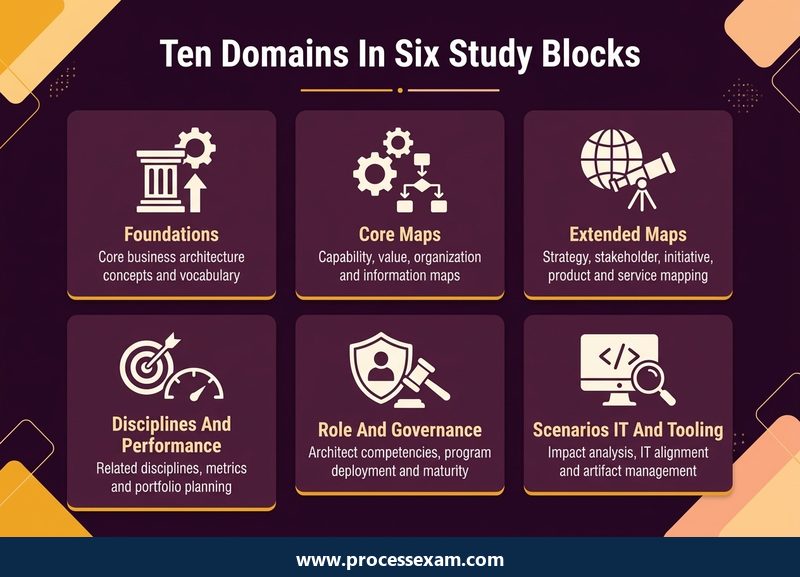
To check your grasp of the whole list, turn the ten domains into a checklist you can tick off, which is the quickest way to find the one you have been quietly avoiding. The CBA sits in the OMG family of certifications, so the habit of mapping every study session to a published domain carries over to the other OMG credentials too.
How do you get from Guild membership to a seat in the exam room?
The route is more procedural than most certifications, and it is where first-time candidates lose the most calendar time, so it is worth laying out in order.
Step one: be a member in good standing
Membership is not a formality. The Guild states that exam vouchers are made available only to members in good standing, and Pearson VUE repeats it as the only requirement to sit the exam. There is no experience threshold or prior certificate in either source, which is unusual and worth knowing if you assumed a seniority gate.
Step two: request a voucher early
You have to request and receive a voucher before you can schedule an appointment. The Guild asks for requests at least ten days ahead, and the voucher is free and valid for roughly a year. So the safest habit is to request it the day you decide to sit the exam, not the week you want the date.
Step three: choose a study route
The Guild describes guided self-study, free to members, or a programme from one of its accredited training partners, or a mix of the two. Whichever you choose, the Guild strongly recommends taking its two readiness quizzes before you book. That recommendation is the most useful sentence on the whole certification page, and the next section looks at what those quizzes can and cannot tell you.
Step four: schedule with Pearson VUE and sit the paper
You book through Pearson VUE, which offers test centres and online proctoring through OnVUE. Payment is taken when you schedule the exam rather than when you receive the voucher. Pearson VUE asks that appointments, in person or online, are made at least one day ahead, so there is no same-day booking to fall back on if a plan slips.
Step five: finish the paperwork after the paper
A pass is not the end of the process. The Guild says you must upload your exam results and complete a certification package before you can reach your certificate and badge, and that a candidate who did not pass receives discounted retake instructions only after doing the same. Renewal is tied to continuing education units. Read the current renewal terms on the Guild's certification page before you rely on any number of years you have heard, because the pages that could be read do not state a validity period.
What can the Guild's two readiness quizzes tell you before you pay?
The self-study route includes two readiness quizzes: one of 13 questions and one of 20. Together that is 33 questions against a 150-question exam, so the quizzes are a smoke alarm, not a mock exam. They tell you whether something is badly wrong. They cannot tell you that you are ready.
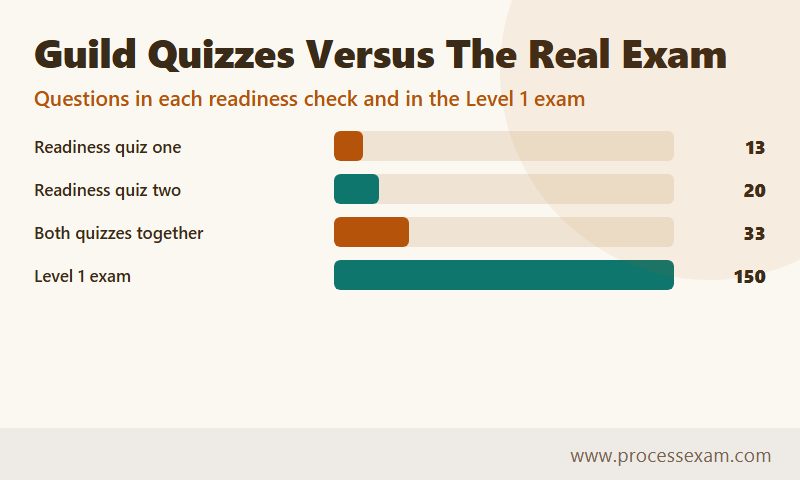
Use them the way a pilot uses a checklist. Take the shorter one cold, before you have studied the BIZBOK Guide, and note which domains the questions came from. That gives you a baseline and, more usefully, a map of your blind spots. Take the longer one after two weeks of reading and compare. If the score has not moved, the problem is your method, not your effort, and it is cheaper to discover that now than after paying the fee.
Then bridge the gap. Thirty-three questions run out quickly, and a candidate who has memorised them has learned nothing about the other hundred and seventeen. Once the quizzes are spent, work through a bank of unfamiliar scenario questions, and mark each miss with its domain number. After forty or fifty questions a pattern appears, and that pattern is your study plan for the final fortnight. Our OMG exam store lists the OMG practice exams currently available.
What does a scenario question on the CBA look like?
The exam's own question wording is not published in the sources checked, so the examples below are original illustrations of the reasoning it rewards, not copies of live questions. What is clear from the domain list is that domain 9 is explicitly about situations and scenarios, and that several other domains reward the same habit.
Choosing the right map
Imagine a scenario in which an insurer's executives disagree about why claims take so long. One director says the problem is the claims department; another says it is the systems. The reasoning the exam wants is to reach for a value stream, because the question is about the sequence of stages that delivers an outcome to the claimant, and the capabilities that support each stage can then be assessed against it. A capability map alone would show what the insurer can do but not where the delay sits.
Following an impact
A second illustration: a strategy change drops a product line. The candidate has to trace which capabilities, value streams, initiatives and organisational units touch that product, and say what needs review. This is impact analysis, and it only works if the extended maps from domain 3 are joined to the core maps from domain 2. Candidates who learned each map in isolation find the chain breaks halfway.
Placing a discipline
A third shape asks who owns what. A team wants to redesign a process, and the question asks what business architecture contributes and what belongs to process management. The safe reasoning is that architecture supplies the context, priorities and scope, while process management works out the detailed flow inside that scope. Domain 4 is full of boundary questions like this, and they reward a clear one-sentence answer for each neighbouring discipline.
Reading a governance situation
A fourth shape sits in domains 6 and 7: a business architecture practice has been running for two years and leadership attention is fading. The question asks which action best sustains it. The logic points to measurement and maturity, because a practice that cannot show its value to sponsors loses funding, and the answer that offers a bigger deployment without a measure usually loses to the one that adds evidence.
How should you spread your study across the ten domains?
Because no domain weights are published in the pages that could be read, a fair plan is an even one, adjusted by your own quiz results. What follows is a six-week shape that works for someone reading around a job, and you can stretch or compress it as long as the order survives.
Weeks one and two: vocabulary and the core maps
Read the foundational material and the four core maps. Draw each map for a business you know well, such as your employer or a shop you visit weekly. The drawing exposes what you have not understood far faster than rereading does, and it produces a set of worked examples you will reuse for weeks.
Week three: extended maps and neighbouring disciplines
Add strategy, stakeholder, initiative, product and service maps to your drawings, then write one sentence for each related discipline saying what it takes from architecture and what it returns. Take the first readiness quiz here if you have not already.
Week four: performance, role and governance
These three domains are the most judgement-heavy. Build a short list of the competencies of a business architect, then a list of what governance has to prove to a sponsor. Practise turning each into a single clear sentence, because the answer options on a judgement question are often four sentences that all sound plausible.
Week five: IT alignment, scenarios and tooling
Work through the alignment with IT architecture, then attempt as many scenario questions as you can find. The purpose of the week is to move from knowing the domain content to using it under a clock.
Week six: timed practice and repair
Sit a full-length timed set at one minute a question, log every miss by domain, and spend the final days on the two weakest. Stop new reading three days before the exam. Rest and pace are worth more than another chapter at that point.
Where do experienced analysts lose marks on this exam?
Business analysts, enterprise architects and consultants tend to arrive confident, and the exam punishes a particular kind of confidence. These are the patterns worth checking yourself for.
Answering from your own employer's practice
Every organisation adapts business architecture to its own culture. The exam asks for the Guild's approach as set out in the BIZBOK Guide. When your workplace calls something by another name or uses a shortcut, the exam does not reward loyalty to it. Answer from the Guide.
Treating the maps as diagrams instead of tools
Candidates who can draw a capability map perfectly still miss questions that ask when to use it. The knowledge that earns the mark is the purpose of each map and the question it answers, not the notation.
Skipping the domains that feel like common sense
Foundational concepts and the architect's role sound obvious. Because they are obvious, they are the domains where a single unfamiliar word in an answer option separates the correct choice from a plausible one. Read them from the Guide at least once.
Spending the quizzes in the wrong week
Taking both readiness quizzes on the first day removes your only cheap measure of progress. Space them out, so the second one tells you whether your study is working.
Leaving the voucher and the calendar to the end
The ten-day voucher request, the payment on scheduling and the one-day booking rule are easy to overlook and hard to fix on the day you wanted to sit the exam. Sort the paperwork in week one and the exam date becomes something you choose rather than something you negotiate.
Where does the CBA show up in day-to-day architecture work?
The honest answer is that it changes how quickly other people can place you. The credential shows that you know the Guild's vocabulary and method and have been tested on them under supervision, which is useful when you move into a team that already works from the BIZBOK Guide or when you present business architecture to sponsors who have not seen it before.
It does not, by itself, prove you can run an architecture practice, and it does not come with a published salary uplift. No salary figure is quoted here because none of the sources checked gives one that can be cited. If you are weighing the cost, compare it with what you would do with the certification in the next twelve months: a change of role, a client proposal, an internal case for starting a practice.
It is also a credential that has to be maintained. Renewal depends on continuing education units and on staying in good standing as a Guild member, so the real cost includes membership and the time to log learning, not only the exam fee. A candidate who treats the certificate as a one-off purchase is surprised by that; a candidate who treats it as part of a professional habit is not.
Finally, consider how the certification fits with what you already hold. Analysts who come from a requirements background find domain 4 familiar and domain 2 new. Enterprise architects find domain 8 familiar and domain 5 new. Knowing which side you start from tells you where the six weeks above should lean, and it is the most reliable use of your first readiness quiz.
Frequently Asked Questions
How many questions and how much time does the BAGUILD-CBA-LVL1-100 exam give you?
The exam has 150 multiple-choice questions and a 150-minute time limit, which is one minute a question with no spare time. Pearson VUE delivers it at a test centre or online with OnVUE, and appointments must be made at least one day ahead.
What is the passing score and fee for the Certified Business Architect Level 1 exam?
ProcessExam's records give a 70% passing score and a US$375 exam fee. Payment is taken when you schedule the exam with Pearson VUE, after the free voucher has been issued. Check the Guild's certification page for the current fee before you book.
Do you need to be a Business Architecture Guild member to take the CBA exam?
Yes. The Guild makes exam vouchers available only to members in good standing, and Pearson VUE names membership as the only requirement to sit the exam. No years of experience or earlier certificate are listed, so membership is the one gate to clear first.
Which BIZBOK Guide version should you study for the CBA Level 1 exam?
Pearson VUE recommends A Guide to the Business Architecture Body of Knowledge, version 8.5 or later, and ProcessExam lists the exam under version 8.5. The Guide is available to Guild members, so plan for membership before you plan your reading.
What are the ten domains on the Certified Business Architect exam?
They are Foundational Concepts, Core Mapping, Extended Mapping, Related Business Disciplines, Performance Analysis, the Business Architect Role, Governance, IT Architecture Alignment, Situation and Scenario Usage, and Infrastructure Management. The Guild says the domain content has been consistent since the current exam was introduced in 2020.
- OMG Exam |
- Business Architect |
- Business Architect Certification |
- OMG Business Architect Exam Questions |
- OMG Business Architect Test Questions |
- OMG Business Architect Study Guide |
- OMG BAGUILD-CBA-LVL1-100 Exam |
- BAGUILD-CBA-LVL1-100 |
- BAGUILD-CBA-LVL1-100 Question Bank |
- BAGUILD-CBA-LVL1-100 Certification |
- BAGUILD-CBA-LVL1-100 Questions |
- BAGUILD-CBA-LVL1-100 Body of Knowledge (BOK) |
- BAGUILD-CBA-LVL1-100 Practice Test |
- BAGUILD-CBA-LVL1-100 Study Guide Material |
- BAGUILD-CBA-LVL1-100 Sample Exam |
- CBA Certifications |
- OMG Certified Business Architect |
- Business Architect Simulator |
- Business Architect Mock Exam |
- OMG Business Architect Book |
- OMG BAGUILD-CBA-LVL1-100 BOK PDF |
- BAGUILD-CBA-LVL1-100 Exam |
- BAGUILD-CBA-LVL1-100 Study Guide PDF |
- OMG Business Architect Sample Questions


