
ArchiMate Practitioner Exam: Inside the Open-Book Scenario Paper
Open book sounds like the easy half of ArchiMate certification, and that assumption sinks more candidates than any element they forgot. The ArchiMate Practitioner exam gives you 90 minutes for eight scenario questions with the ArchiMate 3.2 specification on screen, and gradient scoring that rewards only the best model: you need 26 of 40 points.
This guide is for architects who already hold ArchiMate 3 Foundation, or plan to sit both parts on the same day, and want to know what the second paper really asks of them. It covers how the eight scenarios are scored and why that arithmetic matters, what you must hold before booking and what it costs, which parts of the specification the questions draw on, how to reason through a question where every option looks defensible, how to use the built-in specification without losing the clock, and a six-week plan that turns Foundation knowledge into Practitioner judgement. The figures come from The Open Group's ArchiMate examinations datasheet and were checked in October 2026.

Why does an open-book paper with only eight questions still fail prepared candidates?
Because the book answers the wrong question. The ArchiMate 3.2 specification tells you which elements and relationships exist and which combinations are valid. The Practitioner paper rarely asks whether something is valid; it asks which of four valid-looking models is the most appropriate for a stakeholder, a scenario and a set of constraints. The specification cannot rank four answers for you. Only practised modelling judgement can.
The second trap is the question count. Eight questions feels light after the 40-question Foundation paper, so candidates under-prepare. But each scenario is a page of reading: an organisation, its problem, the people who care about it, and a modelling task. Four answer options follow, and they are usually long, each describing a slightly different model in prose. A single misread sentence in the scenario, such as which stakeholder the view is for, can move you from the best answer to the third-best.
The third trap is time. Ninety minutes across eight scenarios gives you a little over eleven minutes per question, and that has to cover reading the scenario, reading four long options, checking the specification where needed and choosing. Candidates who open the specification for every doubt run out of time on question six or seven. The open book is a reference for the one rule you are unsure of, not a textbook to learn from during the exam.
Put those three together and the pattern is clear. People who fail usually knew the language; they lacked practice at choosing between near-correct models under time pressure. The rest of this guide is built around closing that gap.
How are the eight scenarios scored, and what does 26 of 40 really demand?
Each question has four answers, and The Open Group's datasheet describes the scoring exactly: the correct answer scores 5 points, the second-best answer 3 points, the third-best 1 point, and the distracter scores zero. With eight questions the maximum is 40 points, and the pass mark is 65%, which is 26 points or more.
| Answer you choose | Points | What it usually looks like |
|---|---|---|
| Best answer | 5 | Right elements, right relationships, and the view fits the stakeholder named in the scenario |
| Second-best | 3 | A valid model that misses one requirement, often the stakeholder concern or the level of detail |
| Third-best | 1 | Partly right, but uses a weaker relationship or the wrong layer for one element |
| Distracter | 0 | Breaks a language rule or answers a different question from the one asked |
The arithmetic is less forgiving than it looks. If you pick the second-best answer on all eight questions, you score 24 and fail. Consistently good but never best is not enough. On the other hand, you do not need to be perfect: one best answer and seven second-best answers give exactly 26, and three best answers with five second-best give 30. Even a couple of zeros can be absorbed if the rest are strong: four best answers, two second-best and two distracters also make 26.
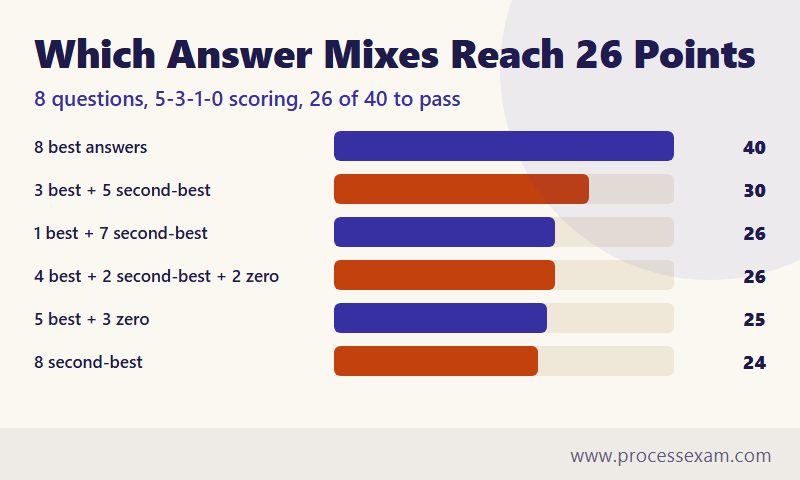
Two lessons follow for preparation. First, every best answer is worth two points more than a second-best, so your study time should go into telling the best and second-best apart, not into eliminating the obvious distracter. Second, a single disaster is survivable, so do not let one confusing scenario eat twenty minutes. Make a reasoned choice, flag it if your delivery lets you, and move on to bank the time for questions you can win.
What do you need before booking, and what does ArchiMate Practitioner certification cost?
The Practitioner exam is formally the ArchiMate 3 Part 2 Exam, and passing it gives the ArchiMate 3 Practitioner qualification. The datasheet sets one prerequisite: you must already hold ArchiMate 3 Foundation, or pass the ArchiMate 3 Part 1 exam on the same day at the same test centre. The Foundation exam itself is 40 closed-book multiple-choice questions in one hour, with a pass mark of 24 out of 40. If that first paper is still ahead of you, our four-week plan for the closed-book first paper covers it.
| Detail | ArchiMate 3 Part 2 (Practitioner) |
|---|---|
| Exam fee | USD 375 (as of October 2026) |
| Questions | 8 scenario-based, complex multiple choice |
| Time | 90 minutes |
| Pass mark | 65% (26 of 40 points) |
| Scoring | Gradient: 5, 3, 1 or 0 points per question |
| Book | Open book: an electronic copy of the ArchiMate 3 Specification built into the exam; no hard copies |
| Delivery | Authorized test centres and online through Pearson VUE OnVUE |
| Prerequisite | ArchiMate 3 Foundation, or Part 1 passed the same day at the same centre |
On cost, the USD 375 exam fee is only part of the picture. The Open Group's datasheet notes that every Accredited Training Course includes the examination in the course fee, with a voucher code to book the exam, so if your employer is paying for a course you may not need to buy the exam separately. If you self-study, you pay the examination provider directly at booking, and local taxes may apply. Add the cost of the Foundation exam if you do not hold it yet, plus whatever study material you use.
Two more practical points from the datasheet. Candidates sitting an English-language exam whose first language is not English may be given additional time, so check this when you book if it applies to you. And the time stated is the actual exam time; the booking itself usually adds around fifteen minutes for registration, a tutorial and a survey. Retake rules sit in The Open Group's Certification Policy for Examination-Based Programs, linked from its ArchiMate certification page; read the current version there rather than relying on a figure quoted secondhand.
Which parts of the ArchiMate 3.2 specification do the scenarios lean on?
The Open Group states that the current program is ArchiMate 3 certification covering the 3.2 release of the specification, and there was no newer version or retirement notice when we checked in October 2026. ArchiMate 3.2 was published in October 2022, the latest step in a language that began as a Dutch research project between 2002 and 2004 and became an Open Group standard in 2009, as its history on Wikipedia records. Practitioner questions test the whole Level 2 learning outcomes, and the topics in the Practitioner syllabus group into areas that behave quite differently in scenarios.
Language structure and the generic metamodel
Layering into Business, Application and Technology; the aspects of active structure, behaviour and passive structure; the Core and Full Frameworks; and the abstractions of external versus internal view and conceptual, logical and physical. In a scenario this shows up as "which element type fits this thing?" A department that performs work is an actor; the work it does is a process or function; what the work reads and writes is a business object. Getting the type wrong is the fastest route to a distracter.
Relationships and derivation rules
This is the area that separates Practitioner candidates most. You need to explain derivation rules for valid relationships and for potential relationships, and apply them to practical modelling situations. In a question, a derived relationship often appears as the second-best answer: it is valid, but it hides an intermediate element the stakeholder needed to see. Knowing when a shortcut is acceptable and when it loses meaning is exactly the judgement the paper scores.
Motivation and Strategy
Stakeholder, driver and assessment; goal, outcome, principle, requirement and constraint; meaning and value. On the Strategy side: resource, capability, value stream and course of action, and how they connect to Motivation elements and to the core layers. Scenarios here often describe an executive concern and ask which model traces it from driver to capability to the work that delivers it. The best answer usually keeps the chain unbroken.
The core layers and the relationships between them
Business, Application and Technology elements applied to real cases, including composite elements and the physical elements for equipment, facilities, distribution networks and material. Cross-layer relationships matter most: how application services serve business behaviour, how data objects realise business objects, how technology services serve applications and how artifacts realise application components and data objects.
Implementation and Migration
Work packages, deliverables, implementation events, plateaus and gaps, and how they model transition architectures. A typical task asks for a model that shows a roadmap between a baseline and a target state, and the second-best answer often forgets the gap or ties a deliverable to the wrong plateau.
Viewpoints and language customisation
How to define and classify viewpoints from stakeholder concerns, the steps to create a view, and the customisation mechanisms: profiles with attributes, and specialisation of elements and relationships, including new notation. Viewpoint questions are where reading the scenario carefully pays most, because the stakeholder named in the question decides which answer is best.
How do you reason through a scenario when every answer looks defensible?
Here is an illustration in the style of the paper. It is our own example, not a question from the exam. An insurer's claims department wants an application view for its operations manager. Claims clerks handle incoming claims through a web portal; the portal registers each claim and stores a claim record. The manager wants to see which application support the claims process relies on, without technology detail.
Four candidate models are described:
- The Claims Portal application component is assigned to an application process that realises a Claim Registration application service; that service serves the Handle Claim business process; the Claim Record data object realises the Claim business object.
- The Claims Portal application component serves the Handle Claim business process directly; the Claim Record data object is accessed by the component.
- The same as the first model, but the portal is shown running on a server node with system software, and a technology service serves the component.
- The Claims Portal is modelled as a business actor assigned to the Handle Claim business process.
How to rank them. The fourth breaks the layering: a portal is application software, not a business actor, so it is the distracter. The first and second are both valid; the second uses a relationship you can derive from the first. But the manager asked to see which application support the process relies on, and the first model shows that support as an explicit service, with the data behind it. It answers the concern in full, so it is the best answer. The second is valid but hides the service the stakeholder cares about, which makes it a strong second-best. The third adds technology detail that the manager explicitly did not want; it is correct but unsuited to the view, so it ranks third.
The reasoning steps generalise to most Practitioner questions:
- Read the last line first. Know who the view is for and what they want before you read the story.
- Type every noun. Mark each thing in the scenario as an actor, role, behaviour, object or service, and in which layer.
- Strike the rule-breaker. One option usually misuses a layer or an element type. Remove it so you are choosing among three.
- Rank by concern, not by completeness. The most detailed answer is not automatically best; the one that answers the stakeholder's concern at the right level is.
- Check derived shortcuts. If two answers differ only by a derived relationship, ask whether the hidden element matters to this stakeholder.
Notice that the specification only helped with step three. Steps one, two, four and five are judgement, and judgement only comes from working through many scenarios and checking why the best answer beat the second-best.
How should you use the built-in specification without losing the clock?
The datasheet is specific: an electronic copy of the ArchiMate 3 Specification is built into the exam, and no hard-copy books may be used. So no printed notes, no tabbed paper copy, and no bookmarks you made at home. You will navigate a document on screen, and you need to know it well enough to land on the right section in under a minute.
- Know the chapter map cold. Before exam day you should be able to say, without looking, which chapter covers relationships, which covers each layer, which covers cross-layer dependencies and which covers viewpoints and customisation.
- Use the relationship tables as your main lookup. The most common real doubt in the exam is whether a particular relationship is permitted between two element types. Practise finding that answer in the appendix tables quickly.
- Set a look-up budget. Allow yourself one or two look-ups per question. If you need more, you are probably trying to learn during the exam; pick the best-reasoned answer and move on.
- Pace by checkpoints. Halfway through the clock you should be starting question five. If you are behind, shorten your look-ups, not your reading of the scenario.
- Do not re-read the book to confirm what you already know. Confirmation look-ups feel safe and cost the minutes you need later.
The best preparation for this is simple: do all your practice scenarios with the same digital copy of the specification open, never a printed one, and time yourself at eleven minutes per question. By the end of your preparation the look-ups should feel automatic.
What does a six-week plan from Foundation to Practitioner look like?
Six weeks of steady part-time study suits most candidates who passed Foundation recently. If your Foundation pass is a year old or more, add a week at the start to refresh element types and notation. The plan below assumes about six to eight hours a week.
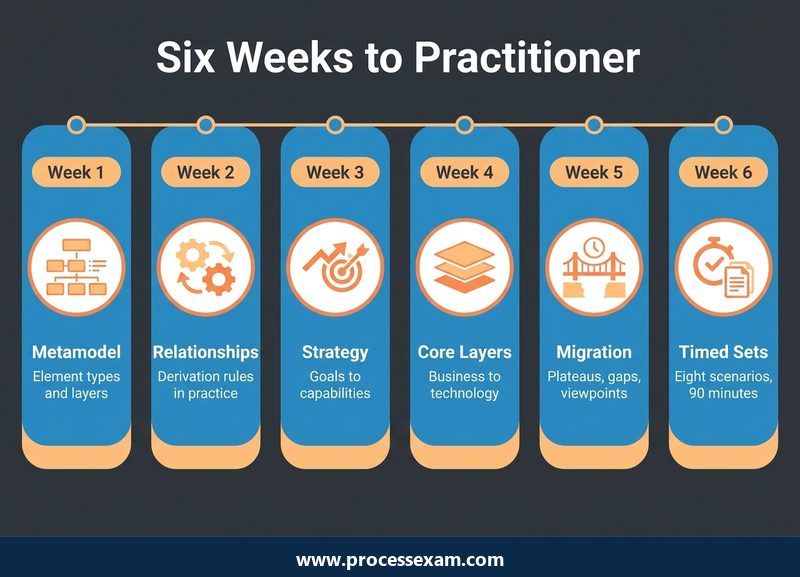
| Week | Focus | What done looks like |
|---|---|---|
| 1 | Language structure and generic metamodel | You can type any noun from a scenario into the right element and layer without the book |
| 2 | Relationships and derivation | You can explain when a derived relationship is valid, and when it hides something a stakeholder needs |
| 3 | Motivation and Strategy | You can trace a driver through goals and capabilities to the work that delivers them |
| 4 | Core layers and cross-layer modelling | You can model a business process down to the application and technology that support it |
| 5 | Implementation and Migration, viewpoints and customisation | You can draw a baseline-to-target roadmap with plateaus and gaps, and choose a viewpoint from a concern |
| 6 | Timed scenario practice | You score 26 or more on full eight-question sets in 90 minutes, twice in a row |
Weeks one to five should each end with a small set of scenarios on that week's area, marked with the 5-3-1-0 scale rather than right or wrong. Write a one-line reason for every question where you picked the second-best answer; those reasons become your revision list for week six.
Week six is about stamina and pacing. Sit full sets under exam conditions, with the specification open on screen and the clock at 90 minutes. When you want timed sets that follow the same eight-scenario format and 5-3-1-0 marking, our OGA-032 mock exam lets you repeat that rehearsal until 26 points feels routine. Treat any set below 26 as a diagnosis, not a failure: find the areas where you are taking second-best answers and go back to that week's material.
Which mistakes cost the most points on the Practitioner paper?
Most lost points fall into a handful of patterns, and nearly all of them come from reading rather than from knowledge.
- Answering for the wrong stakeholder. The scenario names a stakeholder and a concern. An answer that would delight the enterprise architect but drowns the business manager in detail is not the best answer.
- Choosing the most detailed model. More elements and relationships do not mean a better model. Detail beyond the concern usually marks the second or third-best answer.
- Treating derived relationships as wrong. They are valid. The question is whether the shortcut hides an element the view needs, not whether the shortcut is allowed.
- Mixing layers. Modelling software as a business actor, or a business object as a data object, is one of the commonest distracter patterns.
- Spending too long on one scenario. One zero can be absorbed; three unfinished questions cannot.
- Ignoring the Motivation and Strategy elements. Candidates who model only the core layers struggle when a scenario starts from a goal or a capability.
A useful habit in practice is to keep a small error log with three columns: the question, the answer you chose, and the single reason the best answer beat yours. After twenty or thirty scenarios, the log usually shows two or three repeating patterns, and fixing those is worth more than any extra reading.
Where does ArchiMate Practitioner certification take an architect's career?
ArchiMate is The Open Group's modelling language for enterprise architecture, and it sits naturally alongside TOGAF: TOGAF gives the method and the content framework, ArchiMate gives the notation to describe and communicate the architecture. Many organisations that run TOGAF-based practices model in ArchiMate, which is why the two credentials often appear together in enterprise and business architect job descriptions.
The Practitioner level is the one that signals you can actually build models, not just recognise notation. Foundation shows you know the vocabulary; Practitioner shows you can choose the right model for a real stakeholder, which is the day-to-day work of an enterprise, business, solution or information architect who maintains an architecture repository. It is also useful for business analysts and consultants who produce capability maps, application landscapes and transition roadmaps for clients.
Modelling tools reinforce the value. ArchiMate is supported by commercial enterprise architecture suites and by Archi, a free open-source modelling tool, so you can practise the exact notation you will use at work. Building your study models in a tool rather than on paper is good preparation for both the exam and the job.
Finally, the certification is current: The Open Group's program covers the 3.2 release of the specification, and there was no announced successor when we checked in October 2026. Earning it now means the credential matches the language your organisation's tools and repositories are using today.
Frequently Asked Questions
Is the ArchiMate Practitioner exam open book?
Yes. The ArchiMate 3 Part 2 exam is open book, but only in electronic form: an electronic copy of the ArchiMate 3 Specification is built into the exam. No hard-copy books may be used. The exam has eight scenario questions in 90 minutes, so the specification is for quick look-ups, not for learning during the exam.
How much does the ArchiMate Practitioner certification cost?
The Practitioner exam fee is USD 375 as of October 2026, and local taxes may apply. The Open Group's Accredited Training Courses include the exam in the course fee, with a voucher code for booking. Candidates without ArchiMate 3 Foundation also need to pass the Part 1 exam, which has its own fee.
Do I need ArchiMate Foundation before the Practitioner exam?
Yes. The prerequisite is ArchiMate 3 Foundation, or a pass of the ArchiMate 3 Part 1 exam on the same day at the same test centre. Part 1 is 40 closed-book multiple-choice questions in one hour with a pass mark of 24 out of 40, so many candidates prepare for both together.
How is the ArchiMate Practitioner exam scored?
Each of the eight scenario questions has four answers with gradient scoring: 5 points for the best answer, 3 for the second-best, 1 for the third-best and 0 for the distracter. The maximum is 40 points and the pass mark is 65 percent, which means 26 points or more.
Can I take the ArchiMate Practitioner exam online?
Yes. The Open Group lists delivery at authorized examination provider test centres and remotely through Pearson VUE OnVUE. Either way the exam is supervised, lasts 90 minutes of actual exam time, and booking usually adds around fifteen minutes for registration, a tutorial and a survey.
- Open Group ArchiMate 3 Practitioner Test Questions |
- OGA-032 Question Bank |
- ArchiMate 3 Part 2 Exam Simulator |
- ArchiMate 3 Part 2 Exam Mock Exam |
- Open Group ArchiMate 3 Practitioner Book |
- ArchiMate 3 Practitioner Certification Cost |
- ArchiMate 3 Practitioner Certification Requirements |
- Open Group ArchiMate 3 Part 2 Exam Question Bank |
- Open Group ArchiMate 3 Part 2 Exam Book |
- Open Group ArchiMate 3 Part 2 Exam Study Guide |
- ArchiMate 3 Part 2 Exam Certification |
- ArchiMate 3 Part 2 Exam Certification Cost |
- ArchiMate 3 Part 2 Exam Certification Requirements |
- Open Group ArchiMate 3 Practitioner Sample Questions |
- OGA-032 Exam Questions Download |
- OGA-032 Test Questions |
- ArchiMate 3 Practitioner PDF |
- Open Group ArchiMate 3 Part 2 Exam Sample Questions |
- ArchiMate 3 Part 2 Exam |
- ArchiMate 3 Part 2 Exam PDF |
- ArchiMate


