
Becoming a ServiceNow HR Service Delivery Implementer: What the Work Involves
Your HR operations manager has just told you the company bought ServiceNow HR Service Delivery and that you are on the rollout. An implementer configures the HR applications, builds the services employees request, brands the Employee Center and locks HR data down to the right people. Here is that work, and where the certification fits.

Two kinds of people land in this seat. Some are HR operations staff who know exactly how a leave query or a name change travels through an inbox and want to rebuild it properly. Others are ServiceNow administrators who know the platform and have never had to explain a confidential case to a head of people. Both groups tend to underestimate the other half of the job. The credential, the ServiceNow Certified Implementation Specialist - Human Resources, was written for that blend, and its blueprint is a reasonably honest description of what an HR rollout asks of you. Every exam figure below was read from ServiceNow's published blueprint, which the vendor last updated in July 2026, and checked again in October 2026.
What does a ServiceNow HR Service Delivery implementer do on a real rollout?
The short version: you turn the way an HR team works today into a set of configured services on the Now Platform, then make sure only the right people can see what those services produce. ServiceNow's blueprint describes the credential as proof that you can configure, implement and maintain the HR suite, manage the HR architecture, set up the core applications and Employee Center, implement HR Journeys and apply security to protect HR data.
In practice that means four kinds of work that rarely arrive in a neat order.
- Listening and mapping. Before anything is configured, someone has to find out which requests HR actually receives, who answers them, and which ones are really the same request in different clothes. A payslip question and a tax-form question might share one service or need two. That judgement is yours.
- Configuring. Users, groups, skills and roles; assignment rules that send a case to the right queue; HR services, catalog items and record producers that employees fill in; and the Employee Center pages they find them on.
- Sequencing people's days. Hiring, moving and leaving are not single requests. They are chains of tasks across HR, IT, facilities and the manager. Lifecycle events and Journey Designer exist to run those chains.
- Protecting data. HR records include pay, performance, health and conduct information. A rollout that works but lets a colleague read someone else's case is a failure, whatever the demo looked like.
The blueprint lists the HR applications you are expected to know: HR Case Management, Lifecycle Events, Journey Designer, HR Integrations, HR Administration and HR Dashboards and Reports. For each one it asks for the same things: baseline functionality and tables, the roles and default access controls that ship with it, how it integrates, and how to pick the right feature for a business requirement while keeping the instance upgradable, scalable and maintainable. That last phrase matters. It describes a person who configures in the way ServiceNow intends, rather than customising until the next upgrade becomes painful.
How is this different from running the platform as an administrator?
An administrator keeps an instance healthy: users, groups, updates, tables, notifications. An HR implementer works inside a narrower set of applications but has to make design choices that an administrator can usually avoid. Should this request be a catalog item or a record producer? Should access be controlled by role, by a criteria record or by a contextual rule? Where does the data live, and which application scope owns it? Those choices are why ServiceNow suggests a few months of hands-on project or instance work, plus at least one HR deployment, rather than treating the exam as an extension of the administrator badge.
Who is the HR implementation certification written for, and what experience does ServiceNow expect?
The blueprint states the recommended experience plainly. It asks for roughly three to six months in the field, either working on ServiceNow deployments or looking after live instances, and for you to have been part of at least one HR deployment. Practical knowledge of HR processes is called helpful, and so is some knowledge of IT service request workflows. It is a recommendation, not a gate: the blueprint does not list another certification you must hold before you can register.
That has a few consequences for the typical readers.
- If you come from HR operations, you already understand case types, confidentiality and the difference between a policy question and a transaction. Your gap is the platform: tables, scopes, roles, access controls and how a catalog item becomes a case. Plan most of your time there.
- If you come from ServiceNow administration, you already know the platform. Your gap is HR vocabulary and HR-specific design: centres of expertise, HR services, lifecycle events, and why a manager must not see the case an employee raised about them. Plan time to sit with an HR colleague and walk through a real request.
- If you are new to both, the training list in the blueprint is where to start, because it begins with Welcome to ServiceNow and ServiceNow Administration Fundamentals before moving to Employee Center Essentials, Introduction to HR Service Delivery, and the HR Fundamentals and HR Implementation courses.
ServiceNow also lists extra resources worth knowing about: a candidate journey guide, an HR simulator, Service Portal Fundamentals, Performance Analytics Fundamentals, the Common Service Data Model and CMDB fundamentals, plus Universal Request and a few optimisation courses. You do not need all of them. The HR simulator and the HR implementation course are the two that map most directly to the questions.
How does the blueprint weight the work an implementer does?
The exam has three domains, and they are lopsided towards one kind of job. The middle domain carries the largest share, which is why people who only know the architecture often find the exam harder than the blueprint suggests.
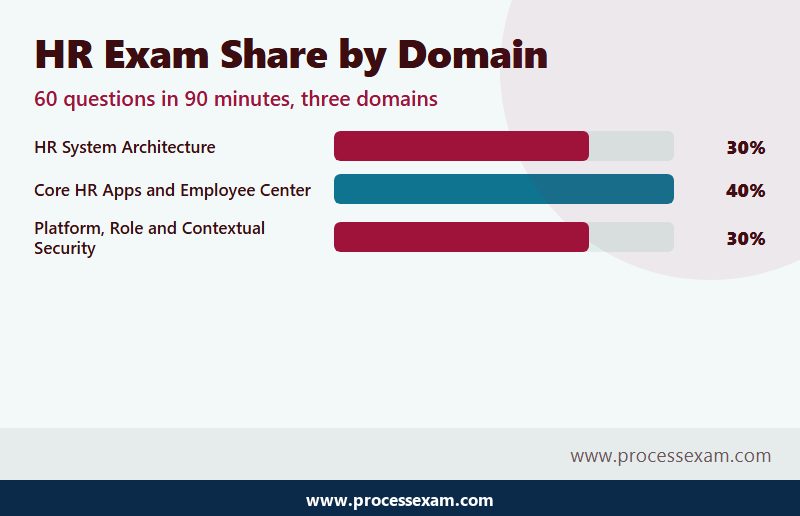
| Domain | Share of the exam | What it covers |
|---|---|---|
| Describe and use the ServiceNow HR system architecture | 30% | Plugins, HR table structure, application scoping |
| Configure and implement ServiceNow core HR applications and Employee Center | 40% | Users, groups, skills and roles; assignment rules; HR services, catalog items and record producers; Employee Center branding |
| Describe and use platform, role and contextual security | 30% | How platform, role and contextual security work; the Delegated Developer role; configuring security options to protect HR data |
Read the table as a job description. A third of the work is knowing what is installed and where the data sits. A third is protecting it. The other forty percent is the hands-on configuration that people think of as the job. ServiceNow adds a caution that is easy to skip: the sub-topics it lists are not an all-inclusive list of exam content. Our CIS-HR syllabus page sets the same three domains out beside the exam facts if you want them in one place.
What does the architecture domain expect you to know?
It expects you to describe how the HR suite is assembled. That starts with plugins: which ones add the HR applications and which supporting ones sit underneath them. It continues with the HR table structure, meaning where cases, services and the records around them are stored and how those tables relate. Finally it covers application scoping, which is the least glamorous and most examinable idea in the domain. The HR applications live in their own scopes, and the first sample item in the blueprint asks in which scope HR Case Management sits. The answer is Human Resources: Core. Knowing scope boundaries helps you decide where a customisation belongs and what an upgrade might touch.
What does the configuration domain expect you to build?
This is the domain you can practise most easily, because everything in it is something you can click through on a development instance. The blueprint names users, groups, skills and roles, assignment rules, HR services, HR catalog items, record producers and Employee Center branding. A sensible way to think about it is the path of one request. An employee finds an item on the Employee Center. It creates a case. Assignment rules, using groups and skills, decide who gets it. The HR service the case belongs to decides which template, which fields and which centre of expertise apply. The second sample item makes a quiet point about that last part: an HR service can be associated with exactly one centre of expertise, not several. Small facts like that are what separate people who have built a service from people who have only read about it.
What does the security domain expect you to explain?
It expects you to describe how platform, role and contextual security work together, to understand how the Delegated Developer role works, and to configure options that protect HR data. In plain terms, platform security is the baseline every ServiceNow table inherits, role security decides what each kind of HR user can do, and contextual security narrows access further based on the record in front of you. The Delegated Developer idea matters for HR because it lets an administrator give a developer limited rights within a specific application instead of full administrator access, which is exactly the kind of restraint an HR instance needs. Expect scenario questions that ask you to pick the least access that still lets someone do their job.
How does an HR rollout run from plugins to a protected Employee Center?
Every project differs, but the blueprint implies a sequence that most rollouts follow. It is worth holding in your head, because exam scenarios often start in the middle of it and ask what should have happened before.
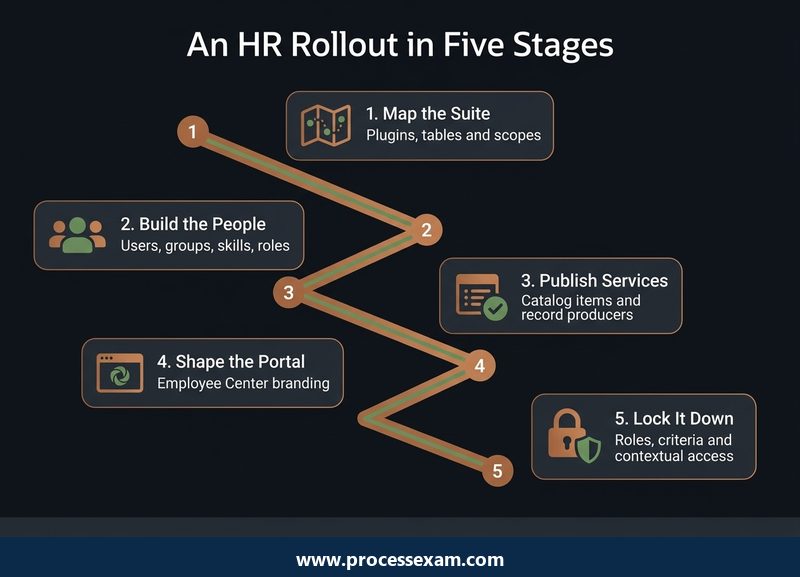
The roadmap above shows five stages, and each one lines up with a part of the blueprint.
- Understand what is installed. You confirm the plugins and the scoped applications, and find out which tables will hold the cases. This is the architecture domain at work, and skipping it is how teams end up configuring the wrong application.
- Build the people model. Users, groups, skills and roles come next, because nothing routes correctly without them. An assignment rule that points at a group nobody belongs to creates a case that sits for a week.
- Publish the services. HR services, catalog items and record producers turn the mapping work into things employees can request. A good rollout starts with the handful of requests that make up most of HR's volume rather than trying to cover every policy.
- Shape the experience. Employee Center branding and navigation make the portal feel like the company's own. The blueprint names branding explicitly. Knowledge articles in the portal are controlled by user criteria, which links this stage to the next.
- Lock the data down. You review roles, access controls and criteria, then test as a normal employee, a manager and an HR agent. Anything a test user can see and should not is a defect, not a polish item.
Lifecycle events and journeys run across these stages rather than sitting at the end. A journey for a new starter, for example, can create tasks for HR, IT and the hiring manager over several weeks. The blueprint lists Lifecycle Events and Journey Designer among the applications you should know, and ServiceNow's description of the credential mentions implementing HR Journeys, so it is worth building at least one on a practice instance.
Where do integrations fit?
HR Integrations is also on the application list. Most organisations keep employee records in a separate HR system, and a rollout has to decide which data flows into ServiceNow and how often. The blueprint asks for the integration capabilities of each application, not the details of any one vendor's connector, so the useful habit is to know what each application can bring in and send out, and to prefer supported capabilities over custom scripts.
Which situations from real HR projects does the exam test?
ServiceNow publishes four sample items in the blueprint, and they show the style well: short, practical, and aimed at the kind of thing you would otherwise have to look up on an instance.
- Scope. Which application scope holds HR Case Management? The answer is Human Resources: Core. It is a recall question about architecture, and it is the sort of fact that stops a customisation landing in the wrong scope.
- Service design. How many centres of expertise can be associated with a single HR service? One. This rewards people who have configured a service and noticed the field, rather than those who assumed an HR service could be shared across several teams.
- Visibility. What decides whether an employee can view a knowledge article on the Employee Center? The Can Read user criteria. A reader who thinks in terms of roles alone will pick the wrong option, because the portal uses criteria records for this.
- Administration. Which options let an HR administrator configure a personal copy of the HR Case dashboard? Add Content and Change Layout. This is a select-all question, a format the next section covers.
The pattern is consistent. Each item tests a single decision a practitioner makes, and each has distractors that sound plausible if you only know the general ServiceNow platform. That is the main reason experience on an HR instance beats generic ServiceNow knowledge here.
What kind of scenario should you rehearse yourself?
Take three situations and work out the answer on an instance before you read any explanation. A new starter cannot see the knowledge article their onboarding task points to: which criteria record is missing? A case about a sensitive matter is visible to the employee's own manager: which security layer failed? A client wants an extra field on every HR case: should it be added in the Core scope directly, or somewhere that survives an upgrade? Working those out once teaches more than rereading a list of tables.
What do the exam format, fee, booking and results look like?
The facts are short, and they are worth having in one place before you plan your weeks.
| Item | Detail |
|---|---|
| Exam | ServiceNow Certified Implementation Specialist - Human Resources |
| Questions | 60 |
| Duration | 90 minutes |
| Fee | USD $450 (as of October 2026) |
| Result | Pass or fail, shown as a conditional result straight after you submit |
| Delivery | Pearson test centre or online with OnVUE |
| Window after payment | 90 days to schedule and sit the exam |
Two question types appear. Multiple choice questions have at least three options and one correct answer. Multiple select questions have at least four options, tell you how many to choose, and give no partial credit, so a half-right answer scores nothing. Each question is worth one point, and the total is compared with a cut score that ServiceNow does not publish and says is not always 70 percent. The section percentages on your result show how you did in each domain, but ServiceNow warns that they play no part in the pass decision, must not be averaged together and say nothing about expertise.
The booking steps are: register and pay, which secures your attempt; schedule within 90 days; choose a Pearson test centre or OnVUE online proctoring; then sit the exam. If the 90 days pass, the registration expires and you pay again. Fees are non-refundable, so register only when you are ready to book a date. Completing instructor-led training includes one free exam attempt, and learning credits are accepted.
Where do you see your result afterwards?
Pearson's ServiceNow page explains the route. Sign in to ServiceNow University, go to My University Account and then My Exams, find the exam under My Past Exams, choose View Exam and then View Exam Result, which opens your Pearson score report. You can read more about delivery options on Pearson VUE's ServiceNow page. Because the result is conditional, ServiceNow can audit or review it later, and a certification can be revoked if the test security policies were broken.
What happens if you do not pass, and how do you keep the credential?
The blueprint tells you to review the exam blueprint and the recommended training before a retake. There is a waiting period between attempts and the exam fee is paid again each time; the Credentialing Program Guide holds the exact details, so read it rather than relying on a forum post. After you pass you receive a Credly digital badge, and keeping the certification current means completing annual maintenance exams, called deltas, and paying the yearly Certification Maintenance Program fee.
How would you prepare for it alongside a full-time job?
Because the recommended experience includes an HR deployment, the strongest preparation is to build a small version of one. Six weeks of evenings is a workable plan for someone who already knows either HR or the platform, and it changes little if you take eight.
- Weeks 1 and 2: architecture and scope. Take the Introduction to HR Service Delivery and HR Fundamentals courses, then list the HR plugins, scoped applications and core tables on a personal developer instance. Write down which scope owns what. This domain is 30 percent and mostly recall, so short, repeated review pays off.
- Weeks 3 and 4: configuration. Complete the HR Implementation course and build the path of one request from start to finish: create users, groups and skills, write an assignment rule, publish an HR service and a catalog item, and brand an Employee Center page. This is 40 percent of the exam, so give it the biggest block of time.
- Week 5: security. Create test users with different roles and criteria and check what each can open. Read how the Delegated Developer role limits a developer. Try to break your own setup.
- Week 6: consolidate. Build one lifecycle event or journey, review the six HR applications from the blueprint, and sit full practice papers.
The blueprint is firm that exam questions are based on ServiceNow training materials and on the product documentation for HR and Employee Center, and that study material posted elsewhere online is not official and should not be used. Start there, with your own instance open beside the documentation. Once your lab work is steady, the CIS-HR mock exam lets you rehearse the 60-question, 90-minute pattern and see whether you pick the right answer between two reasonable-looking configurations.
Whatever you practise with, review a wrong answer by going back to the instance and reproducing the situation, not by memorising the option. The sample items reward exactly that habit.
Where can an HR implementation credential take you?
The honest answer is that it opens a defined lane rather than guaranteeing a promotion. ServiceNow describes certified individuals as people who optimise HR service delivery and improve employee experience, and the credential is most useful when you already work on or near HR projects. It tells a hiring manager, a partner or a project lead that you know the applications, the tables, the scoping and the security model, which shortens the conversation about whether to put you on a rollout.
From there the paths are practical ones. HR operations staff can move towards HR systems analyst or platform owner roles, where they run the service catalogue they helped build. ServiceNow administrators can become the person trusted with the sensitive HR instance. Consultants at implementation partners can staff HR engagements more easily. Alongside this, the credential connects naturally to nearby ServiceNow skills such as system administration, customer service management and platform analytics, which are good next steps once HR feels comfortable.
Plan on the maintenance too. Annual deltas and a yearly fee are part of keeping the badge useful, and they reward people who stay close to the product as it changes. If you are about to be put on an HR rollout, the best preparation for the work and for the exam is the same: build one service, break one rule on purpose, and fix it with the least access that still lets people do their jobs. For the primary reference, keep ServiceNow's HR implementation specialist exam blueprint open.
Frequently Asked Questions
How many questions are on the CIS-HR exam and how long do you get?
The exam has 60 questions and lasts 90 minutes. Most are multiple choice with one correct answer; some are multiple select, where the question states how many options to choose and no partial credit is given. You take it at a Pearson test centre or online with OnVUE.
What is the passing score for the CIS-HR exam?
ServiceNow reports a pass or fail and does not publish the cut score, noting it is not always 70 percent. Each question is worth one point. The result shown right after you submit is conditional, and the section percentages play no part in the decision and should not be averaged.
What experience does ServiceNow recommend before taking the HR implementation exam?
The blueprint recommends three to six months of hands-on work on ServiceNow deployments or live instances, plus at least one ServiceNow HR deployment project. Knowledge of HR processes and some IT service request workflows also helps. It lists no other certification as a requirement to register.
Where do you find your CIS-HR score report?
Sign in to ServiceNow University, open My University Account, then My Exams. Under My Past Exams find the exam, select View Exam, then View Exam Result, which opens your Pearson score report. It shows your result and the share of items you answered correctly in each section.
How long do you have to take the exam after paying, and what if you fail?
After you register and pay you have 90 days to schedule and sit the exam, otherwise the registration expires and you pay again. If you do not pass, ServiceNow asks you to review the blueprint and training first; a waiting period applies and the fee is paid for each attempt.
- ServiceNow Human Resources Implementation Specialist Test Questions |
- CIS-HR Question Bank |
- CIS-HR Certification |
- ServiceNow Human Resources Implementation Specialist Book |
- Human Resources Implementation Specialist Certification Cost |
- Human Resources Implementation Specialist Certification Requirements |
- ServiceNow Human Resources Implementation Specialist Sample Questions |
- CIS-HR Exam Questions Download |
- CIS-HR Test Questions |
- Human Resources Implementation Specialist PDF |
- CIS-Human Resource Mock Exam |
- CIS-Human Resource Simulator |
- CIS-Human Resource Certification |
- CIS-Human Resource Certification Cost |
- CIS-Human Resource Certification Requirements |
- ServiceNow CIS-Human Resource Book |
- ServiceNow CIS-Human Resource Question Bank |
- ServiceNow CIS-Human Resource Study Guide |
- CIS-Human Resource |
- CIS-Human Resource PDF |
- ServiceNow CIS-Human Resource Exam Questions |
- ServiceNow CIS-Human Resource Sample Questions |
- Core Business


