
OGA-031 ArchiMate 3 Foundation Exam: Pass Mark, Syllabus and Study Plan
You can pass OGA-031 without ever opening a modelling tool, but not without knowing the language's rules by heart. The ArchiMate 3 Foundation paper is 40 closed-book multiple-choice questions in 60 minutes, and 24 correct answers (60%) pass. It asks which element, relationship or layer a situation calls for, so vocabulary drills and diagram reading beat long hours of passive reading.

That framing matters because ArchiMate is often described as "just boxes and arrows". At Foundation level the arrows are the exam. A question may describe a customer-facing service, an application component and a server, then ask which relationship joins two of them, or which element type fits a described thing. Candidates who can draw well but have not memorised the definitions lose marks to candidates who have. This guide covers the exam format, the language you need to know, the relationship rules, a four-week plan and the route on to the Practitioner paper.
What does the OGA-031 exam look like, and which ArchiMate version does it test?
OGA-031 is the Open Group's ArchiMate 3 Part 1 exam, and passing it earns the ArchiMate 3 Foundation qualification. There are no prerequisites. The paper is supervised and closed book, so no specification, notes or tools are allowed, and each correct answer scores one point. The Open Group's own ArchiMate examinations summary lists these terms, and they match the figures below.
| Detail | OGA-031 |
|---|---|
| Exam code | OGA-031 |
| Exam name | The Open Group ArchiMate 3 Foundation (ArchiMate 3 Part 1 Exam) |
| Vendor | Open Group |
| Number of questions | 40 |
| Duration | 60 minutes |
| Passing score | 60% |
| Exam fee | USD $375 |
| Format | Multiple choice, closed book, supervised |
Which specification version should you study?
Check this before you buy a book. The Open Group's ArchiMate certification page, read in October 2026, says the current program covers the 3.2 release of the specification, and the matching conformance document (version 3.2) was published in October 2023. Many study materials and older exam listings still say 3.1, and the Foundation material changed little between the two releases, so a 3.1 book is not useless. But study from the 3.2 specification where you can, and treat any 3.1 label as out of date.
A newer specification, ArchiMate 4, was announced by the Open Group in 2026. At the time of checking, the certification page still described the 3.2-based ArchiMate 3 program and did not announce a replacement exam, so OGA-031 is the paper to prepare for today. Look at that page again when you book, because a version change is the one thing that would make a study plan obsolete.
Plan for the clock as well. The exam summary notes that the test provider's booking information may show a longer slot than 60 minutes, because registration, a tutorial and a survey add time around the exam itself. The 60 minutes is the time you actually have for the 40 questions, which works out at 90 seconds each.
Which parts of the ArchiMate language do you need to recognise on sight?
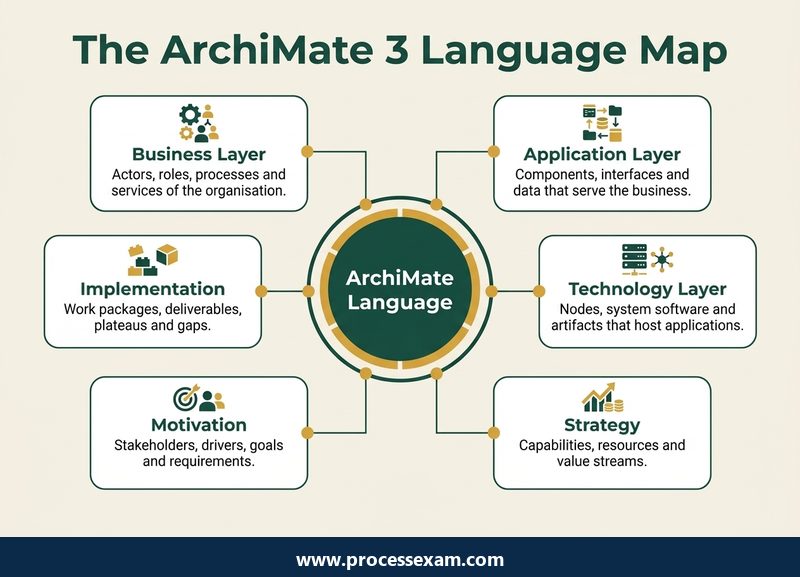
The Open Group defines the Foundation outcomes in its conformance requirements for ArchiMate 3.2, a document that groups the knowledge into learning units running from basic concepts and definitions to viewpoints and stakeholder concerns. You can read the ArchiMate 3 conformance requirements to see the exact wording, and it is worth skimming because it shows what "know" and "understand" mean for each topic. The practical version is a six-part map of the language.
The generic structure: active structure, behaviour and passive structure
Everything in the core language falls into one of three kinds. Active structure elements perform behaviour, such as an actor, a component or a node. Behaviour elements are the work done, such as a process, a function or a service. Passive structure elements are what the behaviour acts on, such as a business object or a data object. A great many questions reduce to sorting a described thing into one of these three kinds first and picking the specific element second.
The business layer
The business layer describes how the organisation works. Know the active elements (business actor, business role, business collaboration, business interface), the behaviour elements (business process, function, interaction, event and service) and the passive ones (business object, contract and representation). The product element bundles services and a contract for customers. The common trap is mixing up a process with a function: a process is a sequence of behaviour toward a result, whereas a function groups behaviour by competency or resource.
The application and technology layers
The application layer mirrors the business layer for software: application component, collaboration, interface, function, process, interaction, event, service and data object. The technology layer covers the platform: node, device, system software, technology collaboration, interface, path, communication network, the technology behaviour elements, and the artifact, which is a concrete piece of data such as a file or a deployable. Know that an artifact realises application components, and that application services serve the business layer above them.
Physical elements
ArchiMate 3 adds equipment, facility, distribution network and material for the physical world, such as machines, buildings and delivery routes. They are a small topic, but they are easy marks because few candidates revise them.
Strategy, motivation, and implementation and migration
The strategy elements are resource, capability, value stream and course of action. The motivation elements explain why: stakeholder, driver, assessment, goal, outcome, principle, requirement, constraint, meaning and value. The implementation and migration elements describe change over time: work package, deliverable, implementation event, plateau and gap. Learn the difference between a goal and an outcome, and between a principle and a requirement, because the exam likes those near-neighbours.
Composite elements and junctions
Grouping and location let you cluster elements without changing their meaning, and a junction joins several relationships of the same type with an "and" or an "or" logic. These are short topics that come up as single questions, often about what a junction may or may not connect.
How do ArchiMate relationships work, and which ones trip candidates up?
The language defines eleven relationships, and most of the hard questions are about them. Learn them in four families: structural, dependency, dynamic and the one specialisation relationship. For each, remember the meaning, the direction and one example.
| Relationship | Family | What it says |
|---|---|---|
| Composition | Structural | A whole is made of parts that cannot exist without it |
| Aggregation | Structural | A whole groups parts that can exist on their own |
| Assignment | Structural | An active element performs behaviour or holds a role |
| Realization | Structural | A concrete thing makes an abstract thing real |
| Serving | Dependency | One element provides functionality to another |
| Access | Dependency | Behaviour reads or writes a passive element |
| Influence | Dependency | One element affects the achievement of another |
| Association | Dependency | An unspecified link between elements |
| Triggering | Dynamic | One behaviour starts another in time |
| Flow | Dynamic | Something is passed from one behaviour to another |
| Specialization | Other | One element is a kind of another |
The pairs that get confused
Composition against aggregation is the classic. Ask whether the part can outlive the whole: if it cannot, it is composition. Serving against flow is the second: serving says a service is available to something, while flow says information or goods move between two pieces of behaviour. Triggering against flow is the third, because both connect behaviour, but triggering is about order and flow is about what is passed along.
Assignment and realization also blur. A role is assigned to an actor, and an actor is assigned to a process; a component realises a service, and an artifact realises a component. Say each sentence aloud in that "X is assigned to Y" form until it sounds natural.
Access, influence and notation details
Access carries a direction: the behaviour may read, write, both, or the access may be unspecified, and the arrowhead shows which. Influence can be shown as positive or negative with a plus or minus sign, which matters in motivation diagrams. Because the exam is closed book, you need these notation details from memory, so redraw them on paper instead of only looking at them.
Why derivation rules matter less than you fear
The specification also defines how relationships can be derived through chains, and a Foundation candidate should know the idea: a chain of relationships can sometimes be shortened into one valid relationship, and the weakest link in the chain decides what survives. You are not expected to work through long derivations, which belong to the Practitioner paper. Understand the principle and move on.
How do viewpoints and stakeholder concerns show up in the questions?
The last block of the Foundation outcomes is about using the language to answer people's questions. A stakeholder has concerns, a viewpoint is a template that selects the elements suited to those concerns, and a view is the actual diagram. The exam checks that you understand this chain and can match a viewpoint to a purpose.
You do not need to memorise every viewpoint in the catalogue, but learn the families and a few examples. Organisation and business process views show who does what. Application and technology usage views show which software and infrastructure support which work. The layered view shows all the layers in one picture. Motivation views such as stakeholder and goal realization trace why a change is wanted. Strategy views such as capability maps and value stream maps show what the organisation can do and how it creates value. Migration and project views cover the road from the current architecture to the target.
A sensible question might give a concern, such as "the board wants to see which capabilities a new platform will improve", and ask which viewpoint to build. Reason from the concern to the elements it needs, and the right viewpoint usually follows.
Language customisation
ArchiMate lets practitioners add properties and specialisations to adapt the language to their organisation. At Foundation level you only need to know why this is allowed and that the core language stays intact. It is a short topic, so a quick read is enough.
How should four weeks of study be split around the specification?
Four weeks at roughly an hour a day suits someone who has seen architecture diagrams before. If ArchiMate is new, add a fifth week for the early blocks. The order below follows the way the language builds on itself, so each week prepares the next.
| Week | Focus | What to finish |
|---|---|---|
| 1 | Language structure and the business layer | Active, behaviour and passive structure; every business element and its definition written out from memory |
| 2 | Application, technology and physical layers | Cross-layer links: services serving up, artifacts realising components |
| 3 | All eleven relationships, plus strategy, motivation, and implementation and migration | The relationship table recalled without notes; goal versus outcome; plateau, gap and work package |
| 4 | Viewpoints, then timed mixed practice | Concern-to-viewpoint matching; two full 40-question runs at 90 seconds each |
Use the specification itself as your main text. It is written in plain language, each element has a short definition and an example, and its definitions are the ones the questions follow. A training course helps if you learn better from a teacher, and the exam summary notes that accredited courses include the exam in their fee, but self-study from the specification is a recognised route.
A daily rhythm that works
Spend the first twenty minutes recalling the previous day's elements from a blank page, then thirty minutes on new material, then ten minutes drawing one small diagram that uses it. Recall before reading is the habit that sticks. Keep a running list of confusable pairs, such as process and function, goal and outcome, composition and aggregation, and review it every evening.
Draw a little, even though it is not a drawing test
Sketching a three-element chain, such as a role assigned to an actor that is assigned to a process that serves a customer, fixes the relationship directions in memory far better than rereading the definition. Ten minutes of sketching a day is plenty.
What is the best way to drill 40 closed-book questions?
The exam rewards fast, accurate recognition, and that is a skill built by answering questions, not by reading about them. Start drilling in week two, short sets after each block, then move to full timed runs in week four. After every set, write down why the right option is right and why the nearest wrong option is wrong. That sentence is the learning; the score is only the signal.
When you are ready for a full dress rehearsal, the OGA-031 practice exam on ProcessExam gives you a timed set built for the same 40-question, 60-minute shape, so you can test your pace and find the confusable pairs that still cost you points.
Pacing the paper
Ninety seconds a question is generous for recall questions and tight for the longer descriptive ones, so bank time on the quick ones. Make a first pass answering anything you know at once, mark the rest, and return with the clock in mind. With 40 questions and a 60% pass mark, you can afford to miss sixteen, so one hard question is never worth four minutes.
Elimination on option sets
Many options differ by a single element or relationship. Strike any option that breaks a layer rule first, for example a technology node serving a business actor directly without an application between, then compare what is left against the exact definition. Read the verb in the question carefully: "realises", "serves" and "is assigned to" are three different answers.
Exam day
The exam is supervised and can be taken at an authorised test centre or remotely with online proctoring. Check the identity and room requirements with the provider a few days ahead, not on the morning, and log in early. Sleep matters more than a final cram, since recall questions suffer most from tiredness. Afterwards, results come from the exam provider, and the Open Group issues the credential on a pass.
Are OGA-031 dumps a shortcut worth taking?
No. "OGA-031 dumps" is one of the phrases people type most when they search for this exam, so it deserves a straight answer. A dump is a set of questions said to be copied from the live exam. Beyond the ethical problem of cheating on a supervised certification, there is a plain practical one: the memorised answers tend to be out of date, because the program moved from the 3.1 wording to the 3.2 specification, and a dump cannot teach the reasoning that scenario-style Practitioner questions later demand.
The credential is only worth something if you can read an ArchiMate diagram at work, and that comes from understanding the rules. Legitimate practice is the better investment: the free OGA-031 sample questions show you the style and difficulty, and each answer you get wrong points to a concept to revise.
What comes after OGA-031, and is the Practitioner paper next?
Passing OGA-031 gives you the ArchiMate 3 Foundation qualification and partial credit toward the ArchiMate 3 Practitioner qualification. The second step is OGA-032, the Part 2 exam, and the two papers are very different in kind.
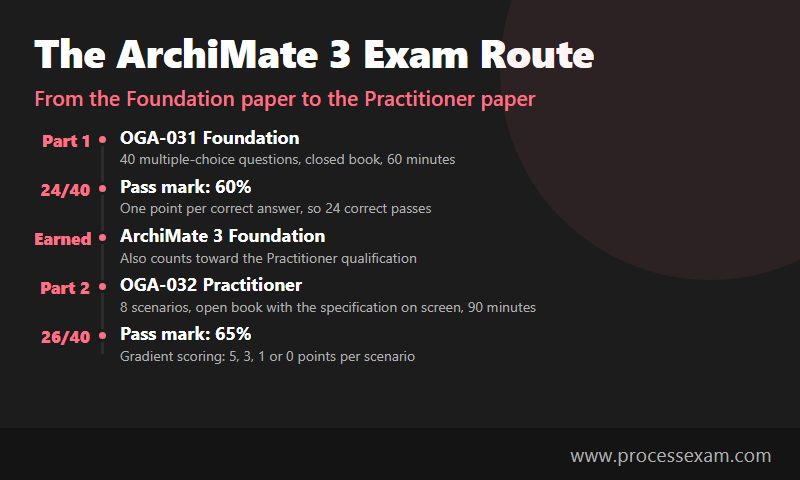
Part 2 has eight complex scenario questions in 90 minutes, and it is open book: an electronic copy of the specification is built into the exam. Scoring is gradient, so the best answer earns 5 points, the second best 3, the third best 1 and the distracter nothing, and you need 26 of 40 points. You must hold the Foundation credential first, or pass Part 1 on the same day at the same test centre, according to the Open Group's exam summary.
Should you do both papers at once?
Many candidates sit the two papers in one visit through an accredited course, and that suits people who have modelling experience. If you are new to architecture, take Foundation first, spend a few weeks building a real model, and then prepare for the scenarios. A solid pass on OGA-031 is the best predictor of readiness, because Part 2 assumes you can use the Foundation vocabulary without thinking.
What the credential does for you
ArchiMate Foundation tells an employer that you can read and write the shared language of enterprise architecture, which is useful for business analysts, solution architects, enterprise architects and consultants who exchange models with others. It does not prove you can run an architecture practice; that is what the Practitioner qualification and experience show. Treat Foundation as the common vocabulary and use it to join model reviews with confidence.
If you work with TOGAF as well, ArchiMate is the notation many teams use to draw the architectures the TOGAF method produces, so the two certifications complement each other. Either way, start from the Open Group's certification page to confirm the current version before you book your slot.
Frequently Asked Questions
How many questions are on the OGA-031 exam?
OGA-031 has 40 multiple-choice questions to answer in 60 minutes, which is about 90 seconds each. It is a closed-book, supervised paper, so you cannot consult the specification. Each correct answer scores one point, and 60% (24 of 40) passes.
What is the passing score for OGA-031?
The passing score is 60%, which means 24 correct answers out of 40. Every question carries one point, so you can miss up to 16 and still pass. The Practitioner paper, OGA-032, is scored differently and needs 26 of 40 points.
How much does the OGA-031 exam cost?
The OGA-031 exam fee is USD $375. Prices can vary with the delivery route and local taxes, and accredited training courses include the exam fee in the course price, so confirm the amount with the exam provider or The Open Group when you book.
Which ArchiMate version does OGA-031 cover?
The Open Group's certification page, checked in October 2026, says the current ArchiMate 3 program covers the 3.2 release of the specification. Some study materials still say 3.1, so prefer the 3.2 specification and check the page again before you book.
Are OGA-031 dumps worth using?
No. Dumps are copied questions that tend to be out of date, and they teach recall instead of the rules of the language. Foundation questions test element and relationship definitions, so understanding beats memorised answers. Use the specification, sample questions and timed practice to prepare honestly.
- Open Group ArchiMate 3 Foundation Test Questions |
- OGA-031 Question Bank |
- ArchiMate 3 Part 1 Exam Simulator |
- ArchiMate 3 Part 1 Exam Mock Exam |
- Open Group ArchiMate 3 Foundation Book |
- ArchiMate 3 Foundation Certification Cost |
- ArchiMate 3 Foundation Certification Requirements |
- Open Group ArchiMate 3 Part 1 Exam Question Bank |
- Open Group ArchiMate 3 Part 1 Exam Book |
- Open Group ArchiMate 3 Part 1 Exam Study Guide |
- ArchiMate 3 Part 1 Exam Certification |
- ArchiMate 3 Part 1 Exam Certification Cost |
- ArchiMate 3 Part 1 Exam Certification Requirements |
- Open Group ArchiMate 3 Foundation Sample Questions |
- OGA-031 Exam Questions Download |
- OGA-031 Test Questions |
- ArchiMate 3 Foundation PDF |
- Open Group ArchiMate 3 Part 1 Exam Sample Questions |
- ArchiMate 3 Part 1 Exam |
- ArchiMate 3 Part 1 Exam PDF |
- ArchiMate


