
Is the CJAPM Certification Worth Sitting With No Experience?

Yes, with one condition: you want proof of Scrum basics before anyone has handed you a Scrum team. The IAPM Certified Junior Agile Project Manager (CJAPM) asks for no project experience, takes 40 questions in 35 minutes, needs 65% and never expires. It will not make you a Scrum Master overnight, but it is a cheap, honest first line on a CV, and it works best for people who have not yet worked in a sprint.
Who gains from a junior Scrum certificate, and who gains little?
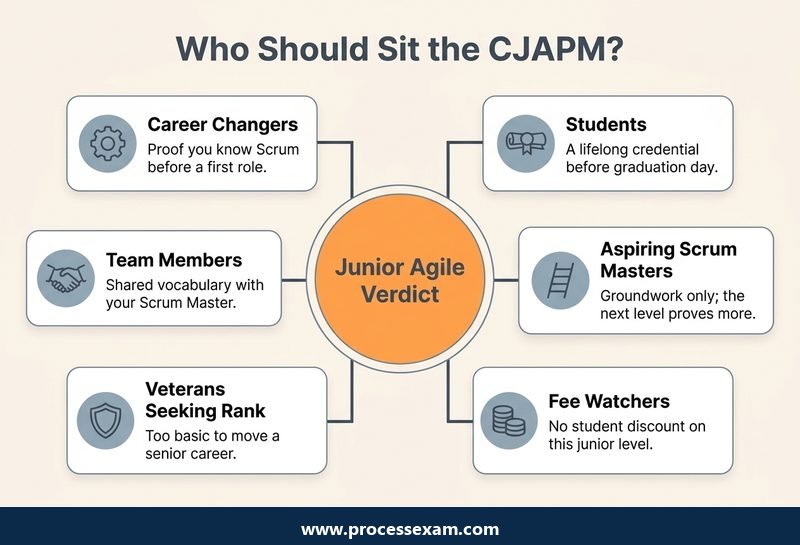
The CJAPM is built for a narrow audience, and IAPM says so plainly on its own page for the certificate: agile project management novices, students and people interested in a future career in agile project management. Project experience is not required. That makes the certificate a poor fit for a ten-year delivery lead and a good fit for almost everyone else standing at the door of an agile team.
Career changers
If you are moving from teaching, operations, support or testing into agile delivery, the hardest part of the first interview is vocabulary. Recruiters screening for a junior Scrum role want to hear that you know what a Product Backlog is and who owns it. A certificate does not replace a story about a team you supported, but it tells the reader that you have already spent time with the terms and passed an independent test on them.
Students and graduates
A student has little to put under the heading of experience, so a credential that is valid for life and costs one exam fee is a sensible addition. IAPM describes the certificate as recognised worldwide and valid for life, with no recertification, so the one-off effort stays useful long after graduation. Treat that recognition claim as IAPM's own description rather than a guarantee that every employer knows the name.
People already inside a Scrum team
Plenty of testers, designers and analysts work in sprints without ever having read a Scrum text end to end. They pick the practice up from colleagues, which means they pick up the habits of that one team, including its mistakes. Studying for the CJAPM resets that to a shared standard, and it gives you the exact words to use when a Scrum Master or Product Owner asks why something is done a certain way.
Who should look elsewhere
If you already hold a Scrum certificate from another body, or you have run agile projects for years, the CJAPM adds little. The same is true if you are hoping a junior credential alone will win a Scrum Master job: it proves knowledge of the framework, not the judgement of having facilitated one. Experienced people are better served by the next IAPM level, covered further down.
What do the 13 CJAPM topics ask of a complete beginner?
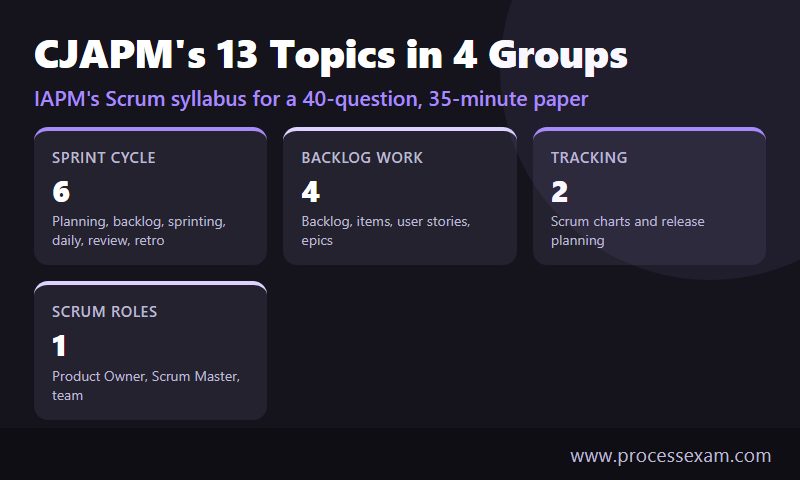
IAPM lists thirteen content areas on its CJAPM page: Scrum Roles, Product Backlog, Product Backlog Items, User Stories, Epics, Sprint Planning, Sprint Backlog, Sprinting, Daily Scrum, Sprint Review, Sprint Retrospective, Scrum Charts and Release Planning. Grouping them makes them easier to hold in your head, because they are not thirteen separate subjects. They are one loop seen from four angles.
Scrum roles: who decides what
One topic, but it colours every other question. You need to know what the Product Owner decides (what goes in the backlog and in what order), what the Scrum Master protects (the process and the team's focus), and what the team owns (how the work is built). A common beginner slip is to give the Scrum Master a project manager's powers, such as assigning tasks. When a scenario shows someone assigning work, ask whether the role would really do that.
Backlog work: from wish to ready item
Four topics sit here. The Product Backlog is the ordered list of everything the product may need. A Product Backlog Item is one entry on it. A user story states a need from the user's side, and an epic is a story too large to fit in one sprint, so it is split before it is built. Expect questions that hand you a sentence and ask whether it is a story, an epic or a task, and questions on why the top of the backlog should be better understood than the bottom.
The sprint cycle: six topics, one rhythm
This is the biggest group, and the one to learn as a sequence. Sprint Planning chooses the work and produces the Sprint Backlog. Sprinting is the timeboxed period of building. The Daily Scrum is a short daily check on progress towards the sprint goal, traditionally limited to 15 minutes. The Sprint Review shows the increment to stakeholders, and the Sprint Retrospective looks inward at how the team worked. Mixing up the Review and the Retrospective is the single most predictable confusion: one inspects the product, the other inspects the process.
Tracking and release planning
Scrum Charts and Release Planning are only two topics, but they carry the numbers. Know what a burndown or velocity chart is trying to show, what it cannot show, and how past sprint output feeds an estimate of when a release might be ready. You are not asked to run a forecast on a spreadsheet; you are asked to read a described chart and say what it implies.
The topic list is laid out in more detail on the IAPM CJAPM syllabus page if you prefer to tick topics off against a list, and IAPM's own certificate page names the same thirteen areas.
How does the 40-question paper run, and what is the retake rule?
The figures below come from IAPM's CJAPM page, so you can set expectations before you register.
| Item | CJAPM figure |
|---|---|
| Certification | IAPM Certified Junior Agile Project Manager (CJAPM) |
| Vendor | IAPM |
| Questions | 40 |
| Duration | 35 minutes |
| Passing score | 65% (26 of 40 correct) |
| Fee | USD 111 as listed; IAPM sets the price by citizenship |
| Delivery | Online, through Classmarker |
| Prerequisites | None; project experience is not required |
| Validity | For life, with no recertification |
Thirty-five minutes for forty questions leaves about 52 seconds each, which is generous for a candidate who has actually met the terms and tight for one who is working the answer out from scratch. According to IAPM, an item may have one correct choice or several, and some items are simple true-or-false statements. You sit the paper on a device with a stable internet connection, and IAPM says all major operating systems and smart devices work.
What happens if you do not pass
IAPM allows two repeats with new questions. After a second failed attempt you must wait 12 months before a third, and the fee is charged again each time. The practical lesson is that a fail is not a catastrophe but it is not free either, so the cheapest attempt is the one you were ready for. IAPM also says the access link for the pre-test and the exam is valid for 12 months from registration, so you cannot park a registration for years.
How hard is it, honestly?
The paper is not designed to trick experts. It is a recall-and-apply test on a published syllabus, and the pass mark of 65% leaves room for fourteen wrong answers. What catches people out is carelessness, not depth: skimming a multi-answer question and ticking one box, or answering from how their current employer runs Scrum rather than from the framework.
What does the CJAPM cost, and does any discount apply?
The CJAPM is listed at USD 111, but that is a planning figure, not a quote. IAPM's own pages explain that the price follows your citizenship, which keeps its certificates within reach of candidates in every country, and they show the exact amount only after you choose your nationality in a drop-down on the IAPM fee page. Two candidates in different countries can pay different amounts for the same paper, so confirm yours there before you decide.
On discounts, read the fine print. IAPM offers 20% off to pupils, students and active employees of charities, but its fee page says in plain words that the discount cannot be granted on the Certified Junior Agile Project Manager certification or its pre-test (nor on the Certified Junior Project Manager or Project Management Trainer certificates). A student reading the general discount headline could easily assume otherwise, so do not budget for it.
What the fee includes
IAPM's FAQ says the pre-test for the junior certificates is included in the certification fee at no extra charge. You can take it once. It is not an exam, its result does not affect your final result, and afterwards IAPM emails an evaluation with recommendations on gaps. That makes the fee better value than it first looks, because you get a graded diagnostic before the real paper. Details are on IAPM's pre-test FAQ.
What it is worth against the alternatives
Some Scrum credentials from other bodies come with a course requirement or renewal fees. IAPM sells its certifications without compulsory preparatory training, and the certificate does not lapse. The total outlay for a self-studying candidate is therefore one exam fee plus whatever practice material you choose, with no renewal cycle afterwards. That is a modest bet for a credential you can show for the rest of your career.
In what order should a beginner work through IAPM's material?
Skip the temptation to build a calendar first. Build a sequence, then let your own availability decide how long it takes. A candidate with an hour each evening can cover the ground in a couple of weeks; someone with a lighter schedule stretches it without changing the order. The sequence has five stages.
Stage 1: read the baseline
IAPM's Agile Project Managers' Guide is the baseline for the IAPM agile certificates and defines the topics the exams draw on. IAPM describes three sections: agile frameworks and methods (Scrum, Kanban and Extreme Programming), people in agile projects, and the certification levels and process. For the CJAPM, concentrate on the Scrum material and read the other chapters for context only. Note which words the Guide uses, because exam wording follows it.
Stage 2: use IAPM's web-learning platform
IAPM recommends working through every chapter of its free web-learning platform, studying the theory, learning the technical terms and doing the practical exercises, with notes. This is the step beginners skip because it looks like homework. Do the exercises: they are where the roles and events stop being a list and start being a process you can narrate.
Stage 3: rebuild the sprint from memory
Close the material and draw the sprint on a blank page: backlog, planning, sprint backlog, daily check, review, retrospective, and where each role acts. Then add the artefacts and the charts. If you cannot draw a stage, that is the chapter to reread. This cheap exercise tests understanding far better than rereading highlights does.
Stage 4: take IAPM's pre-test, then fix what it shows
IAPM suggests taking the pre-test as a mock exam and using its feedback to find deficits, then returning to the learning platform for those areas. Remember you only get one pre-test, so take it when you are mostly ready, not on day one.
Stage 5: rehearse the timing
The 52-second average is the last thing to practise. Run at least two timed sets of 40 mixed questions, mark every multi-answer item you rushed, and read the rationale for each wrong answer. For a full-length rehearsal with explanations, the CJAPM practice exam on ProcessExam follows the same 40-question, 35-minute shape, so exam day is not the first time you feel the pace.
Where do Scrum newcomers trip on questions with more than one right answer?
Because IAPM mixes single-answer, multi-answer and right-or-wrong items, the format itself is part of the test. These are the patterns that most often separate a pass from a near miss for people new to Scrum.
Treating "one or more" as "one"
If a question could have several correct answers, read every option as its own true-or-false statement before deciding. Beginners stop at the first plausible tick. Use the clock to your advantage: a question you are sure about takes ten seconds, which buys time to read the ambiguous ones twice.
Answering from your workplace instead of the framework
Your employer may run a daily meeting that lasts 40 minutes, or a Scrum Master who also writes the stories. That is how one organisation adapted Scrum, not what the framework says. The exam rewards the textbook answer, so when your habit and the Guide disagree, go with the Guide.
Confusing events that sound alike
Planning, Review and Retrospective all involve the team talking about the sprint, so the wording of a scenario often decides the answer. Ask what is being inspected: the plan, the product or the process. Pair it with who attends and what leaves the room (a Sprint Backlog, feedback on the increment, or an improvement action).
Mixing up stories, epics and tasks
A story is a need stated from the user's side, an epic is a story that is too big to finish in a sprint, and a task is a unit of work the team uses to deliver a story. If a candidate cannot place an example in one of the three, they usually guess. Practise by writing three of each for something familiar, such as a library app, and trading them with a study partner.
Misreading charts
A burndown shows work remaining over time; a velocity chart shows how much a team completes per sprint. Both describe the past and support a forecast, but neither guarantees a date. Questions in this group often include a described graph and ask what a flat line, or a sudden drop, suggests.
How does the junior agile level compare with the levels above it?
IAPM keeps separate ladders for traditional and agile project management, so the CJAPM is the first rung on the agile side. It is not the same exam as the CJPM, which belongs to the traditional ladder and tests project management basics rather than Scrum. If you are unsure which one you need, the question is whether the jobs you are applying for say Scrum, sprints and backlogs (CJAPM) or plans, scope and stakeholders (CJPM).
The next step up
IAPM's Certified Agile Project Manager sits above the junior level. Its IAPM page for that certificate lists a bigger paper, with 120 questions in 80 minutes and the same 65% pass mark, and the syllabus widens to include team building, motivation, conflict management, Kanban, Extreme Programming, product vision and the project environment. IAPM states that project experience is not required for it either, so the step is a matter of knowledge and time, not a gate.
| Level | Questions | Time | Pass mark | Extra topics beyond Scrum events |
|---|---|---|---|---|
| Certified Junior Agile Project Manager | 40 | 35 minutes | 65% | None; Scrum roles, backlog, events and charts only |
| Certified Agile Project Manager | 120 | 80 minutes | 65% | Team building, motivation, conflict, Kanban, XP, vision |
How to decide whether to skip the junior level
A confident self-studier with a real Scrum background could go straight to the bigger paper. A newcomer is better served by starting small: the junior exam is a quick win and checks that the self-study method works for you, before you sit a paper three times as long. Remember also that the pre-test is included only with the junior fee, not with the higher self-tests.
What can you do with the certificate once it arrives?
The certificate has no recurring costs, so the question is how to turn one test result into evidence. Be specific rather than decorative.
Put it where recruiters look
List the full name, Certified Junior Agile Project Manager (IAPM), with the issuer, not just the acronym, since many recruiters will not recognise CJAPM at a glance. Add one line on what you studied: Scrum roles, backlog management, sprint events and release planning. IAPM publishes a certificate validation service, which lets an employer confirm that the credential is genuine.
Pair it with something you did
One credential is a claim; a claim plus an example is evidence. Run a small piece of real work in sprint form: a society event, a side project, a volunteer rota. Keep a backlog, hold a planning session and a retrospective, and write down what you changed afterwards. In an interview, the certificate says you know the framework and the example says you can use it.
Choose the next move on purpose
Three realistic routes follow. You can look for a Scrum team member or coordinator role and learn on the job. You can step up to IAPM's agile project manager level when you want broader coverage. Or you can add a second, different credential once you have team experience, because by then you will know which gaps hurt. Do not stack three junior certificates in a row; employers read depth, not volume.
Is that enough to answer the opening question?
For a person with no experience, the CJAPM is worth sitting if its cost, one exam fee that IAPM sets by citizenship, is comfortable, and if you will study it properly rather than guess. It is a weak purchase if you expect it to land a job by itself or if you already hold stronger Scrum credentials. Check your own price on the IAPM fee page and read IAPM's CJAPM page for current exam conditions, since fees and rules are set by IAPM and can change.
Frequently Asked Questions
Is the CJAPM worth it with no experience?
Yes, if you want recognised proof of Scrum basics before your first agile role. IAPM says no project experience is required, and the certificate is valid for life. It will not replace hands-on work, so pair it with one small real example of sprint practice.
How hard is the CJAPM exam?
It is a beginner-level recall-and-apply test: 40 multiple-choice and right-or-wrong questions in 35 minutes, with 65% needed, which means 26 correct answers. The difficulty is mostly pace and reading carefully, because some questions have more than one correct answer.
Can I retake the CJAPM if I fail?
Yes. IAPM allows two repeats with new questions, and the fee applies again each time. After failing the second time you wait 12 months before a third attempt. The access link for the exam stays valid for 12 months from registration.
How much does the CJAPM cost, and is there a student discount?
The listed fee is USD 111, but IAPM sets the real amount by your citizenship, shown on its fee page. IAPM's 20% student discount does not apply to the Certified Junior Agile Project Manager certification or its pre-test, so do not budget for it.
Does the CJAPM expire or need renewal?
No. IAPM states that its certificates are valid for life, with no recertification and no recurring fees. That makes the CJAPM a one-off cost, unlike credentials that charge renewal fees or require continuing-education points to stay active.
- Agile |
- IAPM Junior Agile Project Manager Test Questions |
- CJAPM Question Bank |
- CJAPM Body of Knowledge (BOK) |
- Junior Agile Project Manager Simulator |
- Junior Agile Project Manager Mock Exam |
- IAPM Junior Agile Project Manager Book |
- IAPM CJAPM BOK PDF |
- Junior Agile Project Manager Certification Cost |
- Junior Agile Project Manager Certification Requirements |
- IAPM Junior Agile Project Manager Sample Questions |
- CJAPM Exam Questions Download |
- CJAPM Test Questions |
- Junior Agile Project Manager PDF


