
APICS CLTD Certification: The Nine Modules and a Study Plan
Updated on 23 September 2026. What’s new: CLTD now follows ASCM's exam content manual version 3.0, the basis of the 2026 CLTD Learning System, in place of the 2024 version named before.
Everything in the CLTD exam comes down to one number: 300 out of 350. To reach it you answer 150 multiple-choice questions in 210 minutes, for an exam fee of USD $1,100, across the nine modules ASCM sets out in its CLTD content outline. This guide reads those nine modules one by one, says plainly who the credential suits, and turns the outline into a study plan you can hold yourself to.

One thing you will not find here is a success statistic. ProcessExam has never run a controlled study of CLTD pass rates, so this article quotes none, and it gives no salary figure that cannot be traced to a published survey. What it does give you is the exam as ASCM publishes it today, the content outline read section by section, and preparation advice that follows from how the paper is actually built.
Here are the numbers to plan around.
| Exam detail | Value |
|---|---|
| Exam name | ASCM APICS Certified in Logistics, Transportation and Distribution |
| Exam code | CLTD |
| Exam fee | USD $1,100 |
| Exam duration | 210 Minutes |
| Number of questions | 150 |
| Passing score | 300 / 350 |
| Format | Multiple Choice Questions |
| Exam version | Version 3.0 |
| Books / training | APICS 2026 CLTD Self-Study Exam Prep |
| Scheduling | Pearson VUE |
That version line carries more weight than it looks. ASCM's module content outline states that the CLTD 2026 Learning System follows the APICS CLTD Exam Content Manual (ECM) version 3.0, which is what we checked in September 2026. Older preparation material will still teach you logistics, but its chapters no longer line up with the section headings the current exam is built from, and that mismatch is where wasted study time hides.
Which nine modules does the CLTD exam actually cover?
The content outline divides the body of knowledge into nine modules and 38 lettered sections. Those modules are nowhere near equal in size. Transportation management alone carries eight sections; inventory management and customer and order management carry two each. Reading the syllabus as a flat list of nine headings is the first planning error a candidate makes, because the flat list hides where most of the questions live.
- Logistics Fundamentals and Strategy (seven sections). The broadest module. It asks you to recognise logistics fundamentals, to discern the role, value and cost of logistics inside a business, and to develop logistics strategy within the wider supply chain. It then reaches into the planning processes logistics has to serve: sales and operations planning, distribution requirements planning, master scheduling and material requirements planning, and sourcing and procurement.
- Demand Management and Supply, or Capacity Management (three sections). Forecasting demand, understanding demand management as a process rather than a spreadsheet, and translating that demand into logistics capacity planning. This is the module that connects a forecast to the number of trailers, pallet positions and pickers you will need.
- Customer and Order Management (two sections). Customer relationship management, and outbound and inbound order management. Short, but it underpins the service targets that every later decision on inventory and transport is measured against.
- Warehouse Distribution and Fulfillment Center Management (five sections). Warehouse strategy, ownership and roles; warehouse processes and order flow; facility layout decisions and performance management; packaging; and materials handling with warehouse automation. Expect questions that ask you to choose a layout or a handling method for a described order profile, not to recite a definition.
- Inventory Management (two sections). Inventory fundamentals, then inventory strategy, policy and control. Two sections, but dense: this is where the numeric reasoning sits.
- Transportation Management (eight sections). The largest module. Transportation fundamentals, then the characteristics of road, rail, air and water transport including inland waterways, then multimodal, multi-stop and other modes, then implementing transportation management and conducting transportation administration. Eight sections out of 38 sit here, and a candidate who treats transport as common sense usually finds out too late.
- Global Logistics (four sections). The international environment and global infrastructure, regulations in global logistics processes, export and import with customs clearing and documentation, and the finance, payment, currency and tax implications of moving goods across borders.
- Sustainability, Reverse Logistics and Risk Management (three sections). Applying sustainability principles, incorporating reverse logistics, and incorporating risk management principles. A small module by section count and a growing one in practice.
- Logistics Framework, Metrics, Network Design, Transformation and Improvement (four sections). Designing the logistics framework, coordinating strategic performance management, facilities planning and network design, and coordinating digital transformation and continuous improvement. It is the module that pulls the other eight together, which is why it rewards being studied last.
ASCM publishes that structure in its 2026 CLTD module content outline, and the same section list is set out topic by topic on our CLTD exam syllabus page. Neither document assigns a published percentage to each module, so the section counts above are the closest honest proxy for how much of the paper each area is likely to claim. Treat them as a guide to effort, not as a scoring table.
Should you take CLTD, or is CSCP the better fit?
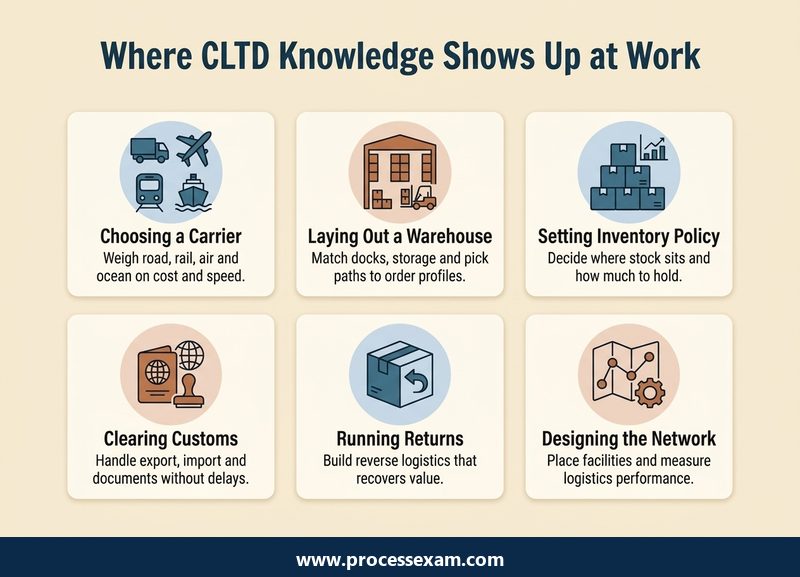
CLTD is the narrow, deep option in ASCM's range. It belongs to people whose working day is spent on the physical movement and storage of goods: transport planners and carrier managers, distribution centre and warehouse supervisors, freight forwarders, import and export coordinators, third-party logistics account managers, replenishment and inventory analysts, and the operations managers who sign off all of the above. If your problems are lanes, docks, modes, duties and stock locations, this is the credential that examines them directly.
The three ASCM supply chain exams share a shape and differ in scope. Each is 150 questions in 210 minutes with a passing score of 300 / 350, so the difference is not difficulty of format but breadth of subject and price.
| Credential | Where it looks |
|---|---|
| CLTD | How goods move and where they rest: transport, warehousing, global trade, network design |
| CPIM | Planning and inventory inside the organisation |
| CSCP | The end-to-end supply chain, supplier to customer |
On price the gap is real but never decisive: CLTD's USD $1,100 fee is $165 below CPIM's and $350 below CSCP's, which is not enough of a spread to choose a credential on cost. Let the subject decide and the fee follow.
A simple test decides it. Write down the five decisions you were asked to make last month. If three or more of them involved a mode, a carrier, a warehouse, a border or a stock location, CLTD will pay you back fastest. If they were about demand plans, master schedules or supplier strategy, one of the other two credentials fits your work better, and taking the wrong one first is an expensive way to find that out.
There is no rule that says you must choose only one. Plenty of logistics managers add CLTD after a broader credential because the depth on transport and warehousing is what their role actually demands. What you should not do is take CLTD because it is the cheapest of the three and hope it covers planning work it was never written for.
What does the CLTD exam cost, and how is it scored?
The exam fee is USD $1,100. ASCM also sells learning-system bundles that package study material with the exam, priced separately from the exam alone, so check ASCM's CLTD credential page for exactly what any package you are quoted includes before you pay. Budget for the study material as a second line in the same plan rather than a surprise after booking.
Scoring is the part most candidates get wrong in their heads. The result is a scaled score, not a percentage of questions answered correctly. The pass mark is 300 on a 350-point scale, and ASCM describes its credential exams as containing unscored pretest items mixed in among the scored ones, which is set out on ASCM's CLTD exam process page. You cannot tell a pretest question from a live one while you are sitting there, and you gain nothing by trying. The practical consequence is the only one that matters: answer all 150, because a blank scores the same as a wrong answer and costs you a chance you paid for.
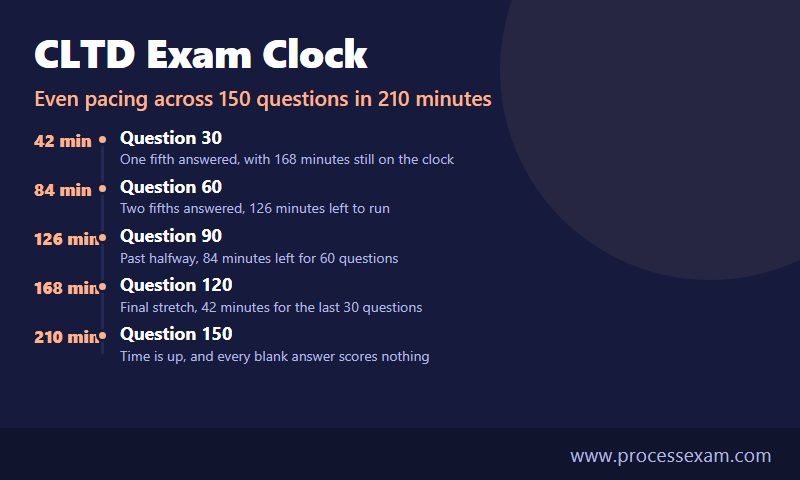
Now do the arithmetic on the clock. Spread evenly, 210 minutes across 150 questions is 84 seconds each. That is generous for a definition and tight for a scenario that describes an order profile, three modes and a service target before it asks anything. The pacing that works is not per question but per block: each block of thirty should cost you roughly 42 minutes, and you check yourself against that at four points rather than fretting after every screen.
Sittings are booked through Pearson VUE, which is the route recorded for CLTD in our exam data. Whatever delivery option you pick, treat the booking date as the anchor of your study plan rather than something you arrange once you feel ready. A date in the diary converts good intentions into weeks of study; waiting to feel ready converts them into another quarter.
How do you build a CLTD study plan around the nine modules?
Plan in sections, not modules. Thirty-eight sections is a number you can divide; nine modules of wildly different sizes is not. Over fourteen weeks, 38 sections works out at fewer than three sections a week, which is a pace a working professional can keep without abandoning evenings entirely. Pair the modules so that each block has one heavy area and one light one.
- Weeks 1 to 3, modules 1 and 2 (10 sections). Logistics fundamentals and strategy, then demand management and capacity. Start here even if it feels basic. Every later module assumes you know how logistics strategy is set and how a forecast becomes a capacity requirement.
- Weeks 4 to 6, modules 3 and 4 (7 sections). Customer and order management, then warehousing and fulfilment. These two belong together, because the order profile you accept in module 3 is what the layout and handling decisions in module 4 have to serve.
- Weeks 7 to 9, modules 5 and 6 (10 sections). Inventory management and the eight transport sections. This is the heaviest block of the fourteen weeks, and it is deliberately placed in the middle, when your routine is established and the exam is still far enough away to allow a slow week.
- Weeks 10 and 11, modules 7 and 8 (7 sections). Global logistics, then sustainability, reverse logistics and risk. Documentation and customs reward flashcards more than any other part of the syllabus, so build them as you read rather than afterwards.
- Weeks 12 to 14, module 9 plus revision (4 sections). Framework, metrics, network design and improvement, then full-length timed practice. Do not save your first complete 210-minute rehearsal for the final week; run one at the start of week 12 so there is time to act on what it tells you.
Somewhere in that last block, sit a full-length CLTD practice exam under real conditions, phone away and clock running, because reading nine modules and answering 150 timed questions are two different skills and only one of them is tested. Before that, ASCM's own free CLTD sample questions are worth an hour early on, purely to see the house style of the wording.
Two habits matter more than the calendar itself. Write a one-page summary in your own words at the end of every section, so that revision is reading your work rather than re-reading a textbook. And after every practice attempt, record why each wrong answer was wrong, sorted into three buckets: I did not know it, I misread the question, or I ran out of time. Those three failures have three different cures, and treating them all as gaps in knowledge is why some candidates study hard and improve slowly.
Which CLTD topics take the longest to learn?
Candidates consistently underestimate four areas. None of them is conceptually hard; all of them are wide, and width is what runs you out of weeks.
Transport modes and their economics
Eight of the 38 sections sit in transportation management, and the questions rarely ask what a mode is. They describe a shipment with a weight, a distance, a deadline and a value, then ask which mode or combination serves it best. That needs you to hold the cost, speed, reliability and handling characteristics of road, rail, air and water side by side, plus the compromises multimodal and multi-stop movements introduce. Build one comparison sheet and keep adding to it all the way through.
Customs, documentation and cross-border finance
Global logistics is only four sections, but it covers regulation, export and import procedure, customs clearing, documentation, and the finance, payment, currency and tax implications that follow. The vocabulary is unforgiving and mostly unfamiliar to anyone who has worked domestically. This is the area that most often separates a comfortable pass from a narrow one, and it is why the study plan above gives it a whole block of its own.
Warehouse layout and materials handling
Layout questions are judgement questions. Given a described order profile, the right answer depends on pick frequency, unit size, storage density and how much automation the described operation can justify. Reading about layouts teaches you the names; walking a real facility, or at least tracing the path of one order through one, teaches you the reasoning the exam asks for.
Inventory policy and the numbers behind it
Two sections, but the arithmetic of ordering policy, safety stock and control methods shows up inside questions filed under other modules too. Practise until you can set up the calculation quickly, because the exam gives you no extra time for a topic you find fiddly.
What mistakes cost CLTD candidates their score?
Most failures are not caused by a missing topic. They are caused by the same handful of avoidable habits.
- Studying an outdated manual. Material aligned to an older exam content manual teaches the subject but not the current section structure. Check what edition your book, course or notes follow before you start, not in week ten.
- Weighting the modules evenly. Nine modules, nine equal slices of time, and eight transport sections receive the same attention as two on customer management. The section count is the honest guide to effort.
- Reading instead of answering. Recognition feels like knowledge. Until you have answered questions without the book open, you do not know which of the nine modules you actually hold.
- Leaving questions blank. There is no penalty that makes a blank better than a guess. Mark anything you are unsure of, move on, and return with whatever minutes the block checkpoints have saved you.
- Never rehearsing the full 210 minutes. Concentration at question 130 is a different thing from concentration at question 20, and the only way to find out how yours holds is to sit the whole length at least twice.
- Treating scenarios as definition questions. When a question describes an operation before it asks anything, the description is the question. Read what the operation actually needs before you look at the options.
- Booking late. Without a date, week one repeats itself. Book first, then build the fourteen weeks backwards from it.
Is CLTD certification worth the fee and the study hours?
Answer it as an investment decision rather than a hope. The measurable costs are the USD $1,100 exam fee, whatever study material you buy, and roughly three to four months of evenings. Against that, ask what the credential does in your particular market, and insist on evidence. Look at the logistics roles being advertised where you live and count how many name CLTD or an equivalent credential. Ask two people who hold it what changed. Check whether your employer reimburses exam fees, since that single answer often decides the question on its own.
What the credential genuinely signals is breadth with proof. Many logistics professionals know their own link of the chain extremely well and have never had to demonstrate the rest. Passing an exam that spans transport, warehousing, inventory, global trade, reverse logistics and network design says you can hold the whole picture, which is exactly the step between running an operation and being asked to design one. It also gives a common vocabulary with planners and procurement colleagues, which is worth more in a cross-functional meeting than any line on a profile.
Be equally clear about what it is not. A credential does not replace operating experience, and no certificate makes a case for a promotion on its own. Anyone quoting you a guaranteed salary increase or a pass-rate improvement without naming the study behind it is selling something. Judge CLTD on whether its nine modules match the work you want next, and on whether the people who make hiring decisions in your sector recognise it.
If that answer is yes, the path from here is short enough to write in a sentence. Confirm which exam content manual your material follows, book a date roughly fourteen weeks out, work the 38 sections in blocks rather than as nine equal lumps, rehearse the full 210 minutes twice, and walk in knowing that 300 out of 350 is the only number you need.
Frequently Asked Questions
How much does the APICS CLTD certification cost?
The CLTD exam fee is USD $1,100. Study material is priced separately, and ASCM sells learning-system packages that bundle preparation resources with the exam, so the total you pay depends on which package you buy. Check what any quoted price includes before you commit, and ask whether your employer reimburses certification fees.
What is the CLTD exam format and passing score?
CLTD is a multiple-choice exam of 150 questions with a time limit of 210 minutes. The passing score is 300 / 350, reported as a scaled score rather than a percentage. ASCM includes unscored pretest questions among the scored ones, so you should answer every question because a blank earns nothing.
Which version of the CLTD exam is current?
ASCM's module content outline states that the CLTD 2026 Learning System follows the APICS CLTD Exam Content Manual version 3.0, checked in September 2026. The outline lists nine modules and 38 lettered sections. Preparation material written for an earlier manual will not match those section headings.
What is the difference between CLTD and CSCP?
Both are ASCM credentials of 150 questions in 210 minutes with a 300 / 350 pass mark. CLTD costs USD $1,100 and goes deep into transport, warehousing, global logistics and network design. CSCP is priced several hundred dollars higher and looks across the whole end-to-end supply chain rather than specialising in physical distribution.
How long does it take to prepare for the CLTD exam?
Around fourteen weeks suits most working candidates, because 38 syllabus sections divide into fewer than three a week at that pace. Allow a heavier block for transportation management, which holds eight sections, and reserve the final three weeks for full-length timed practice and revision.
- Supply Chain Management |
- CLTD Question Bank |
- CLTD Body of Knowledge (BOK) |
- APICS CLTD Simulator |
- APICS CLTD Mock Exam |
- APICS CLTD Certification |
- APICS CLTD Certification Cost |
- APICS CLTD Certification Requirements |
- CLTD Exam Questions Download |
- CLTD Test Questions |
- APICS CLTD |
- APICS CLTD PDF |
- ASCM CLTD BOK PDF |
- ASCM APICS Certified in Logistics Transportation and Distribution Test Questions |
- ASCM APICS Certified in Logistics Transportation and Distribution Book |
- ASCM APICS CLTD Question Bank |
- ASCM APICS CLTD Book |
- ASCM APICS CLTD Study Guide |
- ASCM APICS Certified in Logistics Transportation and Distribution Sample Questions |
- ASCM APICS CLTD Exam Questions |
- ASCM APICS CLTD Sample Questions


