admin's blog

Six Sigma Teamwork: Roles and Communication on a Project Team

A common myth says a Six Sigma project belongs to the Black Belt, and everyone else simply hands over data when asked. In practice a project moves at the speed of its slowest conversation: the sponsor who releases budget, the process owner who opens the line for measurement, the Green Belt who gathers samples, and the operator who knows why the numbers look odd. This guide shows how those roles work and talk to each other on one project.

Blue figures assembling puzzle pieces that spell the word teamwork

Who sits on a Six Sigma project team, and what does each person own?

Job titles differ between companies, but most programmes use the same cast. The table below puts each role beside the thing it owns and the thing it needs from the others, because a project stalls at the second column far more often than at the first.

Six Sigma and Innovation: How Companies Manage the Tension

For years the argument ran one way: Six Sigma shrinks variation, innovation needs variation, so one must smother the other. Most of the current discussion has moved on to a more useful question: which work in a company deserves tight control, which deserves room to wander, and how do you keep one scoreboard from judging both? The answer is a division of labour with rules for handing ideas across, and it is something a Black Belt can set up in practice.

Design team working with prototypes and sticky notes beside a laptop showing a stable chart

Why did Six Sigma and innovation start out as rivals?

The quarrel comes from what each side treats as the enemy. Six Sigma treats variation as the enemy: if every invoice, part or call behaves the same way, defects fall and the process becomes predictable. Innovation treats sameness as the enemy: a company that only repeats what it already does has nothing new to sell. Put those two instincts in one meeting and each hears the other as a threat.

The words are also part of the problem. Six Sigma has a firm definition: a data-driven method for finding the causes of defects and removing them. Innovation has none. It can mean a new product, a new business model, a new way of delivering an old service, or a small tweak that saves a minute. When one side has a rulebook and the other has a mood, the rulebook usually wins the budget meeting, and the people who came to invent something go home feeling audited.

What has shifted in the debate

Three things have changed how people talk about it.

Top Management Support in Six Sigma: What Executives Must Do

A regional distributor launches Six Sigma with a keynote from its chief executive, twelve new Black Belts and a wall chart of projects. By the third quarter the executive has missed two reviews, a hiring freeze has pulled two belts back to their old jobs, and nobody can say who approved the latest charter. Top management support is vital because only executives control priorities, time and barriers, and this guide sets out what they must actually do.

Senior executive listening to an improvement team beside a whiteboard of process flows

The distributor is made up for illustration, but the pattern is familiar to anyone who has worked in a deployment. The sections below follow the sponsor's job in order: what the stall looks like, the duties that prevent it, the questions worth asking in a review, the signs that attention is slipping, and the way a Master Black Belt coaches leaders who have little time. The guide stays on leadership. The project methods themselves, DMAIC and DMADV, are covered elsewhere on this blog.

Why does a Six Sigma deployment stall when the sponsor stops showing up?

A Black Belt can analyse data, run a team and write a control plan. A Black Belt cannot decide that a project outranks a shipping deadline, cannot release a machine operator for a week of measurement, and cannot tell another vice president to share a data set. Those decisions sit with executives, and when executives stop making them, the programme does not collapse in a single event. It thins out, one deferred decision at a time.

The made-up distributor shows how gradual the slide is. Nothing in the table below is dramatic, and each row looks reasonable on the day it happens.

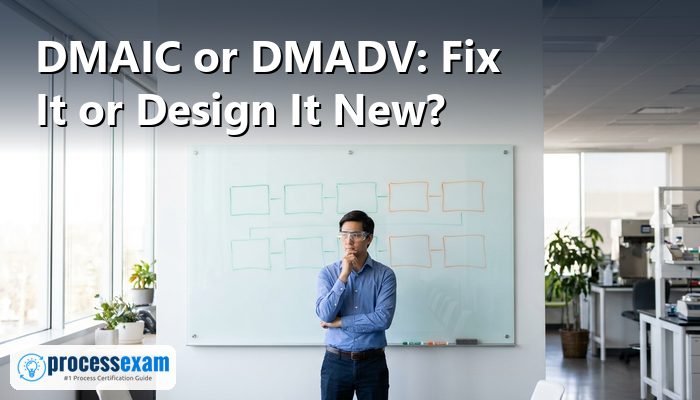
DMAIC vs DMADV: Differences, Phases and When to Use Each

A diagnostics lab finds that one blood sample in twenty arrives with a label that does not match its request form, so the job is to repair a process that already runs. The same company wants a finger-prick kit patients can use at home, so the job is to create something that does not exist yet. The first is a DMAIC project (define, measure, analyze, improve, control); the second is DMADV (define, measure, analyze, design, verify).

Process engineer comparing two workflow plans on a glass board in a lab

Six Sigma gives you two road maps, and choosing the wrong one is an expensive way to learn the difference. This guide sets the phases side by side, follows one DMAIC project and one DMADV project from the first meeting to the last, shows how to pick between them, and then points to the exact places where ASQ's Green Belt and Black Belt Bodies of Knowledge test the distinction. It is about the methods, not an exam-prep course, though anyone studying for a belt will find the last sections useful.

What do DMAIC and DMADV stand for, and what does each one assume?

DMAIC is the improvement road map. Define the problem and the target, measure how the process performs today, analyze the data to find what causes the gap, improve the process by dealing with those causes, and control it so the gain does not leak away. The method assumes that a process exists, that it delivers an output you can measure now, and that its basic design is capable of reaching the goal once its faults are removed.

Value of Being Six Sigma Aspirant - The Concept Seed

The concept behind Six Sigma Certification is to bring awareness in quality professionals, Progressing through Six Sigma courses with the practical approach. The demand for qualified and certified quality professionals has also been on the increase.

Quality analyst reviewing a process chart at a desk

In a survey, it is estimated that certified Six Sigma Professionals (Master Black Belt, Black Belt) have an advantage of more than $20,000 hike in their salary when compared to their non-certified peer group. 

If you are already in Quality field and planning about Six Sigma Certifications, we will help you to make the right decision. You will be aware of important quality factors like Need of the Industry, Manufacturing process of your organization, Tools, and Techniques of used in your organization to resolve quality problems.

There isn’t a single authorized certification body for Six Sigma Levels. Due to this, you’ll find certification options from consulting companies like ASQ, as well as from businesses like Motorola, Allied Signal, GE, and many others. Each of these businesses has different certification criteria and procedure to enroll for the course.

Syndicate content