
Project Manager to Program Manager: What Changes and What PMI Tests
A project manager delivers one project to its scope, schedule and budget. A program manager oversees several related projects so that together they produce benefits none would deliver alone. PMI's program management credential tests that shift: it asks for three to seven years of program experience and a 170-question exam.

Most project managers drift into program work before anyone gives them the title. A product launch has four workstreams, each with its own manager, and somebody has to decide which one gets the scarce engineers. A merger needs eleven projects to land in the right order. A regulatory change touches three countries and a dozen teams. If you are the person fielding those calls, you are already doing part of the job. What is usually missing is a way to prove it, to a hiring manager or to yourself. This article follows the move from project manager to program manager using PMI's own documents as the map: the handbook and the Exam Content Outline, both revised in March 2024, published on the PMI program management certification page. You will see what really changes in the role, how much experience PMI asks for, how the anonymous panel review works, what the five exam domains test, how to prepare around a full-time job, and what the credential costs. Every exam figure below was read from PMI's certification page, handbook and outline in October 2026.
What is the difference between a project manager and a program manager?
The difference is the unit of work and the thing you are judged on. A project manager is accountable for the cost, schedule and performance of one project. A program manager is accountable for the coordinated management of multiple related projects directed at a strategic business objective, which PMI's handbook describes as a way to group projects "to achieve benefits that may not be realized if the projects were managed in a stand-alone fashion." A project ends when its deliverables are accepted. A program ends when its benefits have been delivered, handed over to operations and shown to hold.
PMI's handbook adds a detail that is easy to miss: the program manager defines and initiates the component projects and assigns project managers to run them. In other words, the program manager is often the person a project manager reports to, and the person who decides whether a project should exist at all. The role also spans functions, organisations, regions and cultures, with stakeholders at several levels, including some outside your own company.
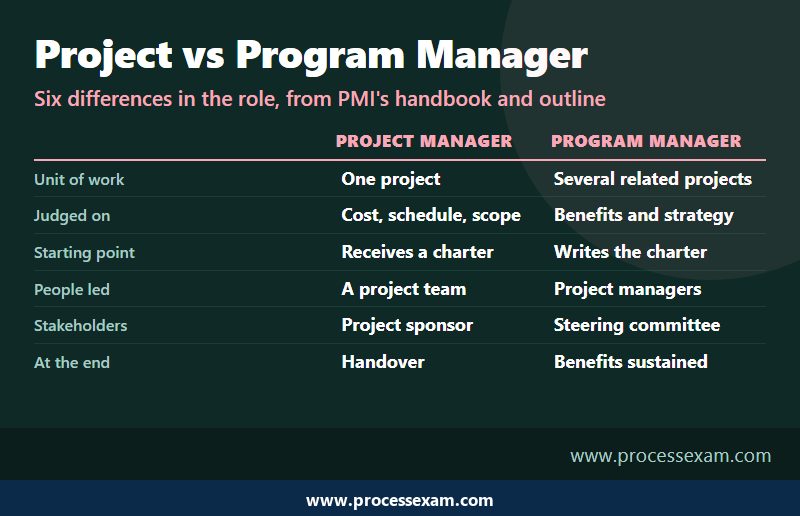
| Aspect | Project manager | Program manager |
|---|---|---|
| Unit of work | One project with a defined end | Several related projects and the work between them |
| Judged on | Cost, schedule and performance of the project | Whether the combined benefits arrive and serve the strategy |
| Starting point | Receives a charter and a sponsor | Writes the program charter and charters each component project |
| People led | A project team | Project managers, a program team and shared resources across projects |
| Stakeholders | The sponsor and project stakeholders | Executives, a steering committee and groups outside the organisation |
| What happens at the end | Deliverables are handed over | Benefits are transitioned to operations and sustained |
None of this makes the project manager's craft less important. A program is only as good as the projects inside it, and PMI's outline expects a program manager to review how project managers perform and to approve the closure of each component project. It does mean that skills which made you excellent, such as chasing a task to completion or running a tight stand-up, matter less than skills you may not have used yet: negotiating funding, reading a business case, deciding when to stop a project, and keeping a steering committee supportive for years.
What changes in your working week when you start running a program?
Four things shift most, and each of them shows up in PMI's outline as tasks you will be examined on.
You manage a roadmap before you manage a plan
A project plan is a schedule of work. A program roadmap is a sequence of outcomes, with milestones and preliminary estimates that an executive sponsor can validate. The outline asks you to establish a high-level road map with milestones to win that validation, then define a financial framework that sets the baseline for planning and execution. You will spend more of your week in conversations about why and when than about who and how.
You manage project managers, not tasks
Component projects are chartered by you and handed to project managers with the resources to deliver them. The outline lists reviewing project managers' performance against their plans, consolidating project data into program reports, and analysing variances in cost, schedule, quality and risk to decide on corrective action. You stop fixing the project yourself, because the moment you do, you lose sight of the other projects.
You work through governance
Stage gates, change boards and escalation paths are not paperwork at program level. They are how decisions get made. The outline expects you to select a governance framework, obtain approval to move to the next phase through stage gate reviews, and set up escalation policies so that risks are handled at the right level. A change to one project is judged by its effect on the whole program, so impact assessment becomes a daily habit.
You own benefits after the projects finish
This is the change that surprises people most. A project manager closes the project and moves on. A program manager keeps a benefits register, monitors the metrics that show whether the benefits are arriving, and writes a sustainment plan for the period after the program ends. Delivering every project on time and still missing the benefit counts as a program failure.
What experience does PMI ask for, and how does the path to certification run?
PMI requires you to prove experience twice: first on paper, through an application reviewed by other program managers, then in an exam. The two evaluations take roughly 60 days in total according to the handbook. All experience must fall within the last 15 years, must be professional (school projects and personal events do not count) and is counted as unique, non-overlapping months. If two programs overlap in a month, only the time on one of them counts.
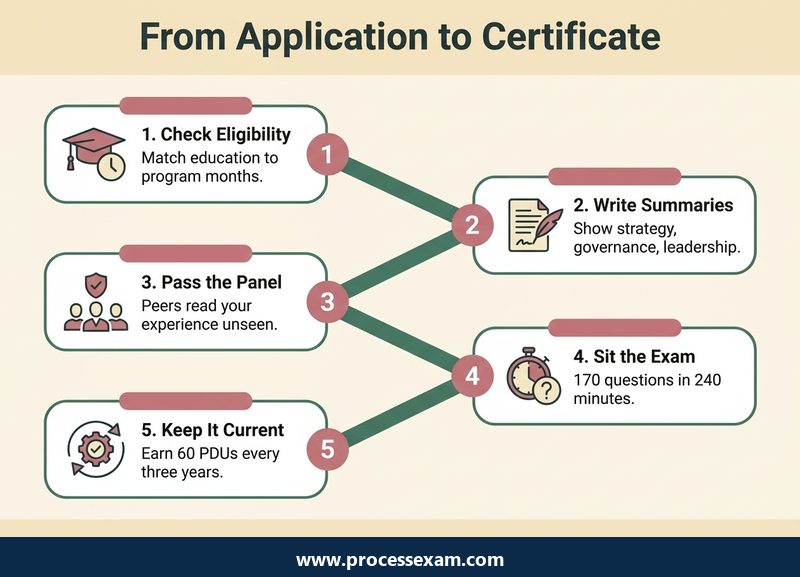
PMI's certification page sets out three combinations of education and experience. Pick the one that matches your background:
| Set | Education | Project management experience | Program management experience |
|---|---|---|---|
| A | High school or secondary diploma (or global equivalent) | 48 months, or an active PMP | 84 months (7 years) |
| B | Bachelor's degree or higher (or global equivalent) | 48 months, or an active PMP | 48 months (4 years) |
| C | Bachelor's degree or higher from a GAC-accredited program | 36 months, or an active PMP | 36 months (3 years) |
Two points matter for project managers. First, holding the PMP removes the need to record the project-experience months, so the application goes straight to the program section. Second, the projects you list as project experience cannot be component projects of the program you claim as program experience, so you cannot count the same work twice. If you have run the same large initiative as both a project and a program, decide honestly which description fits what you did.
Be realistic about what counts as program management. Running a big project with many workstreams is not enough on its own. The panel looks for coordinated management of multiple, related component projects directed at a common organisational objective, with benefits realised, under limited supervision. If your largest piece of work was one very large project, talk to your manager about taking on a second related project before you apply.
How does the panel review work, and what must your experience summaries show?
The panel review is the part of the path that has no equivalent in most other PMI credentials, and it is where many project managers stumble. A panel of volunteer program managers who already hold the credential reads your written experience summaries. PMI says your identity is hidden from the reviewers, and that they are trained and calibrated to assess your answers.
Since March 2024 the prompts are based on three areas of your experience: program strategy, program governance and program leadership. For each prompt PMI's handbook gives clear guidance:
- Write in the first person. "I developed the governance model" passes; "the program team developed it" does not, because the panel needs to see your individual contribution.
- Give program-level specifics. Name projects, objectives, stakeholder groups, barriers, risks and escalations, and quantify goals and results.
- Avoid textbook definitions. The handbook says to describe how you applied practices, not what they are.
- Length. Answers that cover every element of a prompt usually run 350 words or more; the maximum is 700 words.
- Do not sound like a project manager. PMI's own checklist asks whether your response sounds like a project manager who oversaw multiple projects instead of a program manager.
PMI illustrates the difference with short examples. A strong statement is concrete, such as recommending to a sponsoring committee that installation charges be waived to move customers onto a new network. A weak one is vague, such as "I developed clear expectations that began with understanding requirements." If you fail the first time, you receive an email with reasons and one chance to amend and resubmit. A second failure closes the application and the exam fee is refunded. PMI can also select an application for audit; if yours is selected, the audit finishes before the panel review begins.
The practical lesson is to start writing your summaries before you feel ready. Draft them in a document, read them as a stranger would, and ask whether a reviewer could tell what you decided, which stakeholders pushed back and what the program delivered. If you cannot answer, that gap is also a gap in your preparation for the exam.
How is the exam built, and what do the five domains ask of a program manager?
Once you pass the panel review, PMI sends an eligibility ID and you have one year to sit the exam. The exam has 170 multiple-choice questions in 240 minutes. Of the 170, 150 are scored and 20 are unscored pretest questions placed at random. There are no scheduled breaks, and if you take one the exam clock keeps running. An optional tutorial before the exam and survey after it can take up to 15 minutes each and are not counted in the four hours. The exam is delivered at test centres, booked through Pearson VUE's PMI page, and a candidate who does not pass has up to three attempts inside the one-year eligibility period. PMI recommends booking at least three months before that period ends because seating cannot be guaranteed.
The current blueprint is the Exam Content Outline of March 2024. PMI reviewed and minorly updated it that month to align with the fifth edition of the Standard for Program Management; no new job-task analysis was done, and PMI states that the exam continues to reflect this outline. If you see older study material describing a different blueprint, trust the March 2024 outline.
| Domain | Share of exam | Tasks in outline | What it asks of you |
|---|---|---|---|
| I. Strategic Program Alignment | 15% | 11 | Assess the program against strategy, build the business case, set the roadmap, win approval |
| II. Program Life Cycle Management | 44% | 35 | Charter, plan, run, control and close the program and its component projects |
| III. Benefits Management | 11% | 8 | Plan, track and sustain benefits, then transition them to operations |
| IV. Stakeholder Engagement | 16% | 7 | Analyse stakeholders, negotiate support, keep the program visible |
| V. Governance | 14% | 11 | Choose the governance framework, run stage gates, handle escalation and lessons learned |
If the percentages apply to the 150 scored questions, Domain II alone accounts for about 66 of them. That is the single most important fact for planning your time. Life-cycle management covers 35 of the outline's 72 tasks, from developing the program charter and responsibility assignment matrix, to establishing the program management plan and information system, to managing change, risk, resources and closure. It is also the domain where project managers feel most at home, which makes it tempting to over-study.
The smaller domains are where project managers usually lose ground. Domain I questions are about the business case, funding and strategic fit, so they reward people who have sat in executive conversations. Domain III is about benefits realisation and sustainment, which many project managers have never been asked to plan. Domain IV is not a stakeholder register exercise; it is about negotiating support and setting acceptance criteria for benefits. Domain V covers the program management office, go/no-go criteria, stage gate reviews and escalation. The outline also lists core skills that apply across all domains, such as integration, systems thinking, executive-level presentation, negotiating, influencing, and managing virtual and multicultural teams.
The score report rates each domain as Above Target, Target, Below Target or Needs Improvement, and no percentage pass mark appears in the handbook or on the certification page.
Which program situations does the exam put in front of you?
The handbook describes the questions as situational and scenario-based, and PMI's outline ties every task to a domain. The outline therefore tells you what the situations look like. Expect problems of the following kinds, each of which maps to specific tasks:
- A component project slips, and the program benefit depends on it. You decide whether to re-plan, reallocate shared resources, escalate through the governance route or accept a delay. The tasks behind this are issue management, variance analysis and updating program plans.
- A sponsor asks for a scope change late in the program. The right answer usually runs through an impact assessment and the change process in the governance framework before anything is agreed.
- A project manager is not delivering what the plan says. The outline expects you to review that person's performance and act on it, not to take over their project.
- A steering committee loses interest. Questions of this type test whether you maintain the program's visibility, adapt your communications to different stakeholders and incorporate their risks into your own risk plan.
- The projects close on time and the benefits start to fade. The correct approach is built around the benefits register, the sustainment plan and the transition to operations.
A pattern worth learning early: wrong options tend to be answers that a skilled project manager would give. They fix the task, rebuild the schedule or add resources to a single project. The better option usually acts at program level, through the roadmap, governance, benefits or stakeholders. When you review practice questions, ask which level each answer works at. Working through scenarios like these against the five domains is easier with a question bank; the PgMP practice exam is one place to check that reasoning before you book the real sitting.
How can a working project manager prepare around a full-time job?
Start with a gap analysis against the outline rather than a book. Download PMI's Exam Content Outline, read the tasks for each domain and mark each one green, amber or red depending on whether you have done it in practice. Your red items are your study plan. A project manager with ten years of experience typically finds that the list of reds concentrates in Domains I, III and V.
A workable eight-week shape
- Weeks 1 and 2: gap analysis, then read the Standard for Program Management, fifth edition, which PMI makes free for members. Focus on the program life cycle and the performance domains it describes.
- Weeks 3 and 4: Domain II in depth. Link each of the 35 tasks to something that happened in a program you know, or one you can imagine.
- Week 5: Domains I and III together, because the business case produces the benefits that Domain III then tracks.
- Week 6: Domains IV and V, with extra time on governance frameworks, stage gates and escalation.
- Week 7: mixed scenario questions under a clock, followed by a review of every wrong answer by domain and task.
- Week 8: a full-length rehearsal of 170 questions in 240 minutes, then light revision of your weakest tasks and logistics for exam day.
This is a suggestion rather than a PMI requirement, so adjust it to the reds in your own gap analysis. People with a heavy travel schedule often stretch it to twelve weeks at fewer hours per week. What matters is the order: outline first, then standard, then questions, then a rehearsal that copies the real exam length.
Alongside the Standard for Program Management, PMI lists the PMBOK Guide as a resource and offers a set of sample questions on its certification page. Use a syllabus to cross-check coverage: the PgMP syllabus lists the same five domains and their tasks, which makes a handy checklist as you work through them.
Keep your experience summaries and your exam preparation connected. The stories you write for the panel, about a governance model you built or a stakeholder group you had to win over, are also the best memory hooks for exam scenarios. When a question describes a steering committee dispute, you want to think of a real one.
What does the credential cost, and what do you commit to once you hold it?
As of October 2026 the exam fee is USD $800 at the PMI member price and USD $1,000 at the full price. PMI shows prices in local currency according to the region of the visitor, so the amount on its page can look different from these figures. PMI states the exam fee is required only after your application has been accepted and you are ready to schedule. PMI membership is not required to apply, but members pay less and receive the Standard for Program Management and the PMBOK Guide free of charge.
Because a second failed panel review leads to a refund of the exam fee, the financial risk of the application stage is limited. A failed exam is different: the handbook allows up to three attempts within the one-year eligibility period, and you should check PMI's current re-examination terms before you pay for another sitting.
PMI says certification holders must earn 60 professional development units in each three-year cycle to keep the credential. Each unit stands for an hour of activity such as study, teaching, presenting, reading, volunteering or content creation, so most working program managers meet the requirement through work they already do. PMI's page also reports that program managers holding the credential earn 42% more than program professionals without it, and that 23% of surveyed holders globally reported a salary increase after becoming certified. Treat these as PMI's own survey claims rather than a promise: your result depends on your industry, your employer and the programs you run.
Is it the right next step for you?
Choose the credential when you already run, or are about to run, a set of related projects and you want independent proof of that work. It is a poor fit if your experience is a single large project, because the panel is looking for program-level evidence you may not have yet. In that case, aim for a second related project, a seat on a program governance board, or a PMP first, and revisit the application when your record supports it.
The move from project manager to program manager is not a promotion in the usual sense. It is a change in what you are accountable for. PMI's credential is one way to show you have made that change, and the preparation is useful even if you never apply, because the outline is an unusually clear description of what program managers are expected to do. Read it, mark your reds, and decide from there.
Frequently Asked Questions
Who is eligible to apply for PMI's program management credential?
You need 36 to 84 months of program management experience depending on your education, plus 36 to 48 months of project management experience or an active PMP. Everything must fall within the last 15 years. Set A (secondary diploma) needs 84 months, Set B (bachelor's degree) 48 months and Set C (GAC-accredited degree) 36 months.
Do you need the PMP before applying for the program management credential?
No. The PMP is one way to meet the project experience requirement, not a prerequisite. If you hold an active PMP, you skip recording project months and go straight to your program experience. Without it, you must record 36 to 48 months of unique, non-overlapping project management experience. The projects cannot be components of the program you claim.
How much does the PgMP exam cost?
As of October 2026 the exam fee is USD $800 at the PMI member price and USD $1,000 at the full price. PMI may display the amount in your local currency. The fee is required only after your application has been accepted. If the panel review fails a second time, the application closes and the exam fee is refunded.
How many questions are on the PgMP exam and how long is it?
The exam has 170 multiple-choice questions and lasts 240 minutes. Of these, 150 are scored and 20 are unscored pretest questions placed at random. There are no scheduled breaks, and the clock keeps running if you take one. You can sit the exam up to three times within your one-year eligibility period.
What is the passing score for the PgMP exam?
PMI does not publish a percentage pass mark in its handbook or certification page. The score report rates each domain as Above Target, Target, Below Target or Needs Improvement. Domain II, Program Life Cycle Management, carries the largest share at 44% of the exam, so a weak result there is the hardest to recover from.
- PMI Program Management Exam Questions |
- PMI Program Management Question Bank |
- PMI Program Management Questions |
- PMI Program Management Study Guide |
- PMI PgMP Quiz |
- PgMP Certification |
- PgMP Questions |
- PgMP Practice Test |
- PgMP Study Guide Material |
- PgMP Sample Exam |
- Program Management Certification |
- PMI Program Management Book |
- Program Management Certification Cost |
- Program Management Certification Requirements |
- PMI Program Management Sample Questions |
- PgMP Exam Questions Download |
- PgMP Test Questions |
- Program Management PDF |
- PMI Program Management Professional


