
DMAIC vs DMADV: Differences, Phases and When to Use Each
A diagnostics lab finds that one blood sample in twenty arrives with a label that does not match its request form, so the job is to repair a process that already runs. The same company wants a finger-prick kit patients can use at home, so the job is to create something that does not exist yet. The first is a DMAIC project (define, measure, analyze, improve, control); the second is DMADV (define, measure, analyze, design, verify).
Six Sigma gives you two road maps, and choosing the wrong one is an expensive way to learn the difference. This guide sets the phases side by side, follows one DMAIC project and one DMADV project from the first meeting to the last, shows how to pick between them, and then points to the exact places where ASQ's Green Belt and Black Belt Bodies of Knowledge test the distinction. It is about the methods, not an exam-prep course, though anyone studying for a belt will find the last sections useful.
What do DMAIC and DMADV stand for, and what does each one assume?
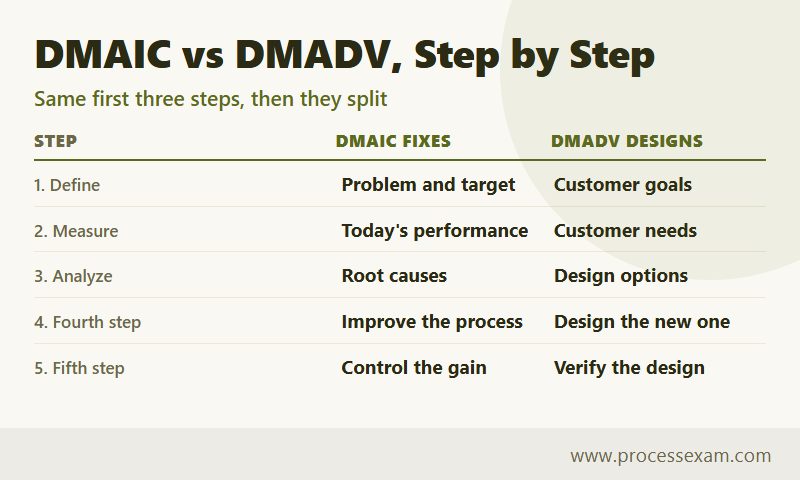
DMAIC is the improvement road map. Define the problem and the target, measure how the process performs today, analyze the data to find what causes the gap, improve the process by dealing with those causes, and control it so the gain does not leak away. The method assumes that a process exists, that it delivers an output you can measure now, and that its basic design is capable of reaching the goal once its faults are removed.
DMADV is the design road map. Define the goals of the project and of the customers, measure what the customers need and what the organisation requires, analyze the options that could meet those needs, design the new process or product in detail, and verify that the design performs as planned. It assumes the opposite: there is no process to measure yet, or the current one cannot reach the target however well it is tuned, so the starting evidence has to come from customers and not from historical output.
Where DMADV sits in the Six Sigma family
DMADV belongs to Design for Six Sigma (DFSS), the group of methods used when the aim is to design a product, service or process so that it performs at a high sigma level from its first day, instead of repairing it afterwards. Wikipedia's article on Design for Six Sigma gives the general background. DMADV is the best-known DFSS road map, but not the only one. ASQ's Green Belt Body of Knowledge asks candidates to tell DMADV from IDOV (identify, design, optimize, verify) and to recognise how both line up with DMAIC, while the Black Belt Body of Knowledge names DMADV and its six-step cousin DMADOV (define, measure, analyze, design, optimize, validate).
Verify or validate?
You will see the last letter of DMADV written two ways. ASQ's Green Belt document spells the road map define, measure, analyze, design, verify, and its Black Belt document writes define, measure, analyze, design, validate. The job is the same in both: test the finished design against the requirements set in the first two phases and show, with data, that it meets them. In project language, verification asks whether the design was built to specification, and validation asks whether it satisfies the customer's real need. A good DMADV project does both, so treat the two words as two halves of the final phase.
The three letters they share
Both methods start define, measure, analyze. That is not an accident, because every Six Sigma project begins by agreeing what success means, putting a number on it and understanding what drives it. The paths part company after analysis. A DMAIC team now has a list of root causes and moves to fix them; a DMADV team has a ranked set of customer requirements and design options, and moves to build something that meets them.
How do DMAIC and DMADV differ, point by point?
The table sets the two methods against the questions a project sponsor usually asks before approving either one.
| Question | DMAIC | DMADV |
|---|---|---|
| What exists at the start? | A running process with a track record | An idea, a requirement or a process that cannot be tuned to the target |
| What is the goal? | Fewer defects, less variation, lower cost on the current design | A new design that meets customer requirements from the first unit |
| Where does the baseline come from? | Measuring the live process | Customer research, benchmarks and the organisation's own targets |
| What does the Measure phase quantify? | Current performance and the reliability of the data | Customer needs, turned into measurable requirements |
| What does the Analyze phase produce? | Verified root causes of the gap | Ranked design options and the one chosen |
| What are the last two phases? | Improve, then Control | Design, then Verify |
| What is handed over at the end? | An improved process, a control plan and an owner | A proven design, a pilot result and a plan to run it |
| Typical risk | Fixing symptoms of a design that cannot reach the goal | Designing for needs nobody confirmed |
| Typical time and cost | Shorter, and mostly spent on analysis | Longer, because design and pilot builds cost money |
Two rows deserve a second look. The Measure phase is where the methods feel most different even though the letter is the same: a DMAIC team measures what the process does, while a DMADV team measures what the customer wants. And the last row follows from the others. A repair uses a process that is already paid for, whereas a design has to be built, piloted and, often, revised before it is proved.
How would a DMAIC project fix the mislabelled samples?
Take the lab from the opening. Every figure in this example is illustrative, chosen to show how the phases work rather than taken from a real laboratory. The sponsor is the lab manager, the process is the journey of a blood sample from collection to the analyser, and the problem is that a mismatched label forces a recollection, which delays a result and upsets the patient.
Define: put the problem and the target on one page
The team writes a one-page project charter. The problem statement says that in the last quarter about 5 per cent of samples arrived with a label that did not match the request form. The goal is to cut that rate below 1 per cent within five months. The scope starts when a collector calls the patient and ends when the sample is accepted at the analyser, and everything outside that boundary, such as the analyser itself, is left alone. A short supplier-input-process-output-customer map (SIPOC) shows who supplies what to whom, and the voice of the customer, here the clinicians waiting for results, sets what counts as a defect: any sample that cannot be accepted on first receipt.
Measure: find out what actually happens
Before collecting anything the team checks the measurement system, because a count of mismatches is only useful if two checkers agree on what a mismatch is. They test the agreement on 50 samples and fix a definition. Then they collect four weeks of data: 600 samples, 30 of them rejected, which confirms the 5 per cent baseline. They also record where each sample was labelled, which shift handled it and which collector took it. A process map made by walking the route shows three separate hand-offs where a label can be created or changed.
Analyze: separate the real causes from the favourite suspects
A Pareto chart of the 30 rejections shows that 19 came from labels printed in a batch at the reception desk before the patient was seen, so the sticker was already on the wrong tube when the collector arrived. Seven came from handwritten labels that were hard to read, and four from skipped barcode scans. The team suspects the evening shift is worse, and tests the idea instead of assuming it: a hypothesis test on rejection rates for the two shifts shows that the evening rate is higher, but the difference vanishes once batch printing is taken into account, because the evening shift simply prints bigger batches. The root cause is the batch step, not the people.
Improve: change the cause, then check that it worked
The team's solution is to print each label at the point of collection, after the collector scans the patient's wristband, so that a label cannot exist before the tube does. A two-week pilot on one ward is compared with the baseline. Of 200 samples, 2 are rejected, a rate of about 1 per cent, and a test on the two proportions says the drop is unlikely to be chance. A failure mode and effects analysis flags one new risk, the printer running out of labels mid-round, and the team adds a spare roll to the collection kit.
Control: make the gain survive the project team
The last phase hands the new process to the people who run it. A chart of weekly mismatch rates shows the owner at a glance whether the process is stable; a written response plan says what to do if the rate rises above its control limit; the procedure and training records are updated; and the project is closed only after the rate has held for several weeks. Without this phase the batch printers would quietly return within a year.
| Measure (illustrative) | Before | Target | Pilot result |
|---|---|---|---|
| Samples with a mismatched label | About 5 per cent | Below 1 per cent | About 1 per cent |
| Hand-offs where a label can be created | 3 | 1 | 1 |
| Labels printed before collection | Routine | None | None |
How would a DMADV project design the home collection kit?
Now the second half of the opening. Nobody can measure the current performance of a kit that does not exist, so a repair project would have nothing to work on. The figures here are again illustrative. The sponsor is the product director, and the team's job is to deliver a kit that a patient can use unaided and post back, with a sample that the lab can still analyse.
Define: write down the goals of the business and of the customer
The charter states the business goal, a home collection service launched within a year at a unit cost the service can carry, and the customer goals: no appointment, no nurse, and a result as reliable as a clinic draw. It also lists the constraints, such as the regulatory approvals the kit must obtain, since some requirements are not negotiable. The team is cross-functional from the start, with someone from laboratory science, engineering, supply chain, customer support and compliance.
Measure: turn what customers say into numbers
The team interviews a sample of patients and clinicians and sorts their comments into needs: easy to use alone, little pain, clear instructions, a sample that survives the post. Those needs are then converted into measurable requirements, the critical-to-quality characteristics. Easy to use alone becomes a share of first-time users who complete the steps without help; survives the post becomes a number of days during which the sample must stay analysable. A tool such as quality function deployment links each requirement to the design feature that will deliver it, and ranks the requirements so scarce effort goes to the ones customers value most.
Analyze: compare ways to meet the requirements
Three concepts are on the table: a lancet-and-card kit, a capillary tube device and a small self-contained cartridge. The team scores each against the ranked requirements, estimates unit cost and manufacturing risk, and uses a decision matrix to choose. Benchmarking against similar products on the market shows which features are already expected and which would be a real advantage. The output of this phase is a chosen concept and a clear reason for the choice, written so that a sponsor who disagrees can still see the evidence.
Design: build the details and find the failures early
The chosen concept becomes a full design: materials, instructions, packaging, the labelling flow and the lab's receiving step. A design failure mode and effects analysis lists how each part might fail and what the patient would experience, and the highest-risk items are redesigned before anything is manufactured. The team also builds prototypes and tests tolerances, because a lancet depth that works on average and fails for one user in twenty is a design flaw, not a statistical footnote. Notice that the labelling issue from the DMAIC project is now designed out: the kit ships with pre-printed matching labels for the tube and the form.
Verify: prove it, in conditions close to real use
A pilot with volunteers tests the design against every requirement written in Measure. The table shows how the verdict is recorded. Results that miss a target go back to the Design phase, not forward to launch, and the final step is a handover: a process owner, a control plan for production and a monitoring routine, much like the Control phase of DMAIC.
| Requirement (illustrative) | How it is measured | Target | Pilot result |
|---|---|---|---|
| Usable without help | Share of first-time users completing every step unaided | At least 90 per cent | 93 per cent |
| Sample survives the post | Share of returned samples the lab can analyse | At least 95 per cent | 94 per cent, so redesign the packing |
| Label always matches the form | Mismatches in returned kits | Zero in the pilot | Zero |
One requirement missed its target, which is exactly what the Verify phase exists to find. The packing is redesigned and the pilot repeated on a smaller scale before the service goes ahead.
How do you decide which method a project needs?
Start from what exists and what the goal demands, not from which method your organisation prefers. Four questions settle most cases.
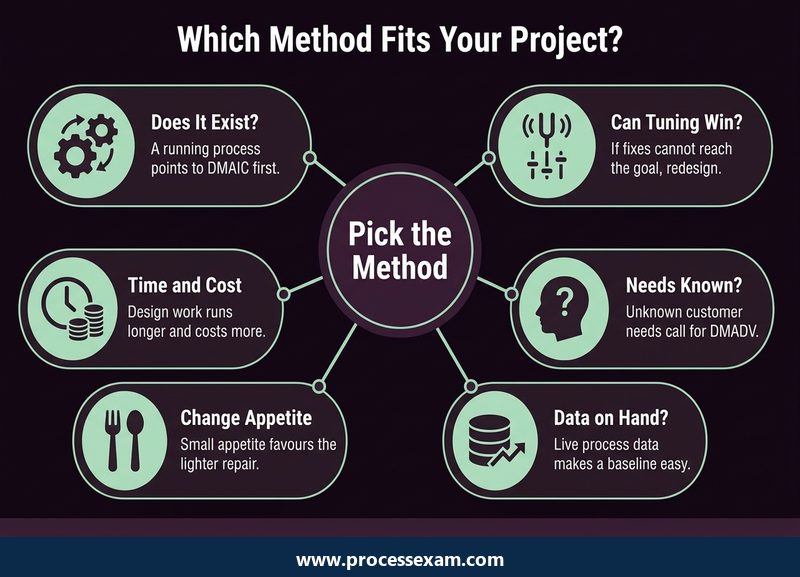
Is there a process to measure today?
If the process runs and you can collect data from it this week, DMAIC is the natural start. If the thing has never been built, there is nothing to baseline and DMADV is the only one of the two that can begin.
Could tuning ever reach the target?
This is the question that separates a hard DMAIC project from a hidden DMADV one. If the best case for fixing the current design still falls short of the goal, for example because the process has too many steps or an unsuitable technology, the honest answer is a redesign. ASQ's Green Belt Body of Knowledge expects a candidate to weigh exactly this when selecting a project, deciding whether the Six Sigma DMAIC methodology or another problem-solving process fits.
Do you know what the customer needs?
A DMAIC project can often inherit the needs from the existing process, because the complaints and specifications are already known. A DMADV project must discover them, which is why its Measure phase leans on interviews, surveys and benchmarks. Teams that skip this step design something elegant that nobody asked for.
How much change can the organisation absorb?
A repair changes a few steps and the people who perform them. A redesign can change tools, roles and suppliers, with a matching budget and a longer wait for results. When the appetite for change is small and the problem is a defect rate, begin with DMAIC; when the target is strategic and the current design is the limit, plan for DMADV.
What happens when a project changes lanes
Projects do not always start in the right lane. A DMAIC team that finds in the Analyze phase that the process has no realistic way to reach the goal may stop and reclassify the work as a design project, bringing its measurements along as the baseline for the new design. The reverse is rarer: a DMADV project may spin off a small DMAIC project later, to refine a process once the new design is running and real data finally exist.
What each approach costs
Whichever road map you choose, the main budget items are similar: direct payroll for people dedicated to the work full time, indirect payroll for the time that executives, process owners and team members spend on data collection and meetings, training and consulting fees to teach the skills, and the cost of implementing the improvement itself. DMADV tends to push the last item higher, since prototypes, pilots and tooling belong to the design work, and its longer calendar adds to the payroll items.
Where do the two methods appear in ASQ's Green Belt and Black Belt Bodies of Knowledge?
Both belts are built around DMAIC, with DMADV as a smaller, deliberately shallower topic. The counts below come from ASQ's 2022 Bodies of Knowledge, which ASQ publishes as a Green Belt brochure on its Green Belt certification page, and as the matching Black Belt document on the Black Belt page.
| Where it appears | Green Belt (CSSGB) | Black Belt (CSSBB) |
|---|---|---|
| DMAIC phases as the main structure | Five sections: Define 20, Measure 20, Analyze 18, Improve 16 and Control 15 questions | Five sections: Define 20, Measure 25, Analyze 22, Improve 21 and Control 17 questions |
| Questions in those five sections | 89 of 100 scored | 105 of 150 scored |
| DMADV | A subtopic called road maps for DfSS, inside the 11-question Overview section | Its own section, Design for Six Sigma Framework and Methodologies, with 6 questions |
| Other DfSS content | IDOV, basic FMEA, design FMEA against process FMEA | DMADOV, design for X, robust design and statistical tolerancing |
| Expected depth for DMADV | Understand | Understand |
What a Green Belt must be able to do
The Green Belt topic asks you to distinguish DMADV from IDOV, recognise how they align with DMAIC, describe how they are used for improving an end product or process during design, and understand how verification and validation compare results against stated goals. ASQ rates this at the Understand level, meaning you explain and compare, not calculate. Alongside it sit the basic failure mode and effects analysis, rated at Analyze, and the distinction between design and process FMEA. A second Green Belt topic, project selection in the Define section, expects you to decide when DMAIC is the right problem-solving process at all. The full list of subjects is on the CSSGB syllabus page.
What a Black Belt adds
The Black Belt document goes further on structure, not on depth of recall: it separates a whole section for the DFSS framework, introduces the six-step DMADOV variant and adds design for cost, manufacturability, test and maintainability, plus robust design. It also states that a Black Belt should have a thorough understanding of all aspects of the DMAIC model, which is why the five DMAIC sections carry far more weight than the six DFSS questions. For both belts the practical reading is the same: DMAIC is where marks and everyday project work are, and DMADV is the concept you must be able to place, explain and contrast.
To see how ASQ phrases these distinctions under time pressure, a few sessions with the CSSGB practice exam will show whether your explanation of DMADV holds when the options are close.
| Exam detail | CSSGB | CSSBB |
|---|---|---|
| Certification | ASQ Certified Six Sigma Green Belt (CSSGB) | ASQ Certified Six Sigma Black Belt (CSSBB) |
| Questions | 110 | 165 |
| Duration | Total appointment time - 270 minutes, exam time - 258 minutes | Total appointment time - 270 minutes, exam time - 258 minutes |
| Exam fee (USD) | Members $383, non-members $483, retakes $283 | Members $485, non-members $585, retakes $385 |
| Passing score | 550/750 | 550/750 |
ASQ's exam pages state that the computer-delivered Green Belt paper has 100 scored and 10 unscored questions, and the Black Belt paper has 150 scored and 15 unscored. They also state that the exams are open book, so the skill being tested is knowing where to look and how to apply what you find, not reciting definitions.
What are the warning signs that a team picked the wrong method?
Choosing the lane is the first decision; noticing a wrong choice early is the second. These signals show up before the budget is gone.
The metric stops moving
If a DMAIC project has closed two or three improvement cycles and the defect rate sits at the same level each time, the process design may be what limits it. Stop tuning, ask whether the target is reachable at all, and consider a design project that uses the data already collected.
The design team cannot name a customer
A DMADV charter that talks about features and technology but never about who will use the result is a warning. If the Measure phase produces no requirements with numbers attached, the Design phase has nothing to be judged against, and the Verify phase will have nothing to verify.
Verify is treated as a ceremony
When the pilot is planned after the launch date has been announced, any failure becomes a political problem instead of a finding. The pilot needs time in the plan to fail, be fixed and be run again.
Control is left off the end
Both methods finish with a handover, one called Control and the other folded into Verify. A project that ends at the last build or the last improvement without an owner, a monitoring routine and a response plan is only a one-off event, and the old results return gradually.
DMADV is used as a bigger DMAIC
Teams sometimes choose the design road map because it sounds more serious, then apply it to a defect that a single analysis would have solved. The cost is months of design work around a cause that was visible in the first dataset. Use the shortest road map that can reach the goal.
Taken together, the two methods answer one question: do you need to fix what is there, or build what is not? A team that can answer it before the charter is written has already saved most of the project's rework.
Frequently Asked Questions
What is the difference between DMAIC and DMADV?
DMAIC improves a process that already runs: define, measure, analyze, improve, control. DMADV designs a new process or product, or replaces one that cannot reach its target: define, measure, analyze, design, verify. Both begin the same way and split after the analysis phase.
What does DMADV stand for?
DMADV stands for define, measure, analyze, design and verify. ASQ's Black Belt Body of Knowledge writes the last letter as validate, and it also lists DMADOV, which adds an optimize step before validation. Both versions test a finished design against customer requirements.
Is DMADV the same as DFSS?
Not exactly. Design for Six Sigma is the whole family of methods for designing products and processes to perform well from the start. DMADV is the best-known road map within it, and IDOV is another. ASQ's Green Belt document asks candidates to tell the two apart.
When should you use DMADV instead of DMAIC?
Use DMADV when no process exists yet, or when the evidence shows that the current design cannot reach the target however well it is tuned. If the process runs and measuring it today gives a baseline to improve, DMAIC is usually the shorter, cheaper route.
Does the ASQ Green Belt exam test DMADV?
Yes, at a light level. The Body of Knowledge includes a topic on road maps for DfSS, asking candidates to distinguish DMADV from IDOV and recognise how both align with DMAIC. It sits inside the Overview section, at the Understand level, while DMAIC drives the rest.
- Six Sigma |
- ASQ Six Sigma Green Belt Sample Questions |
- ASQ Six Sigma Green Belt Test Questions |
- CSSGB Question Bank |
- CSSGB Exam Questions Download |
- CSSGB Test Questions |
- Six Sigma Green Belt PDF |
- ASQ Six Sigma Green Belt Book |
- ASQ CSSGB BOK PDF |
- Six Sigma Green Belt Certification Cost |
- Six Sigma Green Belt Certification Requirements |
- CSSGB Body of Knowledge (BOK) |
- CSSGB Handbook


