
Six Sigma and Innovation: How Companies Manage the Tension
For years the argument ran one way: Six Sigma shrinks variation, innovation needs variation, so one must smother the other. Most of the current discussion has moved on to a more useful question: which work in a company deserves tight control, which deserves room to wander, and how do you keep one scoreboard from judging both? The answer is a division of labour with rules for handing ideas across, and it is something a Black Belt can set up in practice.

Why did Six Sigma and innovation start out as rivals?
The quarrel comes from what each side treats as the enemy. Six Sigma treats variation as the enemy: if every invoice, part or call behaves the same way, defects fall and the process becomes predictable. Innovation treats sameness as the enemy: a company that only repeats what it already does has nothing new to sell. Put those two instincts in one meeting and each hears the other as a threat.
The words are also part of the problem. Six Sigma has a firm definition: a data-driven method for finding the causes of defects and removing them. Innovation has none. It can mean a new product, a new business model, a new way of delivering an old service, or a small tweak that saves a minute. When one side has a rulebook and the other has a mood, the rulebook usually wins the budget meeting, and the people who came to invent something go home feeling audited.
What has shifted in the debate
Three things have changed how people talk about it.
- The question is no longer "either or". Research on organizational ambidexterity, describes the ability to be efficient in today's business and adaptable to tomorrow's. The aim is to do both, not to pick a winner.
- Six Sigma has widened its scope. It began in manufacturing, but the same measuring habit is now applied to services such as claims handling and healthcare, so more of a company's routine work can be stabilised and freed for other things.
- Experiments are a shared language. Designed experiments sit in the Six Sigma toolkit (IASSC's Black Belt body of knowledge lists them), and controlled tests are a normal way for product teams to learn, so the two cultures have a method in common.
None of this makes the tension disappear. It changes the job from settling an argument to managing a tension, and the rest of this article is about how organisations do that.
What do exploiting and exploring ask of a team?
The ambidexterity literature gives the two sides plain names. According to the Wikipedia summary, exploration covers search, variation, risk taking, experimentation, flexibility and discovery, while exploitation covers refinement, choice, production, efficiency, selection and execution. DMAIC sits firmly on the exploitation side. Its first move is to find a process that already exists and make it behave.
The same summary notes the cost of leaning one way. Companies that explore only risk wasting resources on ideas that never turn into anything, and companies that exploit only may settle for the performance they already have. A company that runs Six Sigma everywhere drifts to the second trap, and one that runs no discipline at all drifts to the first.
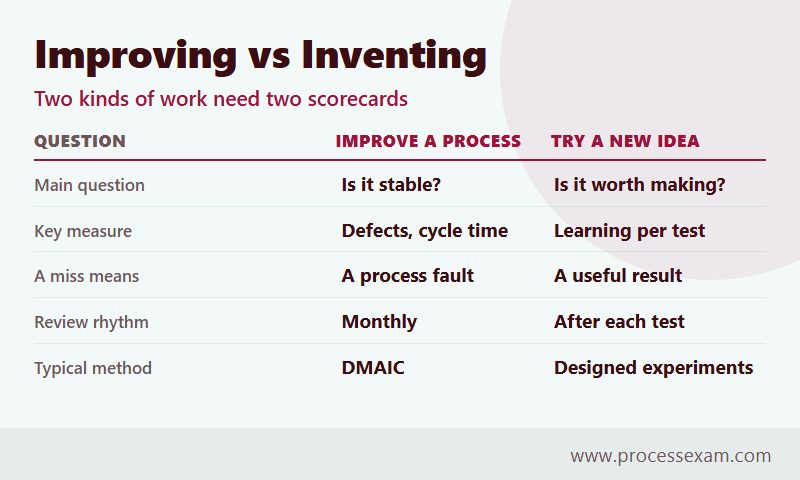
Two ways of arranging it
The same source separates two designs, and the difference matters when you decide where Six Sigma goes.
- Structural ambidexterity gives each side its own unit. One part of the company focuses on exploiting and another on exploring, with different structures and strategies. Teams can follow their own rules, but the units may not fit well together, and some researchers argue that mismatched structures can hurt performance.
- Contextual ambidexterity keeps both inside the same unit and relies on behaviour and culture so that people switch between improving and exploring. It avoids the handoff problem, but it puts the burden on individuals and managers to know which mode they are in.
A third idea from the same page is alternation: a company that focuses on one mode for a period and then the other. Whatever design a company picks, the practical rule for a Six Sigma programme is the same. Know which mode a piece of work is in before choosing a tool for it.
Where does cutting variation make new ideas cheaper to try?
The strongest argument that Six Sigma helps innovation is not about creativity at all. It is about capacity and clarity. Three mechanisms do the work.
Stable processes free up people
A team that spends its week fixing escaped defects and repeating manual steps has no time left to try anything. Take an illustrative product team of 12 people where 30% of engineering time goes on rework and manual release steps. A DMAIC project on the release process brings that down to 12%. The 18-point difference is worth 12 x 0.18, or just over two people's time, and it can be pointed at experiments. The projects did not invent anything, but they paid for the people who will.
Short cycles mean more tests
Learning is limited by how often you can run a test. If a change only reaches users through a release that takes 10 working days, a team gets about six tests in a 65-day quarter. Cut the release to two days and the same quarter allows 32. Those figures are illustrative, but the arithmetic is general: shortening the cycle time of a process multiplies the number of experiments attached to it, which is a Lean and Six Sigma speciality.
Good measurement makes small effects visible
An experiment is only as good as the instrument reading it. If your measurement system adds noise of a point or more, a real improvement of half a point disappears into it. Six Sigma's measurement system analysis, covering precision, accuracy, bias, stability and repeatability and reproducibility, exists to check this before the experiment, not after it. Innovation teams often skip the check and then argue about whether a result was real.
Together these explain why the order matters. A process that is stable and measurable is a cheap platform for experiments. A process that is chaotic gives every experiment a second, hidden variable.
When does a defect scoreboard kill an idea too early?
The harm is real too, and it has specific causes. They are worth spelling out because "Six Sigma kills creativity" is too vague to act on.
- Measuring a thing that does not yet exist as a process. A sigma level or a capability index describes how a stable process behaves against a specification. A prototype has neither a stable process nor a specification, so the number has nothing to describe.
- Treating tiny samples as verdicts. Suppose a prototype is tried with five users and one hits a fault. The dashboard says 20% defective. A standard exact 95% confidence interval for 1 failure in 5 runs stretches from under 1% to about 70%, so the data cannot tell a nearly perfect idea from a badly flawed one. The right response is to test more, not to kill it.
- Demanding hard-dollar savings from an idea whose value is new revenue. DMAIC business cases count cost taken out of a process. A new service has no cost base to take out, so it loses any contest scored that way.
- Asking for a control plan before there is a design. Control is the last phase of DMAIC for a reason. Requiring it on day one forces people to freeze choices they have not yet had the chance to compare.
- Rewarding the team on defect targets alone. People with a quarterly defect target will not use that quarter on something that could make the number worse before it improves it.
The same tools can help or hurt, depending on timing
Lists of Six Sigma tools rarely say when to use each one, and timing is the useful part. This table is a guide.
| Tool | Helps a new idea when | Hurts a new idea when |
|---|---|---|
| Voice of the customer | Used to find unmet needs before any design | Used to ask customers to rank features of something they cannot yet picture |
| TRIZ | A team is stuck on a contradiction, such as stronger but lighter | Applied as a form to fill in, in place of a conversation |
| Pugh matrix | Several concepts can be compared against a reference | Scored so early that the weights decide the winner |
| Failure mode and effects analysis | A near-final design is tested for how it could fail | Run on a rough concept, where it records guesses as risks |
| Measurement system analysis | Before any experiment whose result must be trusted | Never harmful, but skipped surprisingly often |
| Designed experiments | Several factors could matter and trials are limited | Only one factor is in doubt and a simple test will do |
| Capability analysis | A process is stable and has a specification | Applied to a prototype with no stable process |
| Control charts | A pilot has become a routine process | Used to flag normal early swings as problems |
The pattern is that tools aimed at understanding and comparing options suit the early stage, while tools aimed at holding a gain suit the late stage. Most of the damage comes from late-stage tools used early.
How do organisations run improvement and new-idea work side by side?
The working answer is to keep two portfolios, each with its own rules, and to define in advance how an idea moves between them. The table sets out the rules that differ.
| Rule | Improvement portfolio | New-idea portfolio |
|---|---|---|
| How it is funded | Per project, against a savings case | A fixed ring-fenced budget, released in small steps |
| What the panel asks | How much variation or waste will go, by when? | What did the last test teach us, and what is the next one? |
| When it stops | The target is hit and control is handed over | A cheap test says the core assumption is false |
| Who sits on the panel | Process owners, finance, a Black Belt | Product leaders, customer-facing staff, a Black Belt as adviser |
| Review rhythm | Monthly, at tollgates | After each test, with a quarterly look at the whole set |
| Failure is | A missed target needing explanation | An expected outcome for most ideas, provided it is cheap and learned from |
The ring-fenced budget needs protection more than anything else. A workable illustrative rule is to set aside a fixed share of time, such as one day in ten, that no project owner can claim. Without that rule, improvement targets expand to fill every available hour, which is the point the ambidexterity researchers make about the success trap: a company focused on its historically successful business stops exploring.
How an idea graduates into a process
The handoff is where the two portfolios meet, and it is the point at which Six Sigma becomes the right tool. The roadmap below shows one way to run it.
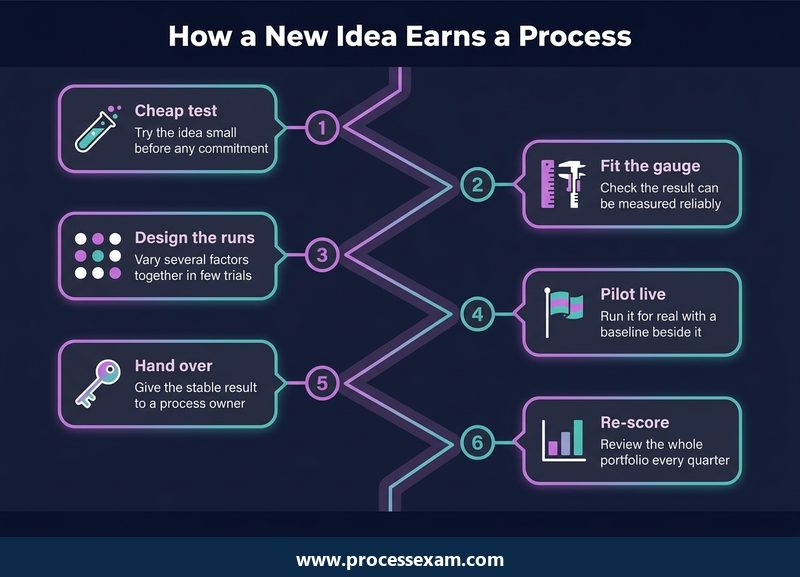
Three tests decide whether an idea is ready to move from the new-idea side to the improvement side.
- A measurable output. Someone can say what good looks like in a number that two people would read the same way.
- A repeatable method. The work happens more than once in roughly the same way, so there is a process to improve.
- An owner. A named person is accountable for the process, which is what DMAIC's Control phase hands over to.
An idea that fails all three belongs on the exploring side, however keen the sponsor is to put it through a project. An idea that passes all three belongs on the improving side, however attached its creators are to the freedom of the lab.
For the formal design branch used when the process does not exist yet, Design for Six Sigma (DMADV) is the established route. It is outside the scope of this article.
How does design of experiments let a team explore without guessing?
Designed experiments are where Six Sigma and innovation overlap most, because the method is built for exploring. According to the Wikipedia article on design of experiments, the approach goes back to Ronald Fisher's work in the 1920s and 1930s, built on comparison and randomisation. It also recommends multifactorial experiments over the one-factor-at-a-time method, because they evaluate the effects and possible interactions of several factors together.
A worked example, with illustrative numbers
Imagine a team improving an onboarding email. Three factors are in play, each with two options: the subject line (plain or a question), the send time (morning or evening) and the button text (Start or See plan). Testing every combination gives 2 x 2 x 2 = 8 runs. The click rates below are invented to show how the method reads them.
| Run | Subject | Send time | Button | Click rate |
|---|---|---|---|---|
| 1 | Plain | Morning | Start | 4.0% |
| 2 | Question | Morning | Start | 5.0% |
| 3 | Plain | Evening | Start | 4.2% |
| 4 | Question | Evening | Start | 7.4% |
| 5 | Plain | Morning | See plan | 4.6% |
| 6 | Question | Morning | See plan | 5.6% |
| 7 | Plain | Evening | See plan | 4.8% |
| 8 | Question | Evening | See plan | 8.0% |
To find the effect of the subject line, compare the average of the four question runs (26.0 / 4 = 6.5%) with the four plain runs (17.6 / 4 = 4.4%): a gain of 2.1 points. The same arithmetic gives 1.3 points for evening against morning and 0.6 points for the button. So the subject line matters most, and the button least.
The more interesting finding is an interaction. In the morning, the question subject adds 1.0 point (5.3% against 4.3%). In the evening it adds 3.2 points (7.7% against 4.5%). A team that changed one factor at a time, starting from the morning baseline, would have measured that 1.0 point and might have dropped the idea. The designed experiment found the combination that works, in 8 runs rather than a long series of separate tests.
Why fractions matter when factors multiply
Full designs grow fast. Each extra two-level factor doubles the number of runs. A fractional design runs a carefully chosen part of the full set and accepts that some effects can no longer be told apart.
| Factors | Full design runs | Half-fraction runs |
|---|---|---|
| 3 | 8 | 4 |
| 4 | 16 | 8 |
| 5 | 32 | 16 |
| 6 | 64 | 32 |
| 7 | 128 | 64 |
The trade-off is called confounding, and the resolution of a design describes how serious it is. That is why a fractional design suits early screening, when the question is which two or three of seven factors matter, and a full design suits the later stage, when you need to understand their interactions properly. It is a good example of an exploring method that is also disciplined.
What does a Black Belt do differently on an innovation team?
A Black Belt does not arrive to put the idea through a DMAIC gate. The more useful role is that of a translator between two vocabularies. Five behaviours show up repeatedly in organisations that make this work.
- Ask what stage the idea is at before offering a tool. The tool-timing table above is the working checklist. A concept gets a comparison method, a pilot gets a measurement check, and a running process gets control.
- Insist on the gauge first. Before the team argues about results, confirm that the measure is repeatable and reproducible. This is the single contribution that costs least and prevents most arguments.
- Design the experiment, not only the analysis. Help choose factors, levels, run order and sample size before data is collected, since rescuing a badly designed test afterwards is rarely possible.
- Protect the exploring budget. When an improvement sponsor asks to borrow the ring-fenced time, the Black Belt is well placed to say what it would cost in learning.
- Run the handoff. When an idea has passed the three readiness tests, scope the DMAIC project that turns it into a stable process, and name the owner.
The same person must also resist the opposite temptation, which is to bless every idea because the data looks clean. A designed experiment can show that a change has a real effect without showing that anyone wants it. Customer demand has to be tested separately, and a Black Belt who knows the limits of the method says so.
Which parts of this appear in IASSC's Black Belt exam?
This article is about the tension between two ways of working, not a study guide, but the statistical half of it is examinable. IASSC's Black Belt body of knowledge lists measurement system analysis in its Measure phase, including how bias, linearity and stability are judged and how a gage study separates repeatability from reproducibility, and in its Improve phase it lists designed experiments, full factorial experiments including two-level (2^k) designs, and fractional factorial experiments including confounding effects and experimental resolution. Those are the topics behind the worked example above.
The facts below come from the IASSC Black Belt page, which also states that there are no prerequisites to sit the exam.
| Item | IASSC Certified Lean Six Sigma Black Belt (ICBB) |
|---|---|
| Vendor | IASSC |
| Exam code | ICBB |
| Questions | 150 |
| Duration | 240 minutes |
| Passing score | 70% |
| Exam fee | $450 USD |
Readers who want to see how a measurement-system or factorial-design question is asked can attempt the ICBB practice exam, then check the full topic list on the ICBB syllabus page.
Frequently Asked Questions
Does Six Sigma stifle innovation?
It can, when a defect scoreboard is applied to ideas that have no stable process yet, because tiny samples and savings targets reject them early. Used on routine work, it frees time and cleaner measurement for experiments. Most companies avoid the harm by keeping separate scorecards for improving a process and trying a new idea.
What is the difference between exploiting and exploring in a business?
Exploitation means refining and running what the company already does well: efficiency, selection, production and execution. Exploration means search, experimentation, risk taking and discovery. Organisational ambidexterity is the ability to do both, either through separate units or through behaviour inside the same unit, without letting one crowd out the other.
How does design of experiments help innovation?
It lets a team change several factors together in a planned set of trials instead of testing one at a time. That shows which factors matter and whether they interact, using few runs. A fractional design cuts the runs further, which suits early screening when many factors could matter and trials are limited.
Should a new idea be judged by its sigma level?
Not at the start. A sigma level or capability index describes a stable process against a specification, and a prototype has neither. Early on, judge an idea by what each cheap test taught and whether the measurement can be trusted. Capability measures become useful once the idea runs as a repeatable process.
Are designed experiments on the IASSC Black Belt exam?
Yes. IASSC's Black Belt body of knowledge lists designed experiments in the Improve phase, including full factorial experiments with two-level designs, fractional factorial experiments, confounding and experimental resolution. Measurement system analysis, which checks that a measure can be trusted, sits in the Measure phase of the same body of knowledge.
- Lean Six Sigma |
- IASSC Lean Six Sigma Black Belt Sample Questions |
- ICBB Exam Questions Download |
- ICBB Test Questions |
- Lean Six Sigma Black Belt PDF |
- Lean Six Sigma Black Belt Certification Requirements |
- IASSC Lean Six Sigma Black Belt Book |
- IASSC ICBB BOK PDF |
- Lean Six Sigma Black Belt Certification Cost |
- IASSC Lean Six Sigma Black Belt Test Questions |
- ICBB Question Bank |
- ICBB Body of Knowledge (BOK)


