
ServiceNow Event Management Implementer: Skills, Career and Certification
Event Management implementers turn a flood of monitoring noise into a short list of alerts that operators trust, and ServiceNow certifies that skill with its Certified Implementation Specialist - Event Management exam. You can reach it from administration, monitoring or network work, provided you can configure rules, connectors and CMDB binding rather than only describe them.

What does a ServiceNow Event Management implementer actually build?
A monitoring estate produces events all day: a disk crosses a threshold, a switch port drops, a service stops answering a health check. Left alone, every one of those messages lands on somebody's screen, and the people who watch those screens stop believing them. An Event Management implementer is the person who decides which messages matter, how repeats are folded into one record, which service each one belongs to and what should happen next. The work is configuration and judgement in roughly equal parts.
ServiceNow describes the purpose of its implementation exam in just those terms: confirming that you can configure, implement and maintain the Event Management application, which means managing event processing, configuring alerts, integrating event sources and using features such as the operator workspace and dependency maps. The aim, in ServiceNow's words, is for certified people to help organisations tackle problems before users notice them. Those sentences come from the vendor's blueprint, which you can read on ServiceNow's own exam blueprint page (last updated January 2026 and checked in November 2026).
In a live project the job breaks into five recurring pieces of work.
- Connecting sources. You decide how monitoring tools send data to the instance, by push or by pull, and you stand up the connector or collector that does it.
- Shaping events. You write event rules, filters and thresholds so that noise is dropped, fields are mapped and each event carries the right identifiers.
- Binding to the CMDB. You tie each event to the configuration item it describes, so an alert about a host can be read as an alert about the business service that host supports.
- Turning events into alerts and tasks. You set up alert management rules, grouping and priority so that operators see a handful of alerts and incidents instead of thousands of lines.
- Keeping it healthy. You validate the MID Server that carries the traffic, tune thresholds as services change and prove that the pipeline still works after an upgrade.
None of this is glamorous, but it is where an organisation's monitoring spend either pays off or becomes shelfware. That is why partners and internal ITOM teams hire for it, and why a credential that tests the configuration, not just the vocabulary, carries some weight with them.
How does one raw event become an alert an operator can act on?
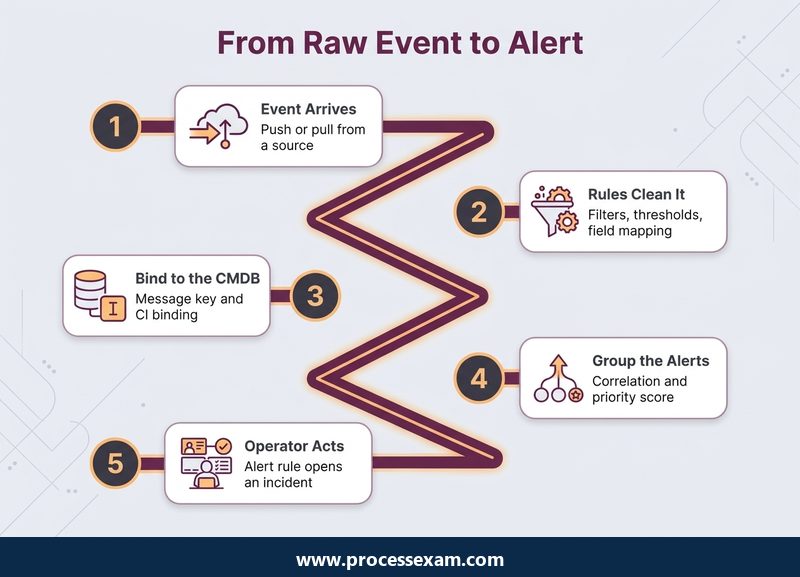
The clearest way to understand the role is to follow a single event from the monitoring tool to the operator's screen. ServiceNow's blueprint names every stage of this journey, and the exam tests each of them, so the walk-through doubles as a revision map.
| Stage | What happens | What you configure |
|---|---|---|
| 1. Arrival | A monitoring tool sends an event, or the instance collects it, and a record lands in the event table. | Connector, push or pull method, inbound action |
| 2. Processing | Event processing jobs read the new record, apply event rules and filters and map source fields onto the platform's own fields. | Event rules, event filter, field mapping, thresholds |
| 3. Identification | The message key ties repeated reports of the same condition together, and the event is bound to a configuration item. | Message key, CI binding |
| 4. Alert | The event creates or updates an alert, which holds the current state of the condition instead of every message about it. | Alert attributes, scheduled jobs |
| 5. Grouping and priority | Correlation rules and aggregation pull related alerts into one view, and a priority score ranks it against the rest. | Correlation rules, priority groups, impact profile |
| 6. Action | Alert management rules create a task such as an incident, and the operator works it from the workspace. | Alert management rules, operator workspace |
Two details from that table deserve a second look because they are where practical projects differ most from textbook ones. The first is the message key. Without a reliable key, a flapping disk alarm creates a new alert on every cycle, and the operators are back to scrolling. With one, the same condition updates a single alert and a count of how often it fired. The second is CI binding. An alert that does not point at a configuration item cannot be tied to a service, cannot inherit the impact of that service and cannot be assigned sensibly. Much of the "Event Configuration and Use" domain, which carries more than a quarter of the marks, is about getting these two things right.
ServiceNow's published sample items show the same level of detail. One asks what happens when more than one event rule applies to the same event, and the answer is that every applicable rule runs, from the lowest to the highest order-of-execution number. Another asks which module creates tasks automatically, and the answer is alert management rules, not event rules. You cannot answer either from a glossary. You need to have seen the rules page, its order field and its actions.
Where do events come from, and how do connectors, push and pull differ?
Sixteen percent of the blueprint is devoted to event sources, and the topic is the one most likely to separate people who have done an integration from people who have only read about it. ServiceNow lists identifying event sources, push versus pull methods, using inbound actions, configuring a monitoring connector and using Agent Client Collector monitoring.
Push means the monitoring tool sends events to the instance when something happens. Pull means the instance, usually through a MID Server, asks the tool for new events on a schedule. Push is quick and cheap when the monitoring tool can post to a web endpoint or send mail the instance reads through an inbound action. Pull is the usual answer when the tool exposes an interface but does not send anything unprompted. A third route is to collect directly on the monitored host with the Agent Client Collector, which is why the blueprint lists it as a separate topic.
The MID Server is the quiet hero of this domain. It is a lightweight application installed on a machine inside the customer's network that moves data between the instance and the tools behind the firewall. The blueprint's sample items test it directly: one asks which systems a MID Server can be installed on, and the answers are Microsoft Windows Server and a Linux system, not a desktop, a Mac or OpenVMS. A separate domain, Architecture and Discovery at ten percent, covers validating a MID Server and how the monitoring process fits the CMDB.
Connectors also have defaults you are expected to know. ServiceNow's fifth sample item asks for the default collection or polling interval applied to all event connectors, and the answer given is every 120 seconds. That kind of figure is easy to pass over when you read documentation and expensive to forget when you tune a real instance, because a shorter interval multiplies the load and a longer one delays every alert.
Which skills outside the platform does this work rely on?
ServiceNow is unusually specific about the background it recommends. Candidates should have intermediate or better Windows and Unix administration, intermediate or better knowledge of SNMP, the protocol many network devices use to report their state, intermediate or better JavaScript and regular-expression skills, and at least an introduction to network administration. The blueprint's scripting topic names regular expressions, JavaScript and PowerShell. In practice these skills do three jobs: regular expressions pull a host name or a severity out of a free-text message, JavaScript transforms and routes the result, and PowerShell is what you reach for when a Windows-based source has to be queried.
This explains who tends to do well. A network or monitoring engineer who has watched alert storms firsthand already holds the half of the skill set that is hardest to teach. A platform administrator holds the other half, the habit of working in forms, lists and scoped rules. Either can learn the missing half in a few months of deliberate work, which is the most hopeful thing the role has to offer a career changer.
How does the blueprint weight the work, and where should study time go?
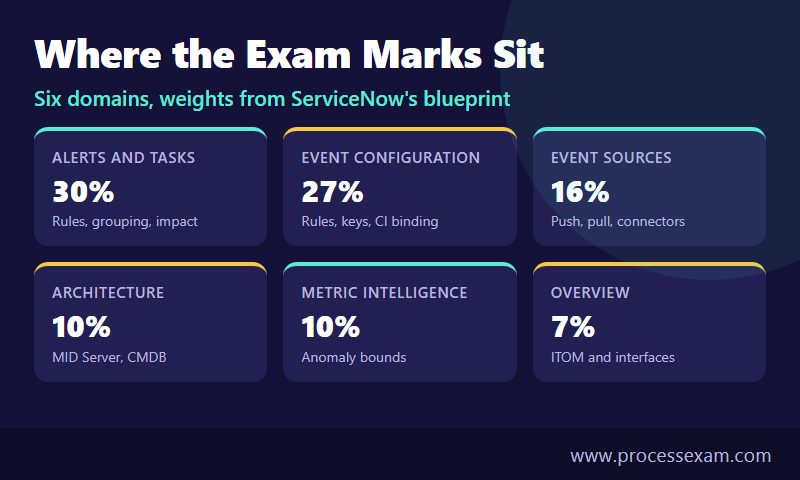
The exam has six domains. The weights below come straight from ServiceNow's blueprint. The question counts in the last column are only my own arithmetic on a 30-question paper, because ServiceNow does not publish a count per domain, so treat them as a guide to emphasis and never as a promise.
| Domain | Weight | About how many of 30 questions |
|---|---|---|
| Alerts and Tasks | 30% | 9 |
| Event Configuration and Use | 27% | 8 |
| Event Sources | 16% | 5 |
| Architecture and Discovery | 10% | 3 |
| Metric Intelligence | 10% | 3 |
| Event Management Overview | 7% | 2 |
Two domains together hold 57 percent of the paper, and both are about the middle of the pipeline: how events are processed and how alerts are managed. A study plan that spends equal time on every domain is therefore wasteful. The sensible split is to give Alerts and Tasks and Event Configuration and Use more than half your hands-on hours, then spread what remains across event sources, architecture and metrics.
What sits inside the two biggest domains?
Alerts and Tasks covers the alert record and its attributes, the scheduled jobs that maintain it, the alert process flow (alert management rules, CI binding, priority scores, priority groups, incidents), alert grouping through correlation rules and aggregation, alert intelligence in the Service Operations Workspace and the alert impact profile with its impact tree, impact rules and service-level effects. Read as a job description, that is the work of keeping the operator's list short and ranked by business consequence.
Event Configuration and Use covers event setup, meaning event processing, event rules, the event filter, thresholds and the operator workspace; the process flow around the event table, message key, processing jobs, field mapping and CI binding; connectors, both preconfigured and customised; and scripting in regular expressions, JavaScript and PowerShell. It is the busiest of the six lists, and the blueprint notes that its sub-skills are not a complete inventory of what can be asked.
Why does a ten percent domain like metric intelligence still matter?
Events are only one signal. Metric Intelligence is about numerical data from monitoring tools: reviewing what the capability does, connecting a metric source, understanding the metric data pipeline, identifying anomaly bounds and thresholds and using the results in Service Operations. Ten percent is about three questions, but they are three questions most event-focused candidates have not practised, and a missed domain costs the same as a missed question anywhere else. Spend one deliberate study session on it rather than hoping it is not asked.
The smallest domain, the overview at seven percent, is also the easiest to bank. It covers the ITOM solution, the customer challenges Event Management answers, its key features, the graphical interfaces (operator workspace, alert intelligence and dependency maps) and the Common Service Data Model. One of ServiceNow's sample items asks which customer challenges Event Management helps resolve, and the correct choices are about the current state of infrastructure, automating and prioritising remediation and consolidating monitoring tools, not about asset ownership.
If you want to see how each domain breaks down topic by topic, ProcessExam keeps a domain-by-domain syllabus for this exam, laid out against the same blueprint headings.
What experience does ServiceNow expect, and what do the exam and booking involve?
ServiceNow's blueprint recommends six months of field experience on ServiceNow deployment projects or in maintaining instances, and participation in at least two ITOM deployments specifically for Event Management. That is a recommendation, not an entry gate, but it tells you what the questions assume. They are written for someone who has opened an event rule and wondered why it did not fire, not for someone who has watched a demonstration.
| Item | Detail |
|---|---|
| Full name | ServiceNow Certified Implementation Specialist - Event Management (CIS-EM) |
| Exam fee | 450 USD (as of November 2026) |
| Questions | 30 |
| Duration | 60 minutes |
| Result | Pass or fail |
| Question types | Multiple choice (single answer) and multiple select, with no partial credit |
| Delivery | Pearson test centre, or online with OnVUE and a proctor watching by webcam |
The practical rules are worth knowing before you pay. Paying is what registers you, and that payment starts a 90-day clock: book a slot and take the test inside it, because an unused registration lapses and a new one costs the full fee. Exam fees are non-refundable, so ServiceNow's advice is to register only when you are ready to schedule. The same blueprint page notes that an instructor-led course comes with a voucher for one attempt, and that you can pay with learning credits or a card.
Multiple-select questions tell you how many answers to choose and give no partial credit, so a question that asks for three correct options needs all three. Single-answer questions have at least three possible responses. Because each question is worth one point and the exam is short, one unanswered item is a large proportion of the paper. Answer everything and flag the ones you want to revisit.
How is the result reported?
The screen shows a provisional pass or fail as soon as you end the session, and a report then shows the share of items you answered correctly in each section. ServiceNow keeps its cut score private and states that it is not always 70 percent, so there is no percentage to aim for. It also warns that the section percentages should not be averaged and do not decide the outcome. The result is conditional because the exam can be audited, and a certification can be revoked if ServiceNow's test security policies are found to have been breached.
If you pass, you receive the certification and a Credly digital badge. Keeping it current means sitting a short delta exam each year as releases change, alongside an annual fee under ServiceNow's Certification Maintenance Program. If you do not pass, ServiceNow asks you to review the blueprint and the recommended training, and it requires a waiting period and a fresh fee for each retake. The Credentialing Program Guide holds the full retake details.
How would you prepare for the exam if you have never configured a connector?
Begin with the three sources ServiceNow names as the basis of its questions: its own training courses, its product documentation and its developer portal. The blueprint says plainly that study material posted elsewhere is not official and should not be used. Its recommended path runs from the platform basics (Welcome to ServiceNow, then Administration Fundamentals and Get Started with Now Create) through Platform Implementation and CMDB Fundamentals to the ITOM Overview, ending with Event Management Fundamentals On Demand. ITIL Foundations certification appears under additional resources, and so does the Credentialing Program Guide.
The list matters because it shows the dependency chain. Event Management without a decent CMDB produces alerts nobody can place, and the CMDB Fundamentals and ITOM Overview courses come before the event-specific one for that reason. If your CMDB knowledge is thin, close that gap first; every domain after the overview leans on it.
What does a four-week plan look like for a working professional?
The plan below suits someone with a day job and a few evenings a week. Adjust the pace if you already run connectors, but keep the order, because each week prepares the next.
- Week one: ground the platform. Finish the fundamentals, CMDB and ITOM courses. Write down in your own words what a configuration item, a service and a MID Server each are, and sketch the pipeline from the table above from memory.
- Week two: events and sources. Complete the Event Management course. In a sandbox, send a test event by push, write one event rule that changes a field, add a filter that drops a noisy message and bind an event to a configuration item. Notice what the order-of-execution number changes.
- Week three: alerts and tasks. Build an alert management rule that opens an incident, set up a correlation rule that groups two related alerts and inspect the impact tree for a service. This is the heaviest domain, so give it the longest sessions.
- Week four: gaps and rehearsal. Cover metric intelligence and the architecture topics, then work through scenario questions under the clock. For each wrong answer, find the page of documentation that settles it and write the rule in a sentence.
When the six domains feel familiar, the CIS-EM practice exam gives you scenario questions weighted like the real paper, so you can find the topics that still trip you before the sitting costs real money.
Hands-on time is the single best predictor of comfort here. Check which Event Management and ITOM capabilities your own instance or training environment actually includes before you plan labs around them, because availability depends on how the instance has been licensed and set up, and nothing in the blueprint promises a particular setup. If you cannot get a sandbox with the features, read the product documentation chapter by chapter and trace the screens in the training videos instead, but accept that questions about order of execution and defaults will feel less certain.
Which roles hire for this skill set, and where does the credential lead?
Event Management implementers work in a few recognisable places. Inside a company, they sit in the ITOM or operations team that owns monitoring and the CMDB, often alongside a ServiceNow administrator. At ServiceNow partners and consultancies, they join implementation projects that connect a client's monitoring estate to the platform. In managed-service and network operations centres, they own the pipeline that decides what an engineer's night shift looks like. Job titles vary a great deal (ITOM consultant, ServiceNow developer, monitoring integration engineer, platform specialist), so search by the skills in the blueprint rather than by title.
This article gives no salary figure because nothing in ServiceNow's blueprint supports one, and a number from a survey of a different region or seniority would mislead you. What the credential does provide is evidence. It tells a hiring manager that you have met ServiceNow's stated experience expectations well enough to answer implementation questions on rules, connectors, binding and alert handling, and that you are willing to keep the credential current through annual maintenance.
What should come next after this credential?
The blueprint's own preparation list points the way. Event Management depends on the CMDB and on discovery, so deepening those areas makes you more useful on the same projects. ServiceNow's other implementation credentials follow the same pattern as this one, with a short exam built around configuration scenarios, so the study habits carry over, and the Discovery and Service Mapping exams are two natural neighbours for anyone who wants to own the data that alerts are bound to.
A realistic first-year path is to pass the exam, then volunteer for the next monitoring integration at work, then document what you learn. The blueprint says certified people optimise operations by addressing issues proactively. Employers believe that claim when they see a project behind it, so give the credential a project to point to.
What are the limits of the credential?
A short, scenario-based exam cannot measure judgement under pressure, and it says little about how well you work with a monitoring team that distrusts the platform. Treat it as a floor: it confirms you know the machinery. The harder skill, deciding what an operator should never have to see, comes only from living with a real alert queue and editing it for months.
Frequently Asked Questions
What does a ServiceNow Event Management implementer do?
An implementer configures the pipeline that turns raw monitoring events into alerts and tasks. That means connecting event sources, writing event rules and filters, binding events to configuration items, setting alert management and correlation rules and keeping the MID Server and thresholds healthy so operators see a short, ranked list.
How many questions and how much time does the exam give you?
The exam has 30 questions and lasts 60 minutes. Questions are multiple choice with a single answer or multiple select, where the question states how many responses to choose and no partial credit is given. You sit it at a Pearson test centre or online with OnVUE, and the fee is 450 USD as of November 2026.
What is the passing score for the Event Management implementation exam?
ServiceNow reports a pass or fail and does not publish the cut score, adding that it is not always 70 percent. Each question is worth one point. The result you see on submission is conditional, because the exam can be audited, and section percentages are for guidance only and should not be averaged.
What experience does ServiceNow recommend before you attempt it?
ServiceNow recommends six months of field experience on deployment projects or maintaining instances, participation in at least two ITOM deployments for Event Management, intermediate Windows and Unix administration, intermediate SNMP knowledge, intermediate JavaScript and regular-expression skills and introductory network administration knowledge. These are recommendations, not entry requirements.
Which domains carry the most marks?
Alerts and Tasks carries 30 percent and Event Configuration and Use carries 27 percent, together 57 percent of the paper. Event Sources follows at 16 percent, then Architecture and Discovery and Metric Intelligence at 10 percent each, and the Event Management Overview at 7 percent, according to ServiceNow's blueprint updated in January 2026.
- ServiceNow Event Management Implementation Specialist Test Questions |
- CIS-EM Question Bank |
- ServiceNow Event Management Implementation Specialist Book |
- Event Management Implementation Specialist Certification Cost |
- Event Management Implementation Specialist Certification Requirements |
- ServiceNow Event Management Implementation Specialist Sample Questions |
- CIS-EM Exam Questions Download |
- CIS-EM Test Questions |
- Event Management Implementation Specialist PDF |
- CIS-Event Management Simulator |
- CIS-Event Management Mock Exam |
- ServiceNow CIS-Event Management Question Bank |
- ServiceNow CIS-Event Management Book |
- ServiceNow CIS-Event Management Study Guide |
- CIS-Event Management Certification |
- CIS-Event Management Certification Cost |
- CIS-Event Management Certification Requirements |
- ServiceNow CIS-Event Management Exam Questions |
- ServiceNow CIS-Event Management Sample Questions |
- CIS-Event Management |
- CIS-Event Management PDF |
- Technology


