
Advanced Product Owner Certification: Skills, Exam and Career Payoff
A common belief among Product Owners is that Scrum.org's second-level credential is simply the first exam with harder wording. It is not. The Professional Scrum Product Owner II assessment checks whether you can manage a product for value, defend your decisions to stakeholders and shape the organisation around you, which is what separates a backlog administrator from a product leader.
This article looks at that step from the job outward. It covers what the advanced assessment expects you to do at work, how its 40 questions are built, where experienced people still lose marks, a preparation plan that fits around a full-time role, and what the credential changes in your career once it is on your profile. Every exam figure below comes from Scrum.org's own PSPO II certification page, checked in November 2026.
Why is the second Product Owner credential a different test, not a harder copy of the first?
The first-level assessment asks whether you understand the Scrum framework as the Scrum Guide describes it: the accountabilities, the events, the artifacts and their commitments. A candidate who has read the Guide closely and practised can pass it without ever having owned a product. The second level assumes all of that and moves on. Scrum.org says candidates should already have experience as a Product Owner and a strong understanding of the fundamentals of Scrum, and that the assessment tests how you would handle real-world situations.
That shift changes what a "right answer" looks like. On the first exam, the correct option usually matches a sentence in the Guide. On the advanced exam, two or three options can all sound reasonable, and the best one is the option that delivers the most value, keeps decisions transparent and leaves the Product Owner accountable rather than turning them into a go-between. You are being asked to judge, not to recall.
The emphasis also moves. Scrum.org states that the greatest weight in the advanced assessment sits on Managing Products with Agility, followed by Evolving the Agile Organization. Understanding and applying the Scrum framework is still there, but as the base that the other two areas stand on. In plain terms, the exam spends most of its questions on product vision, value, forecasting, stakeholders and business strategy, and a meaningful share on how the wider organisation helps or blocks a Product Owner.
If you hold the first credential, think of the second as the difference between knowing the rules of a sport and being trusted to captain the side. The rules have not changed; what you are judged on has.
What does the PSPO II exam actually test?
Scrum.org maps every assessment to its Professional Scrum Competencies. The advanced Product Owner exam draws on three focus areas, and each one breaks down into named competencies. Knowing them by name matters, because your score report after the exam is broken down the same way.
Managing Products with Agility (the heaviest area)
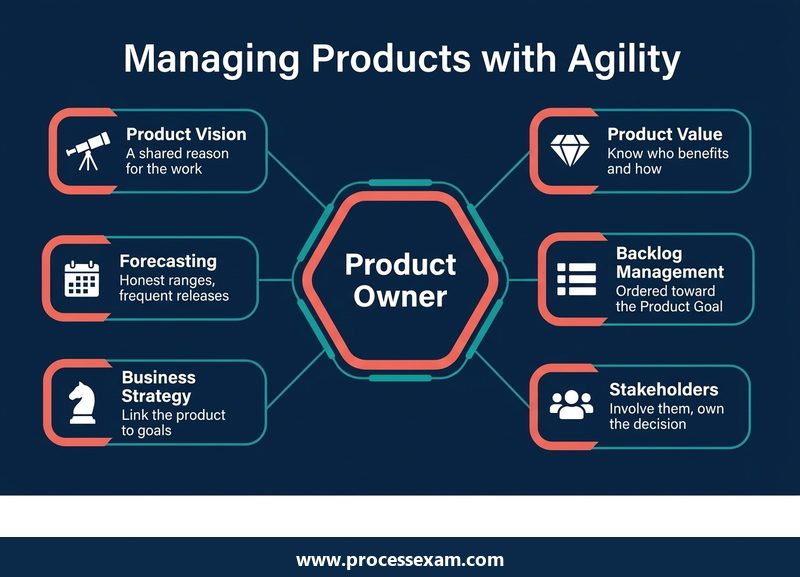
This area holds six competencies, and together they describe the daily and quarterly work of a Product Owner who is responsible for outcomes rather than output:
- Product Vision: describing a future state that gives the Scrum Team and stakeholders a shared reason for the work, and keeping it alive as the product grows.
- Product Value: knowing what value means for this product, who receives it and how you would recognise more of it.
- Product Backlog Management: creating, ordering and refining Product Backlog items so that the backlog stays transparent and points at the Product Goal.
- Stakeholders and Customers: identifying who has a stake in the product, involving them at the right time and handling conflicting demands without passing the decision to someone else.
- Business Strategy: linking the product to the organisation's goals, its market and its business model.
- Forecasting and Release Planning: giving honest, evidence-based forecasts and releasing in a way that lets you learn from real use.
Questions in this area rarely ask for a definition. They describe a product in a particular state and ask what the Product Owner should do next, or which of several measures tells you the most about value.
Evolving the Agile Organization
The second area moves beyond a single Scrum Team. Its competencies are Organizational Design and Culture, Portfolio Planning and Evidence-Based Management. Here the exam wants to know whether you can recognise when the structure around a team is the real obstacle: a funding model that pays for projects rather than products, a portfolio process that decides scope a year in advance, or a reporting line that strips the Product Owner of the authority to order the backlog.
Evidence-Based Management, Scrum.org's framework for measuring value and improvement, deserves particular attention. It groups measures into four Key-Value Areas: Current Value, Unrealized Value, Time-to-Market and Ability to Innovate. It also separates a long-range Strategic Goal from the Intermediate Goals and Immediate Tactical Goals that lead towards it. Expect scenarios in which you must pick the measure that would actually show whether an investment is paying off, rather than one that simply shows the team is busy.
Understanding and Applying the Scrum Framework
The third area covers empiricism, the Scrum Values, the Scrum Team, the events, the artifacts and scaling. At this level it is tested through application. A question will not ask what the Sprint Review is for; it will describe a Sprint Review that has turned into a demonstration with no feedback and ask what the Product Owner should change. Scaling questions tend to test whether several teams working on one product still share one Product Backlog and one Product Owner.
How is the PSPO II assessment structured: questions, time, pass mark and attempts?
The format is short and strict. Scrum.org lists the following details for the assessment:
| Item | Detail |
|---|---|
| Certification | Scrum.org Certified Professional Scrum Product Owner II (PSPO II) |
| Questions | 40 |
| Time limit | 60 minutes |
| Passing score | 85% |
| Question format | Multiple choice and multiple answer, with partial credit on some questions |
| Fee | USD 250 per attempt (as of November 2026; taxes may apply) |
| Language | English |
| Validity | Lifetime, with no annual renewal fee |
Three details in that table shape how you should prepare.
The pass mark is high for a judgement exam. An 85% threshold on 40 questions leaves very little room. Because some questions award partial credit, a single wrong selection on a multiple-answer item does not always cost the whole question, but you cannot rely on that. In practice you need to be confident on almost every scenario.
The clock is generous per question but tight per scenario. Forty questions in an hour gives you about 90 seconds each. That sounds comfortable until you meet a long scenario with four plausible options. Candidates who read every option twice on the early questions often find themselves rushing the last ten.
Each password buys exactly one attempt. Scrum.org's passwords have no expiry date, so you can buy now and sit later, but a password is valid for a single attempt only. A second attempt means a second fee. There is no prerequisite certificate: attending the Professional Scrum Product Owner - Advanced class is highly recommended but not required, and the first-level credential is listed as recommended rather than mandatory. Scrum.org states that its training classes generally include a free attempt at the associated certification, so if you plan to take the advanced class, confirm with the trainer whether an attempt is included before you buy a password separately.
After the exam you receive a pass or fail result and a breakdown of your performance by Professional Scrum Competency. You do not see which individual questions you missed. That rule protects the question pool, and it also means the competency breakdown is the only diagnostic you get, so it pays to know the competency names before you sit. Passing earns a lifetime certification and a free Credly digital credential that you can add to a professional profile.
Where do experienced Product Owners still lose marks?
People who fail the advanced assessment are rarely beginners. More often they are capable professionals whose day-to-day habits do not match the Professional Scrum view of the role. The traps differ depending on where you came from.
From development or engineering
Technical Product Owners tend to answer with the solution in mind. Faced with a scenario about falling customer satisfaction, they reach for an option about refactoring or a new feature. The exam usually prefers the option that first finds out what customers value and how that is measured. A related trap is treating the Product Backlog as a technical work list: the best answer keeps the backlog expressed in terms of outcomes and lets the Developers decide how the work gets done.
From project or programme management
Former project managers lose marks on control. They pick answers that fix scope up front, ask for detailed estimates before ordering, or protect a release date by cutting quality. Scrum treats the Definition of Done as non-negotiable and forecasts as forecasts, so options that trade quality for a date are almost always wrong. Another weak spot is reporting: a project mindset favours status updates and percentage-complete figures, while the exam favours inspecting a working Increment with stakeholders.
From business analysis
Analysts are strong on requirements and weak on letting go of them. Options that have the Product Owner write every item in full detail before refinement, or act as a messenger between stakeholders and Developers, reflect a pattern the exam treats as a misunderstanding of the role. The stronger answer has the Product Owner bring Developers and stakeholders together and stay accountable for the ordering decision.
From line management or sales
People who come from leadership or commercial roles usually do well on vision and stakeholders, then slip on empiricism. They choose to commit to a large release based on conviction rather than evidence, or measure success by features shipped. Evidence-Based Management questions are where this shows: the right measure is usually one that tells you about customer outcomes or the cost of delay, not about activity.
Whatever your background, the hardest area for most candidates is the one with the most questions, Managing Products with Agility. It is also the area that most changes how you work, which is why it is worth studying even if you never sit the exam.
What real-world situations show up, and how do you reason through them?
Scrum.org does not publish its questions, and the examples below are not exam items. They are the kinds of situation the focus areas describe, with the reasoning a strong answer follows. Working through situations like these, aloud or with a colleague, is the closest preparation to the real thing.
The executive who wants a date
A sponsor asks for a firm launch date for a set of features six Sprints away. The weak responses are to promise the date and hope, or to refuse to answer. The stronger response is to give a forecast based on what the team has actually delivered so far, explain the range of likely outcomes, and agree how you will inspect progress each Sprint so the sponsor can see the forecast update as evidence arrives. The principle: forecasts are useful and honest; commitments to fixed scope on a fixed date undermine transparency.
Two stakeholders, one slot
Sales wants a feature for a large prospect; operations wants a fix for a recurring support cost. Both escalate to you. The exam is testing whether you own the decision. A strong Product Owner compares the expected value of each, using whatever evidence exists (revenue at risk, support hours, customer impact), makes the call, explains it openly, and records it in the order of the Product Backlog. Passing the choice up to a manager or splitting the team's capacity in half to avoid upsetting anyone are both signs of a Product Owner who is not yet acting as the owner.
Busy team, flat value
The team's output has risen for three months, yet customer usage and revenue have not moved. The question is which measure to look at next. Velocity and number of items completed only confirm that the team is busy. A better answer looks at Current Value (are customers better off?) and Unrealized Value (is there a bigger opportunity the product is missing?), and then questions whether the backlog is ordered around outcomes at all.
The portfolio that decides your backlog
Your organisation's annual planning process fixes the features for each product a year ahead and funds teams per project. The exam's view is that this limits the Product Owner's ability to maximise value. The strongest answer is not to ignore the process but to work with leadership towards funding stable product teams and to make the cost of the current approach visible, which sits squarely in Organizational Design and Portfolio Planning.
Several teams, one product
The product grows and three Scrum Teams now work on it. Someone proposes a Product Owner and a backlog per team. The Scrum Guide position is one product, one Product Backlog and one Product Owner. The Product Owner can involve others in refinement and delegate work, but remains accountable for the ordering decisions, so options that split ownership of a single product are usually the trap.
Notice the pattern across all five: the best answer keeps the Product Owner accountable, keeps decisions visible, and uses evidence rather than opinion or authority. If you are unsure between two options in the exam, ask which one would make the product more valuable and the decision more transparent.
How can a working Product Owner prepare in five weeks?
Most candidates for this credential already hold a full-time product role, so the plan below assumes four or five study sessions a week of about an hour each, plus your normal work used deliberately as practice. Adjust the pace to your experience, but keep the order: framework first, then value and measurement, then organisational questions, then timed practice.
Week 1: rebuild the base
Read the Scrum Guide twice, slowly, the second time with a pen. Mark every sentence about the Product Owner, the Product Goal and the Product Backlog. Then take Scrum.org's free Product Owner Open assessment several times until you score full marks consistently. It is easier than the real exam, but any gap it exposes in the fundamentals will cost more at the advanced level.
Week 2: product value and vision
Work through Scrum.org's suggested reading for PSPO II, starting with the material on product value, vision and stakeholders. For your own product, write down in one page: the Product Goal, who the customers are, what value means for them, and how you would know it has increased. If you find that hard, the exam will find it hard too.
Week 3: Evidence-Based Management and forecasting
Study the four Key-Value Areas until you can sort any measure into one of them quickly. Take the free Evidence-Based Management Open assessment on Scrum.org. Then pick two measures you could start tracking for your own product in each area, and one measure you currently track that tells you nothing about value. Practise explaining a forecast as a range rather than a date.
Week 4: the organisation around the team
Review the competencies under Evolving the Agile Organization and Business Strategy. For each, write a short note on one obstacle in your own organisation and what a Product Owner could do about it. This is also the week to read the official syllabus page for the exam, so that no competency name is new to you on the day; ProcessExam keeps a focus-area breakdown for the advanced Product Owner exam alongside the topics each area covers.
Week 5: timed practice and review
Now sit full-length, timed practice under exam conditions: 40 questions, one sitting, no notes. Treat every wrong answer as a lesson about the role rather than a fact to memorise, and write a one-line reason why the better option was better. A timed PSPO II practice exam is useful here because it trains the pacing as well as the judgement. Book the real attempt only when you are scoring well above the 85% mark across several fresh attempts, not when you have memorised one set of questions.
Exam-day habits that protect your score
- Read the last line of the question first. It tells you whether you are choosing one answer or several, and what the scenario is really asking.
- Watch for absolute words. Options that say "always", "never" or "must" are right only when the Scrum Guide itself is absolute.
- Prefer the accountable, transparent option. When two answers both seem acceptable, choose the one in which the Product Owner owns the decision and the decision is visible.
- Bookmark and move on. Give any single question no more than about two minutes on the first pass, then come back with whatever time remains.
- Answer from the framework, not from your company. If your organisation does something differently, the exam still expects the Professional Scrum answer.
What changes in your career once you hold the advanced credential?
The honest answer is that a certificate on its own does not promote anyone. What it does is give a hiring manager or a leadership team a quick, independent signal about a skill that is otherwise hard to judge from a CV: whether you can own a product, not just run its backlog.
That signal matters most in four situations:
- Moving from a team-level role to a product-level one. If you are a Product Owner for one team and want to own a whole product or product line, the advanced credential speaks directly to the competencies that role adds: vision, strategy, portfolio and stakeholders.
- Changing industry. A Product Owner moving from, say, banking to healthcare has domain knowledge to build. A credential that proves product-management judgement helps the conversation focus on what transfers.
- Organisations adopting Professional Scrum. Companies that train their teams through Scrum.org often look for the same credentials when they hire, because the vocabulary and the expectations match.
- Coaching and consulting. Agile coaches who support Product Owners benefit from having passed the assessment their clients may be preparing for, and it adds weight when you advise on product ownership rather than only on team practices.
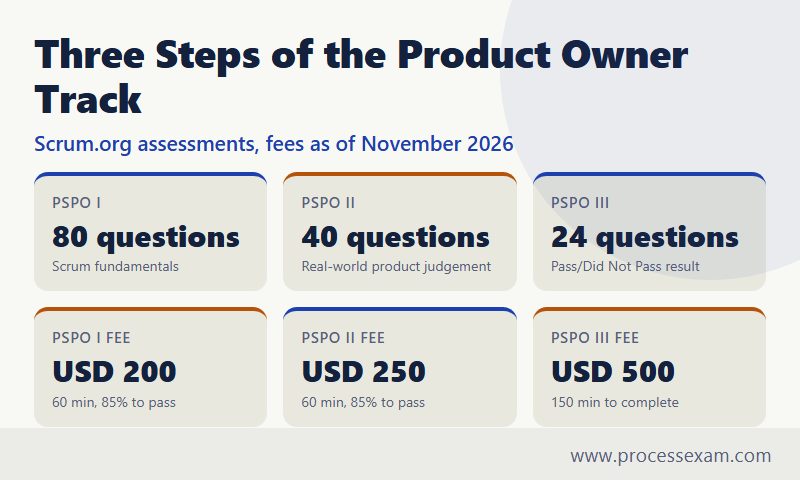
The credential also sits on a clear path. Scrum.org's Product Owner track runs from the first-level assessment (80 questions in an hour, 85% to pass, USD 200) through this one (40 questions in an hour, 85% to pass, USD 250) to the third level, PSPO III, which has two dozen questions, a pass or did-not-pass result and a fee of USD 500, and gives candidates two and a half hours. Each step asks for more judgement and less recall. Because all three are lifetime credentials, the investment does not need renewing as your career moves on.
When you talk about the credential in an interview, skip the exam and describe the competencies with examples from your own product: a forecast you made as a range and how it played out, a stakeholder conflict you resolved by ordering the backlog openly, a measure you dropped because it showed activity rather than value. The credential opens the conversation; the examples are what win it.
Is it worth taking now, or should you wait?
The advanced assessment is worth taking now if you have spent at least a year or so in a Product Owner role with real decision-making authority, you can explain your product's value without notes, and you have hit at least some of the situations described above. In that case the preparation mostly organises what you already know, and the credential documents it.
It is worth waiting if you have not yet owned a product's backlog decisions, if your role is a Product Owner in name only (someone else decides the order of the work), or if you have not passed the first-level exam comfortably. The advanced questions assume you have made trade-offs and lived with them. Without that experience, preparation turns into memorising patterns, which is exactly what the scenario format is built to catch.
There is also a middle path. Start the five-week plan anyway and use it to change how you run your own product: write the one-page value statement, track one measure from each Key-Value Area, and make your ordering decisions visible. If after a few months those habits feel natural, you are ready for the exam. If they do not, you will have improved your product regardless, and that, rather than the badge, is what Scrum.org's advanced Product Owner credential is really trying to measure.
Frequently Asked Questions
Do I need PSPO I before I can take the PSPO II assessment?
No. Scrum.org sets no prerequisite certificate for PSPO II. It lists PSPO I as a recommended certification and highly recommends the Professional Scrum Product Owner - Advanced class, but neither is required. It does expect candidates to have real Product Owner experience and a strong grasp of Scrum fundamentals.
How many questions are on the PSPO II exam, and what score do I need to pass?
The PSPO II assessment has 40 questions in 60 minutes, and you need 85% to pass. Questions are multiple choice and multiple answer, and some award partial credit. The exam is in English, and it tests how you would handle real-world Product Owner situations rather than recall of definitions.
How much does the PSPO II assessment cost, and how many attempts does one password give?
The fee is USD 250 per attempt as of November 2026, and taxes may be added at checkout. Each password is valid for one attempt only but has no expiry date, so you can buy it now and sit later. A second attempt needs a new password at the same fee.
Does the PSPO II certification expire or need renewal?
No. Scrum.org describes PSPO II as a lifetime certification with no annual renewal fee. Candidates who pass also receive a free Credly digital credential that can be shared on professional profiles. There is no continuing-education requirement to keep it, unlike some other product and project management credentials.
Which focus area carries the most weight in PSPO II?
Scrum.org says the greatest emphasis is on Managing Products with Agility, followed by Evolving the Agile Organization. Understanding and Applying the Scrum Framework is also tested. After the exam you see your results broken down by these Professional Scrum Competencies, but not which individual questions you answered wrongly.
- Scrum |
- Scrum.org Professional Scrum Product Owner Test Questions |
- Scrum.org Professional Scrum Product Owner Book |
- Professional Scrum Product Owner Certification Cost |
- Professional Scrum Product Owner Certification Requirements |
- Scrum.org Professional Scrum Product Owner Sample Questions |
- Professional Scrum Product Owner PDF |
- PSPO II Question Bank |
- PSPO II Exam Questions Download |
- PSPO II Test Questions


