
ICLE Certification: IASSC Lean Expert Exam, Topics and Cost
IASSC describes a Lean Expert as the person who drives and leads Lean efforts across an organisation, often full time, working with management on direction while Lean Leaders and Practitioners carry out the improvements. That is a different signal from a Six Sigma belt, which mostly says you can use statistics inside a project. The ICLE exam behind it is 110 questions in 180 minutes, with a 70% pass mark and a USD $350 voucher fee.

Where does a Lean Expert sit beside a Six Sigma belt?
Start with how IASSC itself places the credential. On its Lean Expert certification page the title is marked Advanced Level, and IASSC adds that Lean Experts are also called Lean Black Belt, Lean Gold or Lean Master. Below it sit the Lean Practitioner and Lean Leader levels, each with its own Body of Knowledge. So the Lean Expert is the top of a Lean-only ladder, and it exists next to the Yellow, Green and Black Belt exams in the Lean Six Sigma ladder rather than inside it.
The practical difference is the kind of problem each credential is built for. A Green or Black Belt exam spends much of its time on DMAIC and statistics: sampling, hypothesis tests, regression, control charts. The Lean Expert Body of Knowledge has almost none of that. Its 38 topics are about flow, waste, standard work, equipment losses and how an organisation keeps improvement alive after the workshop ends. A belt holder answers "is this difference real?" A Lean Expert answers "where does work wait, why, and who has to change what to fix it?"
IASSC lists what a Lean Expert is expected to be able to do, and the list reads like a job description more than a syllabus.
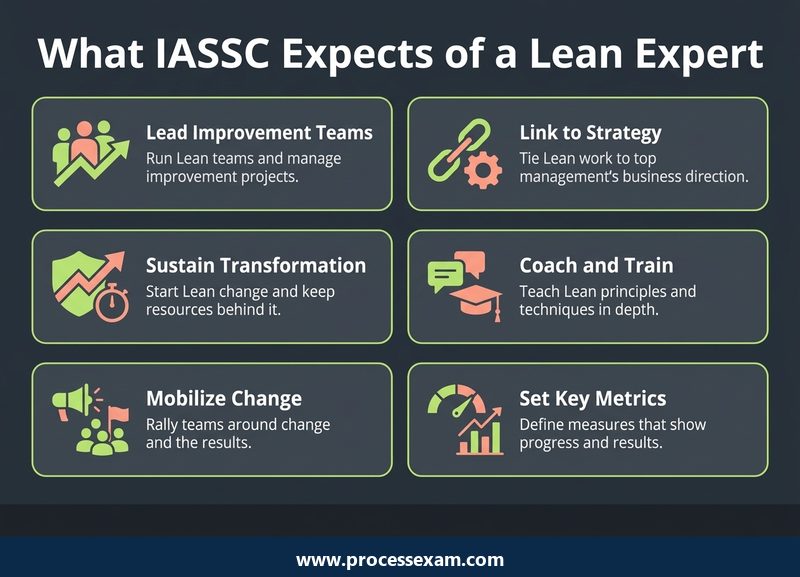
Three features of that list say something about who tends to hold the credential. First, the work is cross-functional: IASSC says the proficiency applies across Lean manufacturing, production, office, IT and development environments, so the exam is not tied to a factory. Second, the expectation is leadership of other people, including in-depth training and coaching, which suits someone who already supervises improvement efforts or aims to. Third, IASSC notes that Lean Experts often work in a full-time capacity, which puts the credential closer to a continuous-improvement role than to a skill added on top of another job.
What the certificate does and does not prove
Be realistic about the claim. IASSC describes its exams as minimum-competency, knowledge-based credentialing exams, and it recommends, without requiring, some real-world Lean work and project experience. A pass shows that you know the tools and the vocabulary at the depth IASSC expects and that you can choose between them in a scenario. It does not show that you led a transformation, and a reader of your CV will look for that evidence beside the certificate. The credential works best as the independent, third-party confirmation of knowledge that your project record then backs up.
IASSC also describes the usual route to the exam. Training for a Lean Expert generally runs to about 96 to 112 hours (12 to 14 days of classroom equivalent), mixing classroom or online study, self-study, coaching and mentoring, and that figure excludes time spent applying the work on projects. Treat it as a measure of how much material the Body of Knowledge represents, which helps when you plan study time later in this guide.
What does the ICLE paper look like, and what does it cost?
The facts below are the figures to plan around. The exam is a closed-book, proctored paper delivered through IASSC's on-demand web-based testing system, and IASSC says it contains multiple-choice and true/false questions drawn from every section of the Lean Expert Body of Knowledge.
| Item | ICLE detail |
|---|---|
| Exam | IASSC Certified Lean Expert (ICLE) |
| Vendor | IASSC |
| Questions | 110 |
| Duration | 180 minutes |
| Passing score | 70% |
| Exam voucher fee | USD $350 |
| Question types | Multiple-choice and true/false |
| Prerequisites | None to sit the exam |
A few details sit around that table. IASSC says some forms of the exam may add up to 11 non-graded questions on top of the 110, and you are not told which ones they are, so every question deserves a full answer. In IASSC's words the designation needs a minimum score of 70%, and nobody has to meet a prerequisite before booking the paper. IASSC also offers a non-proctored, informal Lean Evaluation Exam that it says may help you judge whether you are ready for the proctored one.
What the numbers mean in practice
Divide 180 minutes by 110 questions and you get roughly 98 seconds a question, a little over a minute and a half. A term you know takes seconds, but a scenario that makes you size up a situation, pick the tool and discard the near-miss options takes far longer. A pass at 70% of 110 questions corresponds to 77 correct answers if every question is graded, so you can miss 33 and still pass. The margin is real, but it is spent quickly if a whole theme of the syllabus is weak, which is why the next section matters.
What is inside the 38-topic Lean Expert Body of Knowledge?
IASSC publishes the Lean Expert Body of Knowledge as a numbered list of 38 topics, each with a one-line definition and a target cognitive level. It does not publish a question share for each topic, so no one outside IASSC can tell you that, say, 12% of the paper is Kanban. What you can do is group the 38 topics by what they have in common and study them as five themes. The grouping below is this guide's own, but every topic in it comes from IASSC's list.
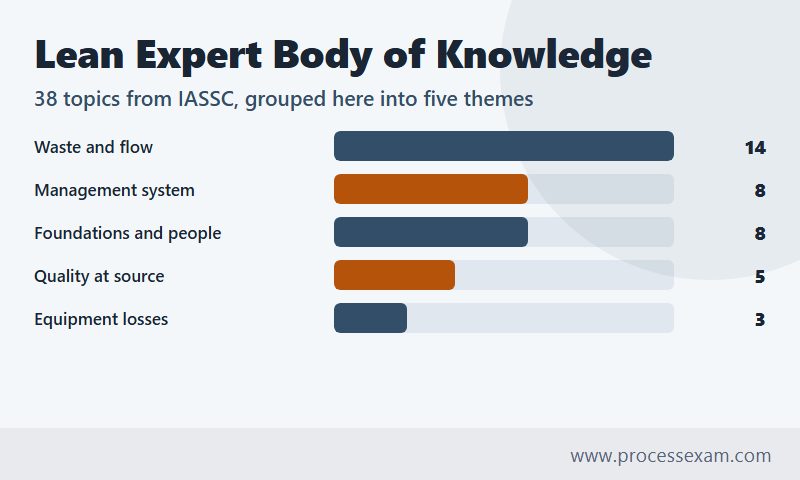
| Theme | Topics | IASSC topics in the group |
|---|---|---|
| Waste and flow | 14 | Muda, Mura and Muri; 5S; Kano model; just-in-time; bottleneck analysis; continuous flow; takt time; value stream mapping; flow (swim-lane) diagram; spaghetti diagram; layout planning; SMED; Heijunka; Kanban |
| Management system | 8 | Standardized work; sustainment; visual management; short interval control; Hoshin Kanri; Kaizen task-force workshops; DMAIC; PDCA |
| Foundations and people | 8 | Introduction to Lean; Gemba; Kaizen; KPIs; teamwork and team skills; change management; SMART goals; stakeholder management |
| Quality at source | 5 | Jidoka; Andon; Poka-Yoke; root cause analysis; risk analysis |
| Equipment losses | 3 | Total Productive Maintenance; the Six Big Losses; Overall Equipment Effectiveness |
Waste and flow: the largest theme
Fourteen of the 38 topics are about how work moves, so this is where a candidate should expect to be asked the most varied questions. IASSC groups the three families of loss, Muda (waste), Mura (unevenness) and Muri (overburden), in one topic, and it points out that Mura drives Muda: failing to smooth demand puts unfair demands on people and processes and creates inventory and the other wastes. Just-in-time is defined as pulling parts through production on customer demand, and IASSC says it relies on continuous flow, Heijunka, Kanban, standardized work and takt time. That sentence is a map of the theme, because those five tools appear again as topics of their own.
The mapping tools form their own cluster. Value stream mapping shows the current and future state; the swim-lane diagram does the same for cross-functional transactional work; the spaghetti diagram traces the physical movement of products or people. A scenario question usually describes a symptom, such as long walking distances or work bouncing between departments, and asks which picture would expose it.
Management system: keeping the gains
The eight topics here separate a Lean Expert from a Lean tool user. Standardized work is described by IASSC as living documentation that is easy to change, and it is tied to making Kaizen gains last. Short interval control covers the daily rituals, stand-up meetings, Gemba walks and shift hand-overs, that let a supervisor react early. Hoshin Kanri aligns company strategy with the plans of middle management and the work on the floor or in the office. Kaizen task-force workshops, also known as a Kaizen blitz or Kaizen event, run for typically three to five days and follow DMAIC logic. If you have only ever run improvement projects, expect this theme to feel unfamiliar.
Foundations, quality at source and equipment
The foundations theme holds the shortest-sounding topics, and several of them carry a surprise. KPIs, for instance, are defined as metrics that track and encourage progress toward critical organisational goals, so the question is rarely "what is a KPI?" and more often "which measure would show that this change worked?" The quality-at-source group is built around Jidoka, described by IASSC as aiming for zero defects by preventing them, signalling, reacting quickly and solving the cause for good, using autonomation, Andon, Poka-Yoke, root cause analysis and quick response quality control. Equipment losses is the smallest theme at three topics, but it is the most numerical, and the worked examples further down deal with it.
When you want a topic-by-topic list that you can tick off against your own notes, the ICLE syllabus page on ProcessExam lays the same ground out for study.
How deep does the thinking go, and why does that change how you study?
IASSC says its Body of Knowledge and exams target the revised Bloom's Taxonomy (2001), and each Lean Expert topic carries a maximum cognitive level. Count them and the picture is lopsided.
| Maximum level | Topics | Which topics |
|---|---|---|
| Create | 29 | Most of the Body of Knowledge, including Gemba, Kaizen, KPIs, the waste families, 5S, JIT, takt time, value stream mapping, SMED, Kanban, Jidoka, TPM and OEE |
| Apply | 6 | Introduction to Lean, teamwork, layout planning, risk analysis, sustainment, stakeholder management |
| Evaluate | 1 | Change management |
| Analyze | 1 | SMART goals |
| Understand | 1 | DMAIC |
IASSC defines Create as putting parts together so that a pattern or structure appears that was not clearly there before, or identifying which data in a complex set is worth examining further. For a closed-book multiple-choice exam, that translates into scenario questions: you are handed a messy situation and asked what to build, change or look at next. Recall alone does not carry you there. Knowing that a Kanban is a signal card is the starting point; the question is what happens to a pull system when demand becomes uneven and which tool you reach for first.
The second thing the table shows is that DMAIC is only an Understand-level topic. A candidate arriving from a Green Belt course may be tempted to lean on the structure they know, but IASSC treats DMAIC as one methodology to understand, beside PDCA, while the weight of the paper sits with tools used at the Create level. Study the tools by building small examples of your own, not by memorising definitions.
Which Lean calculations can turn up, and how do they work?
IASSC does not publish the question list, but several topics are defined with a formula or a set of named components, and these are worth being able to do in your head. The three examples below use invented numbers to show the mechanics.
Takt time
IASSC gives the formula as planned production time divided by customer demand. Suppose a line has 450 minutes of planned production time in a shift, which is 27,000 seconds, and customers want 900 units. Takt time is 27,000 / 900 = 30 seconds a unit. If demand rises to 1,125 units, takt time falls to 27,000 / 1,125 = 24 seconds. The common exam trap is mixing units, or dividing by what the line produced rather than by what customers asked for. Takt is a pace set by demand, not a measure of how fast the line currently runs.
Overall Equipment Effectiveness
IASSC says OEE tracks three categories of loss: availability (downtime), performance (slow cycles) and quality (rejects). The usual way to combine them is to multiply the three rates. With 90% availability, 95% performance and 98% quality, OEE is 0.90 x 0.95 x 0.98, which is about 83.8%. Each loss compounds the others, so three figures that each look healthy still give a lower overall number. Under the common convention, breakdowns and setup or adjustments fall under availability, small stops and reduced speed under performance, and startup and production rejects under quality, which accounts for the Six Big Losses in a tidy way.
Changeover reduction with SMED
SMED, single-minute exchange of dies, attacks setup time. IASSC's techniques are to convert setup steps to external ones that happen while the process is running, simplify the internal setup, eliminate non-essential operations and create standardized work instructions. A changeover takes 40 minutes, and 25 of those minutes are steps that could be prepared while the machine is still running. Moving them outside leaves a quarter of an hour of internal setup, a cut of about 62%. The exam question is usually the first step: classify each action as internal or external before you try to shorten anything.
How should you plan study when your Lean experience is lopsided?
Almost nobody arrives with equal experience in all five themes. A production supervisor lives in waste and flow and may never have written a Hoshin plan. A continuous-improvement analyst in a bank or a software team knows value stream mapping and change management and may never have calculated OEE. Rather than a fixed number of weeks, build the plan around those gaps.
Audit first, then spend your time where you are weak
Take the 38 topics and rate each one honestly: could you explain it to a new team member, and could you choose it from a short scenario? Anything you cannot explain needs the definition in IASSC's Body of Knowledge first. Anything you can explain but cannot choose needs scenarios. Then match your gaps to the themes: floor-based candidates tend to need the management-system and foundations topics, and office or IT candidates tend to need equipment losses, layout planning and SMED, which have no obvious counterpart in their daily work.
Practise with the clock running
Because the paper allows about 98 seconds per question, speed is a skill you build, not a by-product of knowing the material. A timed run on the ICLE practice exam will show you which of the five themes you still answer slowly, and that is more useful than a raw score. After each run, sort your misses into three piles: did not know the term, knew the term but chose the wrong tool, and misread the scenario. Each pile needs a different fix.
Exam-day habits
The exam is closed book and proctored online, so test your webcam, connection and room a few days early, not on the morning. Answer every question, including ones that look odd, because up to 11 ungraded questions may be mixed in and you cannot tell which. Mark and move on when a scenario runs past two minutes, and spend the time you saved on the review pass, where re-reading a question stem often reveals the one word that changes the answer.
How do you book the exam, and how long does the certificate stay Current?
You buy a voucher for the on-demand web-based exam from IASSC's own shop, and the Lean Expert certification page links to it. IASSC states the voucher price as USD $350 and says in future the Lean exams will also be offered through its affiliate partner network and the Pearson VUE network, so check which delivery options are listed when you book.
After a pass, IASSC says you receive a certificate as a PDF with a certification number and a digital badge, you are added to the IASSC Certification Register, and you may use the IASSC certification marks and titles on a resume or a public profile such as LinkedIn, consistent with IASSC's Marks Use Policy. IASSC also has a Verify a Certification page, so an employer can confirm the credential themselves.
Current and Elapsed status
The certificate itself is recognised without an end date, yet IASSC has attached a status to every certification since 1 March 2017. Yours shows as Current for the first three years after you receive it, then flips to Elapsed unless you recertify in time. The IASSC recertification policy page describes abbreviated recertification exams. When this guide was checked in October 2026, that page listed recertification exams for the Yellow, Green and Black Belt only, and none for the Lean Expert, so if your three years are running out, ask IASSC directly what applies to your Lean Expert certificate rather than assuming a shorter paper exists. A page like that can change, so read it when the date approaches.
The wider point is the one this guide opened with. The ICLE is a knowledge credential for people who lead Lean work, and its value grows with the project record you keep next to it, which is worth keeping up to date from the day you pass.
Frequently Asked Questions
What is the ICLE, and who is it for?
ICLE is the IASSC Certified Lean Expert, the advanced level of IASSC's Lean certifications. IASSC says Lean Experts drive and lead Lean efforts across an organisation, often full time, working with management while Practitioners and Leaders implement improvements. It suits people who coach teams and sustain change, not only those who use the tools.
How many questions are on the ICLE exam, and what is the pass mark?
Expect 110 proctored, closed-book questions with a three-hour limit, and a score of 70% or more is needed. The questions are multiple-choice and true/false questions drawn from every section of the Body of Knowledge. IASSC says some forms add up to 11 non-graded questions, which you cannot tell apart from the scored ones.
How much does the ICLE certification cost?
The ICLE exam voucher costs USD $350, bought from IASSC for its on-demand web-based exam. That is the exam fee only and does not include training, which IASSC recommends but does not require. IASSC lists no separate application or membership fee on its Lean Expert page, so check the shop page when you buy.
Do you need experience or training before taking the ICLE?
No. IASSC sets no prerequisites for sitting the Lean Expert exam, and reaching 70% on the paper is the single condition for the designation. It does recommend training from a qualified provider and some real-world Lean and project experience, because the paper tests judgement in scenarios and not just recall.
How long does an ICLE certification last?
IASSC keeps recognising certified professionals, but each certification carries a status: Current for three years, then Elapsed unless it is renewed. The recertification policy page lists abbreviated exams for the Yellow, Green and Black Belt only, so ask IASSC what applies to the Lean Expert when your three years approach.
- IASSC Lean Expert Test Questions |
- ICLE Question Bank |
- ICLE Body of Knowledge (BOK) |
- Lean |
- Lean Expert Simulator |
- Lean Expert Mock Exam |
- IASSC Lean Expert Book |
- IASSC ICLE BOK PDF |
- Lean Expert Certification Cost |
- Lean Expert Certification Requirements |
- IASSC Lean Expert Sample Questions |
- ICLE Exam Questions Download |
- ICLE Test Questions |
- Lean Expert PDF


