
Achieve Global Recognition with CIPM Certification
Updated on 23 September 2026. What’s new: cipm exam fee corrected to USD $599, the amount IAPM works out from the candidate's citizenship rather than charging one flat price worldwide
Two organisations issue a certificate abbreviated CIPM, and they have nothing to do with one another. One sits in the privacy profession. The other is the subject of this guide: the Certified International Project Manager (IAPM), awarded by the International Association of Project Managers to people who deliver projects across borders. It asks 80 questions in 60 minutes, needs 65% to pass, and refuses to let you sit it until you already hold an IAPM project management certificate.

That entry condition is the part most candidates find out about late, and it changes how you should plan. The CIPM is not a starting point and not a rung above the senior level; it is a specialisation bolted onto a certificate you already own. Everything below follows from that: who the credential is built for, what IAPM tests in its 60 minutes, what it costs when the price is set by your passport, and how a certified project manager can get ready in about four weeks.
What does CIPM stand for, and who issues the one you want?
In project management, CIPM is short for Certified International Project Manager (IAPM). The bracketed vendor name is part of the official title, not decoration — IAPM appends it to every credential it issues, which is also what keeps the certificate distinct from a similarly named one awarded elsewhere. When you write the credential after your name, the brackets travel with it.
The confusion is worth clearing up before you spend money. The other CIPM is a privacy-management credential from the International Association of Privacy Professionals. It is about governing a privacy programme: data protection law, breach response, privacy operations. It has no project management syllabus and no relationship with IAPM. Two different professions happened to shorten two different titles to the same four letters.
Three quick tells when you are not sure which one a page means
- Look at what the syllabus contains. Cultural dimensions, stakeholder analysis and supplier management point to the project management credential. GDPR, data subject rights and breach notification point to the privacy one.
- Look at the entry rule. The project management CIPM demands that you already hold another certificate from the same body. A privacy-track description will not mention project management certificates at all.
- Look at the exam shape. Eighty questions in 60 minutes with a 65% threshold is the IAPM pattern. A longer paper scored on a scaled range is a different credential entirely.
Everything from here refers to the IAPM credential only. If you arrived looking for the privacy certificate, this is not the guide you need.
Why can the CIPM never be your first IAPM certificate?
IAPM states the condition plainly on its Certified International Project Manager page: anyone applying for the CIPM must already hold Certified Project Manager (IAPM), Certified Senior Project Manager (IAPM), Certified Agile Project Manager (IAPM) or Certified Senior Agile Project Manager (IAPM). Junior certificates do not open the door. Professional experience is not demanded on top of that, although IAPM notes it is an advantage.
The reason is structural rather than bureaucratic. The CIPM syllabus does not teach project management from scratch. It assumes you can already read a schedule, run a stakeholder analysis and close a project properly, then asks what changes when the team sits in four time zones, the client's contract law is unfamiliar and a polite yes in a meeting does not mean agreement. Without the base certificate, half the questions would be testing ground the exam never covers.
Four doors into the CIPM
- Certified Project Manager (IAPM). The traditional, plan-driven level. No professional experience is required, so this is the shortest route in for someone who has never certified before.
- Certified Senior Project Manager (IAPM). The same traditional syllabus with an experience gate in front of it: five years in project management, three of them in a management position or one carrying considerable responsibility.
- Certified Agile Project Manager (IAPM). The agile equivalent of the standard level. Note that these initials also belong to a well-known PMI credential with an entirely different syllabus; inside IAPM the letters mean the agile certificate.
- Certified Senior Agile Project Manager (IAPM). The agile track with the same five-year experience condition as its traditional twin.
Two practical consequences follow. First, budget for two registrations, not one, unless you already carry an IAPM certificate. Second, choose the base deliberately: the international layer sits on top of whichever methodology you certified in, so an agile practitioner is not forced through a plan-driven exam to reach it.
Where does the CIPM sit in IAPM's ladder of levels?
IAPM arranges its certificates as two parallel tracks — traditional and agile — each running junior, standard and senior. The CIPM does not belong to either sequence. It is a specialisation that hangs off the side of the ladder, in the same category as the trainer credential, and passing it does not promote you from standard to senior. Someone holding the standard certificate plus the CIPM is not thereby a Certified Senior Project Manager.
What the CIPM does add is a named, examined competence in cross-border delivery. That is a narrower claim than seniority, and a more specific one. On a proposal for a programme spanning three countries, it answers a question that a general certificate leaves open.
| What you need to know | IAPM Certified International Project Manager (CIPM) |
|---|---|
| Exam code | CIPM |
| Certification body | IAPM (International Association of Project Managers) |
| Number of questions | 80 |
| Exam duration | 60 minutes |
| Passing score | 65% |
| Exam fee | USD $599 |
| Entry condition | An existing CPM, CSPM, CAPM or CSAPM certificate from IAPM |
| Certificate validity | Valid for life; IAPM runs no recertification |
Set that against the rest of the family and the shape of the exam becomes clear. The per-level table in IAPM's certification exam FAQ gives the standard and senior papers 120 questions in 80 minutes. The CIPM's 80 questions in 60 minutes makes it the shorter paper, with the same 65% threshold applied across every IAPM level. You will be answering fewer questions than you did for your base certificate, drawn from a narrower body of material.
What the CIPM is not
- Not a replacement for your base certificate. It is read alongside it, never instead of it.
- Not an upgrade path. Moving from the standard to the senior level is a separate application judged on your project record.
- Not a country-specific licence. Nothing in it authorises you to practise anywhere; it certifies knowledge, not permission.
- Not an experience audit. Unlike the senior levels, no one scores the projects you have run before admitting you.
What does the International PM Guide 2.0 actually ask you to know?
Every CIPM question is drawn from one document. IAPM's International PM Guide 2.0 is published as a free PDF, which means the entire examinable scope can be downloaded before you pay anything. Read it once before registering and you will know within an hour whether the credential is worth your time.
The guide is organised into sixteen subject areas, followed by a set of quick reference guides covering ten countries. Listed in IAPM's own order, the subject areas are:
- Projects in a globalised world
- Aspects of an international project
- International competencies
- Cultural dimensions
- Project phases
- Environment and stakeholder analysis
- Project organisation
- Decision making processes
- Team development
- Communication culture
- Project control
- Risk management
- Conflict management
- Quality management
- Supplier management
- Management role in the project
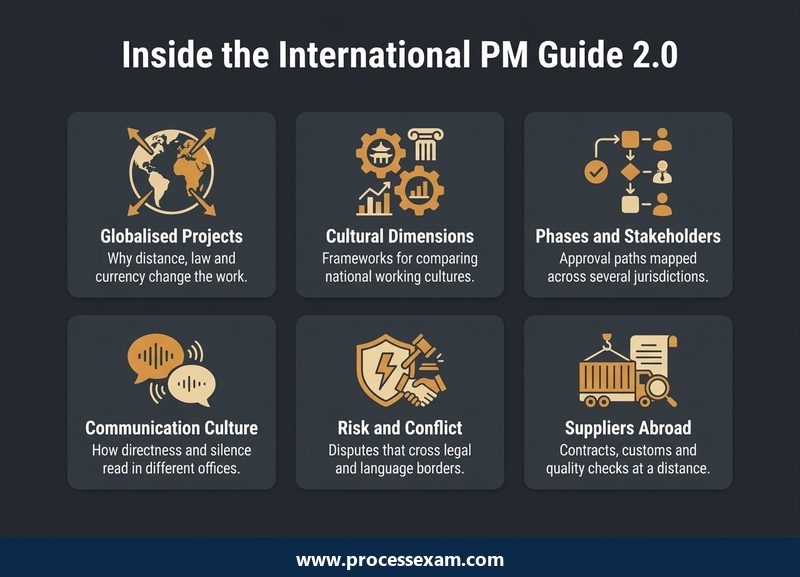
Read as a flat list it looks like any project management syllabus, and that is the trap. Each heading is the international version of a topic your base certificate already covered, so the marks are won on the differences rather than the fundamentals. It helps to read the sixteen as four clusters.
The framing cluster: why international is different
The first four areas set up the problem. Projects in a globalised world and aspects of an international project deal with why distance, law, currency and time zones change the work. International competencies covers what the manager personally has to be able to do. Cultural dimensions introduces the comparison frameworks used to describe how national working cultures differ — the part of the guide that most readers find genuinely new.
The structure cluster: running the project
Project phases, environment and stakeholder analysis, project organisation and decision making processes revisit familiar mechanics under international conditions. Expect questions about stakeholder maps that cross jurisdictions, reporting lines that span subsidiaries, and approval processes where authority is distributed differently from one country to the next.
The people cluster: how the team works
Team development, communication culture, conflict management and the management role in the project carry the soft-skill weight. The guide gives these as much space as the mechanics, and the questions follow. Directness that reads as efficient in one office reads as rude in another; the exam expects you to know that and to know what a manager does about it.
The control cluster: keeping the project safe
Project control, risk management, quality management and supplier management close the list. Supplier management deserves particular attention, because cross-border procurement brings contract law, customs, payment terms and quality assurance at a distance into one topic.
The quick reference guides then profile Brazil, China, Germany, India, Japan, Russia, Saudi Arabia, South Africa, Turkey and the United States, each with historic background, cultural notes, currency and economic context. You are not expected to memorise ten national histories. You are expected to recognise the kind of factor each profile records and why it matters to a project plan.
What happens in the 60 minutes of the CIPM exam?
Eighty questions in 60 minutes leaves 45 seconds each. That arithmetic, more than the difficulty of any single question, is what candidates underestimate. The paper mixes multiple-choice questions where one or more answers may be correct with straightforward true or false items, so the reading load per question varies and you cannot bank on a steady rhythm.
The exam runs online through the Classmarker platform, from wherever you are, on a current browser with JavaScript and cookies enabled. Questions appear one at a time and each must be answered before the next one is shown; once a question page is behind you it stays behind you. IAPM's exam FAQ sets out those mechanics in full, and they apply identically across its certifications, so anyone who has already sat the CPM or CAPM will recognise the interface.
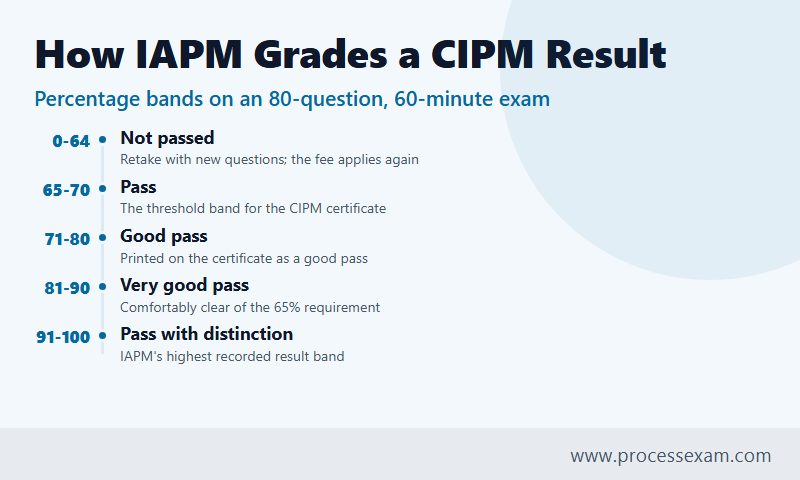
Your result arrives by e-mail within three working days, and IAPM reports it in bands rather than as a bare pass or fail. Sixty-five to seventy per cent is a pass; seventy-one to eighty is recorded as a good pass; eighty-one to ninety as a very good pass; ninety-one to one hundred as a pass with distinction. The certificate is the same in every case, but the band is printed, so candidates who want the stronger wording aim well above the threshold rather than at it.
Because the questions are drawn from a published guide, the most useful rehearsal is not more reading but timed answering. Working through CIPM sample questions in blocks of twenty, with a clock running, teaches you the two habits the format rewards: committing to an answer quickly, and reading a multiple-answer question carefully enough to notice that it wants more than one tick.
What does the CIPM cost, and why is the price different in each country?
The CIPM exam fee is USD $599. That figure is the one to plan around, but it is not a single global price, and understanding why matters if you are comparing quotes with a colleague abroad.
IAPM prices its certifications against the economy behind your passport: each fee is derived from the gross domestic product of the nation whose citizenship you hold. The stated purpose is to keep the certificates affordable for project managers of every nationality, so two people sitting the identical exam can legitimately pay different amounts. On IAPM's own pages you select your nationality to reveal the applicable amount, which is the only way to see your exact price before registering. Checked in September 2026, that GDP-based model was still how every IAPM fee, including the CIPM, is calculated.
The other amounts to budget for
- Your base certificate. If you do not already hold a CPM, CSPM, CAPM or CSAPM, its fee comes first and is set the same way.
- The optional self-test. IAPM offers a stand-alone self-test of 25 questions in 20 minutes. It is charged separately, is not required, and its score has no effect on your certification result — it exists to expose gaps before the real paper.
- Discounts. A twenty per cent reduction is available to students, pupils and members of aid organisations, although it does not apply to the junior certifications.
- An extension, if you need one. Registration is valid for six months from the day your access details arrive. IAPM charges 35 CHF per test to extend it, so treat the six months as the real deadline and book your study accordingly.
- A retake, if it comes to that. A failed attempt can be repeated with a fresh set of questions and the fee applies again. Fail twice and a twelve-month waiting period begins; a third failure ends your eligibility for IAPM certification tests altogether.
Set against that, one number works in your favour. IAPM issues its certificates for life and operates no recertification cycle, so there is no renewal fee waiting for you in three years. Whatever the credential costs, it costs that once.
How do you prepare for the CIPM in four weeks?
A candidate who already holds an IAPM certificate is not learning project management again, so the plan below is deliberately short. It assumes six to eight hours a week and a free copy of the guide.
Week one: map the gap
Read the guide from start to finish without taking notes, then go back and mark every passage that says something your base certificate never taught you. For most readers those marks cluster in cultural dimensions, communication culture and supplier management. What is left unmarked is revision, not study, and should take a fraction of your remaining time.
Week two: the cultural material
Give the whole week to cultural dimensions, international competencies and the country quick reference guides. Work by comparison rather than memorisation: pick two countries with visibly different profiles and write down how a kickoff meeting, an escalation and a contract negotiation would each run differently. The exam asks you to reason about those differences, not to recite the profiles.
Week three: the delivery and control material
Cover project phases, organisation, decision making, control, risk, quality and suppliers in one pass, always asking the international question: what does distance, currency, law or language change here? Team development and conflict management belong to this week too, because both are where cultural theory becomes an actual management decision.
Week four: rehearse against the clock
Spend the final week answering rather than reading. Set 45 seconds per question and hold to it, then review only the items you got wrong, tracing each one back to the paragraph in the guide it came from. A full-length timed run through an online CIPM practice exam two or three days before the real sitting will tell you more about your readiness than another re-read of the guide. Leave the day before free.
One habit is worth building throughout. When a question offers several plausible answers, the guide's wording is usually the tiebreaker, so note the phrases IAPM uses for concepts you already know under different names.
Who gets real value from the CIPM, and who should skip it?
The credential earns its fee when your work is genuinely international and someone has to take that on trust. Four situations fit it well.
- The programme manager with distributed teams. Delivery split across subsidiaries or offshore partners, where a large share of the management effort goes into time zones, handovers and different working norms.
- The manager of cross-border suppliers. Procurement and quality assurance conducted at a distance, under contracts written in another jurisdiction.
- The consultant bidding abroad. A named, examined international competence is a concrete line in a proposal where a general certificate reads as generic.
- The development or aid professional. Projects run with partners in several countries, where cultural and stakeholder complexity is the job rather than a complication of it.
It is equally worth naming the cases where the answer is no. If all your projects sit in one market, the international layer will not change how anyone reads your CV. If you hold no certificate at all, start with the base level, since the CIPM is closed to you until you do. And if your employer's procurement rules name a specific credential, satisfy that requirement first; the CIPM complements a portfolio rather than substituting for a named prerequisite.
Be wary, too, of the claim that any single certificate raises pay by a fixed amount. IAPM publishes no such figure, and neither will this page invent one. What the certificate reliably does is make a specific competence visible and verifiable, on a document that never expires.
Weighed as a whole, the IAPM CIPM is a narrow credential that knows exactly what it is: a second certificate, sat after a first, on a published body of material, kept short and priced to your country. If your projects cross borders, that is a modest amount of study for a claim you can evidence. If they do not, your money is better spent elsewhere — and knowing which of those two describes you is the real decision this guide was written to help you make.
Frequently Asked Questions
What does CIPM stand for in project management?
In project management CIPM stands for Certified International Project Manager (IAPM), a credential from the International Association of Project Managers for people running cross-border projects. A separate privacy credential from another body shares the same four letters, so check which organisation a page or job advert means.
Is the IAPM CIPM certification globally recognised?
IAPM issues the CIPM internationally and the exam is taken online from any country, so the certificate itself is not tied to one market. Recognition still depends on your industry and employer, and the credential is read alongside the IAPM certificate you had to hold before sitting it.
What are the requirements for CIPM certification?
You must already hold an IAPM Certified Project Manager, Certified Senior Project Manager, Certified Agile Project Manager or Certified Senior Agile Project Manager certificate. Junior-level certificates do not qualify. No separate professional experience is demanded for the CIPM, although IAPM notes that practical experience helps.
How many questions is the CIPM exam and how long does it last?
The CIPM exam has 80 questions and a time limit of 60 minutes, which works out at roughly 45 seconds per question. The paper mixes multiple-choice questions, where more than one answer may be correct, with true or false items, and 65% is needed to pass.
Is the CIPM exam difficult?
The material is not advanced, since every question comes from a freely published guide, but the pace is demanding and the syllabus covers cultural and communication topics that many project managers have never studied formally. Candidates who fail usually run out of time rather than knowledge.
- IAPM International Project Manager Test Questions |
- CIPM Question Bank |
- CIPM Body of Knowledge (BOK) |
- International |
- International Project Manager Simulator |
- International Project Manager Mock Exam |
- IAPM International Project Manager Book |
- IAPM CIPM BOK PDF |
- International Project Manager Certification Cost |
- International Project Manager Certification Requirements |
- IAPM International Project Manager Sample Questions |
- CIPM Exam Questions Download |
- CIPM Test Questions |
- International Project Manager PDF


