
IAPM CSPM Certification: Achieve Excellence
Updated on 22 September 2026. What’s new: exam fee updated to USD $711 with IAPM's citizenship-based pricing, and the senior entry rule of five years' experience, three of them leading, added.
The IAPM Certified Senior Project Manager (CSPM) is not a harder paper than IAPM's Certified Project Manager exam. It is the same kind of test with a gate in front of it. You answer 120 questions in 80 minutes and need 65% to pass, but IAPM admits you to the senior level only after it scores the projects you have run over the last five years, three of them in a leading role.

That gate is what this guide is about. Most of what is written about the CSPM treats it as a study problem, yet the first decision a candidate faces is an administrative one: will IAPM accept my experience, and if not, what then? Below you will find how the experience score works, what the certificate costs, what the exam asks of you, how to choose between the senior and the standard level, and how a working manager can prepare without losing weeks to material they already know.
Which CSPM is this, and who is the IAPM senior level built for?
The letters CSPM are shared by more than one field. In cloud computing they stand for Cloud Security Posture Management, a category of security tooling. If you arrived here looking for cloud security, this is not that credential. The CSPM covered here is issued by the International Association of Project Managers (IAPM), and its full name is Certified Senior Project Manager (IAPM). It belongs to traditional, plan-driven project management.
IAPM runs its traditional certifications as a ladder. The junior level welcomes newcomers, the Certified Project Manager level tests knowledge with no experience condition, and the senior level adds a formal check of your professional track record. IAPM's Certified Senior Project Manager page describes it as the certification in traditional project management for experienced professionals, and that phrase is the key to everything that follows.
Three profiles that fit the senior level
- The delivery lead. Seven years in IT projects, the last four running rollouts with their own budget and team. The experience condition is comfortably met, and a senior certificate describes this person more accurately than the standard one.
- The engineer who became a manager. Ten years in construction or manufacturing, with the last three spent leading projects rather than working inside them. Technical depth is not in doubt; what the certificate adds is proof of a shared project management vocabulary.
- The consultant. Someone who has led client engagements for years but never held a certificate, and now meets procurement teams that ask for one. The senior title signals both knowledge and practice in one line of a proposal.
What these profiles share is not seniority of job title but years of responsibility for real projects. That is what IAPM measures.
How does IAPM decide whether your experience is senior enough?
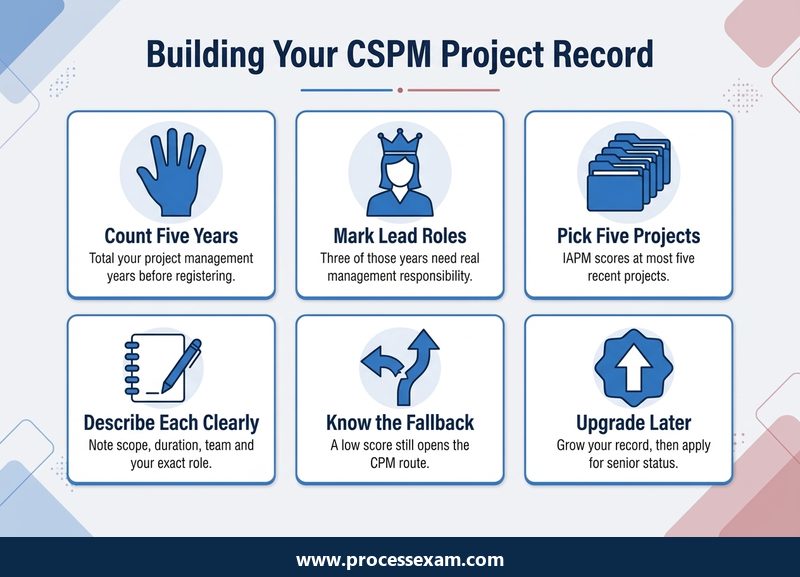
The rule is set out in IAPM's prerequisites FAQ: at least five years of project management experience, of which three years must be in a management position or a position with considerable responsibility. Both conditions apply together. Five years spent inside project teams without any leadership share do not qualify, and neither do three years of management on their own.
The check itself happens during registration. You name up to five projects from the last five years, and IAPM runs the details you supply through a mathematical formula that produces a total score. There is a minimum score for admission to the senior level. IAPM does not publish the formula or the threshold, so no candidate can calculate their result in advance; what you control is how completely and accurately you describe your projects.
If the score falls short
A low score does not end your application. IAPM states that a candidate who does not reach the minimum can still be approved for the Certified Project Manager (IAPM) level instead. The certification upgrade FAQ then describes a route back up: once your traditional project management experience is sufficient, you apply to upgrade the standard certificate to the senior one. The upgrade is charged, and like every IAPM fee its amount depends on your citizenship.
Choosing the five projects
IAPM does not say which project details carry most weight, so the safest approach is to present the projects that best show the two things its rule names: time and responsibility. Some practical points:
- Prefer projects where you personally held the lead or a clearly defined share of it, such as a sub-project or a major work stream, over projects where you were one contributor among many.
- Stay inside the five-year window. Older achievements may be impressive, but the score is built on recent project work.
- Use projects you can describe with facts rather than adjectives: start and end dates, size of the team you directed, the scope you owned and the outcome.
- If you have more than five candidates, choose a spread. Five near-identical maintenance releases say less than a mix of a rollout, a migration and a change programme.
- Write the descriptions before you open the registration form, and keep the notes. If you are routed to the standard level, the same record becomes the basis of your later upgrade.
Two worked examples
Anika has six years in project work: two as a project coordinator, then four as the named project manager for a regional logistics firm. She meets the five-year condition and has more than three years in charge, so her application rests on how well she documents her five best projects.
Tomas also has six years, but he spent five of them as a business analyst on project teams and only one leading a project. He meets the length condition but not the leadership one. His sensible plan is to register for the Certified Project Manager level now, log each project he leads, and request the senior upgrade when two further years in charge have been added to his record.
How much does the CSPM certification cost in total?
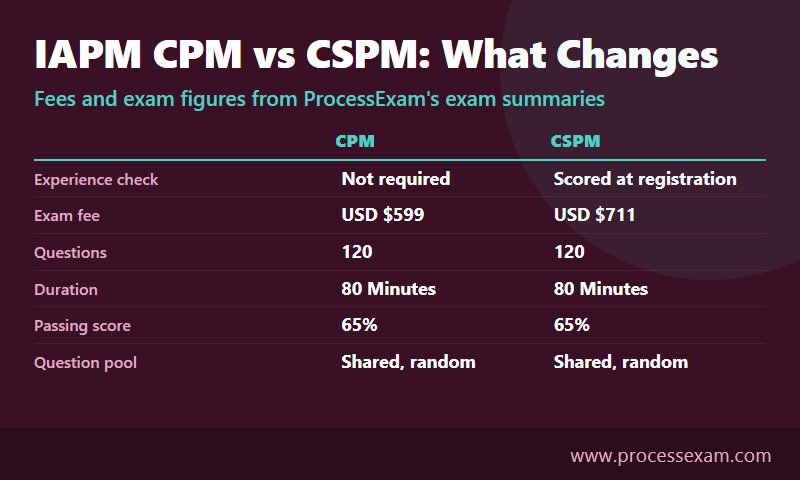
ProcessExam's exam summary lists the CSPM exam fee as USD $711. Treat that as a reference point rather than your invoice, because IAPM does not charge one global price. Its fee is linked to the gross domestic product of the country whose citizenship the candidate holds, so the amount on your invoice depends on your passport rather than where you live or work. The fee information page has a nationality selector that shows the figure for your country.
For comparison, the same summary lists a lower fee for the Certified Project Manager level. The gap between the two is worth understanding: the exam paper is drawn from the same question pool, so the extra cost at the senior level pays for the experience evaluation and the senior title, not for a longer or more difficult test.
What else to budget for
- Discount. IAPM offers 20% off to pupils, students and active employees of aid organisations. Few senior candidates are students, but project managers working for charities and relief agencies should ask for it before they register.
- Study material. The Project Managers' Guide (IAPM), which the exam is based on, is free. IAPM's web-learning platform and seminars run by its training partners are optional extras.
- Self-test. An optional 25-question, 20-minute self-test is sold separately. It does not count toward the exam; its value is the feedback on your weakest areas.
- Retakes. A repeat attempt is charged in full again, which is the strongest financial argument for sitting only when you are ready.
- Time. After registration, IAPM sends an invoice payable within 10 days, and you then have 12 months from the invoice to sit the exam. No travel or test-centre costs arise, because the exam is taken online.
What will you face in the CSPM exam itself?
Code, fee, time, question count and pass mark in this table are taken from ProcessExam's CSPM exam summary; the entry rule and the average score are IAPM's own, from its senior-level pages.
| Item | IAPM Certified Senior Project Manager |
|---|---|
| Exam Name | IAPM Certified Senior Project Manager |
| Exam Code | CSPM |
| Exam Fee | USD $711 (the invoice varies with your citizenship) |
| Exam Duration | 80 Minutes |
| Number of Questions | 120 |
| Passing Score | 65% |
| Entry rule | Five years of project management experience, three with leadership responsibility |
| Experience check | Up to five recent projects scored by formula at registration |
| Average result reported by IAPM | About 73.3% of questions answered correctly |
The questions mix three formats: multiple choice with one correct answer, multiple response with several correct answers, and true or false statements. You sit the exam online through the Classmarker platform, alone and without aids, having signed an affidavit to that effect when you registered. Once the 80 minutes start they cannot be paused.
Navigation is strictly one way. According to IAPM's senior-level FAQ, you can change an answer while you are still on its page, but once you move on the answer is locked, and you cannot leave a page without answering it. Pacing therefore matters more than on exams that allow a review screen. At 120 questions in 80 minutes, a steady rhythm of three questions every two minutes brings you to the end with no time to spare, so decide on each question once and keep moving.
What the average score tells an experienced candidate
IAPM reports that senior-level candidates answer about 73.3% of questions correctly on average. Its Certified Project Manager FAQ gives about 71.1% for the standard level and confirms that both exams are generated at random from one pool of questions. Years of leadership, in other words, buy only about two points. The exam rewards knowledge of IAPM's own guide, and experience helps mainly where the guide agrees with what you already do.
Your certificate wording also depends on the score: a pass from 65% to 70%, a good pass from 71% to 80%, a very good pass from 81% to 90% and a pass with distinction above that. A senior candidate who wants the certificate to reflect their standing should aim well above the pass line rather than at it.
Should you apply for the CSPM or start with the CPM?
Because the two exams share a question pool, the choice is not about difficulty. It comes down to whether your record meets the senior rule today and how much the senior title matters in your market.
Apply for the senior level directly if
- you have five or more years of project management work and at least three of them in a clearly responsible role;
- you can name five recent projects and describe your part in each with dates and facts;
- clients, employers or tender documents in your field value a certificate that includes an experience check.
Start with the Certified Project Manager level if
- you are a year or two short of the leadership condition and would rather certify your knowledge now than wait;
- your projects were mostly contributions to other people's projects;
- the lower fee makes a real difference and the senior title adds little in your current role.
Starting lower carries little penalty. The certificate is valid for life either way, and the upgrade route means the exam you pass today still counts when your experience catches up. The main cost of waiting is the second fee for the upgrade, which you should weigh against the value of holding a certificate a year or two sooner.
How should an experienced manager prepare for the 20 exam topics?
IAPM's topic list for the senior level is the same twenty areas as the standard level, from Project Check to Soft Skills, and our CSPM syllabus page lists them in order. IAPM does not weight the topics, so every area can appear. For a candidate with years of practice, the useful question is not what the topics are but where your habits and the guide part company. We find it helpful to sort the twenty into three groups. The grouping is ours, not IAPM's.
Where your experience will carry you
Stakeholders, Communication, Risk Analysis, Project Start-Up, Project Review and Soft Skills are areas every practising manager handles weekly. Read the guide's chapters once, note any definitions that differ from yours, and move on. Your risk is overconfidence: an answer that is right in your organisation can still differ from the guide's model, particularly on how communication is planned and who reviews a project.
Where your habits may not match the guide
Project Check, Project File, Project Charter, Steering Committee and Core Team, Sub-Project Manager and Work Package Owner, Project Organisations and Creation of the Phase Model depend on IAPM's own structure and terms. Managers trained in another framework, or in agile teams, often use different names for these roles and documents, or skip some of them entirely. Study these carefully, build a small glossary of IAPM's terms, and practise mapping your own experience onto them.
Where exact technique decides the answer
Cost Breakdown and Budget, Creation of the Work Breakdown Structure, Project Environment, Process and Time Schedule, Creation of the Specification, Work Packages and Project Close Out reward precise method. Senior managers often delegate these tasks to planners and controllers and may be rusty on the detail. Work through small examples by hand: break a familiar project into a structure, turn it into a schedule and a budget, then write the close-out steps the guide expects.
A three-pass plan that respects your time
- Pass one, a full read. Read the Project Managers' Guide (IAPM) from start to finish in a week or two, marking every place where it disagrees with your practice. Those marks are your real syllabus.
- Pass two, targeted study. Spend most of your remaining hours on the second and third groups above. Use IAPM's web-learning chapters or recommended literature where the guide is brief, because IAPM itself presents the guide as an overview rather than a complete textbook.
- Pass three, timed rehearsal. Sit full-length sessions of 120 questions in 80 minutes with no going back. A timed CSPM practice exam gives you the same length and a score breakdown, so you can see whether your results sit comfortably above 65% before you use IAPM's access link.
Habits that cost experienced candidates marks
- Translating from another framework. If you learned project management through another body's standard, its terms for charters, boards and phases may not match IAPM's. Answer in IAPM's language.
- Answering "it depends". Experience teaches that every rule has exceptions. The exam asks what the guide prescribes, and a nuanced reading of a plain question often leads to the wrong option.
- Reading at meeting speed. Senior people skim documents for decisions. Multiple-response questions punish skimming, because one missed option makes the answer wrong.
- Relying on seniority. The two-point gap between average senior and standard scores shows that the paper does not favour experience. Prepare as if you had none.
What happens after the exam, whether you pass or not?
Classmarker marks the exam automatically and IAPM sends the result by e-mail within three working days. If you pass, you receive a cover letter, the certificate and a report as digital documents; no printed copy is posted. Each certificate carries your IAPM Identification Code (IAPMIC), which anyone can use on IAPM's website to confirm that it is genuine. That matters to senior candidates in particular, because a client or tender panel can check the credential rather than take it on trust.
The senior certificate never expires. IAPM does not run a recertification scheme, so there are no renewal fees or continuing-education hours to track. The flip side is that the certificate records what you knew on the day you passed; your continuing record of projects is what keeps it current in an employer's eyes.
If the result is a fail
IAPM allows a second attempt with a fresh set of questions, charged at the full fee. If that attempt also fails, there is a compulsory gap of 12 months before a third try, and IAPM warns that failing a third time closes access to all of its certification exams. For a senior candidate the lesson is simple: treat the first attempt as the only one, and do not register for a retake until timed practice shows a clear margin above the pass mark.
Is the IAPM CSPM worth it for your career?
The value of the senior certificate lies in what it combines. Many project management credentials test knowledge alone; a few require documented experience and a long application. The CSPM sits between them: one online exam on a free guide, plus a scored experience check that a reader of your CV can take as evidence that you have led projects, not just studied them.
How much that is worth depends on where you work. In markets and sectors where IAPM is well known, the senior title can help in tenders and promotion rounds. Where it is less familiar, its strengths are cost, speed and lifelong validity rather than name recognition. Look at job adverts and tender requirements in your own region before you decide how much weight to put on it, and do not expect any certificate to replace a strong project record.
Getting the most from the certificate
- Write it in full with the issuer, as "Certified Senior Project Manager (IAPM)", so no one confuses it with a cloud security credential of the same initials.
- Quote your IAPMIC wherever a verifier might want it, such as on a consultancy profile or a bid document.
- Pair the title with two or three lines on the projects that earned it; the experience check gave them a formal weight, so use it.
- If you work across borders, look at IAPM's international level, which builds on its standard or senior certificate and adds the cultural and communication side of international projects.
The CSPM asks two things of you: a record that proves you have led projects, and enough command of IAPM's guide to answer 120 questions at pace. The first you have either built or are building. The second is a matter of weeks of focused study, spent where the guide and your habits disagree.
Frequently Asked Questions
What is the IAPM CSPM certification?
CSPM stands for Certified Senior Project Manager (IAPM), the senior level of the International Association of Project Managers' traditional project management certificates. It combines an online exam on IAPM's Project Managers' Guide with a scored check of your project experience. It is unrelated to Cloud Security Posture Management, which shares the same initials.
How much does the CSPM certification cost?
ProcessExam's exam summary lists the CSPM fee as USD $711. IAPM sets the actual fee by the gross domestic product of your country of citizenship, so use the nationality selector on its fee page to see your figure. Pupils, students and aid-organisation employees can ask for a 20% discount, and retakes are charged again.
What experience do I need for the IAPM Certified Senior Project Manager?
IAPM asks for at least five years of project management experience, three of them in a management role or a position with considerable responsibility. At registration you describe up to five projects from the last five years, and a formula turns them into a score that must reach IAPM's minimum for senior admission.
Is the CSPM exam harder than the CPM exam?
No. IAPM generates both exams at random from the same question pool, with 120 questions, 80 minutes and a 65% pass mark. The difference is the experience check at registration. IAPM reports average scores of about 73.3% at senior level and 71.1% at the standard level, so experience adds only a little.
What happens if my experience score is too low for the CSPM?
IAPM can approve you for the Certified Project Manager (IAPM) level instead, which uses the same kind of exam without the senior title. Once you have built up enough project experience, you can apply to upgrade that certificate to Certified Senior Project Manager (IAPM). The upgrade carries its own citizenship-based fee.
- Traditional Management |
- IAPM Senior Project Manager Test Questions |
- CSPM Question Bank |
- CSPM Body of Knowledge (BOK) |
- Senior Project Manager Simulator |
- Senior Project Manager Mock Exam |
- IAPM Senior Project Manager Book |
- IAPM CSPM BOK PDF |
- Senior Project Manager Certification Cost |
- Senior Project Manager Certification Requirements |
- IAPM Senior Project Manager Sample Questions |
- CSPM Exam Questions Download |
- CSPM Test Questions |
- Senior Project Manager PDF


