
ServiceNow CPOA vs Other Certifications: Which Path Fits Your Career?
The ServiceNow CPOA (Certified Platform Owner Associate) certification proves you can run the Now Platform as a business asset: strategy, people, process, technology, data and governance. It differs from the CSA, CIS and CAD exams, which test configuration and build skills. The exam has 70 questions in 90 minutes, costs USD $300 and is scored Pass / Fail.
Most ServiceNow credentials ask whether you can configure or build something. The Certified Platform Owner Associate asks a different question: can you decide what the platform should do next, who should do it, how it should be released and how its value is shown to the business? That is why many experienced administrators, business analysts and ServiceNow programme leads look at the CPOA once they have spent a few years on the platform.
This guide compares the ServiceNow CPOA with the other mainstream ServiceNow certifications, walks through all six syllabus domains, explains how the exam is run and how difficult it is, and sets out a five-step preparation plan, the mistakes to avoid and the career value of the credential.
What is the ServiceNow CPOA certification, and what does CPOA stand for?
CPOA stands for Certified Platform Owner Associate. It is a ServiceNow credential for people who own, govern or help run a ServiceNow instance. ServiceNow describes it as confirming that you can support the development, management and optimisation of the Now Platform: contributing to the product roadmap, bringing user feedback into planning and working across teams, usually under the direction of a more senior platform owner.
The code causes some confusion, because another body also uses it. The IIBA Certificate in Product Ownership Analysis is also abbreviated CPOA, but it is a business analysis certificate with a different syllabus and a different exam. When a job advert, a colleague or a search result mentions "CPOA" in a ServiceNow context, it means the ServiceNow Certified Platform Owner Associate described here.
Who the ServiceNow CPOA is for
ServiceNow positions the exam for candidates with roughly three to five years of ServiceNow or platform owner experience. In practice, the people who take it fall into five groups:
- Current platform owners and platform managers who want to formalise what they already do.
- Senior administrators and developers moving from hands-on configuration into planning and governance.
- Business analysts and product owners who gather demand for the platform and turn it into a roadmap.
- Project and programme managers who run ServiceNow implementations and upgrades.
- Center of Excellence members responsible for standards, release management and platform health.
If your week involves prioritising demand, explaining licence implications, planning upgrades or reporting platform value to leadership, the CPOA syllabus describes your job.
ServiceNow CPOA exam facts
These are the exam details for the ServiceNow Certified Platform Owner Associate:
| Exam detail | ServiceNow CPOA |
|---|---|
| Exam name | ServiceNow Certified Platform Owner Associate |
| Exam code | CPOA |
| Vendor | ServiceNow |
| Category | Platform and AI |
| Number of questions | 70 |
| Duration | 90 minutes |
| Exam fee | USD $300 |
| Passing score | Pass / Fail |
| Scheduling | Pearson VUE |
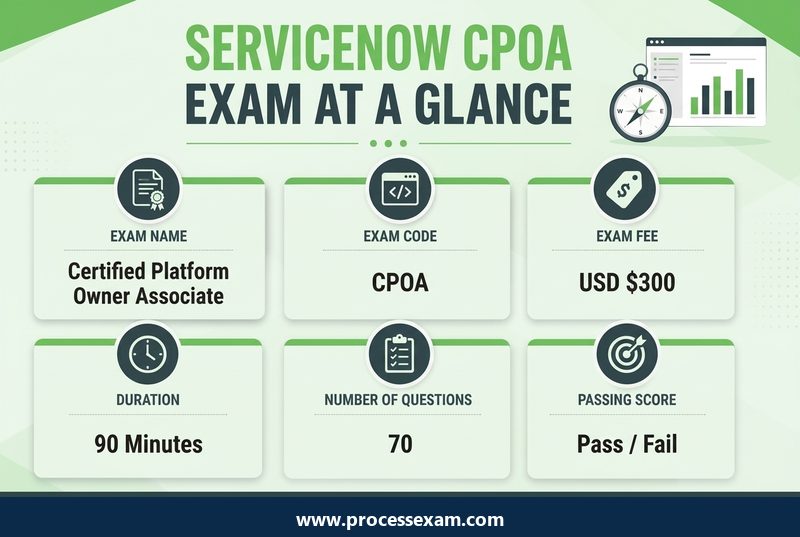
ServiceNow keeps the current blueprint, question types and policies on its CPOA exam blueprint page on ServiceNow University. Read it before you book, because ServiceNow revises exams alongside platform releases.
How does ServiceNow CPOA compare with CSA, CIS and CAD?
The easiest way to place the CPOA is by the question each certification answers. The Certified System Administrator (CSA) asks whether you can run an instance day to day. The Certified Implementation Specialist (CIS) exams ask whether you can implement one product, such as ITSM, HR Service Delivery or Customer Service Management. The Certified Application Developer (CAD) asks whether you can build custom applications. The CPOA asks whether you can decide what the platform should become and govern how it gets there.
| Certification | Main focus | Typical candidate | Style of question |
|---|---|---|---|
| CSA | Administration and configuration of an instance | New and working administrators | How do you configure or maintain this feature? |
| CIS (ITSM, HR, CSM and others) | Implementing one ServiceNow product in depth | Implementers and product consultants | How should this product be set up for this requirement? |
| CAD | Building custom applications and scripting | Developers | How do you build or script this solution? |
| CPOA | Strategy, governance and value of the whole platform | Platform owners, CoE leads, analysts, programme managers | Given this situation, which decision, role or process is right? |
CPOA vs CSA: doing versus directing
The CSA is the usual entry point into ServiceNow and remains useful background for the CPOA, because a platform owner who has never administered an instance struggles with the technology questions on upgrades, cloning and patches. The difference is the point of view. A CSA question might ask how to configure a catalog item. A CPOA question is more likely to ask what licensing implications arise when a business unit wants to start using the service catalog to serve the rest of the organisation.
CPOA vs CIS: depth versus breadth
A CIS credential proves depth in one product. The CPOA needs breadth: how ITSM, HR, security and custom applications share one data model, one release process and one governance structure. A CIS-ITSM specialist configures incident, problem and change well; a platform owner decides whether the next quarter's capacity goes to ITSM improvements, a new HR rollout or technical debt, and explains that choice to sponsors.
CPOA vs CAD: building versus deciding what to build
Developers building on the platform need CAD-level skills. The CPOA touches development only through governance: where development should happen, how code is promoted between instances, which software development life cycle suits the work and when citizen development through low-code tools is appropriate.
Where CPOA leads next
ServiceNow also offers the Certified Platform Owner Professional (CPOP), a more senior platform owner credential. The associate level is the natural first step for anyone planning to move toward it.
What does the CPOA exam syllabus cover?
The CPOA exam is built on six domains. The weightings below are the published blueprint weights, and they are the best guide to how to divide your study time.
| Domain | Weight |
|---|---|
| Strategy | 21.4% |
| People | 15.7% |
| Process | 15.7% |
| Technology | 22.9% |
| Data | 11.4% |
| ServiceNow Governance | 12.9% |
Technology and Strategy together make up more than two fifths of the exam. For the full list of objectives in each area, see the ServiceNow CPOA syllabus and exam details. The summaries below explain what each domain means in practice.
Strategy (21.4%)
Strategy is about shaping the platform's direction. You need to know the inputs to a platform roadmap, how an organisation protects its technology landscape from outages while improving visibility of its infrastructure, and what good technical governance looks like, including coding best practices. The domain also covers user experience considerations, the role of a Project Management Office during implementation and the platform capabilities that support citizen development.
Scenario questions here are common. Expect to be given a business need or an implementation strategy and asked for the right ServiceNow capability, the most efficient implementation sequence, the benefits of following an SDLC, the right application for a testing need, or the foundational element that best meets a stated goal. The domain also asks what happens when an organisation lacks a contextual Configuration Management Database (CMDB), and how the platform itself should be secured.
People (15.7%)
The People domain tests how a platform owner works with and through others. Topics include organisational change management and the scope of an OCM community champion, the factors in a communication plan, sponsorship and the reasons sponsor engagement fails, and how knowledge management should run. You will also see questions that list named roles and ask who should own a task or resolve an issue, questions on which certification shows a person is ready for a piece of work, and questions on when to bring in a supplier or a ServiceNow partner to fill a gap in expertise or time. One objective asks how a platform owner should resolve a clash when IT and Security each bring a conflicting tool.
Process (15.7%)
Process covers how change reaches production. You need to follow the stages of an application deployment process under Now Create, ServiceNow's implementation methodology, and identify the next stage from a given point. Other objectives cover code promotion methods, where development for a new requirement should be done, the drawbacks of a Waterfall approach and how to choose an SDLC and explain its benefits.
Technology (22.9%)
Technology is the heaviest domain, and it is where candidates from pure business roles most often lose marks. It covers the critical components of an upgrade, when cloning is needed and when exclusions or data preservers must be set, testing inside and outside an upgrade cycle, what a given upgrade will bring and the next step when applying patches. It also asks about the support portal and how to use it, the basic technical characteristics of the platform areas (core services, Now Intelligence, administration and configuration, integration services, and security and compliance), the implementation models available for ServiceNow and where to find compliance and regulatory documentation from ServiceNow, such as its trust and compliance resources.
Data (11.4%)
The Data domain is smaller but conceptual. You should be able to explain why data matters to the whole platform, distinguish foundational data from transactional data, decide when reporting or Performance Analytics is the right tool, give examples of value-driven metrics and describe the Strategic Planning Workspace. There is also a compliance scenario that asks which issues need to be addressed.
ServiceNow Governance (12.9%)
This domain covers the commercial and governance side of owning ServiceNow. It includes the artifacts, tools and communication channels used when dealing with licences and subscriptions; the characteristics of licence types such as fulfiller, user and capacity licences; and the three levels of governance: strategic or executive, portfolio or demand, and technical. Scenarios cover the options for integrating ServiceNow with another system (a native integration, Integration Hub, a third-party integration offered as a service, or a custom build), the licensing implications when a business area starts using the service catalog and request fulfilment, and the KPIs, such as customer satisfaction, that ServiceNow tracks.
How hard is the CPOA exam, and what is the passing score?
The CPOA is a moderate exam for experienced platform people and a hard one for anyone who has only read about the platform. Very few questions test a definition in isolation. Most describe an organisation, a conflict or a plan and ask for the best decision, so you must know not just what a feature does but when a platform owner would choose it.
ServiceNow reports the result as Pass / Fail and does not publish a numeric passing score or a pass rate. Any percentage quoted online is an estimate. A better readiness test is your own performance on timed practice questions: if you consistently finish a full set within the time limit and can explain why each wrong option is wrong, you are close.
Four things make the exam feel harder than its content suggests:
- Close answer options. Several choices are often reasonable, and only one matches ServiceNow's recommended practice.
- Role questions. Deciding which named role owns a task requires knowing the governance model well, not just the job titles.
- Technology depth. Business-focused candidates are often surprised by questions on cloning exclusions, data preservers, patches and upgrade testing.
- Time. Seventy questions in 90 minutes leaves under 80 seconds per question, so long scenarios must be read efficiently.
How do you register for and sit the ServiceNow CPOA exam?
Registration starts on ServiceNow University, where the exam blueprint and preparation materials live. The exam itself is scheduled through Pearson VUE. Before booking, read ServiceNow's CPOA certification FAQ, which answers common candidate questions, and confirm the fee and delivery options shown when you schedule, since ServiceNow may change them.
Before exam day
Check the identification rules and, if you sit the exam online, the room and equipment requirements: a quiet private room, a clear desk, a working webcam and a stable connection. Run any system test the delivery provider offers a few days in advance rather than on the morning of the exam.
During the exam
Read the final sentence of each scenario first so you know whether it asks for a role, a process step, a product or a risk. Remove options that break a governance principle, such as developing directly in production or bypassing the agreed code promotion path; they are frequent distractors. Flag anything that takes more than two minutes and return to it at the end. A first pass finished with a quarter of an hour to spare gives you room to revisit flagged questions calmly.
After the exam
You receive a Pass / Fail result. If you pass, add the credential to your professional profiles and keep up with ServiceNow's release cycle, since platform capabilities change with every family release. If you do not pass, note the domains that felt weakest while they are fresh and rebuild your plan around them before booking again.
How should you prepare for the CPOA exam in five steps?
The plan below suits a candidate who already works with ServiceNow and can study for an hour or two on most days. Allow three to five weeks in total; allow longer if the Technology domain is unfamiliar.
For the final step, the ServiceNow CPOA practice exam puts all 70 questions against the clock, which is where most candidates find out whether their time management holds.
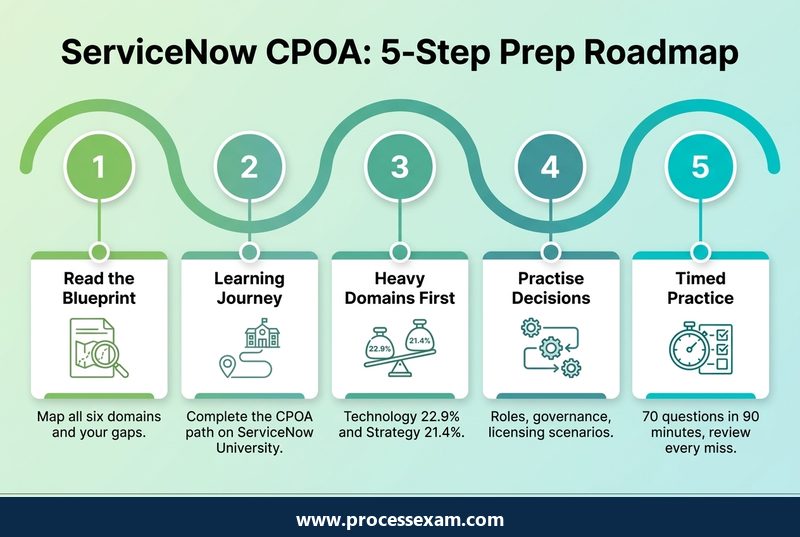
Step 1. Read the blueprint and map your gaps
Go through every objective in the blueprint and mark each one as known, partly known or new. Weight the result by domain: a gap in Technology (22.9%) matters more than a gap in Data (11.4%). This takes an evening and saves weeks of studying what you already know.
Step 2. Complete ServiceNow's learning journey
ServiceNow publishes a CPOA career journey on ServiceNow University that follows the exam's structure and uses its terminology. Work through it in order and take notes inside the six-domain structure, so your notes double as a revision guide.
Step 3. Study the heavy domains first
Spend the largest block of time on Technology and Strategy. For Technology, focus on the upgrade process, cloning with exclusions and data preservers, patching, upgrade testing and the support portal. For Strategy, practise building a roadmap from its inputs and choosing implementation sequences. If your instance access allows, look at how your own organisation handles clones and upgrades; the exam's scenarios are much easier once you have seen the real process.
Step 4. Practise decisions, not definitions
For People, Process and ServiceNow Governance, turn each objective into a decision. Who resolves this conflict? Which licence does this user need? Which integration option fits? Which governance level decides this? Writing a one-line answer and the reason for it trains exactly the judgement the scenario questions reward.
Step 5. Take timed practice exams and review every miss
Finish with full-length timed practice. A ServiceNow CPOA practice exam in the same 70-question, 90-minute format shows both your weak domains and your pace. Review every wrong or guessed answer, note the domain, and return to the material for the domain that appears most often. A rising score on fresh questions is the clearest sign you are ready.
Which mistakes cause candidates to fail the ServiceNow CPOA exam?
The same errors appear again and again, and each is avoidable:
- Treating it as a soft-skills exam. Strategy, People and Process matter, but Technology is the single largest domain at 22.9%.
- Studying from memory of old projects. Your organisation's habits may not match ServiceNow's recommended practice, and the exam marks against the recommendation.
- Ignoring licensing. Licence types and the licensing effect of new catalog or integration use are easy marks that many candidates never revise.
- Confusing governance levels. Know which decisions belong at the strategic, portfolio and technical levels.
- Skipping the SDLC objectives. Questions on Waterfall drawbacks, code promotion and where development belongs come up across two domains.
- Studying the wrong CPOA. Material for the IIBA product ownership certificate uses the same code and will not help with this exam.
- Leaving timed practice to the final day. Timed practice early in the plan exposes weak areas while there is still time to fix them.
Is the ServiceNow platform owner certification worth it for your career?
For anyone moving from configuring ServiceNow toward running it, the CPOA is one of the most relevant credentials ServiceNow offers. Large ServiceNow estates need people who can prioritise demand, manage releases and upgrades, handle licensing and show sponsors what the platform delivers. Those skills are hard to prove on a CV, and the CPOA gives employers independent evidence of them.
The credential supports several career paths:
- Platform owner or platform manager, the role the exam is designed around.
- ServiceNow Center of Excellence lead, responsible for standards, governance and release management.
- ServiceNow product owner or business analyst, turning business demand into a platform roadmap.
- Programme or delivery manager for ServiceNow implementations and upgrades.
- Consultant or advisor helping organisations set up platform governance.
The CPOA also complements the technical credentials rather than replacing them. A CSA or CIS holder who adds the CPOA can show both how the platform works and how it should be run, a combination that suits senior and customer-facing roles. For those who want to go further, the Certified Platform Owner Professional is the next level on the same path.
Choose the CSA if you are starting out, a CIS if you want to specialise in a product, the CAD if you build applications, and the CPOA if your next step is owning the platform. Whichever you pick, study against the vendor's blueprint and confirm your readiness with timed practice before you book.
Frequently Asked Questions
What is the full form of CPOA in ServiceNow?
In ServiceNow, CPOA stands for Certified Platform Owner Associate. It validates the knowledge needed to support the strategy, governance and management of the Now Platform. It is unrelated to the IIBA Certificate in Product Ownership Analysis, which uses the same abbreviation but covers business analysis for product ownership.
How many questions are on the ServiceNow CPOA exam?
The ServiceNow CPOA exam has 70 questions with a time limit of 90 minutes. That is under 80 seconds per question, so practise under timed conditions, read the final line of each scenario first and flag long questions to revisit at the end rather than stalling on them.
What is the passing score for the ServiceNow CPOA exam?
ServiceNow reports CPOA results as Pass / Fail and does not publish a numeric passing score or a pass rate. The most reliable indicator of readiness is consistently strong performance on timed practice questions, together with being able to explain why each incorrect answer option is wrong.
How much does the ServiceNow CPOA exam cost?
The ServiceNow CPOA exam fee is USD $300. ServiceNow may adjust fees or offer vouchers through its learning programmes, so confirm the current price and any voucher options on ServiceNow University or when you schedule the exam through Pearson VUE before you pick a date.
Which domain carries the most weight in the CPOA exam?
Technology is the heaviest CPOA domain at 22.9%, followed by Strategy at 21.4%. People and Process are 15.7% each, ServiceNow Governance is 12.9% and Data is 11.4%. Candidates from business roles should give extra time to Technology topics such as upgrades, cloning and patches.
Do I need the CSA before taking the ServiceNow CPOA?
ServiceNow positions the CPOA for candidates with around three to five years of ServiceNow or platform owner experience. Check the current requirements in ServiceNow's CPOA FAQ. Either way, CSA-level knowledge of how an instance works helps greatly with the Technology questions on upgrades and cloning.
- CPOA Question Bank |
- CPOA Exam Questions Download |
- CPOA Test Questions |
- Platform and AI |
- ServiceNow Platform Owner Associate Test Questions |
- Platform Owner Associate Simulator |
- Platform Owner Associate Mock Exam |
- ServiceNow Platform Owner Associate Book |
- Platform Owner Associate Certification Cost |
- Platform Owner Associate Certification Requirements |
- ServiceNow Platform Owner Associate Sample Questions |
- Platform Owner Associate PDF


