
GInI AGVA Certification: Cost, Requirements and Career Value
Becoming a GInI Authorized Growth Venture Assessor costs USD $250 for GInI members or USD $350 for non-members, and that is only the second payment: GInI will not register you until you already hold its CInP, CInS or CCInO certificate. So the real question is not the exam fee but what the credential lets you earn afterwards. This guide puts the costs, the rules and the work side by side.
The AGVA is a narrow credential. It authorizes you to assess small and medium-sized business ventures for GInI's Certified Innovative Growth Venture (CInGV) accreditation, and nothing else. Whether it pays back depends on whether that one job exists near you, which is why we start with the money and the restrictions rather than the usual list of career perks.
| Exam detail | AGVA |
|---|---|
| Full name | GInI Authorized Growth Venture Assessor |
| Exam code | AGVA |
| Vendor | GInI (Global Innovation Institute) |
| Exam fee | GInI Member USD $250; Non-Member USD $350 |
| Questions | 50, multiple choice |
| Duration | 60 minutes |
| Passing score | 75% |
All of these details were checked against GInI's own AGVA certification page in October 2026, and the exam is still on sale there with the same figures.
What does it cost to become an AGVA once the prerequisite is counted?
The exam enrollment fee is the visible cost. GInI's page lists USD $250 for members and USD $350 for non-members. The hidden cost is the certificate you need first. The AGVA exam is open only to people who hold an active GInI CInP, CInS or CCInO, so a candidate who has none of them is really buying two certifications.
| Route | Prerequisite exam fee | AGVA exam fee | Combined |
|---|---|---|---|
| CInP, then AGVA (GInI member) | USD $450 | USD $250 | USD $700 |
| CInP, then AGVA (non-member) | USD $550 | USD $350 | USD $900 |
| CInS, then AGVA (GInI member) | USD $550 | USD $250 | USD $800 |
| CCInO, then AGVA (GInI member) | USD $750 | USD $250 | USD $1,000 |
The CInP is the cheapest of the three accepted certificates, so it is the usual first step. These totals count exam fees only. They leave out the cost of GInI membership, books such as GInI's Applied Innovation Master Book, and any course you take for the prerequisite, because those prices vary and are set by GInI and its providers. If you already hold one of the three certificates, your extra outlay is just the AGVA fee.
What if you fail the first attempt?
GInI's AGVA guidebook says a candidate who fails on the first attempt can retake the exam once at half price. Every later attempt is charged at the full fee. A failed first try therefore costs about one and a half exam fees, while a third attempt returns to the full price, which is a good reason to sit a timed practice test before you pay for the real one.
What does it cost to keep the certificate?
The AGVA is not a one-time purchase. GInI asks holders to renew every three years by recording 50 Innovation Development Units (IDUs) and paying an IDU application submission fee, listed on its page as USD $100 for members and USD $150 for non-members per three-year cycle. The alternative is to sit the exam again. The guidebook quotes a slightly different administrative processing figure for renewal, so confirm the amount in the GInI store at the time you renew.
Who can sit the AGVA exam, and what must you hold first?
GInI sets three eligibility conditions, and you must meet all of them before it registers you:
- A university degree at bachelor's level or higher.
- At least two years of professional working experience in industry, academia or government.
- An active GInI certification as a CInP, CInS or CCInO.
The process after that is administrative. You pay the exam registration fee in the GInI online store, complete an AGVA exam application, return it to GInI, and then receive the link to the GInI Exam Center, where the exam is taken on a computer. Because the third condition depends on a certificate that has to be kept active, check the status of your CInP, CInS or CCInO before you pay for anything.
The earlier version of this article described the credential as suitable for any consultant or analyst. That overstated it. A consultant with the degree and the experience but no GInI certificate has to earn the prerequisite first, and the costs table above shows what that adds.
What work can an AGVA actually do, and what are they not allowed to do?
The AGVA's job is to run GInI's Innovation-Driven-Growth Readiness and Performance Assessment for a small or medium-sized venture that wants CInGV accreditation. In practice that means reading the venture's documents, visiting it on site, interviewing leadership and staff, working through the 54 questions of GInI's CInGV assessment tool, and then writing the assessment report and sending it to GInI, whose review committee decides.
The limits matter just as much as the duties. GInI's guidebook says AGVAs may not run an official CInGV assessment alone. Each one happens under the authority of a GInI Authorized Training and Assessment Provider (ATAP) or Authorized University Provider (AUP). The venture normally approaches the provider, the provider contacts the AGVA, and the venture pays the provider, which then pays the AGVA. The venture is not meant to pay you directly. GInI explains that this separation protects objectivity.
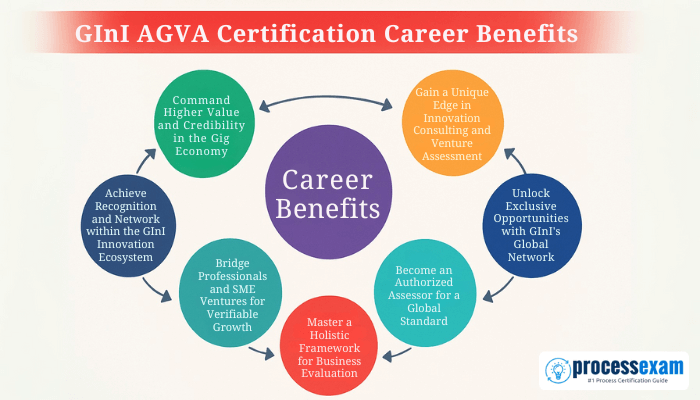
The infographic above lists the seven career benefits the old version of this article claimed. Some hold up, such as a clear specialism and a recognised standard. Two need a caveat after reading the guidebook. Work is not a public job-board pipeline, because it arrives through providers. And premium freelance rates are only possible within the provider arrangement described above. GInI itself says only that demand for AGVA services should grow as demand for CInGV accreditation grows, which is a forecast, not a promise of pay. We found no salary survey for AGVAs, so we quote no earnings figure.
What does one assessment look like from start to finish?
The guidebook describes a clear sequence, and it is worth knowing because the exam is built on the same logic:
- The provider and the AGVA agree the scope and timing of the engagement, along with their own commercial terms.
- The provider, the venture and the AGVA fix a date for the on-site assessment.
- Before the visit, the venture receives the question set so that its leaders can prepare answers and evidence, and it sends full documentation of its history, strategy and plans. GInI advises all three parties to sign a mutual non-disclosure agreement.
- On the day, the AGVA holds one-to-one interviews with leadership, management and staff and tours the facilities. At the end the AGVA may share first impressions but should not go into detail.
- Afterwards, the AGVA completes the assessment report and submits it straight to GInI. A copy may go to the provider, but neither party shows it to the venture at this stage.
- GInI's review committee checks the report. If it is satisfied, GInI notifies the venture, issues the accreditation certificate and sends the report.
Notice how much of this is about discipline: confidentiality, evidence, restraint on the day and independence from the venture. Those habits are what the credential certifies, and they explain why GInI limits who may do the work.
Which people get the most from the credential?
The role fits consultants who already advise growing companies, people who work for or alongside an ATAP or AUP, and CInP or CInS holders who want a practical use for their certificate. GInI recommends an apprenticeship after certification: shadowing an established AGVA on at least one on-site assessment and reading the resulting report, or running a first assessment under one's supervision. Seeing how the credential is used in the first year is the best test of whether it was worth the cost.
Where do the 50 questions come from across the fifteen assessment areas?
GInI says the exam mirrors the structure of the CInGV assessment itself, so its fifteen areas read like the headings of a venture review. Each area carries between one and five questions, which means no single topic can rescue or sink an attempt. You can check the full outline against our AGVA exam syllabus.
| No. | Assessment area | Questions |
|---|---|---|
| 1 | Innovation Driven Growth / IDG Readiness / IDG Performance | 3 |
| 2 | Purpose | 3 |
| 3 | Founder & Leader Engagement | 3 |
| 4 | Industry & Market Awareness | 3 |
| 5 | Leadership & Ecosystem Development | 3 |
| 6 | Market Leadership Orientation | 3 |
| 7 | Front-Line Customer Obsession | 3 |
| 8 | Active Growth Orientation | 5 |
| 9 | Future Orientation | 3 |
| 10 | Strategy Development & Execution | 4 |
| 11 | Innovation Process & Capabilities | 5 |
| 12 | Solutions, Offerings, & Marketing | 4 |
| 13 | Financials | 4 |
| 14 | Facilities, Infrastructure, & Resources | 1 |
| 15 | Outcomes, Results, & Impacts | 3 |
The figures add up to 50. Two areas carry five questions each, Active Growth Orientation and Innovation Process and Capabilities. Financials and Strategy Development and Execution carry four each, as does Solutions, Offerings and Marketing. Eight areas carry three, and Facilities, Infrastructure and Resources carries one.
What do the areas ask you to judge?
Read as a whole, the fifteen areas fall into four groups. The first group is about direction and people: Innovation Driven Growth, Purpose, Founder and Leader Engagement, and Future Orientation. Here you judge whether leaders have a purpose that is specific to the venture and whether they personally drive innovation, with GInI's outline pointing to ideas such as a bias for action and an aversion to bureaucracy.
The second group looks outward at markets and customers: Industry and Market Awareness, Leadership and Ecosystem Development, Market Leadership Orientation, and Front-Line Customer Obsession. The outline mentions industry events, ecosystem resources, relentless experimentation, major customer pain points and empowered front-line staff, so expect scenarios where a venture's behaviour must be matched to one of those ideas.
The third group covers how the venture works: Active Growth Orientation, Strategy Development and Execution, Innovation Process and Capabilities, and Solutions, Offerings and Marketing. This is where the most marks sit. The outline lists failure perception, growth mindset, international expansion, need finding, the innovation pipeline, recognition and rewards, intellectual property and feedback and validation among the sub-topics.
The fourth group is about resources and proof: Financials, Facilities, Infrastructure and Resources, and Outcomes, Results and Impacts, which includes foreign sales and growth foresight. Together these three areas carry eight questions, so a candidate strong on the first three groups can still pass with only a basic grasp of them, though not with none.
Which areas deserve extra study time?
Active Growth Orientation and Innovation Process and Capabilities together make up one fifth of the exam, so they repay careful reading first. Next come the three four-question areas, which add twelve marks between them. Financials is the one most consultants find unfamiliar, because it asks about investment capital, additional investors, sufficient capital and cash flow management from an innovation point of view. The single question on facilities and infrastructure is worth reading about, but it should not take much of your time.
How does the AGVA differ from the AInA, and which one should you aim for?
The AInA, the Authorized Innovation Assessor, is the senior assessor credential. GInI's guidebook states that AInA is a higher level of authorization than AGVA, and that an AGVA can move up by meeting the AInA requirements, including its training and exam. The key difference is scope.
| Point | AGVA | AInA |
|---|---|---|
| Accreditations it can assess | CInGV only | CInGV, plus CInOrg, CGInO, AInL, ABI and AAP |
| Exam questions and time | 50 questions, 60 minutes | 150 questions, 150 minutes |
| Passing score | 75% | 75% |
| Exam fee (member / non-member) | USD $250 / USD $350 | USD $650 / USD $750 |
An AGVA who wants to assess universities, innovation labs or whole organizations will eventually need the AInA. An AGVA who wants to work only with SMEs may never need it. Because the AGVA costs less than half as much as the AInA, many candidates choose it as a first assessor credential and decide later. If you are weighing the two, start from the kind of clients you expect to serve rather than from the cost.
With no official course, how do you prepare for the exam?
GInI's guidebook says there is no official training course for becoming an AGVA, because the skill is meant to be learned in the field. GInI's page describes two learning routes: self-study with its Applied Innovation Master Book, or a course from an accredited provider. Since the exam follows the CInGV assessment, the most useful preparation is to study it as an assessor would.
Turn each assessment area into an evidence question
For every row in the table above, ask what you would need to see in a real venture to rate it. For Financials, that might be a cash flow forecast and a record of how capital has been used for innovation. For Front-Line Customer Obsession, it might be evidence that staff who meet customers can influence the roadmap. Writing two or three such questions per area gives you thirty to forty evidence prompts, which is a stronger study aid than a page of definitions.
Read the assessment as a process, not a list
Know the sequence: the venture studies the question set, sends its documents, the assessor studies them, interviews people on site, completes the report, and GInI's review committee checks it for completeness, accuracy and credibility. Exam items often test judgment about who does what, and the order is useful for that.
Practise under the exam's rules
GInI delivers the exam online. Question order is shuffled, every item offers four choices of which only one is right, and you can go back to revisit earlier answers. The timer cannot be paused, and a lost connection does not stop the clock. At 50 questions in 60 minutes, you have a little over a minute per question. Working through the AGVA practice exam with a 60-minute timer running is the plainest test of whether you can hold that pace across all fifteen areas.
On the day
The outcome is shown the moment you submit, and GInI says the digital certificate follows within seven business days. If the result is a fail, note the areas that felt weakest, remember that the first retake is half price, and study those areas before booking.
Is the AGVA worth the combined spend, and when does it not pay back?
It pays back when three things line up. You hold, or are about to hold, a CInP, CInS or CCInO for other reasons, so the AGVA is a USD $250 or USD $350 step rather than a second full purchase. You are in a region where an ATAP or AUP sells CInGV accreditation to local businesses, so there are assessments to carry out. And you are a consultant or an academic who can fit assessment work around an existing income, since GInI does not describe the role as a guaranteed full-time job.
It does not pay back when you are looking for a credential that employers screen for in job adverts, when no GInI provider operates near you, or when you hope to assess alone and bill ventures directly. The guidebook rules that last model out. In that case, an exam you can use inside your current role may be a better use of the money.
The renewal cost belongs in the same sum. A three-year cycle adds the IDU fee and the effort of logging 50 units of innovation learning, so a fair estimate of the cost is the exam fee, plus the prerequisite if you lack it, plus roughly one renewal. Against that, GInI's stated benefits are authorization to carry out CInGV assessments, recognition as an assessor inside GInI's ecosystem, and consulting work in growth and innovation that the same skills support. Weigh those against what you can verify locally, and treat anything beyond them as optimism.
Frequently Asked Questions
How much does the GInI AGVA exam cost?
GInI lists the AGVA exam enrollment fee at USD $250 for GInI members and USD $350 for non-members. You must also hold an active CInP, CInS or CCInO first, so the full outlay is higher if you have not yet earned one of those certificates.
What is the passing score for the AGVA exam?
The AGVA exam has 50 multiple-choice questions to answer in 60 minutes, and the passing score is 75 percent. GInI shows your pass or fail outcome as soon as you submit, and the digital certificate follows within about seven business days.
Who is eligible to take the AGVA exam?
GInI requires a bachelor's degree or higher, at least two years of professional experience in industry, academia or government, and an active GInI certification as a CInP, CInS or CCInO. Without all three conditions you cannot register for the exam.
Can an AGVA run assessments on their own?
No. GInI's guidebook says AGVAs conduct official CInGV assessments only under an Authorized Training and Assessment Provider or an Authorized University Provider. The provider contracts with the venture and pays the AGVA, so the venture does not pay the assessor directly.
How long does the AGVA certification last?
The certification runs on a three-year cycle. To maintain it, GInI asks you to earn 50 Innovation Development Units and pay the IDU application submission fee, or to sit the AGVA exam again. Check the GInI store for the current renewal amount.
- Professional Certification |
- GInI Growth Venture Assessor Test Questions |
- AGVA Question Bank |
- AGVA Body of Knowledge (BOK) |
- Growth Venture Assessor Simulator |
- Growth Venture Assessor Mock Exam |
- AGVA Study Guide Material |
- Growth Venture Assessor Certification Requirements |
- GInI Growth Venture Assessor Book |
- Growth Venture Assessor Certification Cost |
- AGVA Exam Questions Download |
- AGVA Test Questions |
- Growth Venture Assessor PDF |
- GInI Growth Venture Assessor Sample Questions |
- GInI AGVA BOK PDF


