
APMP AI Micro-Certification: Exam Format, Cost and How to Prepare
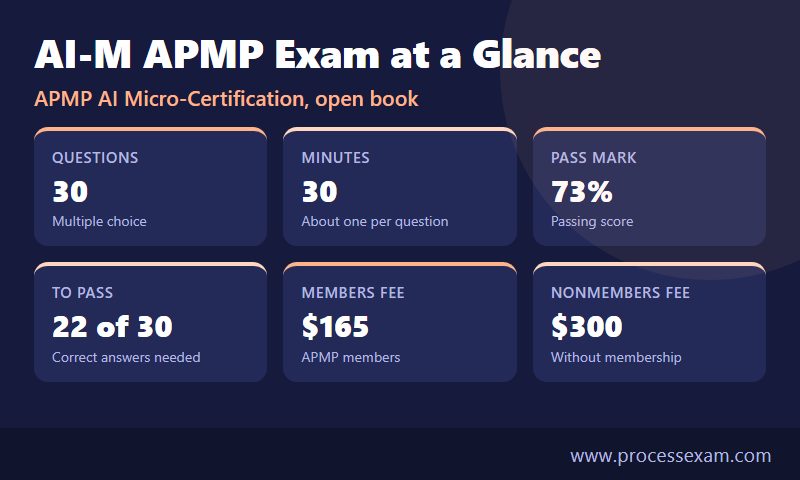
The APMP AI Micro-Certification (AI-M APMP) is a 30-question, 30-minute multiple-choice exam that checks whether you can use artificial intelligence sensibly in bid and proposal work. You need 73% to pass, which is 22 correct answers. The fee is $165 for APMP members and $300 for nonmembers, and most working proposal people can prepare in two to three weeks.
If you have been in bids for ten years or more, you probably do not need someone to tell you that AI has arrived in your team. Your colleagues are pasting requirements into chat tools, your sales director has asked whether a model can write the executive summary, and your security lead has asked you to stop. This credential exists for exactly that moment: it tests judgement about where AI helps a proposal, where it does harm, and who stays accountable for the words that go to the customer.
This guide covers what the credential is and whether the details are current, how the paper is built, what it costs, what the seven topic areas ask, who gains most from it, a three-week preparation plan and the mistakes that cost marks. The exam figures come from our exam data and match what APMP and its training providers publish; we checked them in September 2026.
What is the APMP AI Micro-Certification, and is it still current?
APMP is the Association of Proposal Management Professionals, and its main certification ladder runs Foundation, Practitioner and Professional. The micro-certifications are a separate, lighter family of short credentials, each one built around a single topic. The AI micro-certification is the one about artificial intelligence. It is not a rung on the Foundation-to-Professional ladder, so you do not need to hold any other APMP credential first, and passing it does not replace them.
The credential carries the code AI-M APMP. Its questions are drawn from APMP's AI Body of Knowledge, and APMP offers a study guide for it through its store; the listing carries the product code AIMC2025 and, at the time of our check, was priced at zero. The exam itself is booked online through APMG International, the body that runs APMP's examinations.
What we checked in September 2026
We compared our exam data with the APMP AI Micro-Certification page, the APMP study-guide store listing, the APMG International product page and the sample-paper details that training providers publish. The format they describe (30 multiple-choice questions, 30 minutes, open book, 22 of 30 to pass) matches our figures, and we found no newer edition of the AI Body of Knowledge announced. The APMP site loads much of its detail through scripts, so the fee line is the one figure you should confirm on the booking page on the day you register. If APMP publishes a revised body of knowledge, the study guide will change first, so download it fresh rather than reusing a copy from a colleague.
Micro-certification versus the main APMP levels
A micro-certification does one job. Foundation asks whether you know bid and proposal vocabulary, and Practitioner asks whether you can manage a bid through a scenario. The AI credential asks a narrower question: given a real proposal task, do you know whether an AI tool should be used, how to instruct it, how to protect the information you feed it, and how to check what comes back? That narrower scope is why the exam is short and why you can prepare for it quickly.
How is the AI-M APMP exam built, and how hard is it?
The paper is short, and that makes it different from most certification exams. Thirty questions in thirty minutes leaves one minute per question, which is enough if you know the material and tight if you have to look every answer up. Here are the figures in one place:
| Exam detail | AI-M APMP |
|---|---|
| Exam name | APMP AI Micro-Certification |
| Exam code | AI-M APMP |
| Vendor | APMP |
| Category | AI Micro-Certification |
| Number of questions | 30 |
| Duration | 30 minutes |
| Exam fee | APMP Members: $165 Nonmembers: $300 |
| Passing score | 73% |
Multiple choice and open book
All questions are multiple choice, and APMP's exam information describes the paper as open book. That sounds generous, but it is easy to misuse. A thirty-minute clock means you cannot read a chapter mid-exam. What the open-book rule really allows is a quick check of a term or a framework when you are nearly sure. Candidates who plan to look up everything run out of time by about question twenty; candidates who know the framework and use the guide to settle two or three doubtful items finish with minutes to spare.
What 73% means in practice
With thirty one-mark questions, 73% works out to 22 correct answers, so you can afford eight wrong ones. That is a more forgiving margin than it first appears, which changes how you should spend your time: do not stall on one puzzling question when a minute spent there costs you two easier ones later. Answer, flag and move on.
Time, language and adjustments
English-speaking candidates get the standard thirty minutes. Extra time is available on request to APMG for candidates who sit the exam in a second language or who have additional needs, and the request has to be made before you sit, not afterwards. If that applies to you, arrange it when you book.
How difficult is it really?
The exam is not hard for someone who works in proposals and has read the study guide once with attention. It is unforgiving for someone who has only used AI tools casually, because the questions test structured practice (evaluation criteria, oversight steps, prompt structure) rather than general enthusiasm. The most common surprise is that several answer options sound reasonable; the correct one is usually the option that keeps a human accountable and protects confidential information.
What does the exam cost, and what else should you budget for?
The exam fee is $165 for APMP members and $300 for nonmembers, so the nonmember price is nearly double the member price. Whether membership pays for itself depends on what else you want from APMP; if you only plan to sit this one exam and do not already belong, the higher price is the honest comparison, and if you are joining anyway, the member rate is worth having. Check the current membership fee on APMP's own site, because it varies by category and we do not quote it here.
Other costs, honestly listed
- Study guide. APMP's AI Micro-Certification study guide is listed in its store at no charge at the time of writing, so there is no reason to buy a summary before you have read it.
- Training. Some APMP-approved trainers run a half-day workshop that ends with the exam. It is optional and its price is set by the provider, so compare it with self-study before you commit.
- Practice material. A timed practice set is the one extra worth paying for, because reading the guide does not tell you whether you can answer thirty questions in thirty minutes. Our AI-M APMP practice exam gives you that rehearsal.
- A retake. If you do not pass, plan on paying an exam fee again. Ask APMG for the current retake conditions when you book rather than assuming a waiting period.
Is the fee worth paying?
Judge it against the size of the commitment, not against a salary promise. No public survey we could find links this micro-certification to a specific pay rise, so treat any article that quotes an AI-certificate salary bump with suspicion. The credible return is smaller and more concrete: a way to show a manager, a bid-management client or a hiring panel that you know the rules for using AI safely on proposals, at a cost of a single afternoon of exam time and a few weeks of evening study.
Which seven topics does the AI micro-credential cover?
The AI-M APMP content is usually described as seven learning areas. The wording below follows the outlines published by APMP training providers; the study guide is the authority on emphasis, so read it against this list. Our AI-M APMP syllabus page lays the same ground out for practice work.
1. What role does AI play in proposal management?
This area sets the scene: where AI fits in the bid lifecycle, what it does well (summarising, restructuring, first drafts, consistency checks) and what it does badly (facts it has not been given, nuance about a particular customer, commitments that only a person can make). Expect questions that describe a task and ask whether AI is a sensible tool for it, and what limits should apply.
2. How is AI used in RFP responses?
Here the questions get practical: analysing an RFP for requirements, building a compliance matrix, drafting answers from a content library, tightening a long response to a word limit, and preparing review comments. The trap is to pick the answer that uses AI for everything. The stronger answer usually assigns AI the repetitive work and leaves scoring, pricing and win strategy with the team.
3. How do you select the right AI tools?
Questions here revolve around an evaluation framework: what does the tool do, where does your data go, who can see it, how accurate is the output for your kind of content, and what does it cost to run and support? You will not be tested on product brand names. You will be tested on the criteria you would apply to any of them.
4. How do you balance AI innovation with security and ethics?
This is the area experienced bid managers tend to enjoy, because they already work under confidentiality rules. Think about customer-restricted information, competitor data, personal data in CVs and case studies, contractual limits on third-party processing, and disclosure. When a scenario involves pasting confidential material into a public tool, the safe answer is rarely the one that says "just be careful".
5. Why does human oversight matter in AI-assisted writing?
Expect questions on review steps: fact-checking, checking that claims are evidenced, testing the text against the customer's requirements and win themes, and keeping a named person accountable. An AI draft is an input to the normal review cycle, not a way to skip pink or red team.
6. How do you write effective prompts for proposal work?
Prompt engineering appears as a set of techniques rather than tricks: give the tool a role and an audience, supply the relevant source material, state the format, length and tone, ask for reasoning you can check, and iterate rather than expecting a perfect first answer. If you have never written a structured prompt, practise on a real section of a past bid before the exam.
7. Where is AI in proposals heading?
The last area covers emerging trends and good adoption practice: piloting on low-risk tasks first, training the team, setting written guidelines, measuring the result and revisiting policy as tools change. Questions here reward a staged, governed approach over either blanket bans or unrestricted use.
Who gains most from the credential, and what does it change at work?
The syllabus is aimed at proposal managers and writers, and at the people around them who write in their roles: capture leads, business developers, solution architects and subject matter experts. Public course outlines list no experience requirement for the exam, and some training providers ask for APMP membership at enrolment, so check the terms of whichever route you choose. Here is where the credential earns its keep.
When you feel your skills are ageing
A common mid-career worry is that a decade of craft is being commoditised. The credential gives you a defensible answer. You can be the person who sets the rules for AI in the bid room instead of the person those rules are applied to. That is a leadership position, and it needs nothing more than the knowledge the exam checks.
When a team is already using AI without rules
Many bid teams adopted AI tools informally and now have no shared practice. Having passed the exam gives you standing to propose one: which tasks are allowed, which data never leaves the company, how AI-drafted text is reviewed and how its use is disclosed when a customer asks.
When you are moving to a new employer or client
A short, specific credential is easy for a recruiter to scan for and easy for an interviewer to probe. Put the code, AI-M APMP, and the month you passed on your profile, and be ready to give one concrete example of an AI decision you made on a bid, because that is the follow-up question you will get.
What it does not do
It does not replace the Foundation or Practitioner levels, it does not certify your ability to build models, and it does not guarantee a promotion. It shows applied judgement in a narrow field, and its value depends on whether you use that judgement at work afterwards.
How can you prepare in three weeks, working a few hours each week?
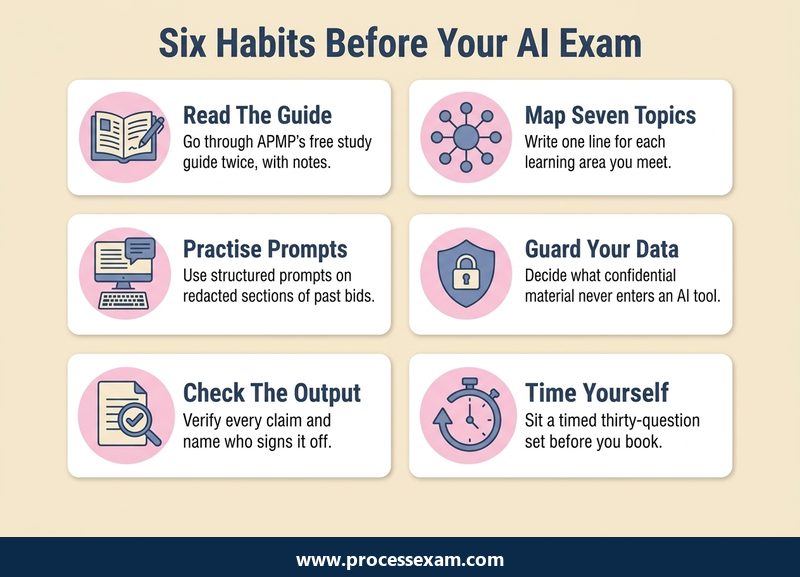
A short paper needs a short plan, but not a casual one. This schedule assumes about four hours a week alongside a full-time job.
| Week | Focus | What to finish |
|---|---|---|
| 1 | Read and map | Read the whole APMP study guide once; write one line for each of the seven topic areas; list every framework or list in the guide |
| 2 | Apply | Run three real proposal tasks through an approved AI tool with structured prompts; write down what you would check before sending any of it to a customer |
| 3 | Rehearse | Take the APMP sample paper, then a timed practice set; review every wrong or guessed answer against the guide |
Week one: read the guide with a pencil
Start from APMP's own AI Micro-Certification study guide, not from a third-party summary. Read it once straight through, then a second time with the seven topic areas beside you. Mark the lists, since exam writers like to ask which item does not belong to a list, or which step comes first.
Week two: use AI on real work
Nothing sets a framework in memory like using it. Take a redacted paragraph from a past bid and prompt an approved tool to summarise it, tighten it and check it against a made-up requirement. Note what the tool got wrong. The errors you catch here are the kind the human-oversight questions describe. If your employer bans AI tools, do the same exercise on paper: write the prompt you would use and the checks you would run.
Week three: time yourself
Sit the official sample paper that APMG publishes, then a timed practice set. Aim to finish the first pass in twenty-five minutes so that five remain for flagged questions. If your practice score is stuck below 22 of 30, go back to the study guide for the topic areas where you lose marks rather than doing more questions.
The night before and the day itself
Book through the APMG public booking page well ahead of the date you want. On the day, check the online-exam requirements for your device, close every other application, and keep the study guide open in a separate window if you plan to use it. Read the last sentence of each question first so you know what is being asked, eliminate the options that put confidential data at risk or remove human review, and flag anything that takes more than ninety seconds.
Where do AI-M APMP candidates usually go wrong?
Most failed attempts come down to a handful of habits, all avoidable.
- Choosing the most automated answer. The exam favours governed use of AI, so an option that hands a whole task to a tool and skips review is usually wrong.
- Ignoring data protection. When a question mentions customer or personal data, look for the answer that protects it before it looks for the one that saves time.
- Treating open book as no revision. Thirty minutes is too short to research thirty questions.
- Learning prompt tricks instead of principles. The paper asks about structure and context, not clever phrasing.
- Studying only the guide, never the clock. Knowing the content and finishing on time are separate skills; practise both.
- Relying on an old copy of the guide. Download the current version from APMP each time you prepare.
When you feel ready, use the free sample questions first, then a full timed practice exam, and only then book your slot. If your practice scores are steadily above 22 of 30 with time left over, you are ready to sit the paper.
Frequently Asked Questions
What is the APMP AI Micro-Certification?
It is a short APMP credential, coded AI-M APMP, that checks whether you can use AI responsibly in bid and proposal work. It covers where AI helps, how to choose tools, security and ethics, human oversight and prompt writing, and it is separate from the Foundation, Practitioner and Professional levels.
How many questions are on the AI-M APMP exam and what is the pass mark?
The exam has 30 multiple-choice questions to answer in 30 minutes. The passing score is 73%, which means at least 22 correct answers out of 30. Extra time can be requested from APMG before the exam for second-language candidates or those with additional needs.
How much does the APMP AI Micro-Certification cost?
The exam fee is $165 for APMP members and $300 for nonmembers, so nonmembers pay nearly double. Budget separately for any training workshop or practice material, since APMP lists the official study guide at no charge at the time of writing.
Is the AI-M APMP exam open book?
Yes, APMP describes the exam as open book, but the thirty-minute limit leaves about one minute per question. You can use the study guide to settle a doubtful term or framework, not to research every answer, so learn the material before you sit.
How long does it take to prepare for the APMP AI Micro-Certification?
Most people working in proposals need about two to three weeks at a few hours a week. Read the APMP study guide, use AI on real proposal tasks, then finish with a timed practice set until you score above 22 out of 30 with time left.
- AI-M APMP Question Bank |
- APMP AI-M APMP BOK PDF |
- AI-M APMP Test Questions |
- APMP Artificial Intelligence Question Bank |
- APMP Artificial Intelligence Book |
- APMP Artificial Intelligence Study Guide |
- Artificial Intelligence Certification |
- Artificial Intelligence Certification Cost |
- Artificial Intelligence Certification Requirements |
- AI-M APMP Exam Questions Download |
- APMP Artificial Intelligence Exam Questions |
- APMP Artificial Intelligence Sample Questions |
- Artificial Intelligence |
- Artificial Intelligence PDF |
- AI-M APMP Body of Knowledge (BOK) |
- AI Micro-Certification |
- Artificial Intelligence Simulator |
- Artificial Intelligence Mock Exam


