
ASQ CQA: 7 Essential Resources to Pass the Quality Auditor Exam
Updated on 21 September 2026. What’s new: CQA exam fees corrected to $450, $550 and $350 for retakes, and the syllabus updated to ASQ's 2026 Body of Knowledge.
You have been running internal audits for six years, your manager has started saying you should have the CQA after your name, and the ASQ application page is open on your screen with three different fees on it. Is the credential worth the money and the paperwork, and if it is, what do you actually read first? For anyone who audits for a living the answer to the first question is yes, and the answer to the second is the 2026 Body of Knowledge, not a textbook.
That order matters more than most candidates expect. The ASQ Certified Quality Auditor exam is an open-book test built from a published outline, which means the outline tells you what to buy, what to read closely and what to leave alone. This guide keeps the seven resources that matter, puts them in the order a working auditor should use them, and ties each one to the domain it is supposed to cover.
Is the ASQ CQA certification worth the fee and the experience it demands?
The ASQ Certified Quality Auditor credential makes a narrow and useful claim on your behalf: that you can plan an audit, select the right criteria, gather objective evidence, group observations into findings that survive challenge, and follow corrective action through to closure. That is a different skill from knowing a quality management system well. Plenty of excellent quality engineers make poor auditors, and the CQA exists precisely to separate the two.
It is not an entry-level credential, and the eligibility rules say so. ASQ asks for eight years of on-the-job experience in one or more areas of the Body of Knowledge, of which at least three years must have been spent in a decision-making position. Education shortens the requirement rather than replacing it: a technical or trade diploma waives one year, an associate degree two years, a bachelor's degree four years and a master's or doctorate five years. If you hold a bachelor's degree and four years of audit-related work, you are already eligible.
The fee depends on your ASQ membership status, and the difference is large enough to be worth a calculation before you apply. Here is what the exam looks like in one place.
| Exam detail | ASQ CQA |
|---|---|
| Certification | ASQ Certified Quality Auditor (CQA) |
| Exam code | CQA |
| Vendor | ASQ |
| Number of questions | 165 |
| Exam time | 318 minutes (5 hours 18 minutes) |
| Total appointment time | 330 minutes (5.5 hours) |
| Exam fee | ASQ members - $450 Non-members - $550 Retakes - $350 |
| Passing score | 550/750 |
| Category | Auditing |
Read the fee line as a decision, not a cost. The $100 gap between the member price of $450 and the non-member price of $550 is close to the price of ASQ membership itself, and membership also gets you a discount on the handbook you will want anyway. The $350 retake fee is worth knowing for a different reason: it is the price of sitting the exam underprepared, and it is the strongest argument for taking timed practice seriously before you book a window.
What you get back is portability. Quality auditing is one of the few roles where a single credential is recognised across manufacturing, medical devices, aerospace, food, pharmaceuticals and services, because the underlying audit process barely changes between them. A CQA on your profile tells a supplier quality manager in an industry you have never worked in that you know how to run a second-party audit without being taught. ASQ maintains the current requirements, fees and testing windows on its official Quality Auditor certification page, and it is the only source worth trusting for those numbers.
What does the 2026 CQA Body of Knowledge actually test?
This is the question that decides which resources you buy, and it is the one where old study advice does the most damage. ASQ began testing a new Certified Quality Auditor Body of Knowledge with the April 2026 testing window, and the weighting moved noticeably. Any guide, blog post or question set written against the previous outline is now pointing you at the wrong proportions.
The exam delivers 165 multiple-choice questions, of which 150 are scored and 15 are unscored pretest items you cannot identify while you are sitting there. The 150 scored questions are distributed across five domains.
| Domain | 2026 scored questions | Previous outline |
|---|---|---|
| I. Auditing Fundamentals | 37 | 28 |
| II. Audit Process | 45 | 44 |
| III. Auditor Competencies | 30 | 24 |
| IV. Audit Program Management and Business Applications | 23 | 30 |
| V. Quality Tools and Techniques | 15 | 24 |
Two shifts stand out. Auditing Fundamentals gained nine questions and now explicitly covers desk audits built on questionnaire-based assessments, hybrid audits and fully remote audits, along with how audits provide an independent view of cybersecurity risk. Auditor Competencies gained six, which is ASQ saying plainly that interviewing, conflict handling, team dynamics and presenting results in remote and multi-site settings are examinable skills, not soft extras. Quality Tools and Techniques lost nine questions but not its difficulty: acceptance sampling is now tested at the Apply level rather than merely Understand, so fewer questions ask you to do more.
Roughly 10 to 15 percent of the exam comes as case studies. Each one gives you a short audit scenario plus supporting documents supplied during the exam, and then asks ordinary four-option questions about it. They are not harder than the rest of the paper, but they are slower, and candidates who have never practised reading an audit document under time pressure lose minutes they had not budgeted.
Where the marks really sit
Domain II, Audit Process, remains the largest single block at 45 scored questions, and it runs in the order a real audit runs: preparation and planning, auditor selection, logistics, working papers and sampling, the opening meeting, data collection, establishing and organising objective evidence, the exit and closing meetings, report development, then the corrective and preventive action cycle through to audit closure. If you can narrate that sequence from memory and say what goes wrong at each step, you have secured the largest domain on the exam.
Domain V is where most candidates over-invest. Fifteen questions cover Pareto charts, cause and effect diagrams, flowcharts, SPC charts, check sheets, scatter diagrams, histograms, root cause analysis, PDCA, Six Sigma DMAIC, lean tools, basic statistics, common versus special cause variation, Cp and Cpk, outliers, sampling plans, change control, verification versus validation and risk tools such as FMEA. That is a lot of surface for fifteen marks. Know what each tool is for and how to read one; do not try to become a statistician. Our domain-by-domain CQA exam syllabus breakdown lists the sub-topics under each of the five areas if you want to build a checklist from them.
Which seven resources earn their place in a CQA study plan?
The list below has not changed in spirit since this article first ran, but what sits behind each item has. Use them roughly in this order. Each one does a job the others cannot.
1. ASQ's 2026 Body of Knowledge, used as a checklist
Download it first and treat it as a document you write on, not one you read. ASQ publishes the 2026 CQA Body of Knowledge as a free PDF, and every line in it carries a cognitive level in brackets: Understand, Apply, Analyze, Evaluate or Create. Those brackets are the most underused study aid in the whole exam. A topic marked Understand will be asked as a definition or a distinction. A topic marked Evaluate or Create will be asked as a scenario where you judge something or build something, which is why "evaluate the acceptability of a proposed CAPA and its completion schedule" cannot be revised from a glossary.
Practically: copy the outline into a spreadsheet, one row per sub-topic, with columns for the cognitive level, where you will study it and a confidence score out of five. That sheet becomes your progress tracker for the next three months and stops you from re-reading the chapters you already enjoy.
2. The Certified Quality Auditor Handbook
ASQ Quality Press publishes the CQA Handbook, and it remains the one book the exam is genuinely built around. Its structure follows the Body of Knowledge, its vocabulary is the vocabulary the question writers use, and its appendices give you the audit forms, checklists and report structures that Domain II keeps asking about.
Read it once at normal speed to build the map, then stop reading and start using it. Because the CQA is open book, the handbook is also the reference you are most likely to carry into the exam, so how you mark it up matters as much as how you read it. Tab the chapters by domain, flag the tables and figures you would want under time pressure, and write your own one-line summaries in the margins. A handbook you have annotated is worth far more in the exam room than a pristine one.
3. A timed CQA practice test you sit more than once
Reading about audits and answering questions about audits are different skills, and only one of them is examined. A full-length timed test is the only resource on this list that measures both your knowledge and your pace at the same time, and pace is a real constraint here: 318 minutes across 165 questions is roughly one minute fifty-five seconds each, and the case studies eat into that.
Take your first one early, around the end of your second month, when it will feel uncomfortable. The score is not the point; the report is. Sort your wrong answers by domain, and if Domain II and Domain III are where the losses cluster, you have learned something that no amount of re-reading would have told you. Then keep taking them, on fresh questions, until your score stops moving. Our CQA practice test holds the same 165-question clock, and the distance between your first attempt and your third is the most honest progress report your preparation will produce.
PDF question dumps versus an online practice test
Many candidates search for a CQA exam questions PDF, and the appeal is obvious: it is offline, it is portable, and it looks like a shortcut. The problem is that a static file cannot do the two things that make practice useful. It cannot randomise, so after the second pass you are remembering the position of the answer rather than the reasoning behind it, and it cannot time you or track which domain you keep losing marks in.
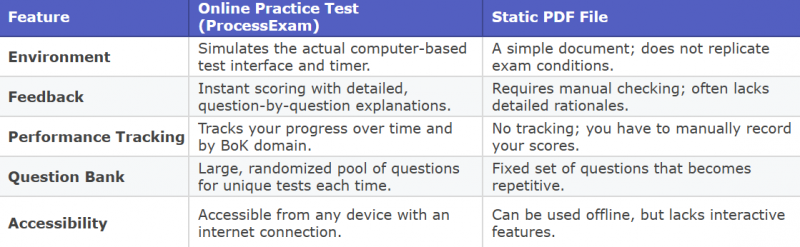
Use a PDF the way you would use flashcards on a train: fine for recall, useless for rehearsal. The rehearsal has to happen on a clock.
4. The standards you audit against
The Body of Knowledge asks you to define and distinguish audit criteria: external standards, contracts and quality agreements, specifications, policies and the internal quality management system. Candidates who audit to one standard every day tend to answer these questions from habit rather than from principle, and habit is what the distractors are built from.
Spend a session on the auditing guidance itself rather than on the management system standard you know best. The distinction between first-party, second-party and third-party audits, the difference between a compliance audit and a for-cause audit, and the definition of audit independence are all cheap marks in Domain I, and all of them come straight from the guidance on auditing management systems.
5. A second author for the topics that will not stick
Every candidate has two or three topics that refuse to land. For most people it is acceptance sampling terms, the Cp and Cpk discussion, or the boundary between verification and validation. One book explaining a concept one way is not a teaching strategy; it is a single point of failure.
Keep a short list of the topics you have failed to explain out loud, and go looking for a second explanation of each, whether that is another auditing title, an ASQ conference paper or a recorded course. The test is simple and worth repeating: can you explain consumer risk and producer risk to a colleague, without notes, in under a minute? If not, the topic is not finished.
6. Sample questions and a question bank you review rather than memorise
Sample questions do a job early that full practice tests do later. They show you the shape of a CQA question before you have studied enough to sit a whole paper: four options, usually more than one defensible, with the right answer turning on a single word such as "objective", "independent" or "shall". Working through twenty of them in week one recalibrates how carefully you read.
The review habit is what turns a question bank into a study tool. For every question you get wrong, write one line about why the correct answer is correct and one about why the option you chose is wrong. For every question you guessed correctly, do the same. Candidates who skip the second half of that rule plateau, because a lucky guess feels identical to knowledge until exam day.
7. Other auditors, in a group or a forum
The CQA rewards judgement, and judgement is easier to develop in conversation than alone. An ASQ section meeting, a study group of three or four candidates, or an active professional forum gives you something no book does: other people's audit situations, argued through.
Bring specific material to it. Take a case study, a difficult CAPA scenario, or a finding you had to word carefully, and ask how others would have handled it. Explaining your reasoning aloud is also the fastest way to discover the topics you only half know, which is why the candidate who runs the study group usually scores better than the ones who attend it.
How should you sequence those resources across twelve weeks?
Twelve weeks at five to seven hours a week suits a working auditor. Compress it to eight if you already audit full time against a standard you know well; stretch it to sixteen if the statistical tools in Domain V are unfamiliar territory.
| Weeks | Focus | What you finish with |
|---|---|---|
| 1-3 | Map the outline | The Body of Knowledge in a spreadsheet with cognitive levels, one read-through of the handbook, twenty sample questions attempted |
| 4-6 | Domain II in depth | The audit lifecycle narrated from memory, working papers and sampling understood, first full timed practice test taken |
| 7-9 | Domains I and III | Audit types, criteria, ethics and credibility; interviewing, conflict resolution, team dynamics and remote reporting |
| 10-11 | Domains IV and V | Program management, cost of quality, and every tool in Domain V readable at a glance; second and third timed tests |
| 12 | Consolidate | Reference books tabbed for open book use, repeat misses re-read, one final timed test, no new material |
Two rules keep the plan honest. Do not let the first timed test slip past week six, because its only real value is the time it leaves you to act on the result. And spend the final week tabbing your references rather than learning anything new, because in an open-book exam the speed at which you can find a table is worth more than a fact you learned the night before.
What should you plan around on CQA exam day?
The CQA is an open-book exam, and candidates misread that in both directions. It does not mean you can look things up as you go; there is nowhere near enough time for that. It does mean you can carry bound reference material, and ASQ is specific about what bound means. References must be permanently bound by stitching or glue, or fastened securely in their cover by fasteners. Sticky tabs are allowed as book tabs only if you attach them before you enter the test centre, so do that at home.
Computer-based delivery gives you 165 questions in 318 minutes of exam time inside a 330-minute appointment; the extra twelve minutes cover check-in and the tutorial, not the paper. Paper-based delivery, where it is offered, is a 150-question five-hour exam. Both are in English only.
The exam runs in testing windows rather than on demand, and each window closes its application some weeks before it opens, so the date you can sit is decided earlier than most candidates realise. Check the current windows and their application deadlines and then apply for your exam with enough margin that a document problem does not cost you a whole window.
Pacing the paper
Divide the paper into blocks and check the clock at each boundary. At one minute fifty-five seconds per question, finishing 55 questions at the two-hour mark keeps you comfortably ahead. Answer every question, because there is no penalty for a wrong answer and an unanswered one scores the same as a wrong one. Flag anything that takes more than three minutes, move on, and give the case studies the surplus you have built up, since those are the questions where the supporting documents genuinely reward a careful read.
Which mistakes cost candidates the CQA exam?
- Studying to the old outline. Domains I and III grew, IV and V shrank. Preparing to a pre-2026 weighting means over-studying quality tools and under-studying audit types and auditor competencies.
- Answering from your own quality system. The exam asks what the audit profession does, not what your employer does. When an option feels obviously right because it is what your site does, check it against the standard instead.
- Treating Domain III as common sense. Thirty scored questions sit on interviewing technique, conflict resolution, team development stages and presentation methods. They are examinable content with named models.
- Carrying unbound references. Loose printouts and unbound notes are turned away, and an open-book exam without your book is a much harder exam.
- Leaving the first practice test to the final fortnight. A diagnostic you cannot act on is a diagnostic wasted.
- Confusing evidence with findings. Objective evidence is observed, measured, confirmed, corroborated and documented. A finding is what you get after evidence has been grouped and assessed for significance and risk. Several questions turn on that boundary.
- Ignoring the unscored questions. Fifteen of the 165 do not count and you cannot tell which. Stalling on a question you find strange may mean stalling on one worth nothing.
How do you keep the CQA credential once you have passed?
The Certified Quality Auditor is not a lifetime credential. ASQ requires holders to earn 18 recertification units within a three-year recertification period, or to retake the exam at the end of it. Recertification by journal costs $120 for ASQ members and $160 for non-members, and holders of more than one certification can synchronise them so the periods and the paperwork line up.
Recertification units are easier to collect than most people expect, because the audits you already perform count toward them, alongside training, teaching, publishing and professional participation. The candidates who struggle are the ones who log nothing for two and a half years and then try to reconstruct it. Start a simple record on the day you pass, and keep it where your audit records live. ASQ sets out the categories, limits and deadlines on its recertification page.
Seen over three years, the arithmetic is mild. A member pays $450 once and $120 every third year, and in return holds a credential that travels across industries and is recognised by employers who will never read your internal audit reports. Weighed against the $350 you would pay to sit the exam a second time, the case for preparing properly the first time makes itself.
Frequently Asked Questions
What is the ASQ CQA exam fee?
The CQA exam fee depends on your ASQ membership. ASQ members pay $450, non-members pay $550, and a retake costs $350 for either group. Because membership costs less than the $100 gap between the two initial fees, most candidates join ASQ before applying for the exam.
How many questions are on the CQA exam and how long is it?
The computer-based CQA exam has 165 multiple-choice questions, of which 150 are scored and 15 are unscored pretest items. Exam time is 318 minutes, or 5 hours 18 minutes, inside a total appointment time of 330 minutes that also covers check-in and the tutorial.
What is the passing score for the ASQ CQA exam?
The passing score is 550 out of 750 on a scaled score, not a raw percentage. Scaling keeps different versions of the exam equivalent in difficulty, so you cannot convert 550/750 into a fixed number of correct answers out of the 150 scored questions.
Is the CQA exam open book?
Yes. You may bring your own reference material, but it must be permanently bound by stitching or glue, or fastened securely in its cover by fasteners. Sticky notes are allowed as book tabs only when attached before you enter the test centre, so tab your references at home.
What changed in the 2026 CQA Body of Knowledge?
The 2026 outline redistributed the 150 scored questions to 37, 45, 30, 23 and 15 across the five domains. Auditing Fundamentals and Auditor Competencies grew, adding remote, hybrid and questionnaire-based audits and cybersecurity risk, while Audit Program Management and Quality Tools each shrank.
What experience do you need to sit the CQA exam?
ASQ asks for eight years of on-the-job experience in areas of the Body of Knowledge, with at least three years in a decision-making position. Education waives part of it: one year for a technical diploma, two for an associate degree, four for a bachelor's and five for a master's or doctorate.
How often does a Certified Quality Auditor have to recertify?
Every three years. Holders must earn 18 recertification units within each three-year period or retake the exam. Recertification by journal costs $120 for ASQ members and $160 for non-members, and the audits you already perform count toward the units alongside training and teaching.
- ASQ Quality Auditor Sample Questions |
- CQA Exam Questions Download |
- CQA Test Questions |
- Quality Auditor PDF |
- ASQ Quality Auditor Book |
- ASQ CQA BOK PDF |
- Quality Auditor Certification Cost |
- Quality Auditor Certification Requirements |
- ASQ Quality Auditor Test Questions |
- CQA Question Bank |
- CQA Body of Knowledge (BOK) |
- Auditing |
- CQA Handbook


