
CInA Certificate for Students: Cost, Eligibility and Syllabus
Picture a final-year business student with a degree on the way, a society role and one summer internship, wondering whether a $300 or $350 certificate adds anything to that CV. For the GInI Certified Innovation Associate it can, provided you are the audience it was built for: a junior, senior or graduate student with no professional experience yet. The exam is 90 multiple-choice questions in 90 minutes with a 60% pass mark.

This guide is written for that student. It covers who is allowed to sit the exam, what the whole route costs once the compulsory reference book is counted, how the 90 questions are spread across eleven sections, what a realistic study route looks like beside coursework, and what happens after you pass. Every rule and fee comes from GInI's own CInA page and its guidebook, checked in October 2026.
Is the CInA certificate worth it for a student about to graduate?
It is worth it when you want a recognised, innovation-specific line on a CV that otherwise looks like every other graduate's. GInI describes the credential as its recognition of university students, usually those nearing graduation, who understand the basics of business innovation and of working as a contributing innovator inside a company. It is an entry-level credential, and it is priced and examined as one.
What the certificate does and does not do is worth stating plainly.
- It signals vocabulary and method. A recruiter reading a graduate CV for a product, consulting, strategy or start-up role sees that you have been examined on research, design thinking, innovation projects, pitching and funding, not just that you attended a module.
- It gives you something specific to talk about. Interview questions such as "tell me about a time you solved a problem in a new way" become easier when you can name a method and a project phase.
- It does not replace experience. Nothing in GInI's material promises a job or a salary, and this guide quotes no salary figures for that reason.
- It is not for everyone. If you already work in a business, GInI's professional-level credentials are the better fit, and the Associate is not open to you on the usual terms.
A fair test is the cost-to-evidence ratio. For the price of a textbook and an exam fee you obtain a dated, verifiable credential. Compared with an unpaid course certificate, that is a stronger signal. Compared with a second internship, it is a weaker one. The two work best together.
Roles where the knowledge is actually used
The syllabus maps onto early-career work that sits near new products and new ventures: research and insight assistants, product and service design teams, innovation or strategy graduate programmes, incubator and accelerator support roles, and start-up founding teams. The common thread is that the work begins with an unclear problem, not a ready brief.
Who is allowed to take the CInA exam, and what do you need first?
The exam is not open to everyone. GInI's page states two requirements: you must be registered as a junior or senior in an accredited university programme, and you must show proof of owning the GInI Innovation Associate Reference Book, usually shortened to InARB. Its guidebook adds that graduate students in any accredited programme can also qualify when they have no earlier experience working in a professional business setting, and describes the target group as students generally within two years of their expected graduation date.
The process runs in a fixed order, and GInI applies it to every candidate.
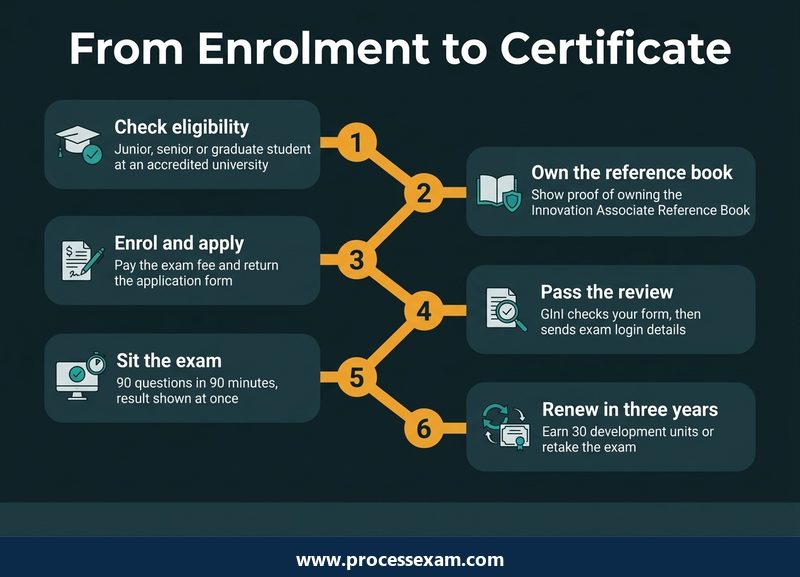
- Enrol for the exam in GInI's online store and enter your reference book serial number if you already own the book.
- Pay the exam enrolment fee.
- Complete the application form GInI emails you and return it.
- GInI reviews the form against the eligibility rules. When it passes, you receive login details for GInI's online exam centre within 48 hours.
- Sit the exam there, on a computer. Paper-based testing is not available.
What an application audit means for you
GInI audits a percentage of applications at random. If yours is chosen, you are told by email after payment and asked for supporting paperwork such as a copy of your diploma or its local equivalent. You get 90 days to send it, and the guidebook says you cannot continue with certification until the audit is complete. Students should keep proof of enrolment to hand and treat this as routine admin rather than a warning sign.
How much does the CInA cost in total, and what if you do not pass first time?
The exam fee is the smaller half of the story for many students, because the reference book is compulsory and sold separately. The table below puts the figures together, all in US dollars and all from GInI's published fee tables.
| Item | GInI member | Non-member |
|---|---|---|
| Exam enrolment fee | USD $300 | USD $350 |
| Innovation Associate Reference Book (InARB) | USD $75 | USD $125 |
| Total to certify, first attempt | USD $375 | USD $475 |
| IDU application fee, every three-year cycle | USD $50 | USD $100 |
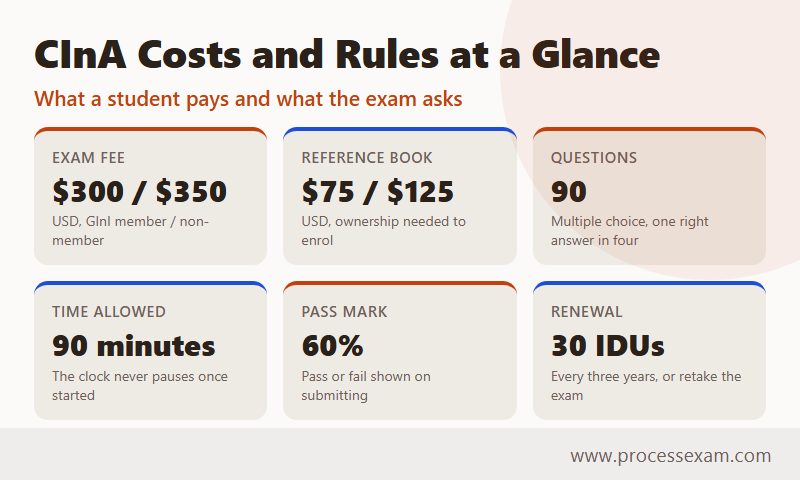
The totals are simple addition of the exam fee and book price; GInI does not publish a bundle price on the pages read for this guide. Membership has its own cost, so a student who is not already a member should compare the saving of $50 on the exam and $50 on the book against what membership asks before assuming it pays for itself.
The exam at a glance
| Detail | CInA |
|---|---|
| Full name | GInI Certified Innovation Associate |
| Exam code | CInA |
| Vendor | GInI |
| Number of questions | 90 |
| Duration | 90 minutes |
| Passing score | 60% |
| Exam fee | GInI Member USD $300; Non-Member USD $350 |
Failing, retaking and the half-price second attempt
GInI's guidebook states that a candidate who fails can retake the exam an unlimited number of times, that the first retake is at half price, and that later retakes cost the full fee. The pass or fail result appears as soon as you submit, so you will know the same day. Read the retake terms again on GInI's page before you pay, since fee policies are the part of any programme most likely to be updated.
How are the 90 questions spread across the eleven reference-book sections?
GInI publishes a blueprint that shows the share of questions drawn from each section of the reference book. It is the most useful single page for planning, because the weights are very uneven.
| Reference-book section | Share of questions |
|---|---|
| Founders & New Business Ventures | 38% |
| Design Thinking & Human-Centered Design | 12% |
| Running Innovation Projects in the Business | 10% |
| The Role of Research in Innovation Projects | 10% |
| The Effective Innovator | 8% |
| Fundamentals of Innovation | 4% |
| Innovation's Design Outputs | 4% |
| Creativity & Creativity Methods | 4% |
| Ideation & Brainstorming | 4% |
| The GInI Breakthrough Innovation Method | 4% |
| The Three Phases of Innovation Project Work | 2% |
Three readings of this table matter. First, one section decides the result: the venture material is 38% on its own, more than the research, project and design thinking sections together would suggest at a glance. Second, the five 4% sections and the 2% section look small, but together they are 22% of the paper, so they cannot be skipped. Third, the chapter numbers GInI attaches to each row show how the book is laid out: the venture block spans chapters 21 to 23, design thinking chapters 17 to 20, and project running chapters 13 to 15, so those three can be read as whole runs of chapters.
The section-by-section topic list is on the CInA exam syllabus breakdown page, which follows the same eleven headings.
One correction worth making to common advice
Some summaries describe the three phases of innovation work as discovery, definition and development. GInI's own outline names them the Front End, the Mid Zone and the Back End, and the exam uses that wording. Learn GInI's labels, because answer options reuse them.
What does the heavy venture section expect you to know?
Since the founders and new ventures material carries 38% of the questions, it deserves most of your study hours. GInI's outline lists four strands inside it, and each one suits a different kind of revision.
Starting a venture and writing the plan
This strand covers what founders do and how a new business is put on paper. Expect questions on the parts of a business plan and which part answers which investor worry: the problem, the customer, the offer, the way money comes in and the way the venture grows. A useful habit is to take a business you know, such as a campus food stall, and write a one-paragraph answer for each part. If you cannot, you have found a gap.
Pitching and the pitch deck
GInI's outline names a winning business plan, pitching new ventures and a winning pitch deck as separate topics. The questions tend to ask what belongs in a deck and in what order, or which weakness a given pitch has. Practise by sketching a ten-slide deck for an invented idea, then asking what a sceptical investor would challenge on each slide.
Incubators and accelerator programmes
Learn the difference. An incubator generally helps a very early idea take shape over an open-ended period, while an accelerator runs a fixed, intensive programme for a venture that already has something to test. A comparison grid with columns for stage, length, support and what the venture gives up is the quickest way to hold that in memory.
Funding mechanisms
The outline lists angels, syndicates, crowdfunding, venture capital, corporate venture capital and private equity. These are classic comparison questions: who invests, at what stage, in exchange for what, and with what level of involvement. A single table with those four columns and six rows is a better revision sheet than six pages of notes.
A worked example
Suppose a team of three students has built a prototype of a reusable-container scheme for campus cafes and has twenty paying cafes on a pilot. Which funding source fits? Friends and family would be too small for the scale described, and a large private equity buyer targets mature companies, so the sensible candidates are angels or a syndicate of angels. Working through a case like that, rather than reciting definitions, is how this section is usually tested.
What do the other ten sections ask, and how do they connect?
The remaining 62% of the paper reads like a story about how an innovation project moves from a vague opportunity to something customers can use. Seeing it as one chain makes it easier to remember than ten separate lists.
Research and needfinding (10%)
The research section in GInI's outline covers core research concepts, problem and solution research, forward-looking research, hard research, opportunity scouting and needfinding, and the insights plan. The skill underneath is choosing the right method for the question: watching users when you do not yet know the problem, and testing a concept when you do.
Design thinking and human-centred design (12%)
This is the second-largest block. It covers the design thinking process, design methods and prototyping. For readers who want a neutral background before the vendor's treatment, Wikipedia's overview of design thinking gives the general history and stages; the exam, however, follows GInI's reference book, so use the overview only to orient yourself.
Running innovation projects (10%)
GInI splits project work into the Front End, the Mid Zone and the Back End, and the section covers how to run each. Expect questions that describe a project situation and ask which phase it is in or what the team should do next.
The effective innovator, creativity and ideation (8% and 4% and 4%)
These sections are about people and practice: the traits and habits of effective innovators, creativity techniques, and the difference between generating many ideas and choosing among them. The old advice to brainstorm without judging is only half of it; the exam also asks how a group moves from a long list to a short one.
The Breakthrough Innovation Method, design outputs and fundamentals (4% each, plus 2%)
The GInI Breakthrough Innovation Method is GInI's own framework, so questions can only be answered from the reference book. Innovation's design outputs ask you to recognise the many forms that something new can take, from products and services to processes and business models. Fundamentals cover the vocabulary every other section depends on.
What study route suits a student with coursework, and where do mocks fit?
GInI offers two paths: self-study from the reference book at your own pace, or a course run by one of its accredited providers. Most students choose self-study around a timetable, so the route below is organised by blueprint weight and not by calendar. Stretch or squeeze each stage to match the weeks you have.
| Stage | Focus | Why it comes here |
|---|---|---|
| 1 | Fundamentals and the effective innovator | Builds the vocabulary that later sections assume |
| 2 | Creativity, ideation and the Breakthrough Innovation Method | Short sections that are quick to cover and easy to revisit |
| 3 | Research and the three project phases | Links to the project-running section that follows |
| 4 | Running projects and design thinking | 22% of the paper, and heavy on process questions |
| 5 | Founders, pitching, incubators and funding | 38% of the paper, so it gets the longest stage and a second pass |
| 6 | Timed practice and gap repair | Shows which of the eleven sections still lose marks |
Habits that suit a student timetable
- Study the venture material twice, once early and once in the last stage, because it is the largest single block.
- After each reference-book chapter, write three questions you think the exam could ask, then answer them the next day.
- Keep an error log with one line per missed question and the section it belongs to; the pattern across eleven sections is more useful than a raw score.
- Do not study in the final evening. The exam clock cannot be paused once it starts, so being rested helps more than another chapter.
Rules of the exam sitting that affect tactics
GInI's guidebook says the questions appear in random order, each has four options with one correct answer, you may skip questions and return to them, and you can move back and forth to change answers. There are no scheduled breaks, and a lost connection does not end the attempt, though the countdown carries on while you reconnect. A first pass that answers the questions you are sure of and flags the rest is a sound approach for 90 minutes, which is exactly one minute per question.
Where GInI's mock and a practice test fit
GInI publishes a CInA mock exam as a PDF, which is a sensible first diagnostic because it costs nothing and shows the question style. It is a single document, so once you have used it you cannot learn much more from it. A CInA practice test is better used after you have read the reference book, when a full timed attempt can show whether the venture and design thinking blocks hold up across a 90-minute sitting.
Whichever you use, treat the first attempt as information. Mark each miss as a gap in knowledge or a slip in reading, link it to one of the eleven sections, and repair the section before sitting another full paper. Book the real exam when your timed scores are comfortably above 60% on questions you have not seen, not when a single lucky score touches the line.
Whatever you choose, take your lead from GInI's reference book for content, since only the vendor decides what is examined.
How do you keep the CInA certificate current once you hold it?
You see pass or fail at once. GInI says a passing candidate is notified of the digital certificate within three days, and it is issued through GInI's certification centre, where you can download a printable PDF.
Putting it to work
- On the CV. List it under certifications with the full name, GInI Certified Innovation Associate, and the year. Add one line on what you did with the method, such as a capstone or competition entry.
- On LinkedIn. Add it under licences and certifications, and say in one sentence which part of the blueprint you enjoyed most.
- In interviews. Use the Front End, Mid Zone and Back End as a frame for describing a project you ran, and the research methods as your answer to how you learn what users need.
Renewal and the three-year cycle
Your certificate runs for three years, counted from your pass date. Keeping it means logging 30 Innovation Development Units in that window; the alternative is sitting the exam again before the window closes. One IDU equals one hour of an approved activity, such as a college course, a conference, a workshop, an e-learning course, or teaching and presenting; video and webcast hours are capped at 15. You submit a continuation application and pay the IDU fee shown in the cost table. Once a certificate has lapsed, passing the exam again reinstates it, and the guidebook sets a 12-month wait from your last certification date before a re-examination.
Where it leads
GInI lists several higher-level credentials on its site, including the Certified Innovation Professional for people already working in business. The Associate is the natural starting point for a student; the professional route is a decision for after your first role, not before it.
For the guidebook with the full rules, fees and maintenance terms, GInI's CInA guidebook (PDF) is the document to read before you pay anything.
Frequently Asked Questions
Who can take the CInA exam?
GInI requires you to be a junior or senior in an accredited university programme and to show proof of owning its Innovation Associate Reference Book. Its guidebook also allows graduate students with no earlier professional business experience. Working professionals are pointed to GInI's higher credentials instead.
How much does the CInA exam cost?
The exam fee is USD $300 for GInI members and USD $350 for non-members. The reference book is extra: USD $75 for members and USD $125 for non-members, according to GInI's guidebook. A first retake is half price, then later retakes are full price.
What is the passing score for CInA?
The passing score is 60%. The exam has 90 multiple-choice questions with four options each and one correct answer, and you have 90 minutes. Your pass or fail result is shown as soon as you submit the exam, so you know the outcome immediately.
Which CInA topic carries the most weight?
Founders and New Business Ventures carries 38% of the questions, covering business plans, pitching, incubators and accelerators, and funding sources. Design Thinking and Human-Centered Design follows at 12%, then Running Innovation Projects and Research at 10% each. All eleven sections can appear.
How long does the CInA certificate last?
It stays active for three years from the day you pass. To renew, you earn 30 Innovation Development Units in that period and pay the IDU application fee, or you retake the exam before the cycle ends. GInI sets a 12-month wait before a re-examination.
- Professional Certification |
- GInI Innovation Associate Test Questions |
- CInA Question Bank |
- Innovation Associate Simulator |
- Innovation Associate Mock Exam |
- GInI Innovation Associate Book |
- Innovation Associate Certification Cost |
- Innovation Associate Certification Requirements |
- GInI Innovation Associate Sample Questions |
- CInA Exam Questions Download |
- CInA Test Questions |
- Innovation Associate PDF |
- CInA Body of Knowledge (BOK) |
- GInI CInA BOK PDF


