admin's blog

Difference Between ITIL and PRINCE2: Which to Take First

Take ITIL if your working day is about keeping live IT services healthy: tickets, changes, outages, suppliers. Take PRINCE2 if your day is about delivering something with a start, an end and a budget. They answer different questions, so they rarely compete. Both foundation exams come from PeopleCert and both run 60 minutes, closed book. ITIL 4 Foundation has 40 questions; PRINCE2 7 Foundation has 60.

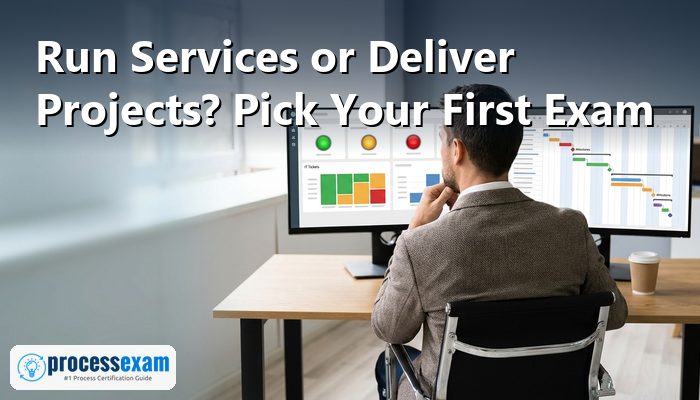
Professional at a desk weighing an IT service workflow against a project plan on two screens

Do you run services or deliver projects?

Most "ITIL or PRINCE2" arguments disappear once you stop comparing the certificates and look at your calendar. Ask yourself three plain questions.

Benefits of PMI Agile Certified Practitioner (PMI-ACP) Certification

Updated on 22 September 2026. What’s new: updated for the rebuilt PMI-ACP exam launched in November 2024, with its current fees, domains and question format.

Picture a project manager whose team switched to two-week sprints while the certificate on their wall still described Gantt charts, phase gates and change control boards. The benefits of PMI-ACP certification start exactly there: it proves you can lead adaptive work, not just plan predictive work. It gives you a shared vocabulary across Scrum, Kanban and Lean, credibility during an agile transition, and a credential PMI rebuilt in 2024 around mindset, leadership, product and delivery.

Benefits of PMI Agile Certified Practitioner certification cover with a planner sketching project charts

That gap between how a team works and what its manager is certified in is more common than most people admit. Plenty of project managers learned their trade on plan-driven projects, earned a predictive credential, and then watched their organisation adopt sprints, backlogs and daily stand-ups around them. They still run the work, but the language in the room has changed, and their credentials no longer describe what they actually do.

The PMI Agile Certified Practitioner, known as PMI-ACP, is the Project Management Institute's answer to that gap. This article looks at what the credential is really good for, what the current exam measures, who gains the most from it, how to qualify, and how a manager with a predictive background can prepare without fighting their own habits.

Top 6 Tips for PMP Exam Preparation

The Project Management Professional (PMP) Certification is among the most sought-after certifications which reveal your dedication towards your career. Having this certification is contemplated to be prestigious as the certification is very detailed and passing the examination is not a cake walk. As challenging the exam may seem, it is not impossible to pass it. According to studies, only 3 out of 5 individuals manage to pass the exam in the first attempt. Amongst those who did not manage to pass in the first attempt, most of them stated that they had not taken enough practice tests, or the time was not sufficient enough to answer the questions. Hence, we can learn from our mistakes and try to rectify these errors to pass.

Here are some tips to help you pass the PMP Certification:

1) Understand Eligibility and Exam content

This may seem overly easy, but your initial step to success is knowing the difficulty you are going to face. The PMI official website will help you find primary information on the PMP certification exam. It will also present links to a lot of useful information, such as official training providers, exam syllabus, practice test, and study material.

The PMBOK Guide includes essential details such as an overview of the certification and the exam, including its eligibility requirements, how many and what type of questions are likely to be asked, time duration of examination and the passing score.

The Top 10 Reasons to Earn ITIL Certification

IT Service Management (ITSM), ITIL Foundation, ITIL Foundation Certification, ITIL Foundation Exam, ITIL Foundation Exam Questions, ITIL Foundation Practice Test, ITIL Foundation Question Bank, ITIL Foundation Questions, ITIL Foundation Quiz, ITIL Foundation Sample Exam, ITIL Foundation Study Guide, ITIL Foundation Study Guide Material, ITIL Foundation Test Questions, ITIL Practitioner, ITIL Practitioner Body of Knowledge (BOK), ITIL Practitioner Certification, ITIL Practitioner Exam, ITIL Practitioner Exam Questions, ITIL Practitioner Practice Test, ITIL Practitioner Question Bank, ITIL Practitioner Questions, ITIL Practitioner Quiz, ITIL Practitioner Sample Exam, ITIL Practitioner Study Guide, ITIL Practitioner Study Guide Material, ITIL Practitioner Test Questions

For years now, ITIL (IT Infrastructure Library) has remained the foundation and industry-standard best practice framework for managing, supporting, and aligning IT Service Management with the requirements of the business. Trademarked by AXELOS, ITIL serves as a governing agent for IT and practices the ITIL Service Lifecycle to plan the entire journey from client demands and requirements through continual development of services.

Tips to Help You Pass Your Six Sigma Green Belt and Six Sigma Black Belt Certification

Banner on how to pass CSSGB and CSSBB exams.

First of all, you should know about Six Sigma Green Belt Certification and Six Sigma Black Belt Certification.

What is Six Sigma Green Belt?

Six Sigma Green Belt is a certification exam wherein contestants will get an introduction to tools and methods that are required to participate in DMIAC improvement projects. This certification focuses on the basic structure of DMAIC. By using up, the Six Sigma Green Belt certification professionals can identify the problems and complete solutions to eradicate them.

Who is it for Six Sigma Green Belt certification?

Six Sigma is a people‐driven process. The Six Sigma project performance level does match the level of strength, expertise, and responsibility of the individual members of the team. While reviewing the roles that provide to the project, most of them think about the champion and Black Belts roles to expand the project. However, to increase the performance of the projects, Green Belts will also play a critical role in the process improvement.

You Must Know: Major Differences Between Scrum and Agile

Scrum Methodology

What Is Scrum?

Scrum is a subset of Agile and one of the most successful process frameworks for performing Agile. It is an iterative software development standard used to manage complicated software and product development. Fixed-length iterations, called sprints lasting one to two weeks long, permit the team to ship software on a regular flow. At the end of each race, stakeholders and team members meet to plan next steps.

Scrum follows a set of roles, responsibilities, and agreements that never change. For example, Scrum calls for four services that provide structure to each sprint: sprint planning, regular stand-up, sprint demo, and sprint retrospective. During each race, the team will use visual artifacts like task boards or burndown charts to show progress and receive incremental feedback.

Advantages of Scrum

Scrum is a highly rigid framework with particular roles and functions. While it can be a lot to learn, these rules have several advantages. The advantages of Scrum include:

Build a Successful Career in ASQ Certified Quality Engineer

A quality engineer is also known as a quality control engineer. The engineer decides products to ensure they satisfy a company’s specifications. The engineer gives tests and analyzes data to prepare a product’s loyalty. Becoming a quality control engineer takes time because individuals must meet particular requirements that include a college degree, several years of experience and certification. According to the salary survey, quality control engineer’s salaries ranged between $27,000 and $176,000.

CQE, Quality Engineer, ASQ Quality Engineer Exam Questions, ASQ Quality Engineer Questions, ASQ CQE Quiz, ASQ CQE Exam, CQE

The Quality Engineer is an individual who knows how to control product and service quality. This involves the development and operation of quality control systems. They are designing and implementing testing and inspection procedures and using metrology and statistical methods to investigate and correct improper quality. An understanding of motivation and human factors. How to set in place the cost of quality techniques. Establishing quality information systems and auditing them for deficiencies.

The American Society for Quality (ASQ) defines certification as,

  • “… formal recognition by ASQ that an individual has proficiency within, and comprehension of, a specified body of knowledge. It is peer recognition, not registration or licensure.”

Project Manager Roles and Responsibilities: Who Owns What

At 8:40 a project manager opens three things before email: the risk log, yesterday's status notes and the calendar for the sponsor check-in. None of that is writing code or laying bricks. A project manager owns the plan, the schedule, the budget, the risks and the communication that keep a team pointed at one agreed result. The sponsor owns the reason and the money, and the team owns the craft.

Smiling project manager in a blue blazer beside the title Project Manager Role and Responsibilities

That split sounds tidy and rarely is, which is why "what are a project manager's roles and responsibilities?" keeps being asked in every office that runs projects. This guide answers it in four cuts: a single working morning, the five phases of a project, the line between the manager, the sponsor and the team, and the way the job grows from junior to senior. The IAPM Certified Project Manager (CPM) appears near the end, because that exam tests exactly this division of duties.

What does a project manager actually do on an ordinary morning?

Picture a Tuesday in the middle of a project, with no crisis scheduled. The manager's first half hour is reading, not meeting. The risk log shows one item that has moved from "possible" to "likely": a supplier has hinted that a delivery may slip by a week. Yesterday's notes show that one of the testers is blocked by a missing access request. The calendar shows a sponsor check-in at 11:00 and a change request waiting for a decision.

PMI-ACP Study Plan: How to Prepare for the Exam

Updated on 23 September 2026. What’s new: rewritten for the four-domain exam content outline PMI introduced on 8 November 2024, with the current retake limits and exam delivery arrangements.

Most PMI-ACP study plans still circulating online were built for the seven-domain exam PMI stopped offering after 7 November 2024. The exam you will actually sit has four domains – Mindset 28%, Leadership 25%, Product 19% and Delivery 28% – delivered as 120 questions in 180 minutes. This plan rebuilds preparation around that outline, from the first reading session to your pacing on the day.

Two professionals climbing steps towards the PMI-ACP certification on a teal cover graphic

The rebuild was not cosmetic. PMI moved the credential away from a checklist of agile techniques and towards a set of behaviours an agile practitioner is expected to show: experimenting early, shortening feedback loops, coaching rather than directing, and keeping value flowing. Study material written for the old blueprint still teaches useful agile theory, but it points you at the wrong proportions and the wrong verbs.

Everything below is drawn from PMI's own exam content outline and certification handbook, with the fee, question count and timing taken from the exam details we publish for the credential. Figures were checked in September 2026 against the outline PMI currently serves, which carries a March 2026 revision date on every page.

PMP Career Opportunities by Industry: Where Project Managers Are Needed

Updated on 12 October 2026. What’s new: the PMP exam fee is now USD $425 for PMI members and USD $675 for non-members, and exams are delivered by Pearson VUE.

PMI's Global Project Management Talent Gap report (May 2025) counts 39.6 million project professionals worldwide and warns of a shortfall of up to 29.8 million by 2035. The shortage is not spread evenly. It bites hardest where projects are large, regulated and expensive to get wrong, which is why a PMP opens different doors in a hospital, a utility and a bank.

Smiling professional in a suit beside the title asking why industries want PMI PMP certified professionals

This article walks through seven sectors: construction, IT, healthcare, finance, energy, government and defence, and manufacturing. For each it says what a project manager actually does there, which domain knowledge employers expect on top of the credential, and how the PMP exam's own content lines up with that work. It also separates salary evidence you can check from the kind you cannot.

Is demand for project managers really rising, and in which sectors?

Yes, and PMI's own research is the best place to see it. The talent gap report models demand for project talent growing by 64% between 2025 and 2035, driven by capital investment and by industries rebuilding around new technology. PMI's announcement of the report names construction, manufacturing, IT services and healthcare among the sectors under the most pressure, and points to South Asia, Sub-Saharan Africa and China as the fastest-growing regions.

Syndicate content