
Scrum Master Certification Benefits: Which Ones Are Real?
Does a two-day course and a test make anyone a Scrum Master? No. What the certificate does is show that you learned a shared vocabulary and passed a timed check on it, and employers read it that way. Scaled Agile's SAFe Scrum Master (SSM) exam, for example, is 45 questions in 90 minutes with an 80% pass mark. Some benefits of that paper hold up in daily work, some are oversold, and which one fits depends on your workplace.
Which of the six usual benefits survive a reality check?
Articles on this topic, including the earlier version of this one, tend to list the same six advantages: a wider knowledge base, staying relevant, a change of mindset, better teamwork, benefits for the organisation and a badge of pride. They are not all equally true. The table gives a plain verdict on each, and the notes below explain the reasoning.
| Claimed benefit | Verdict | Why |
|---|---|---|
| A wider Scrum knowledge base | Holds up | A course forces you to learn the framework's terms and rules in one pass, which most people never do from reading alone. |
| Staying relevant to employers | Holds up, with limits | It gets your name past keyword filters, but it will not carry an interview. |
| A change of mindset | Partly oversold | A classroom can introduce the ideas; a mindset changes only after you have lived through real sprints. |
| Better teamwork and fewer conflicts | Depends on you | A shared vocabulary helps, yet the effect comes from how you facilitate, not from holding a certificate. |
| Organisational benefits | Oversold | One certified person cannot fix an organisation that does not give teams room to decide. |
| A badge of pride | Real but small | It marks a milestone and helps morale, but it is not evidence of skill. |
The knowledge benefit is the sturdiest one
Many people practise Scrum from hearsay: a colleague explains the daily meeting, a manager describes the review, and the rest is guessed. Studying for an exam forces you to read what the framework actually says about its events, roles and artefacts. That is the most dependable gain, and it is the same whether you are a fresher or have years of Agile experience. If you want a neutral overview before you commit, the Wikipedia article on Scrum summarises the framework's roles and events.
Relevance is real, but it fades fast without practice
Job boards and recruiters filter on certificate names, so holding one gets your application read. After that the interview tests how you would handle a stalled sprint, a quarrelling pair of developers or a product owner who changes priorities daily. A certificate you cannot discuss in those terms stops helping at that point.
Mindset, teamwork and organisational gains come from practice
The old claim that a certificate gives you fewer conflicts at work confuses cause and effect. A common vocabulary reduces arguments about what a word means, which is useful. But a Scrum Master who has never been in a hard retrospective will still struggle in one, certificate or not. Treat these three benefits as things the certificate prepares you to earn, not things it hands you.
Where does a Scrum Master certificate help in hiring, and where does it stop?
A hiring manager reading "Certified Scrum Master" learns three things: you chose to invest time in the role, you can pass a standardised test on the framework, and you probably know the terms the team will use. That is a lower bar than it sounds, and a useful one, because it lets the manager skip basic screening questions.
What it cannot prove is judgement. Exams are built from multiple-choice questions with one best answer, so they reward knowing the rules. A real team rarely presents a situation with four neat options. Experienced interviewers know this, so they ask for stories: a time you removed an impediment, a time you told a stakeholder no, a time a sprint failed and what you changed. If your answers come from a course case study, the certificate will not rescue them.
There is a second limit. Different certificates carry different weight in different places. A recruiter in a company that runs SAFe will recognise the SAFe Scrum Master title at once; a start-up that follows the Scrum Guide closely may look for Scrum.org credentials. The same certificate can be a strong signal in one job ad and background noise in another, which is why the choice matters as much as the decision to certify.
Questions to ask yourself before the interview
- Can I explain, in my own words, why each Scrum event exists and what happens if it is skipped?
- Do I have one real example of facilitating a team, even from a student project or a volunteer group?
- Can I say what I would do in my first two weeks with a new team?
If you can answer those, the certificate adds weight to your application. If you cannot, spend the next study session on them rather than on more exam questions.
Who gains the most from certifying, and who gains the least?
The benefit is uneven. Scaled Agile's own page for the SAFe Scrum Master lists the audience it has in mind: people in project management, engineers and developers, customer support staff and HR professionals. That list is broad, but the gain is not the same for each group.
Newcomers and career changers
Someone with no Agile history gains the most. The certificate gives a structured entry point, and the course or exam preparation gives language for interviews. The risk is overselling it: a newcomer with only a certificate competes against candidates who have run real sprints, so pair it with a small project, a volunteer team or an internal secondment.
Project managers moving to Agile
A traditional project manager already has the planning, reporting and stakeholder skills. What is missing is the shift from directing work to facilitating a team that decides how to do it. Certification marks that move formally, and it helps when the company is reorganising and needs to know who can take a Scrum Master seat. The adjustment itself still takes months of practice.
Developers and testers who already work in sprints
Team members who already live in a sprint often gain least from the knowledge side and most from the signal. If you want to move into a facilitation or coaching role, the certificate tells your manager you are serious. If you plan to stay a developer, it is optional.
Experienced Scrum Masters
For someone with several years in the seat, an entry-level certificate adds little to ability but can still unlock opportunities, for example a client or an employer that insists on a named credential. At that stage the question is whether to certify at all, or to move to an advanced level, since advanced credentials say more about depth than a first one does.
Support and HR staff
Scaled Agile lists customer support and HR among the people the course suits. The gain here is mostly vocabulary and an understanding of how product teams plan, which helps you work with them. It is not a route into the Scrum Master job by itself.
Which certificate fits which kind of workplace?
The same word, "Scrum Master", appears on very different credentials. Two that people compare often are the SAFe Scrum Master from Scaled Agile and Professional Scrum Master I (PSM I) from Scrum.org. They answer different questions, so the right one depends on how your employer works.
| Exam detail | SSM | PSM I |
|---|---|---|
| Certification | Certified SAFe Scrum Master (SSM) | Scrum.org Certified Professional Scrum Master I (PSM I) |
| Vendor | SAFe | Scrum.org |
| Questions | 45 | 80 |
| Duration | 90 minutes | 60 minutes |
| Passing score | 80% | 85% |
Scaled Agile's page describes the SSM exam as 90 minutes, 45 questions and an 80% pass mark, and notes that the training course is not required to sit the proctored exam. The PSM I figures above are 80 questions, 60 minutes and an 85% pass mark, with a fee of $200; confirm them on Scrum.org's PSM I page, as vendors change prices.
| Your workplace | Credential that usually fits | Reason |
|---|---|---|
| A single team running Scrum with little scaling | PSM I or a similar Scrum-focused certificate | The questions follow the Scrum Guide closely, which matches how the team works. |
| A team inside a large programme that plans together every few months | SSM | It covers the role of a Scrum Master on a SAFe release train, including joint planning and cross-team coordination. |
| An employer that lists a SAFe title in its job ads | SSM | The recruiter's filter is looking for exactly that name. |
| A client-facing consultancy with many different clients | Both, in time | Clients differ in the framework they use, so a pair of credentials keeps options open. |
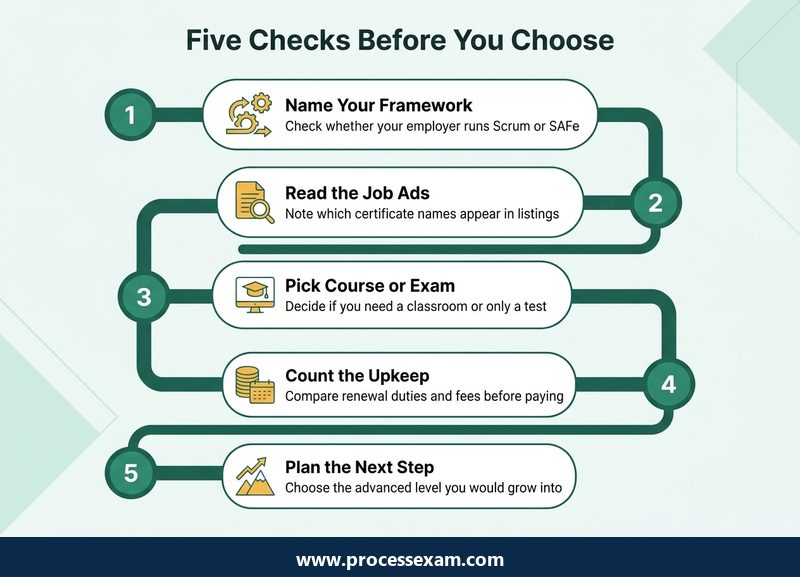
| No Agile culture yet | Whichever the first target employer names | Read three live job ads and count which name appears most often. |
Why a team-level Scrum credential is not a train-level one
In a SAFe organisation the Scrum Master is one role on a larger release train, and the SSM syllabus reflects that, with a domain on joint planning that a standalone Scrum credential has no reason to cover. Read the other way round, PSM I tests how well you know the Scrum Guide itself, which is useful anywhere but does not teach how a train works. Neither is "better"; each is better in its own setting.
What Scaled Agile does list as a benefit of holding SSM
Scaled Agile's page names access to its community forums, job boards, role-based networking circles, webinars, a skills library, planning toolkits and its SAFe CoPilot AI assistant. It also says the credential earns PMI PDUs and Scrum CEUs. Those are real perks, though how much they are worth depends on whether you use them. A forum login does not help anyone who never opens it.
A practice exam is one way to find out where you stand before you pay for an attempt. Our SSM practice exam lets you test yourself on SAFe Scrum Master questions before you book the real one.
What did Scaled Agile put on sale in 2026, and does it change the value?
Checked in October 2026: Scaled Agile now sells the AI-Empowered SAFe Scrum Master. Its page describes the credential as foundational level, with a 90-minute, 45-question exam and an 80% pass mark. The page does not name a SAFe version number, so this article does not either. The course teaches the role on an Agile Release Train and adds AI fundamentals, and the exam has a domain called Augmenting the Scrum Master Role with AI, weighted at 12-14%. Other domains cover the role of the Scrum Master, joint planning, iteration execution and finishing the planning interval.
That detail changes how you should read older advice, including the old version of this article. Anything that said "SAFe 6.0" or described a purely Scrum-facilitation exam is out of date. The certificate you earn today signals comfort with AI tools in facilitation, retrospectives and metrics, and that is something recruiters in 2026 can ask about.
What the AI domain means for value
Roughly one question in eight is about AI in the Scrum Master role, if you take the weight at its midpoint. That does not make the holder an AI expert, but it does mean the credential tells an employer you have thought about where AI helps a team and where it does not. Scaled Agile also says the credential has to be kept alive with 24 continuing education units across a two-year cycle, so the value depends on continued learning rather than a one-off pass.
A gap to be aware of
Some third-party summaries still label the SSM with an older SAFe version, and some pages show an older pass mark. When you decide, rely on Scaled Agile's own page rather than a third-party summary, and look for the month it was checked.
What should you do in the first months so the certificate shows in results?
The certificate is a starting line. The people who get the most from it do a few simple things in the months after, because that is when a team decides whether you are a facilitator or a note-taker.
Before the interview
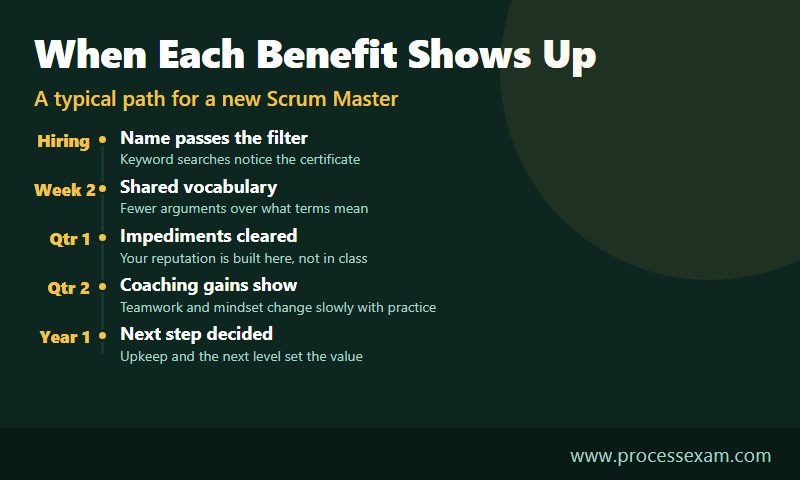
Put the exact certificate name in your resume and your professional profile so keyword filters catch it. Prepare two short stories from real work or a simulation. Hiring managers remember stories, not course names.
In the first sprint
Use the vocabulary lightly. Naming the events correctly helps the team trust you, but lecturing them on the Guide makes you sound like a textbook. Run the first retrospective as an experiment: ask what to keep, what to drop and what to try, and write down the answers.
In the first quarter
Track impediments, not just their number but how long they take to clear and who cleared them. A Scrum Master's reputation is built here. Teams soon notice the person who unblocks them, and they notice the one who only schedules meetings.
In the first year
Decide where you want to go next. For a SAFe Scrum Master that might be an advanced credential, a move to release train coordination, or a role coaching several teams. For a Scrum.org holder the next step is a higher level of the same series. At this point the upkeep matters: Scaled Agile asks for 24 continuing education units in two years, so build learning into your calendar rather than leaving it to the last month.
When is certifying not worth the money?
There are honest cases where the answer is "not yet", and a fair article on benefits should say so.
You cannot say which framework your target employer uses
Paying for a credential before you know which one the market in your city asks for is a gamble. Spend an evening reading job ads first.
You are expecting a pay rise from the certificate alone
This article quotes no salary figures, because the numbers people quote vary widely by country, employer and experience. A certificate may help you get an interview or a promotion discussion, but what raises pay is the role you move into and the results you deliver there. Treat anyone who promises a fixed uplift with caution.
Your employer will pay, but only after you prove you can do the job
If your company funds training for people who already facilitate, wait for that and learn through practice in the meantime. Self-funding an entry-level credential is most sensible when it is your route into the role or when it is a stated requirement in the jobs you want.
You already have the credential you need
A second entry-level certificate teaches little that the first did not, so before paying, ask what you would learn that you do not already know. If the answer is only "another badge", spend the money on an advanced course or a coaching skills programme.
So should you certify, and with which exam?
Put the points together and the answer is conditional. A Scrum Master certificate is worth it when three things line up: you do not yet have a way to prove you know the framework, the employers you are targeting recognise the credential you chose, and you are ready to practise facilitation after you pass. When one of those three is missing, the value drops quickly.
The six classic benefits are better read as a checklist of what the certificate makes possible. Knowledge and relevance come with the credential. Mindset, teamwork and organisational change come from what you do next. Being honest about that difference is what separates a certificate that helps from one that sits on a profile page.
If you decide on the SAFe route, work through the SSM sample questions to see how the exam phrases its scenarios, and read Scaled Agile's SAFe Scrum Master certification page for the current course and exam terms. If you are leaning towards the Scrum.org route instead, its PSM I assessment page carries the current details for that exam.
Frequently Asked Questions
Is a Scrum Master certification worth it?
It is worth it when you need proof of Scrum knowledge, the employers you target recognise the credential, and you plan to practise facilitation afterwards. It helps with screening and vocabulary but does not prove judgement, so pair it with real examples from teams you have supported.
What are the benefits of a Scrum Master certification?
The sturdiest benefits are structured knowledge of the framework and a title recruiters search for. Better teamwork, a changed mindset and organisational gains come mainly from practice after the certificate, not from the certificate itself.
Is the SAFe Scrum Master certification worth it?
It is worth most to people on or heading for a SAFe release train, where employers name the credential in job ads. Scaled Agile's page lists a 90-minute, 45-question exam with an 80% pass mark and community perks, which help only if you use them.
Does a Scrum Master certification help a fresher get a job?
It helps a fresher get noticed and gives language for interviews, but employers also look for evidence of facilitation. Combine the certificate with a small project, a student team or a volunteer group, and prepare two short stories about problems you helped solve.
Should I choose SSM or PSM I?
Choose by your workplace. SSM suits teams inside a SAFe programme and has 45 questions with an 80% pass mark, while PSM I has 80 questions in 60 minutes with an 85% pass mark and follows the Scrum Guide. Read three job ads to see which name appears.


