
8 Pega Certifications That Make You Stand Out: Cost, Exams and Path
Updated on 21 September 2026. What’s new: every Pega exam live today with its questions, time, pass mark and fee, replacing the old list built on CPSA Version 23.
Pega offers eight live certifications, each tied to a role: three System Architect levels (CPSA, CPSSA and CPLSA) for developers, plus Business Architect, Decisioning Consultant, Data Scientist, Robotics System Architect and Customer Service Developer. Every exam costs USD $190 and has 50 or 60 questions. Most beginners should start with the System Architect exam.

Pega (Pegasystems) builds a low-code platform for case management, workflow automation, customer decisioning and robotic automation. Banks, insurers, telecom providers and government agencies run large parts of their operations on it, and they need people who can prove they know how to build on it. A Pega certification is that proof. It is issued by Pega Academy and tested by Pearson VUE, and each one is tied to a specific product release, so a current credential shows your skills match the platform as it is used today.
This guide replaces our older article on four Pega certifications. Pega's line-up has grown and changed since then, so here you will find every exam that is live today, what each one costs, how the exams compare, which path to follow and how to prepare for your first attempt.
What are Pega certifications, and which ones can you take today?
Pega certifications are role-based credentials. Rather than one exam that covers the whole platform, Pega offers separate exams for the people who design, build, configure and run Pega applications. Each exam is linked to a platform release, currently Pega Infinity '25 for most exams, with the Decisioning Consultant and Data Scientist exams already on Infinity '26 (as listed on Pega Academy in September 2026), and each has its own topic list published on Pega Academy. The full list of current credentials is on the Pega Academy certifications page.
The eight certifications that are live today fall into three groups.
The System Architect path (developers)
- Certified Pega System Architect (CPSA): the first level for developers and technical staff who build Pega applications.
- Certified Pega Senior System Architect (CPSSA): the intermediate level, focused on designing and building for reuse across several lines of business.
- Certified Pega Lead System Architect (CPLSA): the advanced level, for architects who lead the design of enterprise Pega solutions.
Business and customer-engagement roles
- Certified Pega Business Architect (CPBA): for business analysts and product owners who design applications in App Studio.
- Certified Pega Decisioning Consultant (CPDC): for professionals who design next-best-action solutions in Pega Customer Decision Hub.
- Certified Pega Data Scientist (CPDS): for data scientists who build predictive, adaptive and text analytics models in Pega.
Specialist and product roles
- Certified Pega Robotics System Architect (CPRSA): for developers who build robotic automations with Pega Robot Studio.
- Certified Pega Customer Service Developer (CPCSD): for system architects who implement Pega Customer Service applications.
If you have seen older names such as PCSA, PCSSA or PCBA, those are earlier labels for the same career tracks. The current exams all use the CP prefix (Certified Pega), and the exam codes printed on Pega Academy carry the release number, for example PEGACPSA25V1 for the System Architect exam. When you study, make sure your material matches the current release, because each new version adds features such as Pega GenAI and Constellation that the older exams did not test.
For free sample questions and practice exams across every one of these credentials, the Pega certification practice exams and sample questions page on ProcessExam groups them in one place, so you can compare the style of each exam before you choose.
How much does a Pega certification cost, and how do the exams compare?
Pega certification cost is the same for every current exam: USD $190 per attempt. Taxes may be added when you register, depending on your country. What differs is the number of questions, the time allowed and the passing score. The table below uses the figures for each exam.
| Certification | Exam code | Questions | Duration | Passing score | Exam fee |
|---|---|---|---|---|---|
| Certified Pega System Architect | CPSA | 60 | 90 minutes | 65% | USD $190 |
| Certified Pega Senior System Architect | CPSSA | 60 | 90 minutes | 70% | USD $190 |
| Certified Pega Lead System Architect | CPLSA | 60 | 120 minutes | 65% | USD $190 |
| Certified Pega Business Architect | CPBA | 50 | 90 minutes | 65% | USD $190 |
| Certified Pega Decisioning Consultant | CPDC | 60 | 90 minutes | 70% | USD $190 |
| Certified Pega Data Scientist | CPDS | 50 | 90 minutes | 70% | USD $190 |
| Certified Pega Robotics System Architect | CPRSA | 60 | 90 minutes | 65% | USD $190 |
| Certified Pega Customer Service Developer | CPCSD | 50 | 90 minutes | 65% | USD $190 |
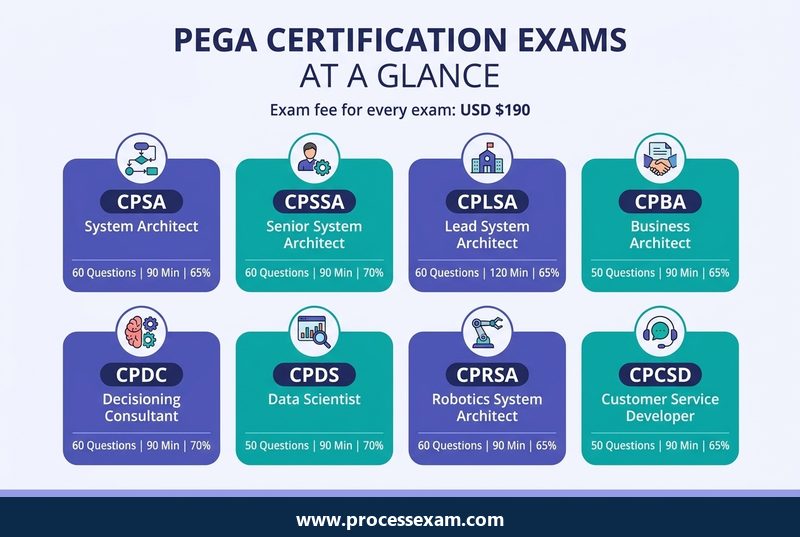
Three patterns stand out. First, the passing score is 70% for the Senior System Architect, Decisioning Consultant and Data Scientist exams, and 65% for the rest, so those three leave less room for error. Second, the Lead System Architecture exam is the only one with a two-hour limit; it has 60 questions like the entry exam, but they are longer architecture scenarios. Third, the 50-question exams (Business Architect, Data Scientist and Customer Service Developer) give you 90 minutes, which is almost two minutes per question, while the 60-question exams leave you one and a half minutes.
Budget for more than one attempt only if you have to. At USD $190 an attempt, a failed exam costs as much as a first one, so it pays to sit the exam only when your timed practice scores are consistently above the passing mark.
What does the Pega System Architect certification path look like?
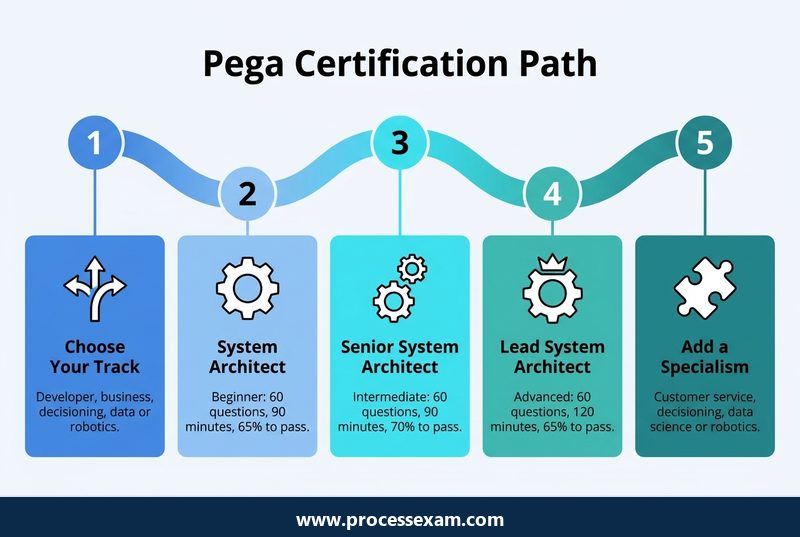
The System Architect path is the backbone of Pega certification and the track most employers ask for. It has three levels, and each one builds on the one before.
Level 1: Certified Pega System Architect (CPSA)
The Pega certified system architect credential is where almost every developer starts. Pega describes it as the first level in the System Architect certification path, giving a baseline measurement of your knowledge of Pega applications. It is rated at beginner level, and the exam is available in English, Japanese, Spanish, French, German and Brazilian Portuguese.
The CPSA exam has 60 questions in 90 minutes, a 65% passing score and a USD $190 fee. Pega publishes the topic weights on its Certified Pega System Architect exam page:
- Case Management (25%): case lifecycles, stages and statuses, service level agreements, routing to users, work groups and work queues, approvals, duplicate cases, child cases, and decision tables and trees.
- Data and Integration (20%): the data model, data types and relationships, calculated values, validation, data transforms, sourced data and saving data to a system of record.
- Application Development (15%): rules, rulesets, classes and inheritance, and debugging application errors.
- Security (10%): authentication and authorization, operators, access groups, access roles and personas, and the Security Checklist.
- User Experience (10%): views and templates, form types, field settings, and landing page and localization practices.
- Pega GenAI (10%): using Pega GenAI features such as Coach, Agents and Tool Rules inside applications.
- DevOps (5%): Pega's continuous integration and delivery process and the tests a deployment needs.
- Insights (5%): Insights, dashboards and landing pages.
Case management and data together make up almost half of the exam, so that is where your study hours should go first. If you want to measure yourself against the real format, the Pega System Architect practice exam on ProcessExam uses the same 60-question, 90-minute structure, so you can check both your knowledge and your pace.
Level 2: Certified Pega Senior System Architect (CPSSA)
The Senior System Architect certification is the natural next step once you have the System Architect credential and some project experience. Pega says it validates the ability to design and build for reusability across multiple lines of business, including best practices, debugging, performance tuning, system maintenance and security requirements. It is rated intermediate.
The exam has 60 questions in 90 minutes, a 70% passing score and a USD $190 fee. Its topics are weighted as follows:
- Application Development (30%): class hierarchy, modular architecture and enterprise reuse, rule resolution, circumstancing, queue processors and job schedulers, rulesets, versioning and application migration.
- Case Management (20%): work groups and organizational structure, parallel processing, locking strategies, flow action processing and advanced service level agreements.
- Data and Integration (20%): data validation, keyed data pages, exchanging data with other applications and handling connector errors.
- System Administration (15%): system and performance events and application settings for integrations.
- Security (10%): access control models, attachments, encryption and auditing.
- User Experience (5%): custom portals, Pega Web Embed and the Constellation SDKs.
The higher passing score and the focus on reuse make this a clear step up. Candidates who passed the entry exam by learning features often find that this exam asks why a design choice is right, not just how to configure it.
Level 3: Certified Pega Lead System Architect (CPLSA)
The Lead System Architect credential sits at the top of the path. According to the Pega Lead System Architecture exam page, the program is intended for Certified Pega Senior System Architects with at least 36 months of field experience. Earning the credential takes two stages: passing the Lead System Architecture exam, then completing the application design and application build exam that follows it.
The Lead System Architecture exam has 60 questions in 120 minutes, a 65% passing score and a USD $190 fee. Its topics are Infrastructure and Architecture (30%), Planning and Design (30%), Implementation and Deployment (30%) and Constellation Adoption (10%). Expect questions on deployment architecture, high availability, event-driven designs with Kafka, service externalization, application stack design, enterprise reuse and the governed use of Pega GenAI. This is an exam about judgment: several options are usually workable, and the right one is the one that scales and is easiest to maintain.
Which Pega certifications suit business, decisioning, data and robotics roles?
Not every Pega professional writes rules. Five certifications cover the other roles on a Pega project.
Certified Pega Business Architect (CPBA)
The Business Architect credential is for people who turn business goals into application designs in App Studio: business analysts, product owners and functional consultants. The exam has 50 questions in 90 minutes with a 65% passing score. Case Management carries the most weight at 30%, followed by Application Development at 25%, Data and Integration at 15%, Pega GenAI and User Experience at 10% each, and Security and Insights at 5% each. The Pega GenAI section covers Pega Blueprint, Knowledge Buddy and Autopilot, which reflects how much application design now starts with generative AI.
Certified Pega Decisioning Consultant (CPDC)
This credential is for people who design next-best-action solutions in Pega Customer Decision Hub. The exam has 60 questions in 90 minutes and a 70% passing score. Topics include next-best-action concepts, actions and treatments, engagement policies, contact policy and volume constraints, AI and arbitration, channels, decision strategies and business agility in one-to-one customer engagement. It suits marketing technologists and decisioning consultants on customer engagement programs.
Certified Pega Data Scientist (CPDS)
The Data Scientist exam has 50 questions in 90 minutes and a 70% passing score. Adaptive Analytics is the largest area at 28%, followed by Predictive Analytics (20%), Prediction Patterns (18%), Pega NLP (14%), Pega Process AI (10%), AI for Customer Decision Hub (6%) and Governance (4%). It is aimed at data scientists who want to apply models inside Pega's case management and customer engagement features.
Certified Pega Robotics System Architect (CPRSA)
The Robotics System Architect credential covers robotic automation with Pega Robot Studio. The exam has 60 questions in 90 minutes with a 65% passing score. Automation Development is the biggest area at 22%, followed by Interrogating and Recording (17%), Advanced Automation and Best Practices (15%), Pega Robotic Integration (15%), Debugging and Diagnostics and Deployment (8% each), Applications (7%), Match Rules (5%) and Overview and Projects (3%). It fits developers who automate desktop and web applications, whether attended or unattended.
Certified Pega Customer Service Developer (CPCSD)
This credential is designed for System Architects and Senior System Architects who implement Pega Customer Service. The exam has 50 questions in 90 minutes with a 65% passing score. Its topics are User Experience, Channels and Interaction Management at 20% each, Data Integration and Application Development at 15% each, and Reporting and Core Business Outcomes at 5% each. Channels cover Pega Call, Digital Messaging, Voice AI and email bots, so this exam rewards people who have worked on real contact-center projects.
Which Pega certification should you take first?
The answer depends on the work you do now and the work you want to do next. Use these rules of thumb.
If CPSA is your starting point, a timed run through the CPSA practice test early in your preparation shows which topic areas deserve the most hours.
- You build applications or want to become a Pega developer. Start with the System Architect exam. It is the entry point to the most in-demand path, and the Senior System Architect and Customer Service Developer credentials build on it.
- You gather requirements, design processes or own a product backlog. Start with the Business Architect exam. It covers the same case and data concepts as the System Architect exam, seen from the design side in App Studio.
- You work on marketing, offers or customer engagement. Choose the Decisioning Consultant exam. If you build models rather than strategies, choose the Data Scientist exam instead.
- You automate desktop tasks and legacy screens. Choose the Robotics System Architect exam.
- You already hold the System Architect credential and work on contact-center projects. Add the Customer Service Developer exam, or move up to Senior System Architect if your role is shifting toward design and reuse.
A common and effective combination is System Architect followed by Senior System Architect within one to two years, with one product credential such as Customer Service Developer or Decisioning Consultant added once you work on that product. The Lead System Architect credential comes later, when you have three or more years of field experience and lead technical design.
How do you prepare for a Pega certification exam?
Every Pega exam is built the same way: scenario questions, taken from a published topic list, on a specific platform release. A good preparation plan follows that structure.
1. Start with the exam's topic list
Open the exam page on Pega Academy and copy its topic list and weights into your notes. This is your map. Tick off each topic as you study it, and give the heaviest areas the most time. For the System Architect exam that means case management and data first; for the Senior System Architect exam it means application development.
2. Complete the matching Pega Academy mission
Each certification has a learning mission on Pega Academy for the current release. It uses the same terms and the same screens the exam uses, which matters because answer options often differ by a single word. Do the exercises, not just the videos.
3. Build something yourself
Pega exams reward people who have configured the platform. Build a small case type from start to finish: stages, steps, routing, a service level agreement, a data object, a validation rule and a simple report. When a question describes a situation, you will recognise it instead of having to reason from theory.
4. Learn the why behind each best practice
Many wrong answers on Pega exams are things you could do, but should not. Learn why Pega recommends one approach over another: why you reuse through the class hierarchy instead of copying rules, why you route to work queues instead of named users, why you keep data in data pages. At the senior and lead levels, almost every question is of this kind.
5. Take timed practice tests
Practice tests show which topics are weak and train your pace. Start with sample questions to learn the style, then take full-length timed tests. Review every question you got wrong or guessed, and write down why the right answer is right. When your scores are steadily above the passing mark on questions you have not seen before, book the exam.
6. Book and sit the exam
Pega exams are delivered by Pearson VUE, either at a test center or through online proctoring from a quiet room at home or at work. You register through the Pearson VUE Pegasystems page. For an online exam, check your computer, webcam and internet connection in advance and clear your desk.
A realistic timeline for the System Architect exam is four to six weeks of steady study if you already work with Pega, or eight weeks or more if the platform is new to you. Senior and lead exams need less reading and more project experience.
What mistakes make candidates fail Pega exams?
The same mistakes come up across all Pega certifications, and each one is avoidable.
- Studying an older release. Pega updates its exams with each platform version. Topics such as Pega GenAI and Constellation are new, and material written for older versions does not cover them.
- Learning features without practice. Reading about case lifecycles is not the same as building one. Scenario questions quickly expose the difference.
- Ignoring the weights. Candidates often spend days on small topics they enjoy and too little time on case management or application development, which carry the most marks.
- Underestimating the 70% exams. The Senior System Architect, Decisioning Consultant and Data Scientist exams leave less room for mistakes than the 65% exams.
- Poor time management. With 60 questions in 90 minutes, you have a minute and a half for each. Flag long questions and come back to them rather than stalling.
- Booking too early. At USD $190 per attempt, it is cheaper to take one more practice test than to sit the exam twice.
Is a Pega certification worth it for your career?
For anyone who works with Pega, or wants to, a certification is one of the clearest ways to stand out. Pega projects are usually large and business-critical, and employers and consulting firms want proof that the people they place on them know the platform's best practices. Many job postings for Pega developers list the System Architect or Senior System Architect credential as a requirement, and partners use certified headcount when they bid for work.
Benefits for you
- Independent proof of your skills on the current platform release.
- A clear path from developer to senior developer to lead architect.
- Access to specialist roles in decisioning, data science, robotics and customer service.
- More confidence in design discussions, because you know which approach Pega recommends and why.
Benefits for your employer
- Teams that follow Pega best practices build applications that are faster to deliver and easier to maintain.
- Fewer design mistakes that need expensive rework later in a project.
- Stronger bids for partners and consultancies, where certified staff count.
- A shared vocabulary between business architects, developers and decisioning specialists.
The value grows as you add levels. A System Architect credential gets you considered for developer roles; the Senior System Architect credential supports a move into design and technical leadership; and the Lead System Architect credential is one of the most respected credentials in the Pega ecosystem, held by the architects who design enterprise solutions.
Whichever path you choose, the approach is the same: pick the certification that matches your role, study its topic list against the current release, build real applications, and use timed practice tests to confirm you are ready before you book.
Frequently Asked Questions
How much does a Pega certification cost?
Every current Pega certification exam costs USD $190 per attempt, from the System Architect entry exam to the Lead System Architecture exam. Taxes may be added at registration depending on your country, and a retake costs the same fee, so it pays to be ready before you book.
Which Pega certification is best for beginners?
Most beginners should start with the Certified Pega System Architect exam, the first level of Pega's System Architect path. Business analysts and product owners may prefer the Certified Pega Business Architect exam, which covers similar case and data concepts from the application design side in App Studio.
How many questions are on Pega certification exams?
Pega exams have either 50 or 60 questions. The System Architect, Senior System Architect, Lead System Architecture, Decisioning Consultant and Robotics System Architect exams have 60. The Business Architect, Data Scientist and Customer Service Developer exams have 50. Most allow 90 minutes; the Lead System Architecture exam allows 120.
What is the passing score for Pega exams?
The passing score is 65% for the System Architect, Lead System Architecture, Business Architect, Robotics System Architect and Customer Service Developer exams. It is 70% for the Senior System Architect, Decisioning Consultant and Data Scientist exams, which leave a little less room for mistakes.
Do I need the System Architect credential before the Senior exam?
The Senior System Architect credential is designed as the second level of the System Architect path, so most candidates earn the System Architect credential and gain project experience first. Check the prerequisites on the Pega Academy exam page before you register, because Pega sets the current entry requirements there.
Where are Pega certification exams taken?
Pega certification exams are delivered by Pearson VUE. You can take them at a Pearson VUE test center or through online proctoring from a quiet room at home or at work, watched by a proctor through your webcam. You create a Pearson VUE account and register for the exam there.
- Pega System Architect Question Bank |
- Pega System Architect Book |
- Pega System Architect Study Guide |
- System Architect Certification |
- Pega System Architect Exam Questions |
- Pega System Architect Questions |
- Pega System Architect Sample Questions |
- System Architect PDF |
- Pega CPSA Quiz |
- CPSA Certification |
- CPSA Questions |
- CPSA Practice Test |
- CPSA Study Guide Material |
- CPSA Sample Exam |
- CPSA Exam Questions Download |
- CPSA Test Questions |
- PEGACPSA25V1 Questions |
- PEGACPSA25V1 Book |
- PEGACPSA25V1 Certification |
- PEGACPSA25V1 Question Bank |
- PEGACPSA25V1 Study Guide |
- PEGACPSA25V1 |
- PEGACPSA25V1 Exam Questions |
- PEGACPSA25V1 PDF |
- PEGACPSA25V1 Sample Questions


