
How to Become a Better Software Tester: Skills, Habits and Techniques
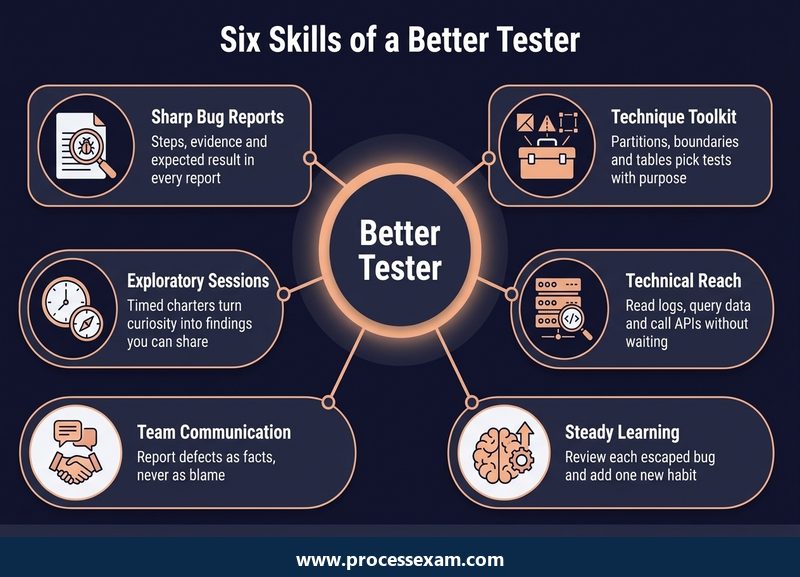
A tester files her fourth bug of the week and it comes back stamped "cannot reproduce". The code was fine; the report was the weak link. Becoming a better software tester mostly means getting five things right: reports a developer can act on, tests chosen on purpose, curious exploration, enough technical reach to look under the surface, and a calm way of delivering bad news. Each one is a habit you can train, and this guide takes them in that order.

It is written for testers with anything from six months to six years behind them, and it keeps to the practical level: what to do on Monday that you did not do last Friday. The ISTQB Certified Tester Foundation Level (CTFL) appears once, in its own section, as one structured route to the same skills rather than a requirement for any of them.
Why do your bug reports keep coming back with "cannot reproduce"?
Because the person reading the report cannot see what you saw. A developer opening your ticket has the code, a different machine and a dozen other tickets. What you pasted is the only evidence that your failure ever happened. A bounced report is rarely a developer being lazy; it is usually a missing step, a missing build number or an "expected result" that exists only in your head.
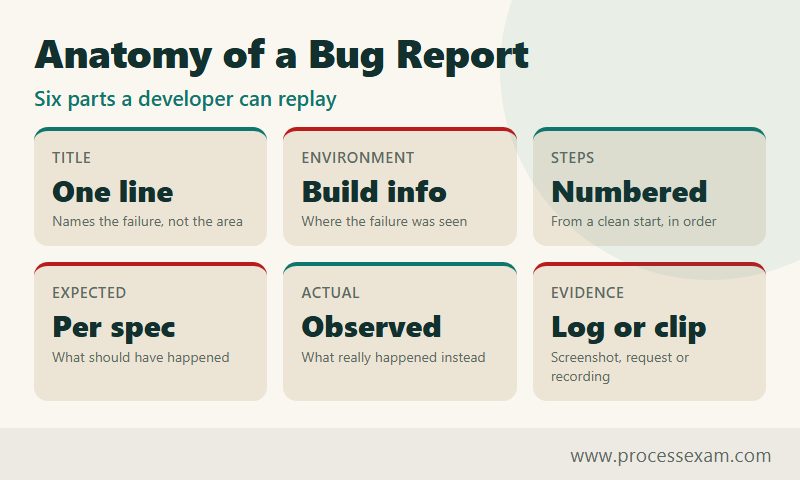
The CTFL syllabus (version 4.0.1) spells out what a defect report logged during dynamic testing typically carries, and the list is a good checklist even if you never sit the exam: a unique identifier, a title with a short summary, the date and author, the test object and environment, the context, a description of the failure that lets someone reproduce it, expected and actual results, severity, priority, status and references. Most trackers fill the identifier, date, author and status for you. The parts that are yours to get right are the title, the environment, the steps and the two results.
What a weak report and a strong report look like side by side
| Field | Report that bounces | Report that gets fixed |
|---|---|---|
| Title | Checkout broken | Coupon SAVE10 removes the discount when the basket quantity is edited |
| Environment | Test server | Build 2.14.3 on staging, Chrome on Windows 11, logged in as a guest |
| Steps | Add things, apply coupon, change something | 1. Add two items. 2. Apply SAVE10. 3. Change quantity of the first item from 1 to 2. 4. Look at the order total |
| Expected result | It should work | The 10% discount stays applied and the total is recalculated |
| Actual result | It does not | The discount line disappears and the full price is charged |
| Evidence | None | Screenshot of the total before and after, plus the failing network call |
Notice what changed between the columns. Nothing in the right-hand column needed extra testing; it only needed the tester to write down what they had already seen, in a form someone else can replay.
Three habits that stop reports bouncing
- Reproduce it twice before you file it. The second run usually reveals the step you forgot, and it tells you whether the failure is steady or intermittent. If it is intermittent, say so and say how often it appeared.
- Shrink the scenario. Remove steps one at a time until the failure stops. The smallest sequence that still fails is the one the developer wants.
- Separate observation from theory. "The total drops the discount" is an observation. "The coupon service is probably timing out" is a theory. Both can appear, but labelled, so a wrong theory does not send someone down the wrong path.
The syllabus also notes that a reported anomaly may turn out to be a false positive or a change request rather than a defect, which is why the workflow includes analysing and classifying a report before anyone fixes it. A precise report makes that triage fast. A vague one starts an argument.
How do you decide what to test when you cannot test everything?
You choose on purpose, and you can say why. The second of the seven testing principles in the CTFL syllabus states that exhaustive testing is impossible except in trivial cases; the syllabus points to test techniques, test case prioritisation and risk-based testing as the way to focus effort. Testers who feel permanently behind are often the ones running every idea they have, in the order they thought of it.
Start from risk, then pick the technique
Ask two questions of every feature: how likely is it to be wrong, and how bad is it if it is? A newly rewritten payment step is both likely to break and costly when it does. A rarely used help page is neither. The syllabus also reminds you that defects cluster together, with a small number of components usually holding most of them, so a module that has produced bugs this month is a better bet for the next hour than one that has been quiet for a year.
Once you know where to look, a technique tells you which values to try. The black-box techniques in CTFL v4.0 are equivalence partitioning, boundary value analysis, decision table testing and state transition testing. You do not need all four every day, but you should be able to reach for each one.
A worked example with one input field
Suppose a travel form accepts a passenger age from 2 to 17 for a child fare. Equivalence partitioning says the values fall into three groups: below 2, from 2 to 17, and above 17. Every value in a group should be treated alike, so one value from each group is enough to start with. Boundary value analysis then adds the places where programmers slip, the edges of each group.
| Input | Group | Expected result |
|---|---|---|
| 1 | Below the range | Rejected, or priced as infant |
| 2 | Lower boundary | Child fare offered |
| 10 | Inside the range | Child fare offered |
| 17 | Upper boundary | Child fare offered |
| 18 | Above the range | Adult fare offered |
Five inputs cover what a tester might otherwise cover with forty guesses, and two of them, 17 and 18, sit exactly where an "age less than 17" mistake would hide. The syllabus explains that boundary value analysis works because developers are more likely to err at the edges, with boundaries misplaced above or below where they were intended or left out altogether.
Add to that the experience-based techniques: error guessing, exploratory testing and checklist-based testing. Error guessing is simply using your memory of past failures, such as empty fields, pasted text with trailing spaces, a date at midnight on the last day of a month, a name containing an apostrophe. Keep a personal list and grow it; it is the cheapest test design aid there is.
Do not let a passing suite convince you
Two more principles are worth keeping where you can see them. Tests wear out: repeat the same set often enough and it stops finding new problems, so vary the data and the paths. And the absence-of-defects fallacy: a system can pass every specified test and still fail the people who use it, which is why a good tester also asks whether the thing is the right thing, not only whether it matches the document.
What does a useful exploratory testing session look like?
It is a time-boxed hunt with a stated mission, not wandering. The syllabus describes exploratory testing as designing, running and evaluating tests at the same time while you learn about the test object, and it says the approach is most useful when specifications are thin or the schedule is tight. It adds that the work is more effective when the tester has domain knowledge and strong analytical skills, curiosity and creativity. In other words, it rewards exactly the habits this article is about.
A session structured the way the syllabus describes, with a charter and a debrief, is easy to run alone or with a colleague:
- Write the charter in one sentence. "Explore the refund flow with expired cards to discover how failures are shown to the customer." A charter names an area, an angle and what you want to learn.
- Set a time box. Sixty to ninety minutes is a common choice; the point is that it ends. When the timer goes, stop and write up.
- Take notes as you go. Steps you followed, questions that came up, ideas you did not have time to try and anything that looked odd even if you could not break it.
- Raise reports while the evidence is fresh. Use the structure from the first section so each bug is replayable.
- Debrief with someone. Ten minutes with a developer or product owner turns your notes into decisions: what to fix, what to automate, what to explore next.
Wikipedia's article on exploratory testing gives the history of the approach if you want background reading; the practical point is that a note-taking habit makes your exploration visible to people who would otherwise assume you were just clicking around.
How much technical skill does a tester really need?
Enough to look at the system without asking someone else to do it for you. The old advice to learn half a dozen programming languages is not what separates good testers from average ones. What matters is whether you can answer "what actually happened?" yourself. The CTFL syllabus lists technical knowledge among the generic skills for testing, giving the use of appropriate test tools as its example, alongside testing knowledge, domain knowledge, analytical and critical thinking, and communication.
A sensible order of learning, with a first exercise for each:
| Skill | What it lets you do | First exercise |
|---|---|---|
| Browser developer tools | See failed requests, console errors and response payloads behind a screen | Reproduce your latest bug with the network tab open and attach the failing call |
| SQL basics | Check that what the screen says matches what is stored | Write one query that finds the record created by your last test |
| API testing with a client tool | Test the layer below the interface and set up data quickly | Send a request, change one field to an invalid value and read the error |
| Version control | Read what changed between the last good build and the bad one | Look at the commit list for the module you are testing this sprint |
| Command line and logs | Find the stack trace and timing that explain an intermittent failure | Search a log file for the time of your last failure |
| One scripting language | Automate repetitive checks and generate test data | Script the login and one search, then run it against two environments |
Pick the language your team already uses, because someone nearby can review your code and the framework is already set up. Automation is a means of freeing your time for exploration and analysis. The syllabus itself is balanced about it: it lists both the benefits and the risks of test automation, and its Test Tools chapter is the shortest of the six for a reason. Use tools where they save effort and keep thinking where thinking is the job.
Domain knowledge belongs on the list too and it is often the cheapest to gain. Sit in on a support call, read last quarter's customer complaints, shadow someone who uses the product all day. The tester who knows what a refund means to an accountant writes better tests than the one who only knows that a button exists.
How do you give bad news to developers and still get fixes?
By treating the defect as the team's shared problem, never as the author's failing. The syllabus is blunt about the dynamic: testers are often the bearers of bad news, people tend to blame the bearer, and communicating results can be read as criticism of the product and of its author. It advises that information about defects and failures be communicated constructively. That is skill, not softness.
Practical ways to do it
- Lead with the user impact. "A customer who edits the basket after applying a coupon is charged full price" lands differently from "your coupon code is broken".
- Offer to show, not only to tell. Two minutes at someone's desk or on a call, replaying the steps, saves a day of comments in a ticket.
- Ask a question when you are unsure. "Is this the intended behaviour?" is honest, and it gets an answer faster than an accusation does.
- Close the loop. When a fix arrives, retest promptly and say so. Developers remember who makes their lives easier.
- Join early. The syllabus describes a whole-team approach in which any team member with the right knowledge can perform any task and everyone shares responsibility for quality. Reviewing a story before it is built is the cheapest place to find a defect; the principle that early testing saves time and money exists because of it.
Active listening matters as much as clear writing. If a developer says your scenario is unrealistic, find out what they know about real usage that you do not. Sometimes they are wrong and sometimes you learn something that changes your next test.
Which habits keep a tester improving after the first year?
The ones that turn every release into a lesson. Skills fade when work becomes repetition, and the first year of fast learning is followed by a plateau for most people. A few small rituals keep the curve going.
- Review every escaped bug. When a defect reaches production, ask what test would have caught it, why it was not run, and what to change. Keep a short log; patterns appear within a quarter.
- Keep a personal bug list. Your own record of failure patterns is your best source of error-guessing ideas.
- Test something you did not build. Pick a public website or app you use and give it an hour. Write a clear report as if you were going to send it. It is practice with no politics attached.
- Learn the vocabulary exactly. Teams lose hours because "regression test", "retest" and "smoke test" mean different things to different people. The ISTQB publishes an online glossary of testing terms that is free to search.
- Teach. Run a short session for new joiners or write up one technique for the team wiki. Explaining a technique shows you where your own understanding is thin.
- Use AI tools as a sparring partner, not an oracle. A language model can suggest test ideas or edge cases from a requirement, which is useful for breaking a blank page. It can also invent behaviour that the product does not have, so every suggestion still needs a human to confirm it against the real system.
Careers also move on evidence. Keep a record of the defects you found, the risks you flagged, the process changes you suggested and what happened as a result. When review time arrives, you will have specifics instead of a feeling.
Where does ISTQB CTFL fit among these habits?
It is a structured way to learn the vocabulary and the techniques, plus a recognised line on a CV. It does not replace practice: nothing in a 40-question multiple-choice paper can show that you write good reports. What it does is give the habits above a shared language, covering testing principles, the test process, static testing, test analysis and design, managing test activities and tool support, so that you and a colleague trained elsewhere mean the same thing by the same word.
For a tester who learned on the job it often fills gaps: you may have been doing boundary testing for years without that name, or never have used a decision table. For someone changing careers it is a faster start than piecing together blog posts. If you already lead a test team and have years of evidence, its value is smaller: you already hold the evidence the paper tries to infer.
| Item | Detail |
|---|---|
| Certification | ISTQB Certified Tester - Foundation Level (CTFL) |
| Exam code | CTFL |
| Syllabus version | CTFL v4.0 |
| Exam fee | USD $229 |
| Number of questions | 40 |
| Exam duration | 60 minutes |
| Passing score | 26 / 40 |
The vendor's page for the exam is on the ISTQB CTFL v4.0 page, and the syllabus itself is a free download from ISTQB as a PDF. Reading it once, quickly, tells you which of the techniques in this article you already use and which are new. After that first read, sit a few papers from the CTFL practice exam and compare your wrong answers with the syllabus chapter each one came from.
If you only want a taste first, ISTQB publishes sample papers, and our CTFL sample questions page lists a few so you can see how a scenario is phrased.
What could a 30-day plan look like?
Small and specific beats ambitious. Here is one month that adds a skill each week without touching your day job's deadlines.
- Week 1, reports. Rewrite your last five reports using the table in the first section. Ask a developer which one they would have picked up fastest and why. From now on reproduce each bug twice before filing it.
- Week 2, technique. Pick the feature with the most input fields. Draw its partitions and boundaries on paper, run the resulting cases and compare them with your current tests. Add the gaps to your regression set.
- Week 3, reach. Use the browser's network tab on every test you run and attach one request to each bug. Write one SQL query that checks a stored result. Keep both habits.
- Week 4, exploration and review. Run two charter-based sessions of an hour each and debrief both. Then review your last three escaped defects and write down one change per defect.
At the end, decide whether a certificate would help the next step you want. If it would, the CTFL syllabus is free to read and most of the vocabulary will already feel familiar. If it would not, you still have a month of better evidence of your own skill than most CVs carry.
Frequently Asked Questions
How can I become a better software tester?
Write reports another person can replay, choose tests with equivalence partitioning and boundary analysis instead of guesses, run short charter-based exploratory sessions, learn to inspect requests, data and logs yourself, and report defects constructively. Review every bug that escapes to production and add one change per defect to your practice.
What skills does a software tester need?
The ISTQB Foundation syllabus lists testing knowledge, thoroughness and curiosity, communication and active listening, analytical and critical thinking, creativity, technical knowledge and domain knowledge. Technical skill means using tools to inspect the system, not mastering many languages; communication is what makes your findings get fixed.
Do software testers need to know programming?
Not to start. Manual testing roles exist without it, but reading code, writing SQL and scripting one language make you faster and open automation work. Choose the language your team already uses so colleagues can review your code and the supporting framework already exists.
How do I write a good bug report?
Give a specific title, the build and environment, numbered steps from a clean start, the expected result, the actual result and evidence such as a screenshot, log or failing request. Reproduce it twice first, shrink it to the smallest failing sequence, and keep observations separate from guesses about the cause.
Is the ISTQB CTFL certification worth getting?
It helps testers who learned on the job or are changing careers, because it supplies shared vocabulary and test techniques plus a recognised credential. The CTFL v4.0 exam has 40 questions in 60 minutes, costs USD $229 and needs 26 of 40 to pass. It adds little for experienced test leads.
- ISTQB Tester Foundation Exam Questions |
- ISTQB Tester Foundation Question Bank |
- ISTQB Tester Foundation Questions |
- ISTQB Tester Foundation Study Guide |
- ISTQB CTFL Quiz |
- CTFL Certification |
- CTFL Questions |
- CTFL Practice Test |
- CTFL Study Guide Material |
- CTFL Sample Exam |
- Tester Foundation Certification |
- ISTQB Tester Foundation Book |
- ISTQB Tester Foundation Sample Questions |
- CTFL Exam Questions Download |
- CTFL Test Questions |
- Tester Foundation PDF |
- ISTQB Foundation Level Certification |
- ISTQB Foundation Level Exam Questions |
- ISTQB Foundation Level Sample Questions |
- ISTQB Foundation Level |
- ISTQB Foundation Level PDF |
- ISTQB Foundation Level Book |
- ISTQB Foundation Level Question Bank |
- ISTQB Foundation Level Study Guide |
- ISTQB Foundation Level Questions


