
How to Become an ASQ Certified Quality Engineer (CQE) in 5 Steps
Updated on 19 September 2026. What’s new: CQE exam fees corrected to $450 for ASQ members, $550 for non-members and $350 for retakes.
To become a Certified Quality Engineer, you meet ASQ's experience requirement of eight years in quality engineering work (three in a decision-making role, with up to five years waived for a degree), apply to ASQ, study the seven areas of the CQE Body of Knowledge, pass the 175-question exam with a score of 550/750, and then recertify every three years. The five steps below walk through each one.
The ASQ Certified Quality Engineer (CQE) credential is one of the longest-standing certifications in the quality profession. It is awarded by the American Society for Quality (ASQ) and recognises engineers who can design quality systems, control products and processes, apply statistics to real production data and lead improvement work. Because the exam is demanding and the experience requirement is strict, employers read the letters CQE as proof of both knowledge and practice.
This guide is for quality engineers, quality assurance specialists, manufacturing and process engineers, and supplier quality professionals who want to know exactly what it takes to earn the credential. It covers the requirements, the fees, the exam format, every area of the Body of Knowledge, a preparation plan, the mistakes that cost candidates a pass, and how to keep the certification once you have it.
What does an ASQ Certified Quality Engineer do?
A Certified Quality Engineer understands the principles of product and service quality evaluation and control. In daily work that means developing and running quality control systems, planning and analysing tests and inspections, using metrology and statistical methods to find and correct weak quality practices, understanding quality cost concepts, and auditing quality systems so that deficiencies are found and fixed.
Quality engineers sit between design, production, suppliers and customers. On one day a CQE might set up a control plan for a new product line; on the next, lead a root cause analysis after a customer complaint, run a gage R&R study on a measurement system, or review a supplier's process capability data before approving a part. Many also supervise inspectors and quality technicians, which is why ASQ looks for experience in decision-making roles.
Where do Certified Quality Engineers work?
Any organisation that runs a formal quality system employs quality engineers. The industries that have historically relied on them most include:
- General manufacturing and industrial equipment
- Automotive and automotive suppliers
- Aviation, space and defence
- Pharmaceutical manufacturing
- Biomedical and medical device companies
- Energy, including oil and gas, nuclear and chemical processing
- Engineering and construction firms
- Electronics, food processing and service organisations that manage quality at scale
What is the working environment like?
Quality engineers often split their time between an office and the places where the work happens: production floors, laboratories, supplier sites and customer facilities. That variety brings travel and a wide mix of projects, but it can also mean exposure to noise and industrial hazards, depending on the industry. Hours sometimes follow the production schedule, because problems have to be investigated on the shift where they occur.
Who should earn the CQE?
The credential suits professionals who already work in quality and want to move up: quality engineers who want formal recognition, quality assurance specialists moving into engineering roles, process and manufacturing engineers who spend much of their time on quality, and supplier quality engineers who need to speak with authority about capability and control. If you are earlier in your career and do not yet meet the experience requirement, ASQ offers other quality certifications with lighter requirements that can serve as a stepping stone.
What are the 5 steps to become a Certified Quality Engineer?
The path to the CQE is the same for every candidate. Each step is explained in detail in the sections that follow.
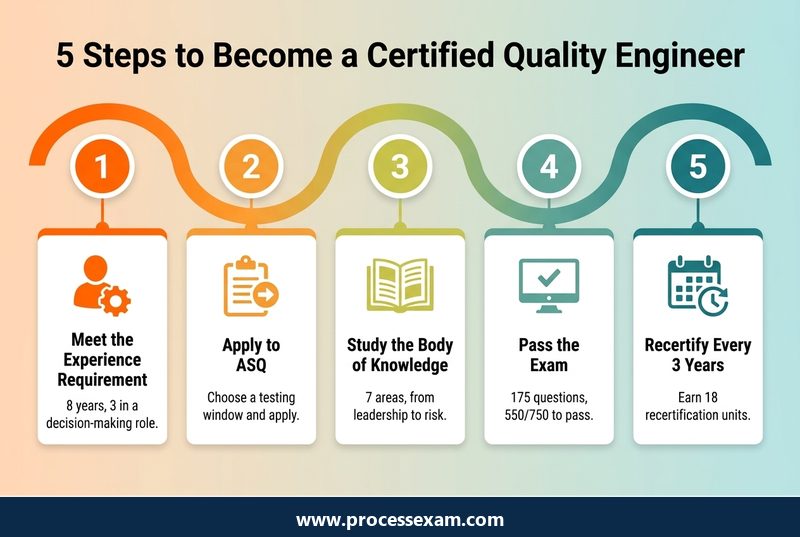
Step 1: Meet the experience requirement
You need eight years of on-the-job experience in one or more areas of the CQE Body of Knowledge, with at least three of those years in a decision-making position. A degree waives part of the eight years.
Step 2: Apply to ASQ and choose a testing window
You submit an application to ASQ, pay the exam fee, and pick one of the computer-based testing windows. Once approved, you schedule your appointment with ASQ's testing partner, Prometric.
Step 3: Study the Body of Knowledge
The exam is written from the CQE Body of Knowledge, which has seven areas ranging from management and leadership to quantitative methods and risk management. Your study plan should follow it closely.
Step 4: Pass the exam
The computer-delivered exam has 175 multiple-choice questions and a passing score of 550/750. It is open book, so organised references are part of your preparation.
Step 5: Recertify every three years
The CQE is not a lifetime certification. You keep it by earning 18 recertification units in each three-year period, or by retaking the exam.
What are the ASQ CQE requirements for experience and education?
ASQ's experience rule is the step that decides when you can apply, so check it before anything else. According to ASQ's Certified Quality Engineer page, candidates need eight years of on-the-job experience in one or more of the areas of the CQE Body of Knowledge.
The decision-making requirement
A minimum of three of those eight years must be in a decision-making position. ASQ defines decision-making as the authority to define, execute or control projects or processes and to be responsible for the outcome. It may or may not include management or supervisory duties, so a senior engineer who owns a process can qualify even without direct reports. The experience must come from a full-time, paid role.
How a degree reduces the eight years
If you hold a degree from a college, university or technical school with accreditation accepted by ASQ, part of the eight-year requirement is waived. Only one waiver can be claimed:
| Education completed | Years waived | Work experience still needed |
|---|---|---|
| Diploma from a technical or trade school | 1 | 7 years |
| Associate degree | 2 | 6 years |
| Bachelor's degree | 4 | 4 years |
| Master's or doctorate | 5 | 3 years |
Whatever waiver applies, the three years in a decision-making position remain. Degrees from institutions outside the United States must be equivalent to degrees from US institutions.
Experience from other ASQ certifications
If ASQ has already certified you as a Quality Auditor, Reliability Engineer, Supplier Quality Professional, Software Quality Engineer or Manager of Quality/Organizational Excellence, the experience you used to qualify for that certification also applies to the CQE.
What employers usually look for
Separately from ASQ's rules, most employers hiring quality engineers prefer a bachelor's degree in engineering, science or a related field. They also look for data analysis, problem solving, organisation and leadership skills, working knowledge of quality standards, and experience with quality improvement tools. The CQE is voluntary, but it is one of the clearest ways to show that combination.
How much does the CQE exam cost, and how do you apply?
The CQE exam fee depends on whether you are an ASQ member and whether this is a first attempt or a retake. The fees are:
- ASQ MEMBERS - $450
- NON-MEMBERS - $550
- RETAKES - $350
The member rate applies to the initial examination, so candidates who plan to use other ASQ resources often join before applying. If you choose not to become a member, you still create a free ASQ account with an email address to apply. The retake rate is available for two years after a previous attempt. Fees can change, so confirm them on ASQ's page before you pay.
The application process
- Submit your application. You can apply for ASQ certification online or download and mail a paper application. Online applications are reviewed in one to two business days; paper applications take three to five.
- ASQ reviews it. You receive either an approval or a hold message asking for more information. If you do not meet the requirements, the fee is refunded minus a processing fee.
- Receive your eligibility email. For computer-based testing, the eligibility email with scheduling instructions arrives one to two business days after approval. Paper-based candidates receive a seating letter about two weeks before the exam.
- Schedule with Prometric. You book a date, time and location inside the testing window you chose, either at a Prometric test centre or through live remote proctoring where available.
Testing windows and deadlines
The CQE is offered in fixed testing windows, each with an application deadline several weeks before it opens. At the time of writing, ASQ lists windows in October and December 2026 and February 2027. Pick your window first and work backwards: apply before the deadline, and leave enough study time between approval and your appointment. Changing an appointment must be done at least five days in advance and carries a fee, and missing an appointment forfeits the exam fee.
What is the CQE exam format and passing score?
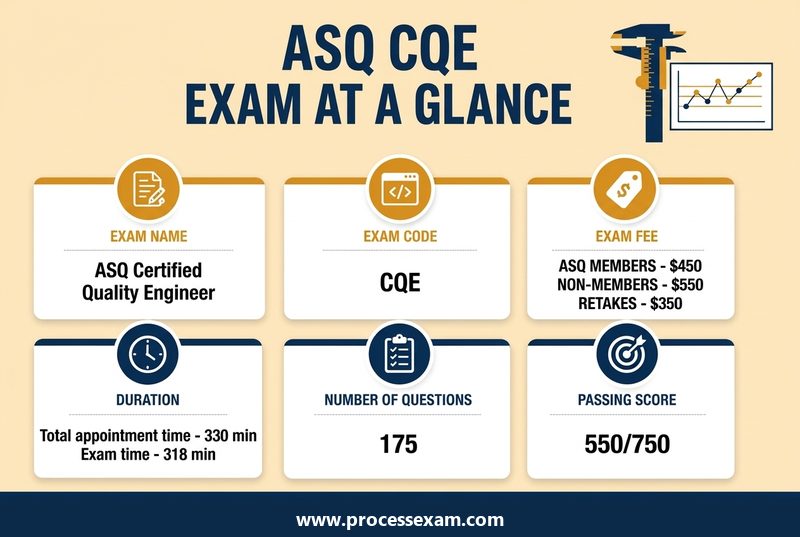
The exam is long, open book and heavily quantitative. Here are the facts in one place:
| Exam detail | ASQ CQE |
|---|---|
| Full name | ASQ Certified Quality Engineer |
| Exam code | CQE |
| Vendor | ASQ |
| Number of questions | 175 |
| Duration (minutes) | Total appointment time - 330 Exam time - 318 |
| Exam fee (USD) | ASQ MEMBERS - $450 NON-MEMBERS - $550 RETAKES - $350 |
| Passing score | 550/750 |
How the questions are scored
All 175 questions are multiple choice. ASQ explains that 160 of them are scored and 15 are unscored items being tested for future exams. You cannot tell which are which, so treat every question as if it counts. Results are reported on a scaled score, and 550/750 is the mark you need to pass.
Open book, with rules
All ASQ exams are open book, but the references must be bound: permanently stitched or glued, or held in ring binders, spiral binders or similar fasteners that go through every page. Hand-stapled notes, loose pages and unbound tablets are not allowed. Sticky notes are permitted only as tabs attached before you arrive, and the test centre administrator inspects every reference before you enter.
Calculators and identification
The computer-based exam includes an on-screen basic scientific calculator, and a hand-held basic calculator is available on request. You may bring a silent, battery-operated calculator with no programmable memory; programmable and graphing models are not allowed. Bring one valid, government-issued photo ID with a signature that matches the name on your application, and arrive half an hour early for check-in.
Languages and paper exams
The computer-delivered exam is offered in English, with bilingual English/German, English/Spanish and English/Mandarin forms. A paper-and-pencil version, with 160 multiple-choice items and a five-hour limit, is offered in Mandarin and Korean in certain locations.
What does the CQE Body of Knowledge cover?
The exam is built from the 2022 CQE Body of Knowledge, which ASQ publishes as a PDF with every topic and its cognitive level. Each topic ends with a level from Bloom's taxonomy, such as Apply, Analyze or Evaluate, which tells you how deeply it is tested. The seven areas and the number of scored questions in each are:
| Body of Knowledge area | Scored questions |
|---|---|
| I. Management and Leadership | 17 |
| II. The Quality System | 18 |
| III. Product, Process, and Service Design | 21 |
| IV. Product and Process Control | 23 |
| V. Continuous Improvement | 26 |
| VI. Quantitative Methods and Tools | 34 |
| VII. Risk Management | 21 |
| Total scored | 160 |
I. Management and Leadership
This area covers quality philosophies from quality control through statistical process control to total quality management, including Deming's 14 points. It also covers the quality management system (strategic planning, deployment tools such as benchmarking, stakeholder analysis, cost-benefit analysis, Gantt charts and the RACI matrix, and quality information systems), the ASQ Code of Ethics, leadership, facilitation, communication, customer relations, supplier management and the barriers to quality improvement.
II. The Quality System
Expect questions on the elements and design of a quality system, document control and quality records, standards such as the ISO 9000 series and the Malcolm Baldrige National Quality Award, quality audits (types, roles, planning, reporting and follow-up), cost of quality and quality training. Industry-specific standards are not tested.
III. Product, Process, and Service Design
This area tests how quality is built in: classifying quality characteristics, design inputs and reviews, Design for X and Design for Six Sigma, requirements traceability, technical drawings and GD&T, verification and validation (IQ, OQ and PQ), reliability models such as the Weibull and the bathtub curve, reliability indices like MTTF, MTBF and MTTR, and FMEA in its design, process and use forms.
IV. Product and Process Control
Here the focus is on control plans, material identification and traceability, segregation, nonconformance classification and the material review board. Acceptance sampling is important, including OC curves, AQL, LTPD and the ANSI/ASQ Z1.4 and Z1.9 standards. The area also covers measurement tools, destructive and nondestructive testing, metrology and calibration, and measurement system analysis with gage R&R studies.
V. Continuous Improvement
This area covers the seven basic quality control tools, the seven management and planning tools, improvement methods such as TQM, kaizen, PDCA and Six Sigma, lean tools from 5S and value stream mapping to SMED and OEE, and the corrective and preventive action process, including root cause analysis, 5 Whys and error proofing.
VI. Quantitative Methods and Tools
The largest area, and the one that decides most results. It covers data types and collection, descriptive statistics, probability, continuous and discrete distributions, confidence and tolerance intervals, hypothesis testing, ANOVA, contingency tables, regression and correlation, statistical process control with the full range of control charts, process capability and performance indices (Cp, Cpk, Cpm, Pp and Ppk), and design of experiments through full and fractional factorial designs.
VII. Risk Management
This area covers risk terminology and types, risk management plans, risk assessment with FMEA, risk matrices and risk priority numbers, and risk treatment, control and monitoring with tools such as a risk register. Scenario questions often join this area to FMEA from area III.
To see how these topics turn into exam questions, work through the free CQE sample questions before you build a full study plan. They show the style of the scenarios and how often a calculation hides inside a wordy question.
How should you prepare for the CQE exam?
Most working professionals need three to four months of steady study, and longer if statistics is not part of their daily job. The plan below assumes around eight to ten hours a week.
Many candidates sit a full-length CQE mock exam once they have worked through the Body of Knowledge, because 175 questions test stamina as much as knowledge.
Build your reference library first
Because the exam is open book, the right references are part of the preparation. ASQ Quality Press publishes The Certified Quality Engineer Handbook, Fifth Edition, and a CQE Study Guide, both organised around the Body of Knowledge. Add a statistics reference you are comfortable with, then tab each book by Body of Knowledge area so that you can find a formula or table in seconds. Candidates who bring a pile of unfamiliar books lose time searching instead of answering.
Follow the Body of Knowledge, weighted by questions
Plan your weeks around the question counts. Quantitative Methods and Tools carries 34 scored items, more than twice as many as Management and Leadership, so give it the most time. A practical sequence is to start with Management and Leadership and the Quality System to learn the language, move to Design and Product and Process Control, spend the longest block on Quantitative Methods and Continuous Improvement, and finish with Risk Management, which draws on many of the earlier tools.
Practise the calculations by hand
Knowing that a control chart exists is not enough; the exam asks you to pick the right chart, compute its limits and interpret the pattern. Work problems on capability indices, sampling plans, hypothesis tests, reliability and gage R&R until you can do them with your calculator and your references alone, the way you will on exam day.
Take timed practice exams
The exam gives you 318 minutes of exam time for 175 questions, a little under two minutes each. Long statistics problems eat that margin quickly. Timed, full-length practice shows which areas are weak and trains your pace. The CQE practice exam on ProcessExam uses the same question count and timing, so you can measure your readiness before booking. Review every question you got wrong or guessed, and note where in your references the answer was.
Mistakes that cost candidates a pass
- Underestimating statistics. Quantitative Methods and Tools is the largest area, and statistics also appears inside continuous improvement, control and risk questions.
- Relying on the open book. References help you confirm an answer, not learn a topic during the exam. There is no time to read a chapter.
- Bringing references that break the rules. Hand-stapled notes are turned away at check-in, along with the study time spent on them.
- Skipping the smaller areas. Management, the quality system and risk management together carry many points and are often the quickest marks.
- Ignoring the clock. Mark long calculations and return to them rather than stalling in the first hour.
- Applying late. Each testing window has a deadline weeks before it opens; missing it pushes your exam back by months.
On exam day
Read the last line of each question first so you know what is being asked, answer the conceptual questions quickly to bank time for calculations, and use your tabs rather than the index. With the computer-based exam you see a pass or fail result as soon as you submit, and ASQ confirms it by email within three to five business days, followed by details for claiming your digital certificate and badge. If you do not pass, ASQ emails a summary of your performance by area, which is the best guide for a retake.
How do you keep your CQE certification, and is it worth it for your career?
The CQE must be renewed every three years so that certified engineers keep the level of knowledge they showed in their first exam. Under ASQ's recertification rules you can either earn 18 recertification units (RUs) within the three-year period, or retake the certification exam at the end of it. Every activity must tie to at least one area of the Body of Knowledge.
How to earn recertification units
RUs come from professional work that keeps your skills current: employment in the field, professional development such as courses and conferences, teaching or presenting, publishing, and, since ASQ simplified its categories in 2024, volunteering and mentoring. Recording each activity in ASQ's online journal as you go is far easier than reconstructing three years of work at the deadline. If you miss the recertification date, there is a short grace period for the journal route before the exam becomes the only option; if you do not recertify, the certification lapses.
What the CQE does for your career
The CQE is valued because it is hard to fake. It combines a demanding, statistics-heavy exam with eight years of verified experience, and the program is accredited by the ANSI National Accreditation Board under ISO/IEC 17024. For employers in regulated and high-reliability industries, that combination is evidence that an engineer can run capability studies, design sampling plans, lead audits and manage risk without close supervision.
In practice, the credential helps in three ways. It supports moves from quality technician or inspector roles into engineering, and from engineering into quality management. It strengthens your case with customers and auditors when you sign off on supplier approvals, validations and corrective actions. And it gives you a common language with quality professionals across industries, which matters when you change sectors. Many candidates ask about the certified quality engineer salary; ASQ publishes an annual salary survey through Quality Progress magazine, which is the most reliable place to compare pay for certified and non-certified quality engineers by industry, region and role.
If you already meet the experience requirement, the fastest route is to choose a testing window, apply before its deadline, build and tab your references, and use timed practice to find your weak areas while there is still time to fix them.
Frequently Asked Questions
What are the requirements to become an ASQ Certified Quality Engineer?
ASQ requires eight years of on-the-job experience in one or more areas of the CQE Body of Knowledge, with at least three years in a decision-making position. A degree waives part of the eight years, from one year for a technical diploma to five years for a master's or doctorate.
How much does the CQE exam cost?
The CQE exam fee is listed as ASQ MEMBERS - $450, NON-MEMBERS - $550 and RETAKES - $350. The member rate applies to the initial exam, and the retake rate is available for two years after a previous attempt. Confirm current fees on ASQ's CQE page before applying.
How many questions are on the CQE exam, and how long is it?
The computer-delivered CQE exam has 175 multiple-choice questions, of which 160 are scored and 15 are unscored. Total appointment time is 330 minutes and exam time is 318 minutes, so plan for a little under two minutes per question and keep time for longer statistics problems.
What is the passing score for the CQE exam?
You need a scaled score of 550/750 to pass the CQE exam. With computer-based testing you see your pass or fail result immediately after submitting, and ASQ confirms it by email within three to five business days. Candidates who fail receive a performance summary by Body of Knowledge area.
Is the CQE exam open book?
Yes. All ASQ exams are open book, but every reference must be bound, for example stitched, glued or held in a ring or spiral binder. Hand-stapled notes and loose pages are not allowed, and sticky notes may be used only as tabs attached before you arrive at the test centre.
How often do you need to recertify the CQE?
The CQE must be renewed every three years. You can earn 18 recertification units during the three-year period through work, professional development, teaching, volunteering and similar activities, or you can retake the certification exam at the end of the period. Otherwise the certification lapses.
- ASQ Quality Engineer Sample Questions |
- CQE Exam Questions Download |
- CQE Test Questions |
- Quality Engineer PDF |
- ASQ Quality Engineer Book |
- ASQ CQE BOK PDF |
- Quality Engineer Certification Cost |
- Quality Engineer Certification Requirements |
- ASQ Quality Engineer Test Questions |
- CQE Question Bank |
- CQE Body of Knowledge (BOK) |
- Engineering |
- CQE Handbook


