
How to Become a Certified Quality Inspector: The ASQ CQI Route
Updated on 22 September 2026. What’s new: CQI eligibility corrected to three years of paid experience, two waived by a diploma or degree, and the syllabus updated to ASQ's 2025 Body of Knowledge.
You do not need a degree to become a quality inspector. Most inspectors start with a high school diploma or GED, learn to read drawings and handle gauges on the shop floor, and then prove that skill with the ASQ Certified Quality Inspector (CQI) credential once they have the paid experience ASQ asks for. That is the whole route: foundation, floor time, then certification.

The rest of this guide fills in each stage. It covers what the job looks like hour by hour, which school subjects and training actually pay off, how much experience ASQ counts and how a diploma or degree shortens it, what the CQI exam asks under ASQ's 2025 Body of Knowledge, and how to prepare for a test where roughly one question in five needs a calculation. It closes with where the credential can take you once you hold it.
What does a quality inspector actually do on a shift?
An inspector's job is to decide, with evidence, whether a product or material meets its requirements, and to say so in a way that other people can act on. The requirements live in drawings, specifications, purchase orders, standards and customer agreements. The evidence comes from measurement, testing and observation. Everything else in the role supports those two things.
A typical shift in a machining or assembly plant might run like this. The first hour goes to a first-article inspection on a part that has just come off a new setup: the inspector checks every dimension on the drawing, records the readings, and either releases the setup for production or sends it back to the machinist with the features that are out. Later come in-process checks at set intervals, pulled at random from the line, with the results plotted on a control chart. Incoming material from a supplier arrives and needs a sampling inspection before it can be used. Near the end of the shift, a batch that failed a check needs to be tagged, segregated and written up so that a material review board can decide whether it is reworked, scrapped or accepted under a customer waiver.
The tools change with the industry. In precision machining the day revolves around micrometers, calipers, height gauges, a granite surface plate and a coordinate measuring machine. In electronics it might be a multimeter, an oscilloscope and a vision system. In plastics or rubber, a durometer and a set of attribute gauges. In aerospace and medical device plants, the paperwork is as demanding as the measurement, because every reading must be traceable to a calibrated instrument and every nonconformance must be documented.
What stays constant is the judgment. A good inspector notices when a reading looks too good, when a gauge has not been zeroed, when two operators are measuring the same feature differently, or when a trend on the chart is heading toward a limit before any part is actually bad. That habit of noticing is what employers are really paying for, and it is exactly what the CQI exam tries to test.
Where inspectors work
Manufacturing employs the largest share: automotive, aerospace, defence, medical devices, electronics, metal fabrication, plastics and food packaging. Inspectors also work for suppliers who ship into those industries, for third-party inspection companies, and in receiving departments of large distributors. Some roles are almost entirely on the floor; others split time between the floor, a metrology lab and a desk where reports are written. Shift work is common in plants that run around the clock.
Which skills and education get you hired as an inspector?
Employers hiring an entry-level inspector usually ask for a high school diploma or equivalent, basic computer skills and a willingness to learn their measuring equipment. What separates candidates is how quickly they can become useful, and that comes down to four skill areas.
Shop math you can do without hesitating
Inspectors add and subtract tolerances, convert between inches and millimetres, work with fractions and decimals, and occasionally solve for an angle. None of it is advanced, but it has to be fast and it has to be right. If algebra and basic trigonometry felt shaky at school, a community college course in technical or shop mathematics is the single most useful thing you can take before applying.
Drawing and GD&T literacy
Every inspection starts with a drawing or a model-based definition. You need to read a title block, find the revision, interpret general tolerances and notes, and understand geometric dimensioning and tolerancing symbols from the ASME Y14.5 standard. Blueprint reading and GD&T classes are offered by technical schools, community colleges and many employers, and they turn up in almost every inspector job advertisement.
Hands-on measurement
Knowing how a micrometer works is not the same as getting a repeatable reading with one. Machining programmes, apprenticeships and trade school courses give you hours on real equipment, which is why employers often prefer candidates who have worked as machine operators or machinists. If your current job puts gauges in your hands, you are already building the experience that counts.
Written communication
An inspection that is not recorded clearly did not happen, as far as an auditor or a customer is concerned. Inspectors write nonconformance reports, fill in first-article inspection reports and explain findings to supervisors and engineers. Clear, factual writing is an underrated advantage.
Is a degree worth it?
For the inspector role itself, a degree is rarely required. An associate degree in quality technology or manufacturing, or a bachelor's in industrial or manufacturing engineering, becomes more valuable when you want to move into quality engineering, supervision or supplier quality later. For the CQI in particular, the payoff from education is specific and easy to measure, as the next section shows.
How much experience do you need before ASQ lets you sit the CQI?
The CQI is not an entry-level exam you can book on your first day. ASQ wants three years of work in at least one area the CQI Body of Knowledge covers, and that work has to come from a full-time job that paid you. Inspection work counts, and so does related work such as machining with in-process checks, calibration, metrology lab work or test technician duties, provided it maps onto areas of the Body of Knowledge.
Education reduces the requirement in a simple way for this exam. Whatever qualification you hold, the reduction is the same: a technical, military or trade school diploma, an associate degree, a bachelor's degree, or a master's or doctorate each removes two years. You can claim only one, so a candidate with both a trade diploma and a bachelor's still needs one year of qualifying work. That makes the CQI unusually friendly to people coming out of a trade programme: finish the diploma, work one full year as an inspector, and you can apply.
A few practical points follow from this:
- Count from the date you apply, not the date you test. Your experience has to be in place when ASQ reviews your application.
- Describe the work in Body of Knowledge terms. "Operated a lathe" says less than "performed in-process dimensional checks with micrometers and recorded SPC data".
- Keep evidence. ASQ can ask for verification, so keep job descriptions and a contact who can confirm your duties.
- Read the current wording before applying. ASQ publishes the requirement on its Certified Quality Inspector certification page, and that page, not a forum post, is what your application is judged against.
What does the CQI exam look like on the day you sit it?
The figures below are the exam facts ProcessExam holds for the CQI. They match what ASQ showed on its CQI page when this article was checked in September 2026.
| Exam fact | ASQ CQI |
|---|---|
| Certification | ASQ Certified Quality Inspector (CQI) |
| Exam code | CQI |
| Number of questions | 110 |
| Duration | Total appointment time- 270 minutes; Exam Time - 258 minutes |
| Passing score | 550/750 |
| Exam fee | ASQ MEMBERS - $360; NON-MEMBERS - $460; RETAKES - $260 |
Of the 110 questions on the computer-based exam, 100 are scored and 10 are unscored trial items. Nothing marks the trial items out on screen, so give each one your full attention. The score is scaled, which means 550 out of 750 is not a simple percentage of questions answered correctly. ASQ also runs a paper-and-pencil version in some settings, a 100-question paper with four hours allowed, and both versions are given in English only.
Open book, but only with bound material
The CQI is an open-book exam. That sounds like a gift, but it is really a test of how well you have organised your references. ASQ sets rules on what you may bring, so check them on the ASQ site before you tab a single page, and plan to carry a handful of well-marked books rather than a crate of loose notes. The time limit leaves little room for browsing.
Fixed testing windows, not year-round
ASQ delivers the computer-based CQI in month-long windows and lists it among its odd-month exams. When this article was checked in September 2026, ASQ's exam dates and deadlines page showed the September 2026 window in progress, the November 2026 window with an application deadline of 12 October 2026, and the January 2027 window with an application deadline of 7 December 2026. Deadlines fall weeks before each window opens, so the realistic plan is to pick a window, work back to its deadline, and apply with your experience details ready.
What the fee buys and what a retake costs
ASQ members pay the lower of the two first-attempt fees, so if you are paying for yourself it is worth comparing the cost of an ASQ membership with the difference. The retake fee is lower than a first attempt, but it also costs you another window and more weeks of study. The cheapest way to sit the CQI is to sit it once.
Which topics fill the 2025 CQI Body of Knowledge?
ASQ tests the CQI against a 2025 Body of Knowledge, which ASQ's official CQI page links as the current edition. It has four sections and 100 scored questions, and ASQ notes that about 20 percent of the questions on each exam need a calculation. Inspection and Test is the largest section, but the four are close enough in size that you cannot skip any of them.
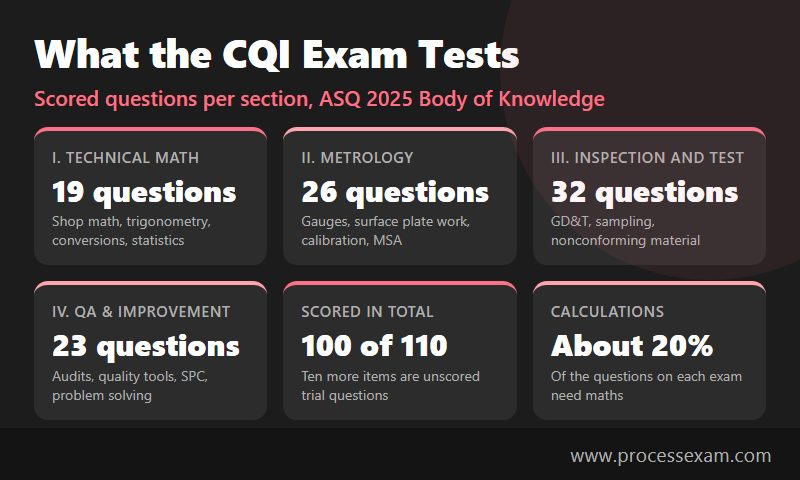
| Section | Scored questions | What you will be asked to do |
|---|---|---|
| I. Technical Mathematics | 19 | Shop math, algebra, geometry, trigonometry, unit and number conversions, basic statistics |
| II. Metrology | 26 | Choose, use and care for gauges, surface plate work, specialised equipment, calibration, MSA |
| III. Inspection and Test | 32 | Drawings and GD&T, sampling, inspection planning, nonconforming material, testing methods |
| IV. Quality Assurance and Improvement | 23 | Improvement concepts, audits, quality tools, SPC, problem-solving methods, resources |
I. Technical Mathematics
This section checks that you can do the arithmetic an inspector meets every day. Expect fractions and decimals, rounding to significant digits, percent change, first-degree equations, areas, circumferences and volumes, complementary and supplementary angles, and sine, cosine, tangent and the Pythagorean theorem. Unit conversion between English and SI units appears here, as do scientific notation and conversions between fractions and decimals. The 2025 edition places basic statistics in this section: mean, median and mode, range, standard deviation and variance, percentages and ratios, simple graphs such as tally sheets and scatter diagrams, and the shape of the normal distribution.
II. Metrology
Metrology is about the instruments. You need to recognise and use variable gauges such as micrometers, calipers, dial indicators and CMMs, attribute gauges such as thread plugs, ring and pin gauges, and transfer gauges such as telescoping and small-hole gauges. The section also covers the 10:1 rule for gauge selection, gauge handling and storage, correlation between instruments, surface plate equipment and angle tools such as sine bars, and specialised equipment from profilometers to optical comparators and vision systems. Calibration takes a large share: calibration intervals and identification, the hierarchy of standards and traceability, environmental effects, and what to do when an instrument is found out of calibration. The section ends with measurement system analysis terms: bias, stability, precision, accuracy, linearity and repeatability and reproducibility studies.
III. Inspection and Test
The largest section starts with drawings. You will interpret title blocks, revision blocks and notes, use ASME Y14.5 terms and symbols, calculate position and bonus tolerances, and set up a part from its datum structure, which the Body of Knowledge tests at the Analyze level, the highest in the exam. Sampling follows: acceptance quality limit, random sampling, lot and sample size, acceptance numbers and sampling plans. Then comes inspection planning, covering incoming, first-article, in-process and final inspection, inspection errors such as fatigue, flinching and cosine error, product traceability, severity levels, and how nonconforming material is identified and dispositioned. The section closes with nondestructive, destructive, functional and hardness testing, plus the basics of checking software used in test equipment.
IV. Quality Assurance and Improvement
This section widens the lens from the part to the system. It covers quality improvement ideas such as prevention over detection and the cost of poor quality, the types and stages of audits, and the classic quality tools: Pareto charts, cause-and-effect diagrams, flowcharts, check sheets, scatter diagrams and histograms. Statistical process control is a major block, from common and special cause variation to variables charts, attributes charts and the difference between Cp, Cpk, Pp and Ppk. Problem-solving methods follow, including PDCA, lean and 5S, DMAIC, FMEA, 8D, 5 Whys, fault tree analysis and corrective and preventive action. It finishes with safety resources, reference standards, teamwork and quality documentation such as first-article inspection reports and PPAP.
ProcessExam keeps the complete CQI topic list, sub-topic by sub-topic on its syllabus page, which is handy as a tracking sheet while you study. For the authoritative wording, ASQ publishes the 2025 CQI Body of Knowledge as a PDF.
How should you prepare when one question in five needs a calculation?
Because the CQI is open book and roughly a fifth of its questions involve arithmetic, preparation has two jobs: make the calculations automatic, and make your references fast to search. Reading alone does neither.
Work these five problem types until they take under a minute
The examples below are illustrations written for this guide, not questions from the exam, but each one matches a line in the Body of Knowledge.
- Gauge selection by the 10:1 rule. A shaft is toleranced at plus or minus 0.005 in, a total band of 0.010 in. The measuring instrument should resolve a tenth of that, 0.001 in or finer, which rules out a steel rule and puts you on a micrometer or a good dial caliper.
- Bonus tolerance. A hole is specified at 10.0 mm +0.2 / -0.0 with a position tolerance of diameter 0.1 mm at maximum material condition. The hole's maximum material size is 10.0 mm. If it measures 10.15 mm, it has departed from MMC by 0.15 mm, so the allowed position tolerance grows to 0.1 + 0.15 = 0.25 mm.
- Percent change. A line's reject rate falls from 2.4 percent to 1.8 percent. Using the Body of Knowledge formula, (1.8 - 2.4) / 2.4 x 100 = -25, a 25 percent reduction, not a 0.6 percent one.
- Sine bar set-up. To set a 5 in sine bar to 30 degrees, stack gauge blocks to 5 x sin 30 = 2.5000 in.
- Basic statistics. Five readings of 10.02, 10.04, 10.01, 10.03 and 10.05 mm have a mean of 10.03 mm and a range of 0.04 mm.
Work each type several times with different numbers, using the same calculator you will take into the test centre, until you no longer need to think about the method.
A ten-week plan for someone already working as an inspector
- Weeks 1 and 2: Technical Mathematics. Rebuild the arithmetic first, because it feeds every other section. Finish with a timed set of mixed calculations.
- Weeks 3 and 4: Metrology. Pair every topic with an instrument you can pick up at work. Read a micrometer, a vernier and a dial indicator deliberately, and write out the calibration hierarchy from memory.
- Weeks 5 to 7: Inspection and Test. Spend the most time here. Practise GD&T on real drawings from your plant where you are allowed to, work bonus tolerance problems, and learn the sampling vocabulary precisely.
- Week 8: Quality Assurance and Improvement. Draw each control chart type and each quality tool by hand once, then learn when each is used.
- Week 9: full timed run. Take a complete mock exam under real time limits with only your bound references, and log every question you had to look up.
- Week 10: close the gaps and tab the books. Revisit the weakest section, add index tabs where the mock exam slowed you down, and stop learning new material two days out.
A timed run matters because the clock, not the content, is what catches most working inspectors. When you are ready to measure your pace, a CQI mock exam taken at full length under the 258-minute limit will show you which sections still send you hunting through your references.
Build your reference kit as you study
Choose a primary handbook that follows the Body of Knowledge, a GD&T reference, and your own bound summary sheets of formulas, conversion factors and chart constants. Tab them by section number, so that a question on attributes charts takes you straight to the right page. The kit is part of your preparation, not something to assemble the week before.
Which mistakes cost experienced inspectors marks on the CQI?
Candidates who fail the CQI are rarely short of shop-floor knowledge. They lose marks in predictable places:
- Trusting plant habits over the standard. Your plant may call a defect "major" when the exam's severity definitions would call it critical, or may skip a step in dispositioning nonconforming material. The exam follows the Body of Knowledge and the standards it names, not local custom.
- Underestimating the maths. Twenty percent of the exam is roughly twenty scored questions. Missing half of them through rusty arithmetic is enough to fail an otherwise strong candidate.
- Leaving GD&T to the end. Position, bonus tolerance and datum set-up questions sit at the highest cognitive level in the exam and take the longest to answer. They need weeks of practice, not an evening.
- Confusing control limits with specification limits. Control limits come from the process; specification limits come from the customer or the drawing. Questions often hinge on exactly that difference.
- Studying only the section you work in. A metrology lab technician may never touch sampling plans, and a receiving inspector may never run a control chart. The exam covers all four sections regardless of your job title.
- Spending too long on one question. With 110 questions in 258 minutes, you have a little over two minutes each. Answer what you know, mark the slow ones, and come back.
- Missing the application deadline. Because windows are fixed, a late application does not mean a late exam; it means the next window, two months on.
Is the CQI worth it, and where can it take your career?
For someone already working in inspection, the CQI does three things. It gives an employer independent evidence that you know the whole discipline rather than one plant's procedures. It shows up in job advertisements, particularly in aerospace, automotive and medical device work, where a recognised credential helps a candidate stand out in screening. And it gives you a structured reason to learn the parts of the job you have not yet been exposed to, which tends to make you more useful whichever way your career goes.
It is also one of the easier ASQ credentials to keep. ASQ lists the Quality Inspector among its lifetime certifications, so once you pass there is no three-year recertification cycle to maintain, a point you can confirm on ASQ's recertification page.
What the credential does for an employer
From the plant's side, a certified inspector means more confidence in measurement results, fewer escapes to customers, and someone who can support audits, first-article submissions and corrective action with the right vocabulary. That is why some employers pay the exam fee or tie certification to a pay grade. Ask your quality manager before you pay for it yourself.
Where inspectors go next
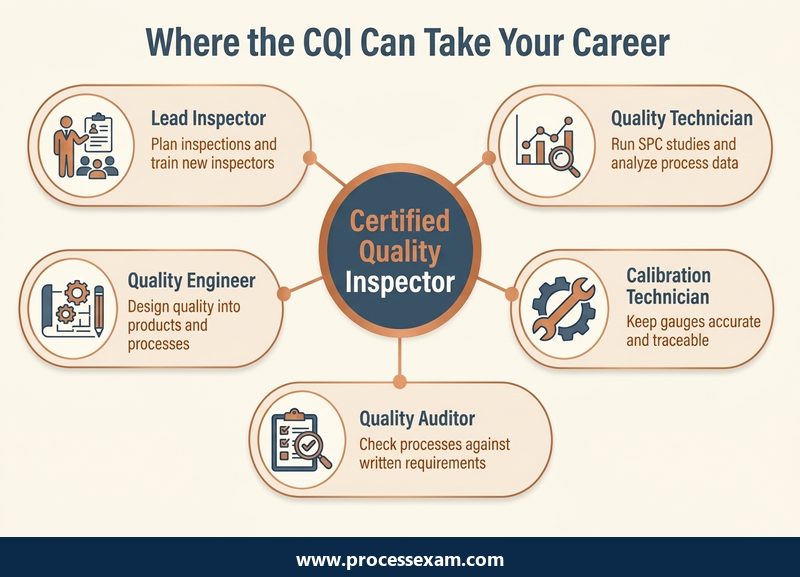
The CQI sits at the start of a well-worn path. Some inspectors become lead inspectors, planning inspection work and training new hires. Others move into quality technician roles with more statistical work, into calibration and metrology labs, into supplier quality, where they inspect and audit incoming material at the source, or into internal auditing. With more experience and often a degree, some go on to quality engineering. ASQ's other certifications follow the same routes, so the CQI is frequently the first of several.
The fastest way to start, if you are not in the field yet, is to find an entry-level inspection or machine operator job where gauges and drawings are part of the work, take a shop math and blueprint reading course alongside it, and keep a record of the tasks you perform. By the time you have the experience ASQ asks for, most of the Body of Knowledge will already be familiar, and the exam becomes the confirmation of a skill you have been building all along.
Frequently Asked Questions
How do I become a certified quality inspector?
Build the foundation with a high school diploma or GED, shop math and blueprint reading, then work in a paid inspection or related role. After three years of qualifying experience, or one year if a diploma or degree waives two, apply to ASQ, choose a testing window and pass the CQI exam.
What are the requirements for the ASQ CQI certification?
ASQ requires three years of full-time, paid on-the-job experience in one or more areas of the CQI Body of Knowledge. A diploma from a technical, military or trade school, an associate, bachelor's, master's or doctorate each waives two years, and only one waiver can be claimed, so the minimum is one year.
How much does the ASQ CQI exam cost?
The CQI exam fee is listed as ASQ MEMBERS - $360 and NON-MEMBERS - $460, with RETAKES - $260. Because members pay less for a first attempt, compare the cost of an ASQ membership with the difference before you apply, and confirm the current figures on ASQ's Quality Inspector certification page.
How many questions are on the CQI exam, and what is the passing score?
The computer-based CQI has 110 multiple-choice questions, 100 scored and 10 unscored, with an exam time of 258 minutes inside a 270-minute appointment. The passing score is 550/750, a scaled score rather than a percentage. The exam is open book and is offered in English only.
Does the ASQ CQI certification expire?
No. ASQ lists the Certified Quality Inspector among its lifetime certifications, so there is no recertification cycle and no recertification units to collect. Many holders still keep their skills current through further training or a second ASQ credential, such as the quality technician or calibration technician certifications.
- ASQ Quality Inspector Test Questions |
- CQI Question Bank |
- CQI Body of Knowledge (BOK) |
- ASQ Quality Inspector Book |
- ASQ CQI BOK PDF |
- Quality Inspector Certification Cost |
- Quality Inspector Certification Requirements |
- ASQ Quality Inspector Sample Questions |
- CQI Exam Questions Download |
- CQI Test Questions |
- Quality Inspector PDF |
- Inspector |
- CQI Handbook


