admin's blog

OMG-OCUP2-ADV300 Exam: Topic Weights, Pass Mark and Prep Guide

Updated on 10 October 2026. What’s new: the exam fee is US$350 whichever country you sit in, and Foundation and Intermediate passes are required before the Advanced exam

The OMG Certified UML Professional 2 Advanced exam, OMG-OCUP2-ADV300, is the level where UML stops being a notation you draw with and becomes a language you have to take apart. Of the 90 questions, 24% of the weighting goes to the MOF, Alf and fUML. You need 57 correct answers (63%) to pass, and the fee is US$350.

Woman smiling at a tablet beside the title Cracking OMG-OCUP2-ADV300 Exam First Attempt

Anyone who reaches this paper has already cleared the Foundation and Intermediate exams, so drawing a class diagram or reading a sequence diagram is assumed. What the Advanced sheet adds is language architecture: how UML is defined by a metamodel, how profiles bend it toward a domain, how a textual action language fits inside a model, and how a subset of UML can be given execution semantics. This guide goes through the weights, the chapters of UML 2.5.1 that OMG names, the exam rules and a revision order for a candidate who already holds Intermediate.

What does the Advanced level ask that Intermediate never needed from you?

It asks you to reason about the language itself. At the lower levels a question hands you a diagram and checks whether you read or complete it correctly. At Advanced level, several areas on the information sheet are about the machinery behind the diagrams: the Meta Object Facility, the metamodel that defines UML, profiles, redefinition, an action language called Alf and the execution semantics called fUML.

OCUP 2 Intermediate (OMG-OCUP2-INT200): Fee, Pass Mark and Prep Plan

Updated on 8 October 2026. What’s new: the exam fee is US$350 whichever country you sit in, and the pass mark is 51 of 90 correct answers (57%)

You need 51 of 90 answers correct, which is 57%, to pass OCUP 2 Intermediate. That is a lower bar than the Foundation exam asks for, but the questions go deeper into components, activities, interactions and state machines. The fee is US$350, and the time limit depends on where you live. This guide covers cost, topics, the UML 2.5.1 chapters worth reading and a short preparation plan.

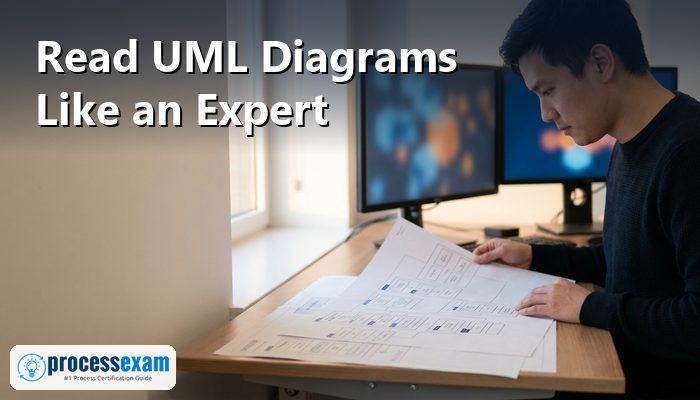
Software engineer reviewing UML diagrams for OCUP 2 Intermediate

The OMG Certified UML Professional 2 (OCUP 2) Intermediate Level certification, exam code OMG-OCUP2-INT200, tests whether you can read and build UML models of larger systems the way UML is used in practice. It sits in the middle of OMG's three-level UML 2 ladder: Foundation, Intermediate and Advanced. Search interest tends to arrive as "ocup 2" or "ocup2", and the questions behind those searches are nearly always the same: how hard is it, what does it cost, what is on it and how long should I study.

Is OCUP 2 Intermediate harder than Foundation, and what score passes?

The pass mark is lower, but the exam is not easier. OMG sets a different threshold at each level, and Intermediate has the lowest of the three: 51 correct out of 90. The Foundation information sheet asks for 60 out of 90 (67%) in 120 minutes for English-speaking countries, while the Advanced sheet asks for 57 out of 90 (63%). Read that as a reminder that each level is scored against its own scope, not as a hint that Intermediate is the soft middle.

PAL I Certification: Is Scrum.org's Agile Leadership Credential Worth It?

A manager does not need to run a Sprint to get value from PAL I. This Scrum.org assessment tests how leaders support teams that work in an agile way, and it is aimed at the people who sit around the Scrum Team: department heads, programme managers, executives and coaches. It has 36 questions, a 60-minute limit, an 85% passing score and a fee of USD $200.

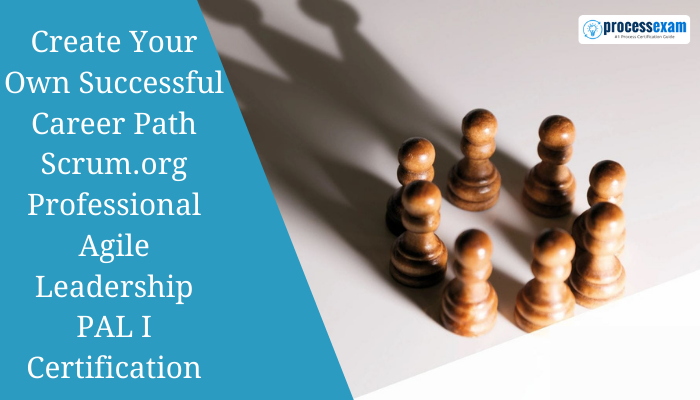
Wooden chess pawns arranged in a circle beside the title for the Scrum.org PAL I certification career path

This guide is written for the reader who has been told that the organisation is "going agile" and wants to know what the Professional Agile Leadership I credential would prove, what is on it, and how to prepare around a full-time job. It also covers what changes at work afterwards, which is the question most pages about PAL I leave out.

Do you need PAL I if you manage people but never run a Sprint?

Probably yes, if your decisions shape how a Scrum Team works. Budgets, targets, reporting lines, hiring and the way you ask for status all reach into a team's daily life, even when you never attend a Sprint Planning. PAL I is built for that influence. It asks whether you know how to use it in a way that helps a team deliver, instead of in a way that slows the team down while sounding supportive.

Three groups tend to get the most out of it:

ASQ Six Sigma Green Belt (CSSGB) Exam: What It Tests and How to Prepare

Picture a production supervisor who is handed a climbing defect rate and a spreadsheet of last quarter's rejects, with no method for getting from one to a fix. The ASQ Certified Six Sigma Green Belt (CSSGB) exam tests exactly that missing method. It is an open-book, computer-based exam of 110 multiple-choice questions, 100 of them scored, spread over the six parts of ASQ's 2022 Body of Knowledge, and it costs $383 for ASQ members or $483 for everyone else.

ASQ Six Sigma Green Belt CSSGB certification badge with the question of which jobs it leads to

This guide is about the exam itself: what each section asks, how the open-book rule works in practice, who qualifies, what the whole attempt costs and how to plan the weeks before your appointment. If you are still choosing between belts, or between certifying bodies, that is a separate decision. Here it is already made, and the task is to pass.

What changes when a supervisor with a spreadsheet learns the Green Belt method?

Go back to the supervisor for a moment, because the way most people attack a defect problem without training is remarkably consistent. The spreadsheet gets sorted by shift, then by machine, then by operator. One average looks worse on the night shift, so the night shift gets the blame. Somebody remembers that a supplier changed in the spring, and that becomes the working theory. A machine setting is adjusted, the reject rate dips for a fortnight, then creeps back, and the spreadsheet grows another tab.

Nobody in that story was lazy. They had data and no disciplined way of questioning it. Every step was a reasonable guess, and none of the guesses was ever tested, so the organisation learned nothing it could reuse on the next problem.


PSK Certification: What Scrum.org's Kanban Credential Proves

Updated on 10 October 2026. What’s new: the certification is lifetime with no annual renewal fee, according to the current Scrum.org assessment page.

Plenty of Scrum Masters assume a Kanban credential means swapping Sprints for a never-ending board. Scrum.org's PSK certification teaches the reverse: keep every Scrum rule and add flow practices on top. The assessment has 45 questions, a 60-minute limit and an 85% passing score, and it costs $200 per attempt. This guide covers what it tests, how to read its questions and how to prepare.

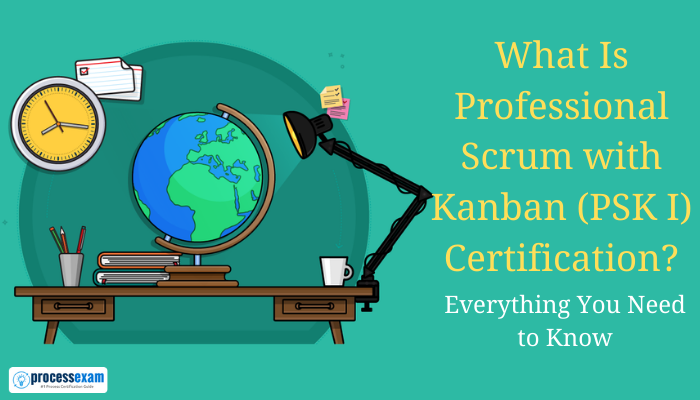
Desk with a globe, clock, books and sticky notes representing Scrum with Kanban study

Does adding Kanban mean a Scrum Team drops its Sprints?

No Sprint disappears. The Scrum Guide's accountabilities, events and artifacts all stay in place, and every Sprint still aims at a Done Increment. Kanban sits inside that frame as a way to make the flow of work visible and to steer it with numbers. Scrum.org describes the PSK I certification as validating knowledge of how Scrum Teams can use Scrum with Kanban to support value creation and delivery. Notice the direction of that sentence: the team is a Scrum Team first, and Kanban is something it uses.

Tips on How to Successfully Pass the Professional Scrum Developer Exam

Professional Scrum Developer, Professional Scrum Developer Certification, PSD I, PSD I Body of Knowledge (BOK), PSD I

Professional Scrum Developer certification is for anyone who wants to prove their knowledge of building complex software products using Scrum. So participants will learn to apply advanced engineering practices and use the Scrum framework to cope with changes.

Professional Scrum Developers are members of the Scrum Development Team and show knowledge and knowledge of Scrum and develop software using Scrum in real-world situations. The purpose of certification is intimately tied to the demonstration of expertise required to achieve it. By that measure, the PSD I assessment is significantly more expensive than available alternatives for Scrum.

The Purpose of the Professional Scrum Developer Certification

Scrum has helped many organizations to produce outstanding products but many other struggles. If you look precisely at why many have succeeded, you may get to understand that it was not only Scrum but excellent engineering culture. They talk about Extreme Programming practices such as minor releases, whole team, collective ownership, simple design, Test-Driven Development, Refactoring, Continuous Integrations, etc. The Scrum.org Certified Professional Scrum Developer plan introduces all these to the Scrum Team developing Software Products.

Is PRINCE2 Agile Worth It? Who Should Pick It Over Foundation or AgilePM

If your projects already answer to a PRINCE2 board but your delivery teams work in sprints, PRINCE2 Agile Foundation is the exam written for that gap; if you only need the governance language, plain PRINCE2 Foundation is cheaper and shorter on ideas, and if you never use PRINCE2 at all, AgilePM fits better. PeopleCert sets the agile paper at 40 multiple-choice questions in 60 minutes with a 60% pass mark.

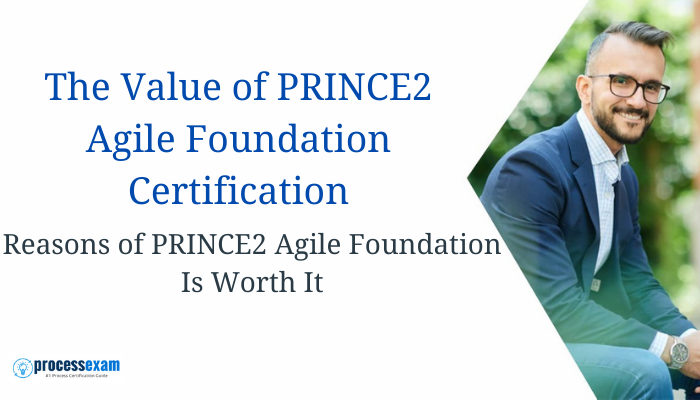
Project manager reviewing an agile board for the PRINCE2 Agile Foundation certification

Everything below was checked in October 2026 against PeopleCert's own PRINCE2 Agile Foundation page and its PRINCE2 Agile family page. The current edition is Version 2, which is the one this article describes, and the exam fee, question count, time and pass mark match the figures ProcessExam lists for it.

Which Foundation exam suits the job you do today?

Three entry exams compete for the same readers: PRINCE2 Foundation, PRINCE2 Agile Foundation and AgilePM Foundation. They are not ranked in a ladder. They answer three different questions, and the quickest way to choose is to ask which question your week keeps raising.

PMI-RMP Exam Format, Five Domains and How to Prepare

Updated on 3 October 2026. What’s new: the exam is 115 questions in 150 minutes across five domains: strategy and planning, identification, analysis, response, and monitor and close

The PMI-RMP is not a project management exam with a risk chapter attached. It is 115 questions in 150 minutes about one job: finding, sizing, answering and tracking risk on projects. PMI's outline gives 68% of the paper to strategy and planning, identification and analysis, and only 13% to response, so candidates who jump straight to mitigation lose ground.

Candidate studying for the PMI-RMP risk management certification at a desk

Who is the PMI-RMP written for, and who should look elsewhere?

The credential describes a person whose daily work is the risk register: a project risk manager, a PMO analyst who owns risk reporting, a project manager who chairs the risk review, or a planner who runs schedule-risk simulations. PMI's outline says the exam was built from a role study of practitioners who work in predictive, agile and hybrid settings, and that all three approaches turn up across every domain rather than in one corner of the paper.

That shapes who benefits. If risk is a side task you handle twice a quarter, the broader PMP is usually the better first credential, because it treats risk as one slice of a much wider job. If you spend most weeks asking what could go wrong, how likely it is and who owns the answer, the RMP is the credential that says so in one line on your CV.

ISTQB CTFL Certification: Is It Really Worth Anything?

Updated on 23 September 2026. What’s new: rewritten for the CTFL v4.0 syllabus, whose six chapters now end with Test Analysis and Design, Managing the Test Activities and Test Tools.

Two words on a CV, ISTQB certified, survive a keyword screen that discards most other testing training. That is the honest value of CTFL, and also its limit. It is worth the USD $229 to anyone who needs a recognised testing vocabulary and a way past that first filter, and worth very little to a test lead who already has the job, the scars and the evidence to show for them.

ISTQB CTFL certification cover with a tester and the question is it worth it

This article takes the question seriously rather than selling an answer. It sets out who gains from the ISTQB Certified Tester - Foundation Level, who gains almost nothing, what the exam costs once training and study time are counted, what the current CTFL v4.0 syllabus actually asks of you, how the 40 questions are distributed, what a hiring manager does and does not read into the line, and how to prepare without losing two months to it.

Who does the ISTQB CTFL certification actually help, and who should skip it?

The credential is not neutral. It moves some people a long way and others barely at all, and the difference is not talent. It is whether you currently have a way of proving that you understand testing as a discipline rather than as a set of habits picked up on one product.

ECBA Exam Preparation Tips: How to Pass on Your First Try

Updated on 8 October 2026. What’s new: the ECBA now follows IIBA's nine-domain blueprint with 50 questions in 75 minutes, and needs no work experience, degree or application.

Most ECBA advice online was written for an older exam, so the first step to passing on your first try is to study the current one. IIBA now tests nine domains, drawn from The Business Analysis Standard and the BABOK Guide, in 50 situation-based and standard multiple-choice questions over 75 minutes. The fee is $395, and no work experience is asked for.

New business analyst mapping requirements on sticky notes with a stakeholder in a bright meeting room

That opening matters because the Entry Certificate in Business Analysis is the IIBA credential people most often try to pass with a borrowed study plan. A friend's notes, a forum thread from a few years back or a summary of BABOK chapters can all feel reassuring and still point at the wrong material. This guide is built on IIBA's own documents, namely the exam blueprint (version 1.1), the ECBA Handbook dated May 2026 and the sample questions, all read in October 2026. It explains what is on the paper, how the marks are spread, how to practise, what exam day involves and which pieces of old advice to drop.

Syndicate content