
Is PRINCE2 Agile Worth It? Who Should Pick It Over Foundation or AgilePM
If your projects already answer to a PRINCE2 board but your delivery teams work in sprints, PRINCE2 Agile Foundation is the exam written for that gap; if you only need the governance language, plain PRINCE2 Foundation is cheaper and shorter on ideas, and if you never use PRINCE2 at all, AgilePM fits better. PeopleCert sets the agile paper at 40 multiple-choice questions in 60 minutes with a 60% pass mark.

Everything below was checked in October 2026 against PeopleCert's own PRINCE2 Agile Foundation page and its PRINCE2 Agile family page. The current edition is Version 2, which is the one this article describes, and the exam fee, question count, time and pass mark match the figures ProcessExam lists for it.
Which Foundation exam suits the job you do today?
Three entry exams compete for the same readers: PRINCE2 Foundation, PRINCE2 Agile Foundation and AgilePM Foundation. They are not ranked in a ladder. They answer three different questions, and the quickest way to choose is to ask which question your week keeps raising.
| Entry exam | Questions | Minutes | Pass mark | Fee (USD) | The question it answers |
|---|---|---|---|---|---|
| PRINCE2 7 Foundation | 60 | 60 | 60% | 338 | How is a project governed from start to close? |
| PRINCE2 Agile Foundation (Version 2) | 40 | 60 | 60% | 464 | How do you keep that governance while teams work iteratively? |
| AgilePM Foundation | 50 | 40 | 60% | 386 | How does a whole agile project run, with no PRINCE2 behind it? |
The figures come from ProcessExam's exam records for the three papers. They show a pattern worth noticing before you read a word of syllabus: the agile paper has the fewest questions and the highest fee of the three, and it gives you the same hour as the plain PRINCE2 paper to answer 40 questions rather than 60. That is roughly 90 seconds a question, so the questions are longer scenario-style items, not quick recall.
Pick PRINCE2 Agile Foundation when
- your organisation names its projects with PRINCE2 terms (project board, stages, tolerances, business case) and a delivery team inside them has started to use Scrum or Kanban;
- you are the person who has to explain to a sponsor why a sprint review does not replace a stage report, or the reverse;
- a tender, a framework contract or a job advert asks for PRINCE2 and agile skills in the same sentence.
Pick plain PRINCE2 Foundation when
- you need the method's vocabulary first and your teams are not yet working iteratively;
- your plan is to sit the Practitioner exam on the PRINCE2 side soon, because the agile paper does not replace the core method;
- cost matters most, since the fee in the table is lower and the syllabus is a single method.
Pick AgilePM Foundation when
- your employer runs agile projects without a PRINCE2 governance layer, or you work in a DSDM-style shop;
- you want one qualification that covers principles, lifecycle, roles and techniques of an agile project from the start.
These are not exclusive. Plenty of people sit PRINCE2 Foundation first and add the agile paper when a project forces the question, which is usually cheaper than guessing wrong at the start.
What does the PRINCE2 Agile Foundation exam involve today?
PeopleCert describes the Foundation level as the core module that covers the method's concepts and the knowledge needed to be agile and to do agile. It is open to any career stage, is delivered in ten languages and has no stated entry condition on its page. The facts you need before booking sit in one place here.
| Exam detail | Figure |
|---|---|
| Exam | PeopleCert PRINCE2 Agile Foundation (Version 2) |
| Questions | 40, multiple choice |
| Duration | 60 minutes |
| Passing score | 60% (24 of 40 correct) |
| Exam fee | USD 464 |
| Books and notes in the exam | None, closed book |
| Languages | English, Chinese, Dutch, French, German, Italian, Japanese, Polish, Portuguese (Brazil), Spanish |
| Certificate renewal | Every 3 years, with 20 CPD points |
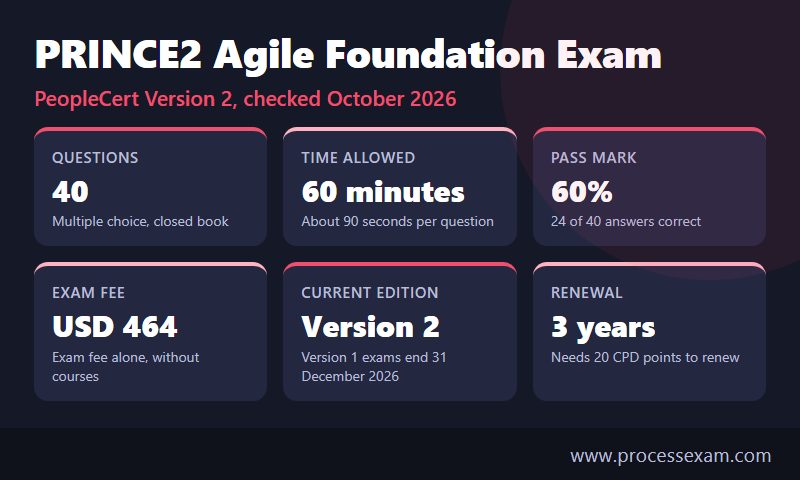
Two details deserve a second look. The first is that the exam is closed book. People who have heard that a PRINCE2 Practitioner paper allows the manual sometimes assume the agile Foundation paper does too, and it does not, so you must carry the ideas in your head. The second is the version. PeopleCert's family page carries a notice that PRINCE2 Agile Version 1 certifications are being retired: the last day to buy a Version 1 voucher was 30 June 2026, and the last day to take a Version 1 exam, including Take2 re-sits, is 31 December 2026. If a study guide, a forum thread or an old copy of this page talks about Version 1 material, check it against the Version 2 syllabus before you rely on it.
PeopleCert also sells the exam inside packages. The one-line summary of its own page is that the plain exam bundle is a self-study option with the voucher, the eBook and the Learning Resource Kit, while dearer tiers add a nine-hour interactive eLearning course, auto-marked sample papers and a free re-take. Read the current price and the contents on the vendor page at checkout, because package prices differ by country and currency and the table above is the exam fee alone.
Rescheduling has a cost too. The booking screen on PeopleCert's page states that moving an exam up to 48 hours before its start is free, and that a fee applies for later changes, rising again inside the last four hours. Book a date you can keep.
What does Version 2 cover that a plain PRINCE2 course leaves out?
PeopleCert's page lists nine learning areas for the Foundation level. Reading them as a group shows where the exam's weight sits: most of them are about behaviour, leadership and agile working rather than about PRINCE2 documents.
| Learning area on PeopleCert's page | What a candidate should be able to explain |
|---|---|
| The agile mindset | Agile values and behaviours, and why they raise adaptability and continuous improvement |
| Blending agile and PRINCE2 | How agile ways of working are tailored inside PRINCE2's governance |
| Stakeholder engagement | How to build stakeholder confidence and leadership backing, and tie work to business goals |
| Agile leadership basics | The part leadership plays in agile success and how endorsement is used |
| Risk and change control | Identifying, assessing and reducing risk in fast-moving delivery |
| Progress tracking | Agile-appropriate measures of progress and team performance, and keeping work visible |
| Agile roles and duties | Who does what across a team and how roles support collaboration |
| Scalable agility | Spreading agile practice across an organisation without losing clarity |
| Value-driven thinking | Picking out and prioritising the work that adds value to the customer |
The full topic breakdown for study is on ProcessExam's syllabus overview for this exam, which follows the same Version 2 structure. Use it as a checklist, and tick a topic only when you can explain it in two sentences without looking.
The method underneath
The agile paper assumes you know what PRINCE2 is for. If you need a refresher, the PRINCE2 article on Wikipedia gives the background of the method, and the Foundation basics (a project board that directs, a manager who controls day to day, a business case that must stay valid, work delivered in management stages) are the frame that the agile material hangs on. A candidate who cannot say why a stage boundary exists will struggle to say why a team can keep sprinting through one.
Older terms you will still meet
Earlier write-ups, including the first version of this page, described the exam as covering tailoring PRINCE2 themes and processes for agile, fixing and flexing the project, agile focus areas and techniques such as Scrum, Kanban, Lean Start-up and Cynefin. Those ideas are still part of how PRINCE2 Agile is explained, but PRINCE2 7 replaced the word themes with practices, and PeopleCert's Version 2 page frames the content as the nine areas above. When a resource uses the older wording, translate it rather than memorising it.
Fix and flex deserves a line of its own because it is the idea most often described. The principle is that you hold some project constraints steady, usually time, cost and quality, and let the amount of delivered content flex, so a team that finds its work larger than expected drops the least valuable items before it asks the board for more money or time. That is the bridge between a team's backlog and a project's tolerances, and expect scenario questions to test whether you can tell which side of that bridge a situation is on.
Is the credential worth the fee for your career?
Whether it is worth USD 464 depends on how often your work puts a PRINCE2 board and an agile team in the same room. Where that happens weekly, the credential is a shared vocabulary and a way to show an employer you can run both. Where it never happens, the same money buys more elsewhere.
Where it earns its fee
- Project and programme managers inside PRINCE2 organisations. Public bodies, large consultancies and many European and UK-linked employers use PRINCE2, and their delivery teams increasingly sprint. You become the translator between the two.
- Project support staff and coordinators. PeopleCert's page lists project support staff, team members, business analysts, product owners, product managers, junior consultants and senior executives as typical candidates. For a coordinator, it is a way to move into planning and control work.
- Business analysts and product owners who feed requirements into a governed project and need to explain to a board why priorities shift between reviews.
- Sponsors and executives who want to ask better questions about a hybrid project without learning a whole delivery method.
Where it earns less
- If you work in a pure product team that never sees a project board, the Scrum or product-owner credentials from the Scrum community may fit the day job better.
- If no employer or client in your market mentions PRINCE2, the agile add-on loses its context. Check job adverts first.
- A Foundation certificate shows knowledge, not experience. It opens an interview; it does not replace a record of delivered work.
A fifteen-minute test before you pay
Do not trust anyone's salary claim for this exam, including claims that it raises pay by a set percentage. Instead run a short check of your own market. Search a job board for roles in your region that mention both PRINCE2 and agile, count how many ask for a certificate and how many just mention the method, and compare with roles that mention only PRINCE2. If the first group is empty, the exam will not help you there. If it is full, you have your answer and also a list of the terms employers use, which you can feed into your study.
PeopleCert's own page pitches the Foundation level as an industry-recognised qualification that helps you qualify for roles in complex business environments, and the page lists Practitioner as a next step. Treat that as the vendor's pitch and weigh it against what your local adverts show.
Which words collide when PRINCE2 and agile meet in a question?
The 40 questions are scenario-flavoured, and most of the lost marks come from using a word with its everyday meaning when the exam means the other framework's. These are the pairs that cause most trouble.
| Idea you know | Where it collides | Ask yourself |
|---|---|---|
| Sprint or timebox | A management stage in PRINCE2 | Is this a short delivery cycle for the team, or a decision point for the board? |
| Definition of done | Product description and quality criteria | Who agreed the standard, and where is it written down? |
| Backlog item | Requirement tied to the business case | Does the item still support a business case that is viable? |
| Team self-organisation | Delegated authority within tolerances | What limit has the board set, and is the team inside it? |
| Sprint review | Progress reporting to the project board | Does the review feed a report, or replace a decision? |
| Changing priorities | Change control and issue handling | Is the change inside the team's remit or does it need escalating? |
A useful habit is to read a scenario twice: once to find who is speaking (a team member, the project manager or the board) and once to find what is being decided. Most wrong answers on a hybrid paper are right answers given by the wrong person.
The sponsor's question worked through
Picture a project to replace a customer portal. The board approved a business case and set cost and time tolerances. The team is two weeks into sprints and reports that a new compliance rule means a planned feature will take three times as long as estimated. A candidate who has learnt only the agile side says the team should reshuffle its backlog. A candidate who has learnt only PRINCE2 says raise an exception report. The PRINCE2 Agile answer sits between them: the team first flexes the lower-priority content to protect the fixed constraints, the project manager watches whether the forecast stays within tolerance, and only if it cannot do so inside tolerance does the matter go up to the board. You will see this decision pattern in many forms, so practise saying out loud who decides at each step.
What does a workable preparation routine look like for this exam?
Most candidates with some PRINCE2 background need between two and four weeks of regular study; a complete newcomer to both PRINCE2 and agile should plan a few more. This is a planning estimate, not a vendor figure, because PeopleCert does not publish study hours for the exam. The stages below fit most schedules.
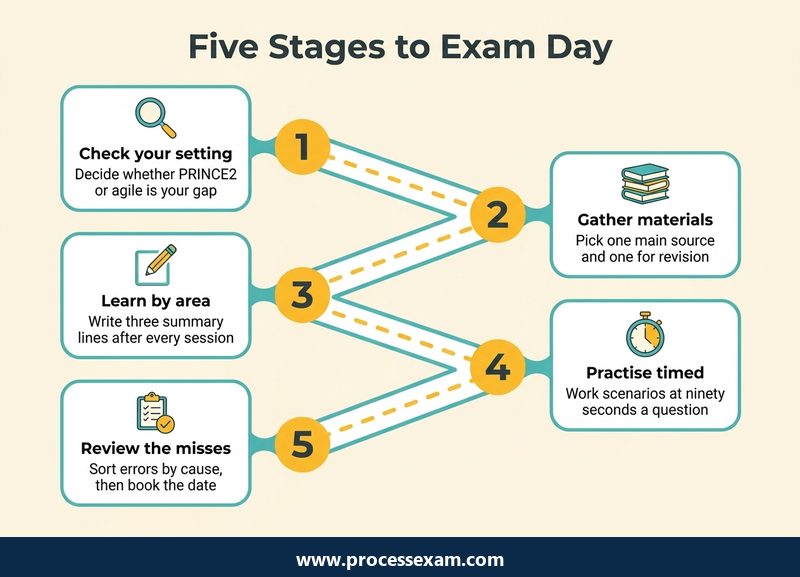
Stage 1: check your setting
Before opening any book, decide which situation you are preparing for: a PRINCE2 job that needs agile, or an agile job that meets PRINCE2. Your answer decides which half of the syllabus needs more hours. Someone from a Scrum background reads PRINCE2 basics first; someone from a PRINCE2 background reads the agile mindset and roles first.
Stage 2: gather the vendor's materials
PeopleCert lists an official eBook and a Learning Resource Kit with a learner workbook and quick reference guide, plus a nine-hour eLearning course. Pick one primary source and one revision source. Using four sources at once is the most common way to waste a week.
Stage 3: learn by area, not by chapter
Work through the nine learning areas in the table above, one or two per session, and end each with three written lines: what it is, why a project would use it, and the usual way a question hides it. That last line is the one that pays off on a closed-book paper.
Stage 4: practise in timed blocks
Time pressure is mild, about 90 seconds a question, but reading scenarios is slower than recalling facts, so practise at that pace from the second week. PeopleCert's site gives a sample paper as a download on its exam page. For a larger pool of scenario items to time yourself on, a PRINCE2 Agile Foundation practice exam gives you enough variety to see which of the nine areas still slips.
Stage 5: review wrong answers by cause
Label each missed question as vocabulary, wrong decision-maker or a missed qualifier such as "most appropriate". The pattern tells you whether to reread or to rehearse. A cluster of wrong decision-makers means you need to redraw the board, manager and team lines.
The week before
Stop adding new sources. Reread your three-line summaries, run one complete timed paper under exam conditions and book the sitting in a slot when you are usually alert. Check that your ID, your equipment and your room meet the delivery rules on PeopleCert's booking pages, and do not leave that check for the morning of the exam.
Do you need Foundation in PRINCE2 first, and does the certificate expire?
PeopleCert's PRINCE2 Agile Foundation page does not list a prerequisite, and it calls the exam the module to get you started, so you can book it as a first PRINCE2 qualification. Confirm the current rule at booking, because a vendor can change entry conditions. That does not make it the best first choice for everyone; the table at the start of this article is the better guide to that.
The certificate has a life span. The page states renewal every three years and that 20 continuing professional development (CPD) points are needed to renew. PeopleCert's route to those points runs through its PeopleCert Plus membership, where you log everyday professional activity, and it also allows renewal by enrolling in a different course from the same product suite and passing its exam before the renewal date. Put the renewal date in your calendar on the day you pass.
Where it leads
The family page lists PRINCE2 Agile Practitioner (Version 2) as the level above, described as the step that teaches you to lead teams, apply agile practices and tailor PRINCE2 Agile to any context. Foundation is a sensible stopping point if your role is to work alongside agile teams. Practitioner is for people who must run the hybrid project themselves. Only the second group needs to plan for it now.
When a different credential makes more sense
If your agile work is in product development rather than in governed projects, a Scrum-focused credential may serve your day job better; if you are moving up the PRINCE2 side, the Practitioner paper of the core method is the better next purchase. Neither choice is a retreat. Matching the credential to the projects you actually run is the whole point of reading a page like this one before paying.
What would a sensible decision look like?
Use these four questions in order and stop at the first clear answer.
- Do my employer or my target employers use PRINCE2? If no, look at AgilePM Foundation or a Scrum credential instead.
- Do the teams I work with deliver iteratively? If no, take PRINCE2 Foundation first and return to the agile paper when it becomes relevant.
- Do I have to explain how the two fit together to a board or a client? If yes, the agile paper is the right one now.
- Can I give it two to four weeks of steady study? If yes, book a date. If not, pick the date later rather than sitting unprepared at USD 464.
A Foundation certificate is the least expensive way to show you understand how governance and agile delivery coexist. Used on the right project, it pays for itself in clearer conversations long before it pays for itself in a job title.
Frequently Asked Questions
Is PRINCE2 Agile worth it?
It is worth it when your projects run under PRINCE2 governance and your teams work iteratively, because the exam teaches you to join the two. If no employer in your market mentions PRINCE2, it adds little. Search job adverts for both terms before paying the USD 464 fee.
How many questions and what pass mark does PRINCE2 Agile Foundation have?
The PeopleCert PRINCE2 Agile Foundation (Version 2) exam has 40 multiple-choice questions in 60 minutes. The passing score is 60%, which means 24 correct answers. The exam is closed book and costs USD 464, so you have to recall the ideas without notes or the manual.
Is PRINCE2 Agile Foundation a good choice if you already hold PRINCE2 Foundation?
Yes, it is the natural add-on if your teams have started sprinting. It builds on the PRINCE2 vocabulary you know and adds the agile mindset, roles, risk, progress tracking and scaling. If your work is still plain waterfall delivery, you can wait until a project needs it.
Does the PRINCE2 Agile Foundation certificate expire?
Yes. PeopleCert states that the certification needs renewal every three years and that 20 CPD points are required. You can collect points through PeopleCert Plus or renew by completing a different course in the same product suite and passing its exam before your renewal date.
Which version of PRINCE2 Agile is current?
Version 2 is the current edition on PeopleCert's site, checked in October 2026. Version 1 certifications are being retired, with the last exam day on 31 December 2026. Study from Version 2 material, and treat older books and forum posts with caution.
- Project Management |
- PRINCE2 Agile Foundation Question Bank |
- PRINCE2 Agile Foundation Test Questions |
- PRINCE2 Agile Foundation Body of Knowledge (BOK) |
- PRINCE2 Agile Foundation Simulator |
- PRINCE2 Agile Foundation Mock Exam |
- PRINCE2 Agile Foundation Certification Cost |
- PRINCE2 Agile Foundation Certification Requirements |
- PRINCE2 Agile Foundation Exam Questions Download |
- PRINCE2 Agile Foundation PDF |
- PeopleCert PRINCE2 Agile Foundation Test Questions |
- PeopleCert PRINCE2 Agile Foundation Book |
- PeopleCert PRINCE2 Agile Foundation BOK PDF |
- PeopleCert PRINCE2 Agile Foundation Sample Questions


