
OCUP 2 Intermediate (OMG-OCUP2-INT200): Fee, Pass Mark and Prep Plan
Updated on 8 October 2026. What’s new: the exam fee is US$350 whichever country you sit in, and the pass mark is 51 of 90 correct answers (57%)
You need 51 of 90 answers correct, which is 57%, to pass OCUP 2 Intermediate. That is a lower bar than the Foundation exam asks for, but the questions go deeper into components, activities, interactions and state machines. The fee is US$350, and the time limit depends on where you live. This guide covers cost, topics, the UML 2.5.1 chapters worth reading and a short preparation plan.

The OMG Certified UML Professional 2 (OCUP 2) Intermediate Level certification, exam code OMG-OCUP2-INT200, tests whether you can read and build UML models of larger systems the way UML is used in practice. It sits in the middle of OMG's three-level UML 2 ladder: Foundation, Intermediate and Advanced. Search interest tends to arrive as "ocup 2" or "ocup2", and the questions behind those searches are nearly always the same: how hard is it, what does it cost, what is on it and how long should I study.
Is OCUP 2 Intermediate harder than Foundation, and what score passes?
The pass mark is lower, but the exam is not easier. OMG sets a different threshold at each level, and Intermediate has the lowest of the three: 51 correct out of 90. The Foundation information sheet asks for 60 out of 90 (67%) in 120 minutes for English-speaking countries, while the Advanced sheet asks for 57 out of 90 (63%). Read that as a reminder that each level is scored against its own scope, not as a hint that Intermediate is the soft middle.
What changes is the depth. Foundation checks that you know the commonly used diagram types and their elements. Intermediate expects you to choose the right element for a structure that appears in complex, larger models, and to explain what a diagram means when two features interact. You can get well over a third of the paper wrong and still pass, which is generous, but a candidate who guesses on the 20% Activities and Actions block and on the 14% Interactions block will find the margin vanishes quickly.
| Level | Questions | Pass mark | Time (English-speaking countries) |
|---|---|---|---|
| UML 2 Foundation | 90 | 60 of 90 (67%) | 120 minutes |
| UML 2 Intermediate | 90 | 51 of 90 (57%) | 105 minutes |
| UML 2 Advanced | 90 | 57 of 90 (63%) | 105 minutes |
Figures for Foundation and Advanced come from OMG's own exam information sheets; the Intermediate row is the one this article is about. Here are the Intermediate facts in one place:
| Exam detail | OCUP 2 Intermediate |
|---|---|
| Full name | OMG Certified UML Professional 2 - Intermediate |
| Exam code | OMG-OCUP2-INT200 |
| Vendor | OMG |
| Number of questions | 90 |
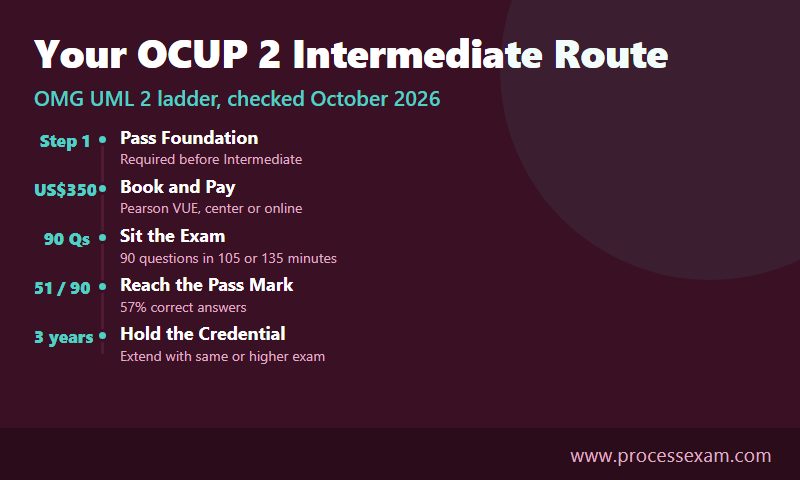
| Duration | 105 minutes for residents of English-speaking countries; 135 minutes for all others |
| Exam fee | US$350 |
| Passing score | 51 of 90 (57%) |
| Format | Multiple choice, text and images |
| Prerequisite | A passing score on the UML 2 Foundation exam |
OMG publishes the same details, plus the standard areas covered, in its Intermediate exam information sheet. Read it once before you plan anything, because it is the only place that lists the exact UML 2.5.1 chapters the questions are drawn from.
How much does the exam cost, and how do you book it?
The fee is US$350. OMG's information sheet adds that the price is shown with taxes and a regional currency equivalent on top, so the amount on your receipt can differ slightly from the headline figure. Everyone pays the same list price; what varies by country is the time allowed, not the fee.
Booking runs through Pearson VUE. You create or sign in to an account, pay for the exam there and choose either a secure test center or an online session. If you pick the online route, run the system test on your own computer before you schedule, because OMG points technical-issue questions to Pearson VUE customer service rather than to itself. Pearson VUE hosts the OMG exam page where those bookings start.
What the booking rules say
- Move or cancel through Pearson VUE with more than a day's notice and the fee comes back in full; leave it later and the fee is lost.
- The exam is delivered in English, and OMG prohibits translation apps during the exam.
- Candidates entitled to the longer allowance receive it by email once the order is finished, so look for that message before exam day.
- If you fail, your score report carries a 20% discount code toward a retake, according to OMG's information sheet.
- Learning or physical disability accommodations are requested through OMG at certification@omg.org.
OMG also runs seasonal discounts and bulk voucher schemes. They change, so check the UML certification page at OMG on the day you book rather than relying on a figure you saw months ago.
What do the eight topic areas ask you to do?
OMG splits the exam into eight standard areas. Their weights add up to 100%, and the two biggest, Activities and Actions at 20% and Basic Structure at 16%, hold over a third of the marks between them. The table below follows the order of the weights, and the full breakdown lives in the OMG-OCUP2-INT200 exam syllabus if you want to tick items off as you study.
| Topic area | Weight | What the questions reward |
|---|---|---|
| Activities and Actions | 20% | Token flow, control nodes, pins, partitions, invocation actions |
| Basic Structure | 16% | Namespaces, constraints, dependencies, multiplicity, properties, instances |
| Interactions | 14% | Lifelines, messages, combined fragments, interaction uses |
| State Machines and Use Cases | 13% | States, regions, pseudostates, transitions, include and extend |
| Components | 12% | Provided and required interfaces, ports, realization |
| Common Behavior | 10% | Events, triggers, behaviors, parameters, receptions |
| Structured Classifiers | 9% | Parts, ports, connectors, collaborations |
| Classification | 6% | Classifiers, generalization sets, interfaces, signals, data types |
Activities and Actions (20%)
This is the block to master first. Activity diagrams run on token semantics, and many questions only need you to follow the tokens. A fork copies one incoming token onto every outgoing edge, a join waits until a token is present on every incoming edge, and a decision sends a token down one outgoing edge only. A merge, by contrast, does not synchronize anything; it passes along whichever token arrives. Mixing up a join and a merge is the single most common way to lose marks here.
An activity final node ends the whole activity the moment it receives a token, whereas a flow final node only consumes the token that reaches it and lets other flows continue. Know how object flows differ from control flows, what an input pin and an output pin represent on an action, how partitions assign responsibility without changing behavior, and what an expansion region does to a collection. For actions, concentrate on call behavior and call operation actions, accept event actions and send signal actions.
Basic Structure (16%)
These questions are about the vocabulary every other diagram relies on. Expect multiplicity (lower and upper bounds, ordered and unique), the effect of visibility, how a constraint is attached to an element, the family of dependencies, and the difference between shared and composite aggregation on a property. Instance specifications and slots show up as small object diagrams: you are given values and asked whether they conform to the classifier.
Interactions (14%)
Sequence diagrams are the main target. Learn the message kinds (synchronous, asynchronous, reply, create and delete), what an execution specification shows, and the combined fragment operators. The alt, opt, loop, par and break fragments are the ones to know cold, together with what a reference to another interaction does. Questions often ask which sequences of events a diagram allows, so practise listing valid traces rather than only recognizing notation.
State Machines and Use Cases (13%)
For state machines, be ready for composite states with several regions, the order in which entry, do and exit behaviors run when a transition crosses a state boundary, and the pseudostates: initial, choice, junction, fork, join and the history variants. Know when a transition is external, internal or local. On the use case side, the classic trap is include versus extend: an included use case is always part of the base, while an extending one adds behavior at a defined extension point under a condition.
Components, Structured Classifiers and Classification (27% combined)
Components (12%) lean on provided and required interfaces, ports and realization. Structured Classifiers (9%) cover parts, connectors and collaborations, including how an assembly connector joins a required interface to a provided one and how a delegation connector passes a request inward. Classification (6%) is the smallest block, and it covers classifiers, generalization sets with their covering and disjoint settings, interfaces, signals and data types. Together these three areas are worth 27% of the exam, so do not skip them because they look quiet next to activities.
Common Behavior (10%)
The questions here concern what makes behavior start and what it carries. Learn the event types (call, signal, change and time), what a trigger links to, how receptions relate to signals, and how behavior parameters work. It is a small block that feeds the activity, interaction and state machine blocks, so a weak grasp here costs marks twice.
Which parts of UML 2.5.1 reward a close read?
The information sheet states that the questions come from the UML 2.5.1 specification, and it names the chapters: 7 (constraints, dependencies, namespaces, types and multiplicity), 8 (intervals and time), 9 (classifiers, generalization sets, instances, operations and properties), 10 (interfaces and signals), 11 (associations, classes, collaborations, components, encapsulated classifiers, receptions and structured classifiers), 12 (packages), 13 (events and behaviors), 14 (protocol state machines and state machine topics), 15 (activities, groups, control nodes and object nodes), 16 (actions, expansion regions, invocation actions and structured actions), 17 (communication diagrams, fragments, interactions, interaction uses, lifelines, messages and sequence diagrams), 18 (use cases), 19 (artifacts and nodes) and 20 (information flows).
You do not need to read the specification from the first page to the last. A practical way to use it is to match chapters to weights:
- Chapters 15 and 16 feed the 20% Activities and Actions block, so read their semantics sections, not only the diagram examples.
- Chapters 7 to 9 support Basic Structure; the multiplicity and constraint sections reward careful reading.
- Chapter 17 covers interactions, and its fragment and message sections give you the trace rules.
- Chapters 14 and 18 cover state machines and use cases.
- Chapters 10 and 11 carry interfaces, components, ports and collaborations.
The specification is dense, so pair it with a lighter source. OMG's information sheet recommends UML 2.0 in a Nutshell by Pitman and UML 2 for Dummies by Schardt as study materials, and the Wikipedia overview of the Unified Modeling Language is a neutral place to refresh the history and diagram families before you open the specification. Treat any book as a guide to the standard, and settle disagreements by checking the specification text.
Is three weeks enough to prepare for OCUP 2 Intermediate?
For someone who already draws UML at work and has passed Foundation recently, yes. Three weeks of an hour or two a day is a realistic window, and it also answers the old question of how to pass in a short time: put the hours where the marks are, not evenly across all eight areas. If UML is new to you, or Foundation was years ago, allow six weeks and spend the first two on Foundation-level refreshers.
| Week | Focus | Share of exam | What to finish |
|---|---|---|---|
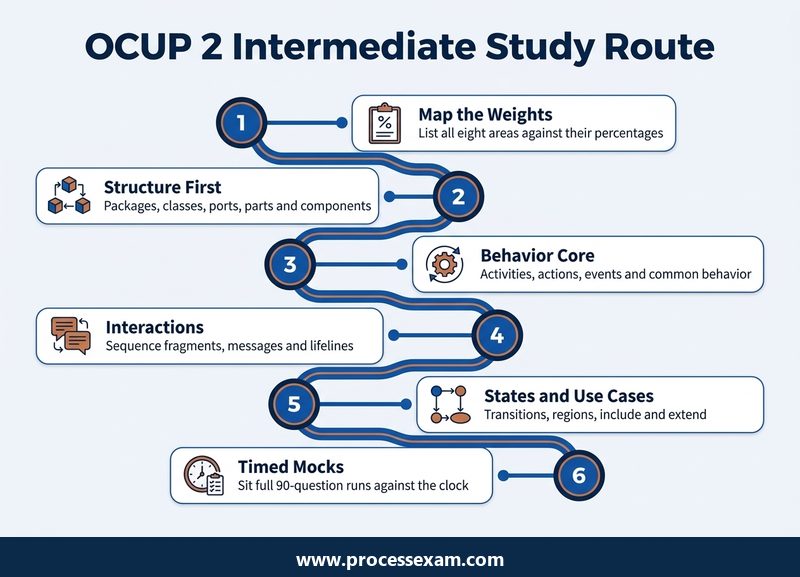
| 1 | Structure side | 43% | Basic Structure, Classification, Structured Classifiers and Components; draw each construct from memory |
| 2 | Behavior side | 30% | Activities and Actions plus Common Behavior; trace tokens through at least ten sample diagrams |
| 3 | Interactions, states, mocks | 27% | Interactions and State Machines and Use Cases; then timed full-length practice papers |
Week one is heavy on percentage but light on difficulty for most working modelers, so it should take less than a third of your time. Spend the extra on week two, where token semantics and invocation actions need repetition rather than reading. Keep a short error log from your first day: every question you get wrong goes in with the rule that decides it, and you re-read that log instead of the chapters in the last three days.
Using practice papers well
Reading about UML is not the same as answering questions about it, because the exam's multiple-choice items often include several answers that look correct at first glance. Do your first untimed practice set only after week one, to find out which topics need more attention. In the final week, switch to timed sets of 90 questions with a clock that matches your allowance. A realistic OMG-OCUP2-INT200 practice exam lets you rehearse that pacing and find the diagram types you hesitate on before you pay the fee.
After every set, go through each wrong or guessed answer and name the rule behind it: which node, which fragment, which connector. If you cannot name the rule, reread that part of the specification. Free question lists scattered around the web are fine as extra practice but rarely reproduce the exam's mix, so check any set against the weights above and drop sets that ignore the 20% Activities and Actions block.
Drawing as revision
Close the book and reproduce a diagram from a sentence: a composite state with two regions, a sequence with an alt fragment and a loop, a component with a port and both interface types. Then compare your drawing with the specification. Candidates who can draw the construct rarely misread it on screen, and this habit costs nothing but paper.
How do you pace 90 questions on exam day?
For residents of English-speaking countries, 105 minutes for 90 questions works out to about 70 seconds a question; for everyone else, 135 minutes gives 90 seconds. Those averages hide a real difference: a definition question takes ten seconds, while a diagram with a token puzzle can take two minutes.
A simple structure works well. Make a first pass at roughly 55 to 60 seconds a question, answer everything you are sure about and flag the rest without agonizing. That leaves about 20 minutes of the shorter allowance for the flagged items and a final check of the diagram questions, which are the ones where one misread arrow flips the answer. Never leave a question blank: the pass mark counts correct answers, so an educated guess costs nothing. Eliminate what you can and choose.
Diagram questions need a method
Do not scan the options first. Read the diagram, say out loud what it shows in one sentence, then read the options and cross out the ones that contradict your sentence. For activity diagrams, put a finger on the start node and move tokens through. For sequence diagrams, list the order of occurrences on each lifeline. For state machines, note the active states after each event.
Before the day
- Confirm your time allowance in the confirmation email, particularly if you live outside an English-speaking country.
- If you sit the exam online, run the Pearson VUE system test on the same computer, room and network you will use.
- Review your appointment at least a day ahead, because that is the cut-off for a full refund if you need to move it.
- Do not start new material the evening before; reread your error log.
Who is the credential for, and how long does it last?
OCUP 2 Intermediate is aimed at people who build or interpret UML models in real projects: IT architects, software architects, system architects, software designers, UML users and requirements engineers. It suits a model builder who has to design interoperating modules, review other people's models and explain the whole diagram suite to the people who only read the models.
It is also a step on the ladder. Intermediate needs a pass on Foundation, and the Advanced exam asks for passes on both Foundation and Intermediate, so this credential is the only route to Advanced. Within hours of passing you can claim a Credly digital credential, and OMG supplies a certificate you can print.
Validity is three years from the exam date. According to OMG, taking the same or a higher level exam extends the validity of your certification, so many holders sit Advanced rather than repeating Intermediate. If your work moves from drawing diagrams to model-driven development, the Advanced syllabus adds metamodeling, Alf and fUML, and you will already have the two prerequisites in hand.
Treat the credential as evidence of modeling discipline rather than as a guarantee of a role. Teams that use UML want to see that you can read a sequence diagram, trace an activity and choose between a component and a class without hesitation; the certificate shows you have been tested on exactly that, using the standard's own language.
Frequently Asked Questions
How many questions are on the OCUP 2 Intermediate exam and what is the pass mark?
OMG-OCUP2-INT200 has 90 multiple-choice questions, some with images. You need 51 correct out of 90, which is 57%, to pass. That leaves room for plenty of wrong answers, but the activity and interaction blocks carry enough weight that guessing on them is risky.
How much does OMG-OCUP2-INT200 cost?
The exam fee is US$350. OMG's information sheet notes that taxes and a regional currency equivalent are added, so your receipt may differ slightly. Booking and payment go through Pearson VUE, and a failed attempt produces a 20% discount code for a retake on the score report.
How long do you get for the OCUP 2 Intermediate exam?
Residents of English-speaking countries get 105 minutes, and all other candidates get 135 minutes. That is roughly 70 or 90 seconds per question. OMG sends confirmation of the longer allowance by email once your order is finished, so check your inbox before the exam.
Do I need to pass Foundation before OCUP 2 Intermediate?
Yes. OMG lists a passing score on the UML 2 Foundation exam as the prerequisite for Intermediate. Intermediate itself is then required, along with Foundation, before you can take the UML 2 Advanced exam, so the three levels must be taken in order.
How long is an OCUP 2 certification valid?
OMG says certifications expire three years after the exam date. You extend validity by taking the same or a higher level exam, for example Advanced after Intermediate. After passing you can claim a Credly digital credential and print a certificate from OMG.
- OMG OCUP 2 Intermediate Exam Questions |
- OMG OCUP 2 Intermediate Question Bank |
- OMG OCUP 2 Intermediate Test Questions |
- OMG OCUP 2 Intermediate Study Guide |
- OMG-OCUP2-INT200 Question Bank |
- OCUP 2 Intermediate Certification |
- OMG-OCUP2-INT200 Exam Questions Download |
- OMG-OCUP2-INT200 Test Questions |
- UML 2 Intermediate Mock Exam |
- UML 2 Intermediate Simulator |
- UML 2 Intermediate Certification |
- UML 2 Intermediate Certification Cost |
- UML 2 Intermediate Certification Requirements |
- OMG UML 2 Intermediate Book |
- OMG UML 2 Intermediate Question Bank |
- OMG UML 2 Intermediate Study Guide |
- UML 2 Intermediate |
- UML 2 Intermediate PDF |
- OMG UML 2 Intermediate Exam Questions |
- OMG UML 2 Intermediate Sample Questions


