
ECBA Exam Preparation Tips: How to Pass on Your First Try
Updated on 8 October 2026. What’s new: the ECBA now follows IIBA's nine-domain blueprint with 50 questions in 75 minutes, and needs no work experience, degree or application.
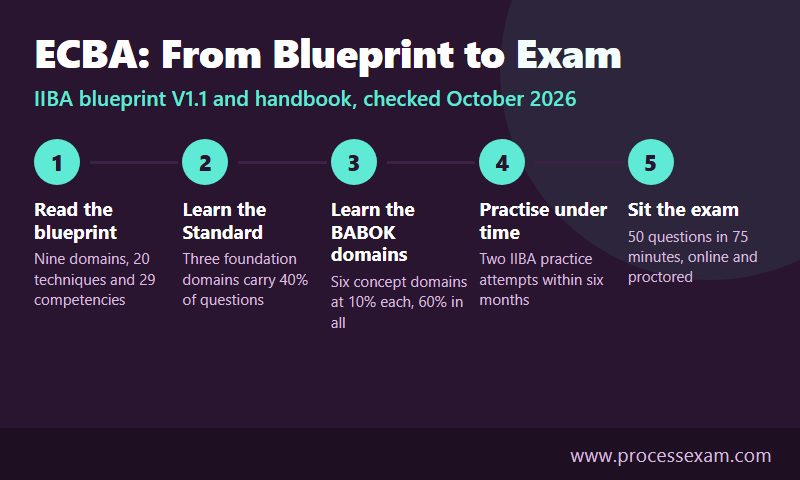
Most ECBA advice online was written for an older exam, so the first step to passing on your first try is to study the current one. IIBA now tests nine domains, drawn from The Business Analysis Standard and the BABOK Guide, in 50 situation-based and standard multiple-choice questions over 75 minutes. The fee is $395, and no work experience is asked for.

That opening matters because the Entry Certificate in Business Analysis is the IIBA credential people most often try to pass with a borrowed study plan. A friend's notes, a forum thread from a few years back or a summary of BABOK chapters can all feel reassuring and still point at the wrong material. This guide is built on IIBA's own documents, namely the exam blueprint (version 1.1), the ECBA Handbook dated May 2026 and the sample questions, all read in October 2026. It explains what is on the paper, how the marks are spread, how to practise, what exam day involves and which pieces of old advice to drop.
It is written for career changers, graduates, project coordinators, testers, support staff and anyone else who wants a recognised starting point in business analysis without a business analyst job on their CV yet.
Is the ECBA you are studying for the same exam older guides describe?
Probably not. IIBA's ECBA page now speaks of a "new ECBA Exam, Roadmap, and Learning Journey" available in English, and says the previous version of the exam continues only in Chinese, Standard French, Canadian French, Japanese and Brazilian Portuguese. If you read in English, the current exam is the one built on the nine-domain blueprint. Older write-ups describe a paper organised around the BABOK Guide alone and call its questions "direct". IIBA now describes the paper as practical and situation-focused, designed to assess application and analytical thinking.
The exam facts below are the ones to plan around.
| Exam detail | ECBA |
|---|---|
| Exam code | ECBA |
| Exam name | IIBA Entry Certificate in Business Analysis |
| Vendor | IIBA |
| Exam fee | USD $395 |
| Duration | 75 minutes |
| Number of questions | 50 |
| Passing score | 70% |
| Format | Online, remote proctored |
| Question types | Situation-based and standard multiple-choice |
Seventy-five minutes for fifty questions gives you ninety seconds each. A short definition question will not use that, but a long scenario can swallow two or three times as much, so pace matters; it is covered later. IIBA keeps its own summary on the ECBA certification page, and since fees and exam terms are listed as subject to change without notice, reread it the day you buy.
What did IIBA change underneath the exam?
Three things stand out when you read the blueprint against older guides. The content is now split between two IIBA references, so about 40% of your study time should go to The Business Analysis Standard rather than only the BABOK Guide. The blueprint lists a fixed set of 20 techniques and 29 underlying competencies to study, which replaces the vague advice to "read the whole BABOK". And every domain is written as activity statements phrased as things you do, such as "document requirements clearly" or "support stakeholders in prioritizing needs", which is why the questions describe a situation instead of asking for a definition.
Who is allowed to sit the ECBA, and what does the fee cover?
Anyone can. IIBA's ECBA Handbook lays out a certification roadmap that starts with buying the exam, and it lists no eligibility requirement before that step: no hours of work experience, no references and no application stage. The IIBA certification fees page backs this up, because the application fee for the ECBA reads "Not Required". The older claim that you need a business degree or five years of business analysis experience is wrong for this credential.
What does the $395 buy?
IIBA's ECBA page prices the route at "$395 or Less" and says the price includes four things: IIBA membership, the ECBA exam, the ECBA practice exam and the ECBA Learning Journey. The words "or less" matter, because IIBA shows special pricing after you log in or create an account, and students can apply for discounted rates that IIBA says range from $315 or less depending on region. Read the price on your own IIBA profile before paying, because that is the figure you will be charged.
What are the terms once you have paid?
- Six months to book and sit. The clock starts when IIBA receives your payment, not when you feel ready. Buying early as a motivator works only if you start studying the same week.
- A 30-day refund window. The Handbook says you can ask for a refund within 30 days of payment, and that the amount eligible for the ECBA exam refund is $145.
- A fee for every attempt. The Handbook states that each attempt carries a fee and that rewrite fees are not part of the initial exam fee. The fees page lists the current rewrite amounts, so look there before you plan a second attempt.
How is the ECBA different from the other IIBA levels?
The ECBA is the foundational entry point. The other levels on IIBA's certification menu, the CCBA and CBAP, are aimed at practising analysts and come with experience requirements of their own, which the other guides on this site explain in detail. For a first-time candidate the practical point is simple: of the three, the ECBA is the one you can buy today and sit within weeks, with nothing to prove first.
Which domains hold the marks, and what sits underneath them?
The blueprint defines nine domains and states the percentage of questions in each. The first three are foundational and come from The Business Analysis Standard. The remaining six are based on the BABOK Guide and apply the Business Analysis Core Concept Model, usually shortened to BACCM, whose six concepts are Change, Need, Solution, Stakeholder, Value and Context.
| Domain | Share of questions | Source | What you are asked to do |
|---|---|---|---|
| Understanding Business Analysis | 20% | The Business Analysis Standard | Define business analysis, explain the six BACCM concepts, describe value and how outcomes are assessed |
| Mindset for Effective Business Analysis | 14% | The Business Analysis Standard | Adopt an empowering mindset, recognise shared values and core principles, assess foundational competencies |
| Implementing Business Analysis | 6% | The Business Analysis Standard | Identify who performs the work, compare approaches, tell requirements from designs |
| Change | 10% | BABOK Guide | Spot factors that shape the work, find impacted areas, track progress, suggest simple improvements |
| Need | 10% | BABOK Guide | Elicit with basic methods, document and validate requirements, support prioritisation |
| Solution | 10% | BABOK Guide | Validate solutions, assess options for feasibility and risk, support scope and design artifacts |
| Stakeholder | 10% | BABOK Guide | Tailor messages, identify roles and interests, facilitate collaboration, understand motivations |
| Value | 10% | BABOK Guide | Confirm desired outcomes, find value opportunities, define KPIs that measure success |
| Context | 10% | BABOK Guide | Validate information quality, recognise constraints, follow technology trends, apply standards |
Add the first three rows and you get 40% of the paper from The Business Analysis Standard; the six BACCM domains make up the other 60%. Understanding Business Analysis alone is worth twice any single BACCM domain, so it earns your first and most careful week. A candidate who spreads time equally across nine domains underinvests in the 20% and 14% blocks, which are mostly about ideas and attitudes that are easy to dismiss as "soft".
Which techniques does the blueprint name?
The blueprint lists 20 techniques from Chapter 10 of the BABOK Guide and asks you to study each one's purpose, description and usage considerations: backlog management, brainstorming, business capability analysis, business rules analysis, collaborative games, data modelling, document analysis, interviews, lessons learned, metrics and key performance indicators, organizational modelling, process analysis, process modelling, risk analysis and management, root cause analysis, scope modelling, stakeholder list, map or personas, SWOT analysis, user stories and workshops. Treat that list as a closed set. You do not need the other techniques in the chapter to sit this exam.
Which competencies sit behind the questions?
The blueprint says all 29 underlying competencies from Chapter 9 of the BABOK Guide are important, grouped in six sets: analytical thinking and problem solving (seven), behavioural characteristics (five), business knowledge (five), communication skills (four), interaction skills (five) and tools and technology (three). For each, learn the purpose, the definition and the effectiveness measures. Candidates with a project background tend to find the behavioural and interaction sets easy to nod along with and hard to define precisely, so write each definition from memory once.
The full topic list also appears on the ECBA syllabus page, which follows the same nine domains.
What does a situation-based question reward?
IIBA's handbook describes two question types, situation-based and standard multiple-choice, and its sample questions PDF shows both. Read the sample stems and a pattern shows. They begin with a short situation and end with a qualifier: which factor should you consider FIRST, which action is MOST appropriate, how should you approach this situation. Each option sounds sensible. The marks go to the one that fits the role and the moment.
How the sample questions reason
One of IIBA's samples describes a process that is underperforming and asks what to consider first. The keyed answer is alignment of the process with business objectives, because objectives are the benchmark against which performance is judged. Stakeholder attitudes, tools and market conditions are all relevant, but none of them comes first. A second sample asks for the main purpose of analysing the current state of an order management system, and the answer is understanding workflows, processes and systems so the areas affected by change can be found, not building a prototype or writing a risk plan. A third describes a delayed milestone: adjust the plan and tell stakeholders, rather than escalating at once or pausing monitoring.
The habit behind all three is the same. Ask what the foundational-level analyst is expected to do at this point, and prefer the option that is proportionate, collaborative and aligned to the objective. The blueprint's activity statements use phrases such as "under direction", "support" and "within clear guidelines" for a reason: an entry-level analyst is not expected to take over the project or make a sweeping recommendation.
A worked example in your own words
Suppose a retailer's service team says refunds take too long, and a sponsor wants a new refund app. A question might ask what you should do before suggesting any solution. The options could be to draft requirements for the app, to compare vendors, to interview the people who handle refunds, or to design a screen. The first two jump ahead to a solution and the fourth is a design artifact. The interview fits the Need domain: elicit with basic methods and build rapport to find out what is happening. Reading the situation through the six BACCM concepts, namely the change, the need, the solution, the stakeholders, the value and the context, is the fastest way to spot which option is out of sequence.
A routine for every question
- Read the last line first, so you know whether the question wants a first step, the best action or a purpose.
- Name the BACCM concept the situation is about before you look at the options.
- Cross out options that leap to a solution before the need is understood, or that go over the stakeholder's head.
- If two options remain, pick the one that is proportionate for an entry-level analyst working under direction.
- Flag it and move on if you are still unsure after about two minutes, and answer every question before the clock ends.
What can you do week by week if you start with no business analysis job behind you?
This plan assumes about six to eight hours a week and no analyst experience, and it follows the weights in the blueprint. If you already work near projects, compress it to four weeks; if you are balancing a full-time job and family, stretch it to eight and keep the order.
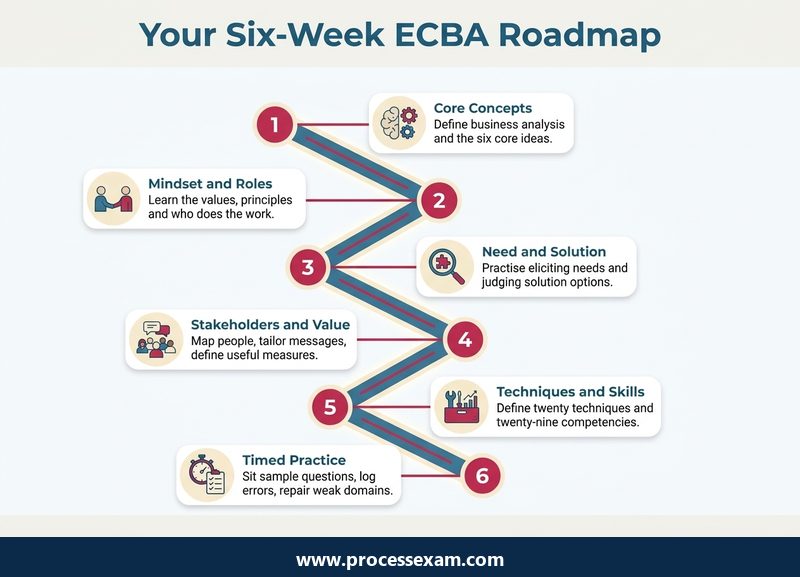
Week 1: the Standard and the core concepts
Study Understanding Business Analysis, the largest block at 20%. Be able to define business analysis in a sentence, name the six BACCM concepts and explain how they relate with an example from a project you know. Then write down how an analyst creates value and how outcomes are assessed.
Week 2: mindset and the shape of the work
Cover the Mindset domain (14%) and Implementing Business Analysis (6%). These sound light, but together they are a fifth of the paper. Learn the shared values and principles, then the roles that perform analysis, how approaches compare and how requirements differ from designs as an initiative progresses.
Week 3: Change, Need and Solution
Start the BABOK domains. For Need, practise eliciting information with an interview script and writing three requirements clearly enough that a stranger could test them. For Solution, list how you would judge two options for feasibility and risk. For Change, map what a small process change would affect.
Week 4: Stakeholder, Value and Context
Draw a stakeholder map for a real or imagined project, and write one message tailored for each of two different stakeholders. Define a KPI that would show whether a change delivered value. For Context, note which constraints would force a plan to change.
Week 5: techniques and competencies
Go through the 20 techniques one at a time, writing a two-line purpose and a note on when not to use each. Then take the 29 competencies in their six groups and define each from memory. This is the week that turns familiarity into precision.
Week 6: timed practice and repair
Take IIBA's free sample questions first, untimed, and read every rationale. IIBA's own practice exam, which comes with the purchase, can be taken up to two times within your six-month term, and the first click on Launch counts as an attempt, so do not open it until you are ready. To build speed on situation-based questions before you spend those attempts, work through a timed ECBA practice exam and keep an error log sorted by domain; whichever domain shows up most is your final-weekend revision.
Join an IIBA chapter's study group if there is one near you. The Handbook also lists IIBA training partners and the IIBA KnowledgeHub, where members can read the Standard and the BABOK Guide online, as further ways to prepare.
What happens between booking the exam and the pass-or-fail screen?
The ECBA is delivered online with a remote proctor, and the Handbook is strict about the setup, because a candidate who fails the requirements on the day forfeits the exam fee.
Before the day
- Use a personal computer. The Handbook says not to use a company office computer, because firewalls and restrictions often get in the way. You need a working camera and microphone, a stable connection and a quiet room with a clear desk.
- Match your names. Your first and last name must be identical on your photo ID, your IIBA profile and your PSI booking. Only IIBA can correct the profile, and any change has to be made at least one week before the exam.
- Book with notice. PSI asks for 48 hours to schedule, reschedule or cancel; inside that window the fee is lost.
- Take the tutorial test. It is worth running at least once, and up to three times, so you can rehearse the room scan and see the exam screens. IIBA says it takes about half an hour, and that its launch link expires 2.5 hours before your exam time.
On the day
Log in through the IIBA portal, never directly through PSI. The Launch Exam button becomes available half an hour before the start time. Have your ID and phone ready, expect the check-in and the room scan, and use PSI's support lines if something fails technically. When you finish, the pass or fail result shows on screen and IIBA emails confirmation within 48 hours, followed by a badge you can share.
Pacing the 50 questions
With 75 minutes you have 90 seconds a question. Aim to finish a first pass with roughly a quarter of the time still on the clock, flagging anything that needs more than a couple of minutes, and spend what remains on the flagged ones. The passing score is listed at 70%, but IIBA shows only pass or fail on screen, so do not count on a running tally; just answer everything.
Which old ECBA tips should you stop following?
Older posts, including the earlier version of this one, repeat several claims that no longer hold. Check your own notes against these.
- "You need five years of business analysis experience and a degree." There is no experience, degree or application requirement for the ECBA. That description belongs to the higher IIBA credentials.
- "You must be skilled in Word, Excel and Outlook." Office tools sit under one of the 29 competencies, but no software prerequisite is listed to take the exam.
- "Read the BABOK Guide cover to cover." The blueprint narrows the BABOK content to a defined set of techniques and competencies, and a large part of the paper comes from the Standard instead.
- "The questions are direct." They are now situation-based, with qualifiers such as FIRST and MOST, so memorising definitions alone will not be enough.
- "Use Facebook groups as your syllabus." Community is useful for motivation, but the blueprint, the reference map and the sample questions are the authority on what is tested.
- "Any ECBA guide will do." A guide that does not say which exam version it covers or when it was checked cannot be trusted, because IIBA says terms can change without notice.
The common thread is that the ECBA changed while the advice about it did not. The cheapest preparation you can do is to download the blueprint and the Handbook, which are free, and read them before anything else.
Is the ECBA worth sitting, and what does it open up?
For someone with no analyst title yet, it is a sensible first credential. It comes as a package with membership and practice material, needs no application and can be done from home. IIBA's own pages say the ECBA signals job readiness, builds confidence at work and can support salary conversations, and its published member stories describe people who were given a lead analyst role or used the credential to align their practice with a global standard. Those are IIBA's statements and testimonials, not guarantees, and IIBA publishes no salary figure for the ECBA, so no pay rise is promised here either.
Who gains the most?
- Graduates and career changers who need a recognised line on a CV for junior business analyst roles.
- Testers, support staff, developers and project coordinators who already do analysis work informally and want shared vocabulary.
- Product owners and team leads who want a structured view of needs, stakeholders and value.
What should you do after you pass?
Download the badge, add it to your profile and use the vocabulary in real work, because the credential carries most weight when you can point to a project where you elicited needs or mapped stakeholders. If you later move to an analyst role, the CCBA and CBAP are the natural next steps, and both ask for documented experience, so start keeping a log of your analysis work now. Whatever route you take, the foundation you build for the ECBA, with its nine domains, its 20 techniques and its 29 competencies, keeps paying off in every later exam.
Frequently Asked Questions
How do I prepare for the ECBA exam and pass on the first try?
Study IIBA's current blueprint, not an old guide. Cover all nine domains in proportion to their weights, learn the 20 listed techniques and 29 competencies, and practise situation-based questions under a 75-minute limit. Use IIBA's free sample questions first, then timed full-length practice, and review every wrong answer.
What score do you need to pass the ECBA exam?
The passing score is listed as 70%. IIBA's handbook says you see a pass or fail result on screen when you finish and receive an email confirmation within 48 hours, so you will not watch a running score. Aim to score comfortably above 70% on timed practice in every domain.
Do you need experience or a degree to take the ECBA?
No. IIBA's ECBA Handbook sets no work-experience, degree or reference requirement, and its fees page lists the application fee as not required. You buy the exam, book a time slot within six months and sit it online. Experience requirements belong to the higher IIBA levels, such as the CCBA and CBAP.
How many questions are on the ECBA exam and how long does it last?
The ECBA has 50 questions, a mix of situation-based and standard multiple-choice, and lasts 75 minutes. It is taken online with a remote proctor. That works out at about 90 seconds a question, so plan a first pass that flags long scenarios and leaves time to return to them.
How much does the ECBA cost, and what if you fail?
IIBA prices the ECBA route at $395 or less, including membership, the exam, a practice exam and the Learning Journey, with student rates available. Every attempt carries a fee, and rewrite fees are not included in the first payment, so check IIBA's fees page before booking a second attempt.
- IIBA Business Analysis Entry Sample Questions |
- ECBA Exam Questions Download |
- ECBA Test Questions |
- Business Analysis Entry PDF |
- IIBA Business Analysis Entry Test Questions |
- ECBA Question Bank |
- IIBA Business Analysis Entry Book |
- Business Analysis Entry Certification Cost |
- Business Analysis Entry Certification Requirements |
- Business Analysis Entry Certificate Simulator |
- Business Analysis Entry Certificate Mock Exam |
- IIBA Business Analysis Entry Certificate Question Bank |
- IIBA Business Analysis Entry Certificate Book |
- IIBA Business Analysis Entry Certificate Study Guide |
- IIBA Business Analysis Entry Certificate Exam Questions |
- IIBA Business Analysis Entry Certificate Sample Questions |
- Business Analysis Entry Certificate PDF |
- Core Business Analysis |
- Business Analysis Entry Certificate Cost |
- Business Analysis Entry Certificate Requirements


