
ISTQB CTFL Certification: Is It Really Worth Anything?
Updated on 23 September 2026. What’s new: rewritten for the CTFL v4.0 syllabus, whose six chapters now end with Test Analysis and Design, Managing the Test Activities and Test Tools.
Two words on a CV, ISTQB certified, survive a keyword screen that discards most other testing training. That is the honest value of CTFL, and also its limit. It is worth the USD $229 to anyone who needs a recognised testing vocabulary and a way past that first filter, and worth very little to a test lead who already has the job, the scars and the evidence to show for them.

This article takes the question seriously rather than selling an answer. It sets out who gains from the ISTQB Certified Tester - Foundation Level, who gains almost nothing, what the exam costs once training and study time are counted, what the current CTFL v4.0 syllabus actually asks of you, how the 40 questions are distributed, what a hiring manager does and does not read into the line, and how to prepare without losing two months to it.
Who does the ISTQB CTFL certification actually help, and who should skip it?
The credential is not neutral. It moves some people a long way and others barely at all, and the difference is not talent. It is whether you currently have a way of proving that you understand testing as a discipline rather than as a set of habits picked up on one product.
The people it moves furthest
If you are a manual tester who learned on the job, CTFL gives structure and names to work you already do well. You have been writing test cases for years; the syllabus tells you which technique you were using and when a different one would have found more. That vocabulary is what lets you argue for coverage in a planning meeting instead of simply asking for more time.
Career changers benefit for a different reason. A support engineer, a business analyst or a graduate with no testing history on paper has nothing a recruiter can point at. The certificate is a small, checkable fact in a CV otherwise full of claims, and it signals that the applicant took the trouble to learn the field's language before applying.
Two more groups are often overlooked. Developers and product owners in teams that have dissolved the separate QA role still have to reason about test levels, risk and defect reports; the Foundation syllabus is the cheapest way to pick that up coherently. And anyone working with outsourced or client-audited delivery will meet contracts and tender documents that name ISTQB certification directly, because a buyer in one country needs a way to read a supplier's skills in another.
The people it moves hardly at all
A senior test manager who already sets strategy, owns a budget and can describe three projects in detail will not be promoted for holding a Foundation certificate. The same is true of an automation engineer whose value sits in code, pipelines and flaky-test triage. In both cases the certificate certifies something the person has already demonstrated at a higher level, and the money and weeks are better spent at Advanced or Specialist level, or on a technical skill with a shortage behind it.
There is also the candidate who wants the certificate to substitute for practice. CTFL is a knowledge exam. Nothing in it requires you to have tested anything, which is exactly why it is easy to earn and exactly why nobody treats it as proof of ability. If you cannot yet describe a bug you found and how you found it, the certificate will not rescue the interview.
The honest middle case
Most readers sit between the two. You have some testing experience, no formal grounding, and a job market that reads CVs quickly. For you the question is not whether the certificate is impressive, because it is not, but whether it is cheap enough to be worth having anyway. That is a cost question, which the next section answers.
What does the CTFL exam cost, and what is the real bill?
Start with the figures our exam pages carry, which come from the certification's own published details.
| Item | Detail |
|---|---|
| Certification | ISTQB Certified Tester - Foundation Level (CTFL) |
| Exam code | CTFL |
| Syllabus version | CTFL v4.0 (syllabus document v4.0.1), checked September 2026 |
| Exam fee | USD $229 |
| Number of questions | 40 |
| Exam duration | 60 minutes |
| Passing score | 26 / 40 |
| Prerequisite | None |
| Validity | Lifelong, with no renewal fee |
The fee, and why yours may differ
USD $229 is the figure to plan around. The exam is sold through member boards and exam providers rather than centrally, so the amount you are quoted depends on where you sit it and in which currency, and a remotely proctored sitting is not always priced the same as a test centre. Check the number on the booking page before you budget, and do not assume a failed attempt is free: a retake is a fresh purchase.
Training is optional, and that changes the sum
ISTQB's own guidance for CTFL v4.0 offers two routes: attend a three-day accredited training course, or self-study using the syllabus and the published sample exams. A course adds several hundred dollars or more, and for a disciplined reader with testing experience it is not required. It earns its money for career changers who need the material explained rather than read, and for anyone whose employer pays and who wants three uninterrupted days.
The cost that is not money
The part candidates underestimate is time. The accredited syllabus specifies 1,135 minutes of teaching, close to nineteen hours, and that is contact time with an instructor, not the reading, note-taking and practice that follow. A realistic self-study budget is 35 to 45 hours spread over four to six weeks. Priced against an hourly rate, that is by far the largest line in the bill, and it is the reason the credential is worth taking seriously or not taking at all.
What does CTFL v4.0 test, and what changed in 2023?
This matters more than it sounds, because a great deal of the CTFL study material still circulating online describes a syllabus that no longer exists. ISTQB released version 4.0 on 9 May 2023 as a complete redesign rather than an edit, and retired the English v3.1 exams and accredited training a year later, on 9 May 2024. Version 4.0, published as syllabus document v4.0.1, is the version in force as at September 2026 on the ISTQB Foundation Level certification page.
Six chapters, and where the teaching time goes
The syllabus expresses 14 business outcomes through 64 learning objectives, grouped into six chapters. The recommended teaching minutes show what the authors consider hard, and they are not spread evenly.
- Fundamentals of Testing (180 minutes) - what testing is and why it is necessary, the seven principles, the test activities and the skills a tester needs.
- Testing Throughout the Software Development Lifecycle (130 minutes) - how testing fits different delivery approaches, the test levels, the test types and maintenance testing.
- Static Testing (80 minutes) - reviews and static analysis, the value of finding a defect in a document before it reaches code, and the review process itself.
- Test Analysis and Design (390 minutes) - black-box, white-box and experience-based techniques, plus collaboration-based approaches such as acceptance criteria and example mapping.
- Managing the Test Activities (335 minutes) - planning and estimation, risk management, monitoring and control, configuration management and defect management.
- Test Tools (20 minutes) - what tool support does for testing, and the benefits and risks of automation.
Two chapters, Test Analysis and Design and Managing the Test Activities, take 725 of the 1,135 minutes between them. If your study plan gives every chapter a week, you have already mis-budgeted. Our chapter-by-chapter breakdown of the Foundation Level syllabus lists the same structure with the topics under each heading, and the full text is free from ISTQB as the CTFL v4.0.1 syllabus PDF.
What the redesign actually changed for a candidate
The older syllabus read as a waterfall document with agile bolted on. Version 4.0 assumes mixed delivery from the start, so testing in a sprint, shift-left review work and continuous delivery are part of the main argument rather than an appendix. Two chapters were also re-cut: technique material and the design work around it now sit together under Test Analysis and Design, and the management chapter is framed around activities rather than roles. The practical effect is that answers copied from a 2019 study guide will sometimes use terms the current exam does not.
How are the 40 questions spread across the six chapters?
ISTQB publishes the exam structure it gives to question writers, and it is the single most useful document a self-studying candidate can read. Each chapter has a fixed number of questions, each question is worth one point, and the pass mark of 26 is therefore 65% of the paper.
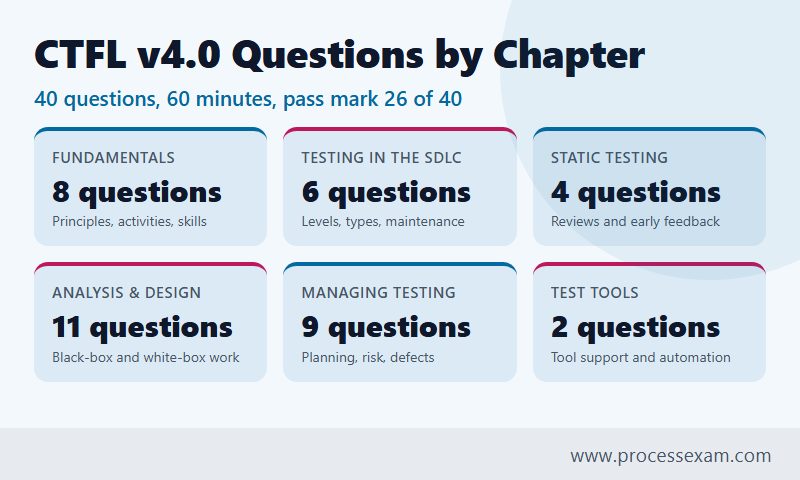
The distribution is Fundamentals 8, Testing Throughout the Lifecycle 6, Static Testing 4, Test Analysis and Design 11, Managing the Test Activities 9, and Test Tools 2. One chapter carries more than a quarter of the paper; another carries a twentieth.
Cognitive levels decide how long a question takes
Questions are also classified by cognitive level. The paper holds 8 recall questions, 24 comprehension questions and 8 application questions, and the published timing allows one minute for each of the first two kinds and three minutes for each application question. That accounts for roughly 56 of the 60 minutes, which tells you how little slack the clock holds.
What that means for a study plan
Application questions are where a technique must be used rather than described: deriving equivalence partitions, calculating boundary values, completing a decision table, walking a state transition diagram, working out statement or branch coverage. Eight marks of the paper are earned by hand, under time pressure, and they sit almost entirely in the analysis and design chapter. Study time should follow the marks: heavy on chapter 4, solid on chapter 5, light on chapter 6, where two questions are waiting and twenty minutes of teaching covers them.
What do employers actually read into "ISTQB certified"?
Here is where honesty is worth more than encouragement. Recruiters and hiring managers read the line in three different ways, and only one of them is the way candidates hope for.
What it genuinely does
It gets a CV through a filter. Testing job descriptions frequently list ISTQB as desirable, and an applicant tracking system that has been told to look for it will look for it. ISTQB reports having administered 1.5 million exams and issued more than 1.1 million certifications as at May 2025, across over 130 countries, and that scale is precisely the point: a manager in Rotterdam and a supplier in Bengaluru can use the same shorthand without either having to explain their local training market.
It also settles vocabulary disputes before they start. When a team argues about whether something is a defect, a failure or an error, or whether a test is a smoke test or a sanity check, having people who learned the same definitions saves hours over a year. That is a real benefit, and it is the one the syllabus is designed to deliver.
The third use is contractual. Managed testing services, tenders and client audits often require a stated proportion of certified staff. In that world the certificate has a direct commercial value to your employer, which is why many consultancies pay for it without being asked.
What it does not do
It does not evidence skill. An interviewer who knows the field will move past the line within a minute and ask what you tested, what you found, what you missed and how you decided what to leave out. A Foundation certificate answers none of those, and a candidate who leans on it instead of examples interviews badly.
It is not a salary lever on its own. The certificate is common enough to be unremarkable in many markets, and pay follows the work you can prove, the domain you know and the tools you handle. Any promise that a Foundation certificate produces a specific rise should be read as advertising.
And it does not replace a portfolio. A public repository with a small automated suite, a well-written bug report you are proud of, or a clear account of a release you helped rescue will always say more about you than a pass mark. The strongest position is both: the certificate to get read, the evidence to get hired.
How do you prepare for the CTFL exam in four to six weeks?
A plan that follows the marks rather than the chapter numbers works for most candidates studying around a job. Five or six hours a week over five weeks is enough for someone with testing experience; a career changer should allow eight.
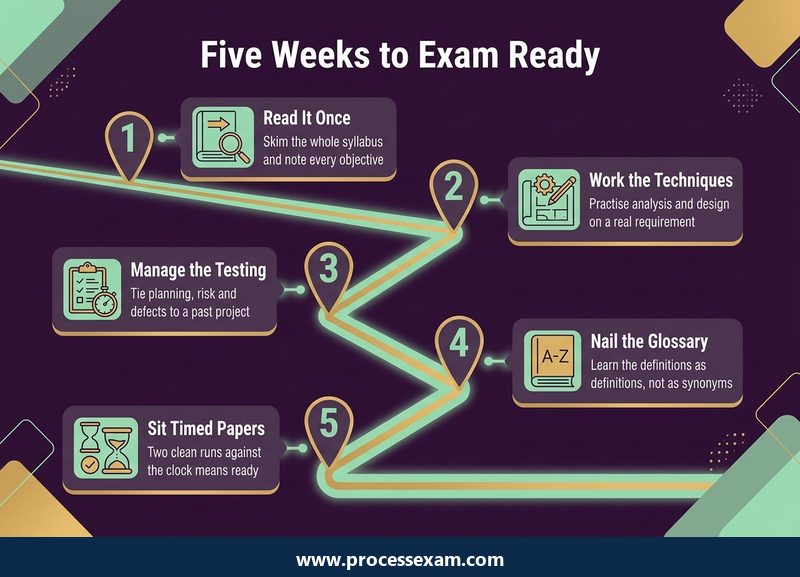
Week one: read once, quickly
Read the whole syllabus at speed without trying to memorise anything. The point is to see its shape and to notice which learning objectives are K1, K2 or K3, because that tells you what the exam will ask you to do with each topic. Keep a running list of terms you could not define.
Weeks two and three: the two heavy chapters
Give Test Analysis and Design the largest block you have, and work the techniques on paper rather than reading about them. Take a real requirement from your own work, derive equivalence partitions and boundary values, build a decision table for it, and sketch the state transitions. Then take Managing the Test Activities and connect it to a project you have lived through: what the risks were, how they were prioritised, what the defect reports looked like.
Week four: the lighter chapters and the glossary
Fundamentals, lifecycle testing, static testing and tools are largely definitional, which makes them fast but easy to lose marks on. This is the week to be pedantic about the glossary. Confusing error, defect and failure, or verification and validation, costs marks every sitting.
Week five: sit papers under the clock
Work the ISTQB sample exam papers in a single 60-minute sitting, mark them honestly, then go back only to the topics you lost points on. Timed repetition is what turns knowledge into a pass. If you want more than the two published papers, a full-length CTFL practice exam gives you the repetition and the score history to see whether you are actually improving.
How you know you are ready
Two consecutive timed papers above 80% with at least ten minutes to spare, and no chapter where you are guessing. A single lucky 70% is not a signal.
Which mistakes cost candidates the pass mark?
The Foundation exam is not designed to trick anyone, but it is written precisely, and precision is where marks leak.
Reading loosely
Questions turn on single words. "Which of the following is not..." and "which best describes..." reward the candidate who slows down for one extra second. So does noticing how many answers a question asks for. Most candidates who fail narrowly did not lack knowledge; they answered a question adjacent to the one on the screen.
Treating glossary terms as synonyms
In everyday speech, bug, defect, error and failure are interchangeable. In the exam they are not, and neither are test case and test procedure, or test plan and test strategy. Study the definitions as definitions.
Skipping the technique practice
Reading about boundary value analysis takes ten minutes; being able to apply it correctly under time pressure takes practice. The eight application marks are the ones most often lost by people who studied only by reading.
Losing the clock
Forty questions in sixty minutes is ninety seconds each, and the application questions need more than that. Answer everything you know quickly, flag what you do not and come back. Nothing is deducted for a wrong answer, so an unanswered question is the only guaranteed zero. Candidates sitting in a language that is not their mother tongue are allowed an extra quarter of the time, which takes the sitting to 75 minutes; if that applies to you, claim it when you book rather than discovering the option afterwards.
Preparing from the wrong syllabus
Free question sets written for the pre-2023 syllabus are still everywhere. They are not worthless, but they use retired terminology and weight the chapters differently. Check that anything you practise names version 4.0, and treat ISTQB's Foundation Level v4.0 guidance page as the arbiter on rules and prerequisites.
So, is ISTQB CTFL certification really worth anything?
Yes, conditionally, and the condition is easy to state. CTFL is worth having when you need to be read: when your experience is real but undocumented, when you are entering testing from another field, when your employer or its clients count certified heads, or when your team argues about words that a shared syllabus would settle. In those cases USD $229 and around forty hours buy a durable, internationally legible credential that never expires and never has to be renewed.
It is not worth having when you already hold the job it would help you get. A test lead, a strong automation engineer or anyone who can point to three projects and describe them well is buying a receipt for knowledge they have already proved. Those readers should look at the Advanced and Specialist levels, where the syllabus assumes the Foundation material and starts somewhere useful.
What the certificate never does is replace evidence. The candidates who get the most out of it are the ones who treat it as the ticket that gets their CV read, and then bring the bug reports, the coverage arguments and the release stories that actually win the interview. Judged that way, the title question has a clear answer: it is worth something specific and limited, and knowing the limit is what makes the money well spent.
Frequently Asked Questions
Is ISTQB CTFL certification worth it in 2026?
It is worth it if you need recognised proof of testing knowledge: career changers, self-taught manual testers and anyone whose employer or clients count certified staff. It is poor value for experienced test leads and automation engineers, who already demonstrate more than a Foundation Level exam can certify.
How much does the ISTQB CTFL certification cost?
The exam fee is USD $229. Prices vary by member board, exam provider and currency, so confirm the amount on the booking page. Accredited three-day training is optional and costs extra; self-study from the syllabus and the published sample exams is an accepted route.
What is CTFL certification?
CTFL stands for Certified Tester Foundation Level, the entry-level software testing certification awarded by the International Software Testing Qualifications Board. It certifies knowledge of testing fundamentals, testing across the development lifecycle, static testing, test analysis and design, managing test activities and tool support. There is no prerequisite and no required training course.
How many questions are on the CTFL exam and what is the passing score?
The exam has 40 multiple-choice questions to be answered in 60 minutes, and the passing score is 26 of 40 points. Candidates sitting in a language other than their own receive an extra 25 percent of the time, taking the sitting to 75 minutes.
Which CTFL syllabus version is current, and does the certificate expire?
CTFL v4.0, published as syllabus document v4.0.1, is the version in force as at September 2026; version 3.1 English exams were retired on 9 May 2024. The certificate itself has lifelong validity, so there is no renewal exam and no recertification fee.
- ISTQB Tester Foundation Exam Questions |
- ISTQB Tester Foundation Question Bank |
- ISTQB Tester Foundation Questions |
- ISTQB Tester Foundation Study Guide |
- ISTQB CTFL Quiz |
- CTFL Certification |
- CTFL Questions |
- CTFL Practice Test |
- CTFL Study Guide Material |
- CTFL Sample Exam |
- Tester Foundation Certification |
- ISTQB Tester Foundation Sample Questions |
- CTFL Test Questions |
- Tester Foundation PDF |
- ISTQB Foundation Level Certification |
- ISTQB Foundation Level Exam Questions |
- ISTQB Foundation Level Sample Questions |
- ISTQB Foundation Level |
- ISTQB Foundation Level PDF |
- ISTQB Foundation Level Book |
- ISTQB Foundation Level Question Bank |
- ISTQB Foundation Level Study Guide |
- CTFL - Automotive Software Tester Mock Exam |
- ISTQB CTFL - Automotive Software Tester Questions |
- ISTQB Foundation Level Questions


