
ASQ Six Sigma Green Belt (CSSGB) Exam: What It Tests and How to Prepare
Picture a production supervisor who is handed a climbing defect rate and a spreadsheet of last quarter's rejects, with no method for getting from one to a fix. The ASQ Certified Six Sigma Green Belt (CSSGB) exam tests exactly that missing method. It is an open-book, computer-based exam of 110 multiple-choice questions, 100 of them scored, spread over the six parts of ASQ's 2022 Body of Knowledge, and it costs $383 for ASQ members or $483 for everyone else.

This guide is about the exam itself: what each section asks, how the open-book rule works in practice, who qualifies, what the whole attempt costs and how to plan the weeks before your appointment. If you are still choosing between belts, or between certifying bodies, that is a separate decision. Here it is already made, and the task is to pass.
What changes when a supervisor with a spreadsheet learns the Green Belt method?
Go back to the supervisor for a moment, because the way most people attack a defect problem without training is remarkably consistent. The spreadsheet gets sorted by shift, then by machine, then by operator. One average looks worse on the night shift, so the night shift gets the blame. Somebody remembers that a supplier changed in the spring, and that becomes the working theory. A machine setting is adjusted, the reject rate dips for a fortnight, then creeps back, and the spreadsheet grows another tab.
Nobody in that story was lazy. They had data and no disciplined way of questioning it. Every step was a reasonable guess, and none of the guesses was ever tested, so the organisation learned nothing it could reuse on the next problem.
Green Belt training swaps that pattern for a fixed sequence, and the CSSGB exam checks whether you can follow it under pressure. The sequence is DMAIC, short for define, measure, analyze, improve and control, and each phase exists to stop the next one going wrong.
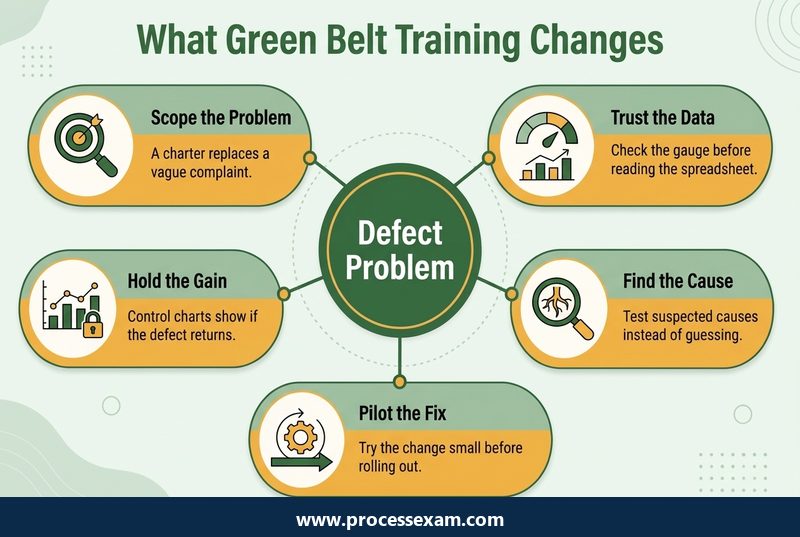
- Scope before solving. A project charter turns "rejects are up" into a problem statement with a baseline, a target, a boundary, a sponsor and a date. Half of the wasted effort in the supervisor's story came from never agreeing what the problem was.
- Question the measurement. Before anyone trusts the spreadsheet, a measurement system study asks whether two inspectors would judge the same part the same way. If they would not, a large share of the recorded defects may be inspection noise rather than process failure.
- Test causes instead of hunches. Multi-vari charts, regression and hypothesis tests show which suspected cause actually moves the output, and which only looked guilty because it was the first thing somebody noticed.
- Pilot the fix. A change is tried on a small scale, with a before-and-after comparison, rather than rolled out across the plant on the strength of a good feeling.
- Hold the gain. Control charts, a control plan and updated work instructions keep the improvement in place after the project team has moved on.
That is the practical reason employers care about the credential. A Green Belt is somebody who can take an ordinary operational problem and run it through a repeatable process, usually as a part-time project lead or as the analyst on a larger team. ASQ positions the role as working next to a Black Belt or under one's direction, and the exam is ASQ's way of confirming that the method has actually stuck, rather than merely been attended.
What does the CSSGB exam look like on test day?
The computer-delivered CSSGB is a single-part exam taken at a Prometric test centre, with an online, remotely proctored route described on ASQ's computer-based testing pages. It is offered in English; ASQ runs a paper version in Mandarin in some locations, which has a different question count, so check which one you are booking. Here are the core facts for the computer version.
| Exam detail | ASQ CSSGB |
|---|---|
| Full name | ASQ Certified Six Sigma Green Belt (CSSGB) |
| Exam code | CSSGB |
| Vendor | ASQ |
| Number of questions | 110 |
| Scored and unscored | 100 scored, 10 unscored |
| Time allowed | Total appointment time - 270 minutes; Exam time - 258 minutes |
| Fee (USD) | ASQ MEMBERS - $383; NON-MEMBERS - $483; RETAKES - $283 |
| Passing score | 550/750 |
| Format | Multiple choice, open book |
| Content outline | 2022 CSSGB Body of Knowledge, six sections |
Two rows deserve a second look. The first is the split between scored and unscored items. The ten unscored questions are trial items that ASQ is evaluating for future versions of the exam. They sit among the real ones with no marking, so there is no way to spot them, and the only sensible approach is to treat every question as if it counts.
The second is the passing score. A result of 550 out of 750 is a scaled score, not a tally of correct answers, so there is no fixed number of questions you must get right. Scaled scoring is the normal way certifying bodies keep different versions of an exam comparable, which means a slightly harder form of the paper does not punish the person who happens to sit it.
The clock matters more than people expect. With 258 minutes of exam time for 110 questions, you have a little over two minutes per question on average. That sounds generous until you remember that many CSSGB items involve a calculation, a chart reading or a lookup in your reference book. Computer-based candidates see a result on screen as soon as they submit, and ASQ sends an email confirmation a few business days later, followed by details for claiming the digital certificate and badge.
What does ASQ's 2022 Body of Knowledge test, section by section?
ASQ publishes the 2022 CSSGB Body of Knowledge as a short PDF, and it is the single most useful document you can read before you study anything else. It lists every topic the question writers may draw on, how many scored questions each section carries, and a cognitive level for each topic, from Remember and Understand up to Analyze, Evaluate and Create. A topic marked Evaluate or Create will be tested with scenarios and calculations, not definitions.
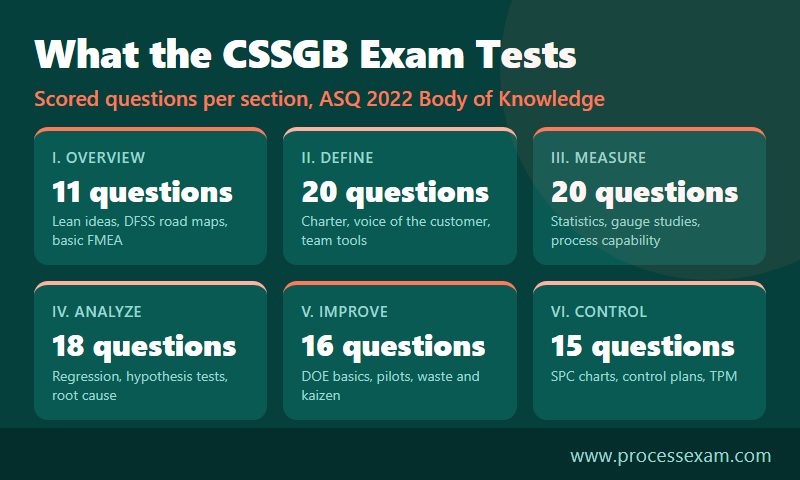
I. Overview: Six Sigma and the organization (11 questions)
The smallest section sets the context. It covers why organisations adopt Six Sigma and how the approach grew out of the work of Deming, Juran, Shewhart and Ishikawa; how a project links to organisational goals and SMART objectives; and how business drivers, key performance indicators and scorecards are built. Lean concepts appear here too: theory of constraints, value chain, flow, takt time, just-in-time, Gemba, spaghetti diagrams and value-stream mapping. The section closes with design for Six Sigma road maps, where you must tell DMADV and IDOV apart, and with failure mode and effects analysis. FMEA is tested at the Analyze level, so expect to calculate a risk priority number and to distinguish a design FMEA from a process FMEA.
II. Define phase (20 questions)
Define ties with Measure as the largest section, and it is broader than it looks. Project identification covers project selection, process boundaries, benchmarking, SIPOC and stakeholders. Voice of the customer covers surveys, focus groups and interviews, then quality function deployment, critical-to-quality trees and the Kano model for turning what customers say into measurable requirements. Project management basics bring in agile and top-down methods, the charter, scope, primary and consequential metrics, work breakdown structures, Gantt charts, the critical path method, PERT, tollgate reviews, risk analysis and project closure.
The section also holds the eight management and planning tools (affinity diagrams, interrelationship digraphs, tree diagrams, prioritization matrices, matrix diagrams, process decision program charts, activity network diagrams and SWOT), team stages and dynamics, RACI charts, nominal group technique and multi-voting. The part that catches people out is business results: defects per unit, rolled throughput yield, cost of poor quality, defects per million opportunities, sigma levels and capability indices are all tested here at the Analyze level. Candidates who skim Define as the soft section often lose marks on exactly those calculations.
III. Measure phase (20 questions)
Measure is where the statistics begin in earnest. You are expected to create process maps and compare them with written procedures, then work with basic probability (independent and mutually exclusive events, multiplication rules, permutations and combinations) and the central limit theorem. The distributions list is normal, binomial, Poisson, chi-square, Student's t and F. Data topics include continuous and discrete data, the four measurement scales, random and stratified sampling, check sheets and data coding, descriptive statistics and graphical methods such as histograms, box plots, scatter diagrams, normal probability plots and stem-and-leaf plots.
Two topics carry particular weight in practice. Measurement system analysis covers gauge repeatability and reproducibility, bias, linearity, percent agreement and the precision-to-tolerance ratio. Process capability covers natural process limits versus specification limits, capability studies, Cp, Cpk, Pp, Ppk and Cpm, sigma level, and the shift that appears when short-term and long-term data are compared. Most of these are tested at the Evaluate level, so you will be interpreting results as well as producing them.
IV. Analyze phase (18 questions)
Analyze asks whether you can separate a real cause from a coincidence. Exploratory data analysis covers multi-vari studies for positional, cyclical and temporal variation, and correlation and linear regression, including the difference between correlation and causation and how to read a p-value. Hypothesis testing covers statistical versus practical significance, sample size, significance level, power, and type I and type II errors, followed by tests for means, variances and proportions: the paired t-test, the F-test, analysis of variance and chi-square. The section finishes with gap analysis and root cause tools such as cause-and-effect diagrams, relational matrices, the 5 Whys and fault tree analysis.
V. Improve phase (16 questions)
Improve starts with design of experiments at an introductory level: factors, levels, responses, treatments, blocking, randomization, replication, and how to read main-effects and interaction plots. Implementation planning covers proofs of concept, try-storming, simulations and pilot tests. The lean tools are pull systems, kanban, 5S, standard work, poka-yoke, continuous flow, setup reduction and single-minute exchange of dies, plus the difference between a kaizen and a kaizen blitz.
VI. Control phase (15 questions)
Control is about keeping the gain. Statistical process control covers common and special cause variation, rational subgrouping and the chart family you must be able to select and use: X-bar and R, X-bar and s, individuals and moving range, median, p, np, c and u charts. Sustaining improvements covers control plans, document control, training plans, first-, second- and third-party audits, and plan-do-check-act. Lean control tools close the outline: total productive maintenance, including predictive maintenance, and the visual factory, with andon and jidoka.
If you prefer a checklist to a PDF, our CSSGB syllabus page sets out the same ASQ outline topic by topic, so you can tick off each subtopic as you study it. Whichever you use, notice the shape: Define and Measure together hold 40 of the scored items, and well over half of the outline asks you to calculate, interpret or choose a statistical tool rather than recall a term.
How does the open-book rule change the way you prepare?
All ASQ exams are open book, and the ASQ Six Sigma Green Belt page spells out what that means. In plain terms, you may bring your own reference material, but it has to be bound. Stitched or glued books qualify, and so do binders where a fastener passes through every sheet: ring binders, spiral binding, snap binders and screw posts. Loose pages and packs you have stapled yourself are refused. Sticky notes are allowed only as tabs, already attached before you arrive, and the test centre staff inspect everything before you go into the room. Scratch paper and pencils are supplied.
Calculators follow a similar logic. The computer exam includes a basic scientific calculator on screen, and you may also bring a silent, battery-powered calculator as long as it has no programmable memory. Anything that stores text or draws graphs is out; ASQ names the TI-89 as an example of a model that is not allowed. Use the same calculator for every practice session so that nothing about it surprises you on the day.
The trap is believing that open book means you do not need to learn the material. With little more than two minutes per question, you cannot look up every formula, and you certainly cannot learn a technique from a textbook in the middle of a question. The reference is a safety net for a detail you half remember, not a substitute for knowing the method. Candidates who plan to look everything up usually run out of time well before the last section.
Building a reference set that actually helps
- One main book, not a suitcase. ASQ's own CSSGB Handbook is written as a companion to the Body of Knowledge and may be used in the exam. Choose one primary text and learn where everything is in it.
- Tab by Body of Knowledge section. Six coloured tabs, one per section, then smaller tabs for the formulas and tables you use most: the normal table, control chart constants, capability formulas and the hypothesis test decision rules.
- A bound formula sheet of your own. Write your notes as you study, then have them bound properly. The act of writing them is revision in itself, and a sheet in your own words is faster to scan than a textbook.
- Practise with the real set. Every timed practice session should use exactly the references you will take on the day, so that finding a table becomes a habit rather than a search.
Who can sit the CSSGB, and how do you secure a testing window?
ASQ keeps the entry bar simple. You need three years of experience gained in a full-time, paid job, and that work has to involve at least one of the areas covered by the Green Belt Body of Knowledge, such as process improvement, data analysis, quality work or project work. A degree does not shorten the three years, because ASQ grants no education waiver for this exam. The requirement list names work experience only, so a completed project or a training certificate is not a condition of applying.
The application itself runs in four stages. You apply online or on paper, choosing the testing window you want. An online form is usually reviewed within a couple of business days, while a paper form takes a little longer. After approval, Prometric's scheduling details arrive by email, and you pick a date and centre inside the window you chose. An applicant who turns out not to qualify gets the money back, less a processing charge that ASQ keeps.
How the testing windows work
ASQ does not test the CSSGB every day of the year. Computer-based exams run in fixed monthly windows, and the Green Belt belongs to the group that tests in even-numbered months. Each window has an application deadline several weeks before it opens. The October 1-31, 2026 window closed to new applications on September 14, 2026, so that one has gone. The next window on ASQ's exam dates and deadlines page runs December 1-31, 2026, with applications due by November 9, 2026, and the one after that runs February 1-28, 2027, with a deadline of January 11, 2027 (dates checked on ASQ's page in September 2026). Dates can move, so confirm them on that page before you plan your study backwards from a deadline.
Once you have a seat, the practical rules are worth knowing early. Changes to an appointment must be made through Prometric at least five days ahead and carry a fee, and missing the appointment forfeits what you paid. On the day, the name on your signed, government photo ID has to be the same as the name you applied under, and plan to arrive 30 minutes before your start time, because late arrivals are not admitted.
What does the CSSGB cost once everything is counted?
The exam fee in our records is ASQ MEMBERS - $383 and NON-MEMBERS - $483, so membership brings a saving of $100 on the initial attempt. Whether joining is worthwhile depends on what else you would use the membership for, so compare ASQ's current membership price with that saving before deciding. If the first attempt does not go your way, the retake fee is $283, and ASQ's reduced retake rate is available for two years from your previous attempt.
The fee is only part of the budget. A realistic plan also accounts for:
- A primary reference. ASQ Quality Press publishes the CSSGB Handbook and a CSSGB Study Guide; the handbook doubles as your main open-book reference.
- Practice material. Timed practice tests are the only reliable way to check your pacing against the real clock.
- Training, if you want it. ASQ and many other providers offer classroom, virtual and self-paced courses. None is required for the certification, but a course suits people who study better with a timetable.
- Changes and extras. The rescheduling fee, travel to a test centre and binding your notes are small costs that are easy to forget.
How should you plan your CSSGB study weeks?
A twelve-week plan works well for most working candidates, and the Body of Knowledge weights tell you where the time should go. The outline below assumes steady evening and weekend study; stretch it if the statistics are new to you, compress it if you already run improvement projects.
- Weeks 1-2: Overview and Define. Read the Body of Knowledge end to end first. Then work through lean concepts, FMEA, the charter, voice of the customer and the planning tools. Practise DPMO, rolled throughput yield and cost of poor quality calculations by hand until they are routine.
- Weeks 3-5: Measure. This is the statistical foundation for everything after it. Learn the distributions by what they model, not by their formulas alone. Work gauge R&R examples and calculate Cp, Cpk, Pp and Ppk from raw data at least a dozen times.
- Weeks 6-8: Analyze. Build a one-page decision chart for choosing a hypothesis test: what type of data, how many groups, means or variances or proportions. Work regression and correlation problems, and practise stating the null and alternative hypotheses in words.
- Week 9: Improve. DOE terms and plots, pilots and the lean waste tools. This section rewards clear definitions, so make your own glossary.
- Week 10: Control. Drill control chart selection until you can name the right chart from a one-line description of the data. Add control plans, audits and PDCA.
- Week 11: First full mock and final tabbing. Sit a complete timed test with your real references, then tab the pages you reached for most.
- Week 12: Close the gaps. Revisit the two weakest sections from your mock, sit a second full test, and confirm your appointment, ID and route to the test centre.
Once your notes cover all six sections, a timed CSSGB practice exam run against the real clock shows whether your lookup habits are quick enough, and which sections still cost you marks.
Mistakes that cost candidates the pass mark
- Relying on the book instead of the method. Open book rewards people who already know where to look, not people who hope to learn in the room.
- Treating Define as easy. It carries as many scored items as Measure and hides several calculations.
- Learning statistics as vocabulary. Knowing what a type II error is will not help if you cannot recognise one in a scenario.
- Mixing up the control charts. Attribute versus variable data, and defects versus defectives, decide the chart. Most wrong answers here come from skipping that first question.
- Arriving with an unfamiliar calculator or an untested reference pile. Anything you have not practised with slows you down.
- No pacing checkpoints. Decide in advance roughly where you should be at the halfway mark of the clock, flag long questions and come back to them.
What is a Green Belt worth once you have passed?
The credential's value is that it proves a method rather than a job title. A Green Belt can lead a contained improvement project, support a Black Belt on a larger one, and speak the same language as quality, operations and finance colleagues when a problem has to be quantified. That makes it relevant well beyond manufacturing: hospitals use the same tools on waiting times and medication errors, banks and insurers on processing delays, and software teams on defect escapes and release failures.
Roles where a Green Belt fits naturally include continuous improvement specialist, quality engineer, process engineer, operations supervisor, project coordinator and data or business analyst working on operational performance. Because the ASQ credential is earned by exam, it tells an employer that you have been tested on the whole outline, not only that you attended a course. For many people it is also the first step on a longer path, towards the Black Belt later or towards related ASQ credentials in quality engineering or auditing.
And for the supervisor with the spreadsheet, the change is immediate. The next time a defect rate climbs, the first move is not a sort by shift. It is a one-page charter, a quick check on how the defects are being measured, and a plan for testing the causes. That shift in habit is what the CSSGB exam sets out to confirm.
Frequently Asked Questions
What are the ASQ Green Belt requirements?
ASQ asks for three years of work experience in a full-time, paid role that covers at least one area of the Green Belt Body of Knowledge. A degree does not reduce that period, because ASQ grants no education waiver for this exam, and the requirements do not include a completed project or a training certificate.
How many questions are on the ASQ CSSGB exam?
The computer-delivered CSSGB has 110 multiple-choice questions. 100 are scored and 10 are unscored trial items that look no different from the rest. The total appointment time is 270 minutes, of which 258 minutes are exam time, so pacing still matters even though the exam is open book.
How much does the ASQ Green Belt exam cost?
The fee is ASQ MEMBERS - $383, NON-MEMBERS - $483 and RETAKES - $283, with the retake rate available for two years after a previous attempt. Budget separately for a reference book, practice material and any rescheduling fee, and confirm the current price on ASQ's page before you apply.
Is the ASQ CSSGB exam open book?
Yes. You may bring your own reference materials, but everything must be bound, for example stitched, glued or held in a ring or spiral binder. Loose or hand-stapled pages are refused, sticky notes are allowed only as tabs, and a non-programmable calculator is permitted alongside the on-screen one.
What score do you need to pass the CSSGB?
You need a scaled score of 550 out of 750. Because the score is scaled, it does not translate into a fixed number of correct answers. Computer-based candidates see a result on screen as soon as they submit, and ASQ follows up with an email confirmation within a few business days.
- Six Sigma |
- ASQ Six Sigma Green Belt Sample Questions |
- ASQ Six Sigma Green Belt Test Questions |
- CSSGB Question Bank |
- CSSGB Exam Questions Download |
- CSSGB Test Questions |
- Six Sigma Green Belt PDF |
- ASQ Six Sigma Green Belt Book |
- ASQ CSSGB BOK PDF |
- Six Sigma Green Belt Certification Cost |
- Six Sigma Green Belt Certification Requirements |
- CSSGB Body of Knowledge (BOK) |
- CSSGB Handbook


