admin's blog

ISTQB Mobile Application Testing (CT-MAT): Syllabus, Exam Format and How to Pass

Picture a mobile app that clears every case on the test bench and then freezes in a customer's hand, because a call arrived while the signal dropped from Wi-Fi to cellular. The ISTQB Certified Tester Mobile Application Testing (CT-MAT) certificate is built around that gap. Its paper has 40 multiple-choice questions, runs 60 minutes and needs 26 correct answers, and it expects you to hold the Foundation Level certificate first.

Woman at a laptop beside the title ISTQB CT-MAT Certification Practice Makes Perfect

Why does an app that passes on the test bench still fail on a customer's phone?

Because the bench rarely contains the things a pocket does to software. A phone changes networks while a form is half sent, rotates in the middle of typing, loses battery, asks the user for permissions that may be refused, and receives notifications that the operating system may delay or drop to save power. CT-MAT teaches you to plan tests around those conditions instead of treating the app as a desktop program with a smaller screen.

ISTQB's CT-MAT certification page describes it as an insight into the methods, techniques and tools a professional may use to test mobile applications, covering the project activities, roles, methods and methodologies. It is aimed at people who already work with mobile technology, people about to start mobile projects, and people in companies that plan to. Checked in October 2026, the exam is still listed there with the 2019 syllabus attached.

Mastering Security Analysis: Study Tips for CCA Exam Preparation

CCA exam study tips with practice test.

Are you gearing up to prepare for the IIBA Cybersecurity Analysis, CCA certification exam? Congratulations on taking this significant step toward advancing your career in the field of cybersecurity! To ensure you're fully prepared to excel in your exam, here's a detailed breakdown of ten valuable study tips tailored specifically for this important milestone:

Effective Study Tips to Conquer the CCA Certification Exam:

Understand the Exam Blueprint for CCA Certification:

The exam blueprint provided by the International Institute of Business Analysis (IIBA) serves as your roadmap to success. By thoroughly familiarizing yourself with this document, you will gain insight into the specific topics covered in the exam and their respective weights. This understanding will help you prioritize your study efforts effectively.

Gather Study Materials for CCA Certification:

Investing in high-quality study materials is essential for comprehensive exam preparation. Seek out reputable textbooks, online courses, and practice exams that are specifically designed to cover the content of the CCA certification exam. By choosing materials that are tailored to the exam's requirements, you'll ensure relevance and accuracy in your studies.

PfMP Certification: Panel Review, Exam Domains and Ten-Week Study Plan

Updated on 3 October 2026. What’s new: corrected the five exam domains to Strategic Alignment, Governance, Portfolio Performance, Portfolio Risk Management and Communications Management

You cannot simply book the PfMP and sit it next week. PMI first asks a panel of reviewers to read how you have managed portfolios, and only then do you face the exam: 170 multiple-choice questions in 240 minutes. Most candidates lose their first month to the application, not the study. This guide covers both halves, the five weighted domains and a ten-week plan.

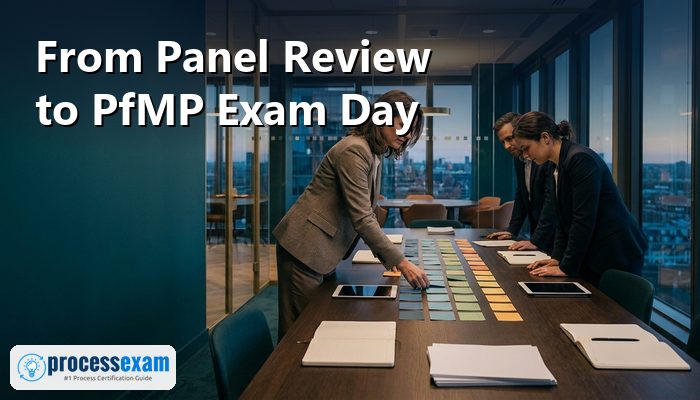
Portfolio leader reviewing a wall of project cards with two colleagues in a boardroom

The Portfolio Management Professional (PfMP) is PMI's credential for people who decide which programs and projects an organisation should fund, delay or stop. It is not a bigger version of the PMP. A project manager asks whether the work is being done well; a portfolio manager asks whether it is the right work at all. Every domain in the exam is built around that second question.

Why does the PfMP start with a panel review instead of the exam?

PMI treats the PfMP as a credential for people who already hold portfolio responsibility, so the application is a screening stage in its own right. After your experience is checked against the eligibility rules, a panel of PMI-appointed reviewers reads the way you have described your portfolio work. Only candidates the panel accepts go on to the exam. Training providers put the review at roughly two to three months, so plan the calendar before you plan the study sessions.

CQPA Certification Exam: The 2026 Body of Knowledge and Study Plan

Updated on 21 September 2026. What’s new: updated for ASQ's 2026 CQPA Body of Knowledge, which took effect on 1 August 2026, with current exam fees.

A quality process analyst lives inside the data. You pull subgroups off a line, plot them on a control chart, decide whether a shift is common cause or something that needs chasing, then work out whether the process is capable of holding its specification at all. The ASQ CQPA exam certifies exactly that scope of work, and since August 2026 it does so against a rewritten Body of Knowledge.

CQPA exam essentials with key quality concepts and practice questions for the ASQ Quality Process Analyst

That last point matters before anything else. ASQ replaced the 2020 Certified Quality Process Analyst Body of Knowledge with a 2026 version that took effect on 1 August 2026 and was tested for the first time in the August 2026 window. The 2020 document stayed available until 1 October 2026 and has since been archived. If your notes, your handbook edition or your study plan were built around the 2020 domain weights, some of the numbers you are working to are no longer the ones on the exam.

This article walks through the credential the way the job works: what the analyst is actually asked to do, how the exam is built and priced, which Body of Knowledge applies today, how heavy the statistics really are, and how to turn 100 scored questions into a study plan that finishes on time.

DevOps Foundation Exam (DOFD): Syllabus, Format and Three-Week Study Plan

A common assumption is that anyone who works with pipelines every day can walk through DevOps Foundation without study. The paper tests something else: whether you can explain the Three Ways, CALMS, CI/CD, metrics and culture in DevOps Institute's own terms. It is 40 multiple-choice questions in 60 minutes, open book, with 65% needed to pass and a fee of USD $257, so knowing where each idea sits matters more than memorising it.
Candidate studying for the DevOps Foundation DOFD certification on a laptop

Most people who search for the devops foundation exam are trying to settle three things: how hard it is, what it actually covers, and how long they need before they book. This guide answers all three from the exam's own numbers and the topic list the vendor publishes, then turns them into a three-week plan you can start today.

DevOps Institute, which created the credential, is now part of the PeopleCert group, and the exam is bought and booked through PeopleCert. We checked the vendor's current DevOps Foundation pages in October 2026. The format, pass mark and open-book rule below match what both pages say.

What is the DOFD exam, and who is it for?

DOFD is the entry-level credential in the DevOps Institute range. It sits underneath the DevSecOps, Site Reliability Engineering, Observability, AIOps, Continuous Testing and Value Stream Management foundation exams, and it is the one most candidates take first because the others assume its vocabulary.

Achieving ASQ CRE Certification: Practice Tests and Exam Strategies

ASQ CRE exam preparation tips.

Are you aspiring to become an ASQ Certified Reliability Engineer CRE? Achieving the certification demonstrates your expertise in ensuring the reliability and quality of products, processes, and services. However, preparing for the ASQ CRE exam can be daunting without the right strategy. To assist you in your preparation journey, here are some comprehensive study tips to help you excel in the ASQ CRE certification exam.

What Is the CRE Certification All About?

A CRE, or Certified Reliability Engineer, is an expert who comprehends the principles of assessing and forecasting performance to enhance product or system safety, reliability, and maintainability.

Here Are the Study Tips to Pass the ASQ CRE Certification:

Understand the ASQ CRE Exam Structure and Content:

Before preparing, it's essential to familiarize yourself with the structure and content of the ASQ CRE exam. The exam consists of multiple-choice questions that evaluate your understanding of reliability engineering principles, statistical analysis, and practical applications. Understanding the exam's format and content areas can help you tailor your study plan.

ICYB Certification Roadmap: Navigating Lean Six Sigma Yellow Belt

ICYB certification study tips

ICYB or the IASSC Certified Lean Six Sigma Yellow Belt certification is a testament to proficiency in fundamental Lean Six Sigma principles and methodologies. Whether you aim to advance your career or deepen your understanding of process improvement strategies, effective preparation is essential to obtain this certification. Here are some study tips to help you prepare thoroughly for the ICYB certification exam.

Who Is An ICYB?

ICYB, or the IASSC Certified Lean Six Sigma Yellow Belt, is a professional who has a strong grasp of the fundamental principles of the Lean Six Sigma Methodology. They can lead minor improvement projects or contribute as a team member in more complex improvement initiatives led by a Certified Green Belt or Certified Black Belt, usually in a part-time capacity. A Lean Six Sigma Yellow Belt possesses a comprehensive understanding of the basic elements of the Lean Six Sigma Method, including proficiency in the areas covered within the Define, Measure, and Control (DMC) phases outlined in the IASSC Lean Six Sigma Yellow Belt Body of Knowledge. They are adept at implementing, executing, interpreting, and applying Lean Six Sigma techniques, albeit within a limited or supportive framework.

Pega Data Scientist Certification: What the CPDS '26 Exam Covers

Updated on 10 October 2026. What’s new: updated for the Pega Customer Decision Hub '26 exam, code PEGACPDS26V1, with its seven weighted topics.

Certified Pega Data Scientist CPDS exam preparation cover

Older CPDS guides describe a paper that Pega has since replaced. The exam on offer today is PEGACPDS26V1, written for Pega Customer Decision Hub '26: 50 questions, 90 minutes, 70% to pass and USD $190 (read on Pega Academy in October 2026). Adaptive Analytics now leads the blueprint at 28%, and tools that earlier write-ups leaned on, such as Pega Data Lake, are absent from the topic list.

What changed in the CPDS exam, and which version is Pega running now?

The Certified Pega Data Scientist exam still exists and shows no retirement date on its Pega Academy exam page. The page says it applies to Pega Customer Decision Hub '26 and gives the exam code as PEGACPDS26V1. It is delivered in English and rated Beginner. Guides, question lists and flashcards still labelled PEGACPDS25V1 describe the previous paper, so check the version label on any study material before you trust it.

Two shifts stand out when you compare today's blueprint with older write-ups of CPDS.

ServiceNow Discovery Certification: What the CIS-Discovery Exam Tests

A Discovery schedule that runs all night and still returns bad data is the exact problem this credential is built around: devices that never get classified, the same server arriving twice under two names, patterns that stop at the connection step. The ServiceNow CIS-Discovery exam asks whether you can trace that back to a cause and fix it, across 60 questions in 90 minutes.

CIS-Discovery exam preparation guide cover for the ServiceNow implementation specialist credential

CIS-Discovery, exam code CIS-DISCO, is the ServiceNow Certified Implementation Specialist - Discovery credential. It sits inside IT Operations Management and it is deliberately practical. The questions describe a schedule, an error message, a pattern step or a MID Server condition, and ask what you would change. Reading about Discovery is not enough; the exam is written for people who have watched a discovery run and read its logs.

This guide walks through what the blueprint weights, how a probe turns into a configuration item, what the MID Server has to do with all of it, and which experiments in a personal developer instance teach the rest.

What goes wrong when a Discovery schedule returns bad data?

Almost every scenario on the exam starts from a symptom an implementer would actually see. Learning to read those symptoms backwards is the single most useful preparation habit, because the answer options are usually all plausible and only one matches the real cause.

Here are the ones that come up most, and the part of the platform each belongs to:

ServiceNow CIS-PA Exam Guide - Indicators, Breakdowns, Dashboards

A ServiceNow Platform Analytics specialist spends the week turning table data into numbers people are willing to act on. That means defining indicator sources, building indicators, mapping breakdowns so a score can be sliced by assignment group or priority, scheduling collection jobs and assembling dashboards leaders actually open. The CIS-PA exam asks about that work directly, over 60 questions in 90 minutes.

Woman holding a laptop beside the text Ace the CIS-PA Exam with expert tips and practice questions

Almost nothing on this exam rewards a memorised definition. The questions describe a situation that a real implementation throws up — a score that collects no data, a breakdown that double-counts records, a dashboard that takes half a minute to load — and ask what you would configure next. That is why candidates who have built analytics content in an instance tend to find CIS-PA fair, while candidates who have only read about it find it slippery.

This guide walks through the job the credential describes, what changed when ServiceNow folded Performance Analytics into Platform Analytics, the exam facts you need before booking, how the blueprint distributes its weight, and the practice that actually moves your score.

What does a ServiceNow Platform Analytics implementer actually do?

Strip the exam away and the role comes down to four repeating questions: what should we measure, where does that number come from, what should we compare it against, and who reads it. Every configuration object in Platform Analytics exists to answer one of those.

Syndicate content