
CQPA Certification Exam: The 2026 Body of Knowledge and Study Plan
Updated on 21 September 2026. What’s new: updated for ASQ's 2026 CQPA Body of Knowledge, which took effect on 1 August 2026, with current exam fees.
A quality process analyst lives inside the data. You pull subgroups off a line, plot them on a control chart, decide whether a shift is common cause or something that needs chasing, then work out whether the process is capable of holding its specification at all. The ASQ CQPA exam certifies exactly that scope of work, and since August 2026 it does so against a rewritten Body of Knowledge.
That last point matters before anything else. ASQ replaced the 2020 Certified Quality Process Analyst Body of Knowledge with a 2026 version that took effect on 1 August 2026 and was tested for the first time in the August 2026 window. The 2020 document stayed available until 1 October 2026 and has since been archived. If your notes, your handbook edition or your study plan were built around the 2020 domain weights, some of the numbers you are working to are no longer the ones on the exam.
This article walks through the credential the way the job works: what the analyst is actually asked to do, how the exam is built and priced, which Body of Knowledge applies today, how heavy the statistics really are, and how to turn 100 scored questions into a study plan that finishes on time.
What does a certified quality process analyst actually do?
ASQ describes the Certified Quality Process Analyst as a paraprofessional who, working in support of and under the direction of quality engineers or supervisors, analyses and solves quality problems and takes part in quality improvement projects. That definition is worth reading twice, because it sets the altitude of the whole exam. The CQPA is not the person who designs the quality system. It is the person who runs the measurements that tell everyone whether the system is working.
In practice that means a recognisable set of tasks. Deciding how to sample a process, and how often. Choosing between an X-bar and R chart, an X-bar and s chart and an individuals and moving-range chart, then reading the pattern the points make. Separating a run or a trend from ordinary noise. Calculating Cp, Cpk, Pp and Ppk and explaining, to a production supervisor who does not want to hear it, that a centred process can still be incapable. Running a gage repeatability and reproducibility study when the measurement system itself is under suspicion. Building the Pareto chart that decides where the improvement team starts, and drafting the corrective action record when something has already gone wrong.
Two consequences follow for anyone deciding whether to sit the exam. The first is that the credential maps cleanly onto a real job title rather than onto a management layer, so it is a natural step for technicians, inspectors, laboratory staff, production data analysts and recent engineering or science graduates who already touch quality data. The second is that the exam tests the analyst's toolkit at analyst depth: you are asked to select, construct, apply and interpret the seven basic quality tools, not to design an experiment from scratch or own a corporate quality strategy. That is a narrower target than the Certified Quality Engineer exam and a considerably deeper one than an entry-level associate credential.
How is the CQPA exam built, and what does sitting it cost?
The computer-delivered CQPA is a one-part, 110-question multiple-choice exam offered in English. ASQ scores 100 of those questions and uses the remaining 10 unscored, so every question you answer counts towards your time but not all of them count towards your result. Scoring is on a scaled basis, and the bar is 550 out of 750.
| Exam detail | ASQ CQPA |
|---|---|
| Certification | ASQ Certified Quality Process Analyst (CQPA) |
| Exam code | CQPA |
| Vendor | ASQ |
| Number of questions | 110 |
| Duration | Total appointment time - 270 minutes Exam Time - 258 minutes |
| Exam fee (USD) | ASQ MEMBERS - $334 NON-MEMBERS - $434 RETAKES - $234 |
| Passing score | 550/750 |
| Format | Multiple choice, open book |
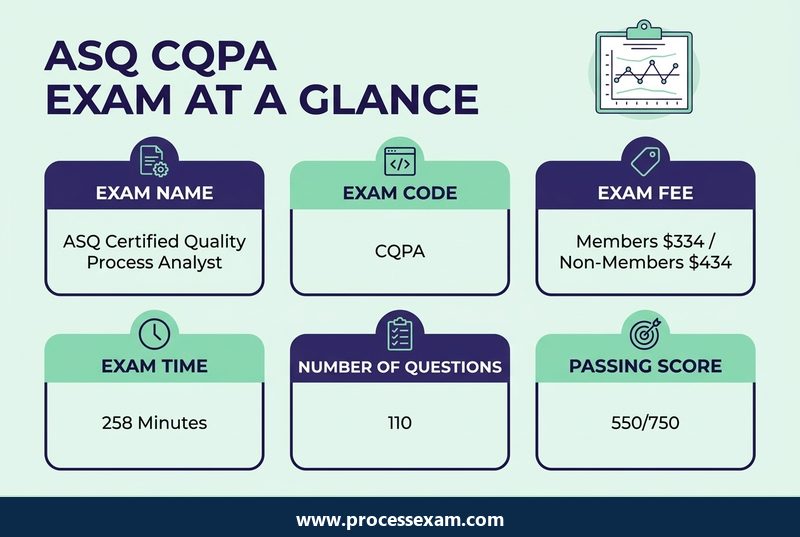
Read the duration row carefully, because the two figures do different jobs. The 270-minute total appointment time is what you block out of your day: check-in, the tutorial, the survey and the exam itself. The 258 minutes of exam time is what you have for the questions. Divided across 110 questions that is about two minutes and twenty seconds each, which sounds generous until you meet a capability calculation or a conditional probability question that wants three steps of arithmetic.
Who is eligible to apply?
ASQ asks for two years of on-the-job experience in one or more of the areas of the CQPA Body of Knowledge, gained in a full-time paid role. An associate degree, or two years of equivalent higher education, can stand in place of that experience. There is no requirement to hold another ASQ certification first and no requirement to complete a training course. Compared with the auditor and engineer credentials, whose experience bars run to five and eight years, the CQPA is deliberately reachable early in a quality career.
What you pay, and when the retake rate applies
The fee structure has three lines, and the gap between them is large enough to be worth planning around: ASQ members pay $334, non-members pay $434, and a retake costs $234. The $100 difference between the first two is, in effect, most of the cost of an ASQ membership, so candidates who are not yet members usually do the arithmetic before they apply rather than after. The retake rate is available for two years from a previous attempt, which softens the cost of a near miss but is not a reason to sit the exam underprepared.
Windows, deadlines and the open-book rule
The CQPA runs in computer-based testing windows rather than on demand, each with an application deadline that falls several weeks before the window opens. ASQ's official Quality Process Analyst certification page lists the next window and its deadline; check it before you build a plan backwards from a date, because missing an application deadline costs you a whole window. ASQ also offers a paper-and-pencil version of the exam in some settings, a one-part 100-question four-hour paper, so confirm which delivery you are booking.
Every ASQ exam is open book, and the CQPA is no exception. You bring your own reference materials, they must be permanently bound, and the test centre administrator inspects them before you go in. Sticky notes are allowed as tabs only, and they must be attached before you arrive. Computer-based exams include an on-screen basic scientific calculator, and any silent, hand-held, battery-operated calculator without programmable memory is permitted. Programmable and graphing models are not.
Which CQPA Body of Knowledge is being tested right now?
The 2026 Body of Knowledge is the one that applies. It became effective on 1 August 2026, was introduced with the August 2026 testing window, and replaced the 2020 document, which ASQ archived on 1 October 2026. Any study material that still sets out the 2020 question counts is describing an exam that is no longer sat.
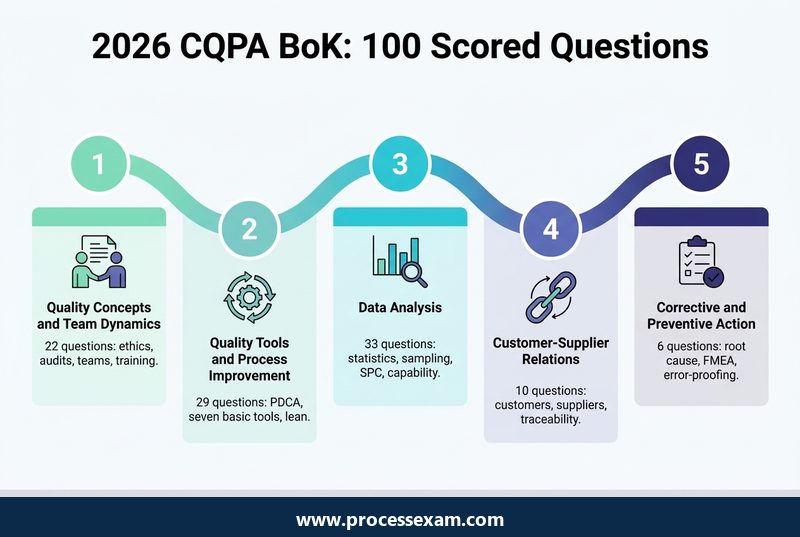
The five section names did not change. What changed is how the 100 scored questions are distributed across them, and that redistribution is the single most useful piece of planning information you will find.
| Body of Knowledge section | 2020 questions | 2026 questions | Change |
|---|---|---|---|
| I. Quality Concepts and Team Dynamics | 20 | 22 | +2 |
| II. Quality Tools and Process Improvement Techniques | 26 | 29 | +3 |
| III. Data Analysis | 33 | 33 | No change |
| IV. Customer-Supplier Relations | 13 | 10 | -3 |
| V. Corrective and Preventive Action | 8 | 6 | -2 |
What ASQ added, removed and raised
ASQ published a body of knowledge map alongside the new document, and it is unusually specific about the changes. Five subtopics were added. Section I gained leadership commitment, communicating quality, and effective team meetings. Section II gained project management approaches, which asks you to understand traditional and agile approaches and when each is appropriate, and change management, which covers communication, employee involvement, leadership support and strategies to reduce resistance and sustain improvements.
One subtopic was removed: analysis of variance, which sat at III.F.5 in the 2020 document, is not in the 2026 Body of Knowledge. Three areas rose in cognitive level, meaning the questions are written to a more demanding standard than before. Cost of quality moved up, so you are expected to apply the four categories of prevention, appraisal, internal failure and external failure rather than simply recognise them. Six Sigma moved up. And product and process approval systems in Section IV moved up. No area was lowered.
If you want the section-by-section detail beside your notes rather than in a browser tab, ASQ publishes both the 2026 CQPA Body of Knowledge and the 2026 CQPA Body of Knowledge map as PDFs, and our ASQ CQPA exam syllabus page sets the same topic list out in a single scrollable page with the exam summary at the top.
How much of the CQPA exam is statistics and process capability?
A third of it. Section III, Data Analysis, carries 33 of the 100 scored questions, which is more than any other section and more than Sections IV and V combined three times over. Candidates who are uncomfortable with numbers often try to make that weight up elsewhere. The arithmetic does not work: even a perfect score across Customer-Supplier Relations and Corrective and Preventive Action gives you 16 questions, half of what Section III is worth.
The statistics you must be able to calculate
Section III opens with basic concepts, and the verbs in the Body of Knowledge tell you the expected depth. You define, calculate and interpret measures of central tendency, which are mean, median and mode, and measures of dispersion, which are standard deviation, range and variance. You explain normal, binomial, Poisson and Weibull frequency distributions and describe what skewed and bimodal data look like. You handle probability concepts including independent and mutually exclusive events, combinations, permutations, additive and multiplicative rules and conditional probability, and you perform the calculations rather than recognising them. Reliability concepts sit here too at recall level: mean time to failure, mean time between failures, mean time between maintenance, mean time to repair, and the shape of the bathtub curve.
Data types, sampling and measurement systems
Before you analyse anything you have to know what you are holding. The exam asks you to use nominal, ordinal, interval and ratio measurement scales, to classify data as continuous variables or discrete attributes and counts, and to judge when converting attributes data to variables measures is appropriate. Data quality and integrity is a live area in the 2026 document, covering accuracy, completeness, consistency, timeliness and relevance, along with the methods that verify data validity from source through analysis, such as audit trails, vendor qualification, error detection software and records-management training.
Sampling follows: random, sequential, stratified, systematic, rational subgroup, attributes and variables sampling, plus acceptance sampling characteristics such as lot size, sample size, acceptance number and the operating characteristic curve. Measurement system analysis then asks you to distinguish accuracy, precision, repeatability and reproducibility studies, bias and linearity.
Statistical process control, which is the heart of it
SPC is where a quality process analyst earns the title, and the Body of Knowledge tests it at analyse level throughout. You distinguish control limits from specification limits, and process stability from process capability, which is the distinction that separates candidates who understand SPC from candidates who have memorised it. You apply the principles of rational subgroups. You identify, select and interpret p, np, c and u charts for attributes and counts, and X-bar and R, X-bar and s, and XmR charts for continuous data. You read chart patterns such as runs, hugging and trends, and you use SPC rules to tell common cause from special cause variation.
Then capability. You describe the conditions that must be met before capability can be measured at all, and you calculate and interpret Cp, Cpk, Pp and Ppk. Expect questions that give you a process which is stable but not capable, or capable but not centred, and ask what to do about it. Those are the questions that reward understanding rather than a formula sheet, even in an open-book exam.
Section III closes with advanced statistical analysis: regression and correlation for estimation and prediction, hypothesis testing with confidence intervals using t tests and the z statistic, basic design of experiments vocabulary including response, factors, levels, treatment, interaction effects, randomisation, error and blocking, and Taguchi concepts such as the quality loss function, robustness, controllable and uncontrollable factors and signal-to-noise ratio. Remember that ANOVA has been dropped from this list in the 2026 update.
What does the exam ask about outside the numbers?
Sixty-seven of the 100 scored questions sit outside Data Analysis, and they are not filler. They are the context that makes the numbers mean something.
Section I: quality concepts and team dynamics, 22 questions
This section starts with professional conduct and behaviours aligned with the ASQ Code of Ethics, then moves through the quality concepts that frame the role: what quality means to employees, the organisation, customers, suppliers and the community; why leadership commitment matters; how to translate data trends and process performance into clear actionable items; quality planning; the difference between national or international standards, customer requirements and product or process specifications; document control and configuration management, including how quality manuals, procedures and work instructions relate; and the four cost of quality categories, now at apply level.
Quality audits appear here rather than in a section of their own: audit types including internal and external, product, process and systems, and first-, second- and third-party audits; the components of the audit process from purpose and scope through to verification of corrective actions; and the roles of lead auditor, team member, client and auditee. Team dynamics closes the section with types of teams, team development, the forming-storming-norming-performing-adjourning stages, the roles of sponsor, champion, facilitator, leader and member, the new effective-meetings subtopic, and group challenges such as groupthink, hidden agendas and disruptive behaviour. Training and evaluation rounds it off.
Section II: quality tools and process improvement, 29 questions
The second-heaviest section, and the one that grew most in 2026. It covers PDCA, kaizen, incremental and breakthrough improvement and the DMAIC phases; the seven basic quality tools, which the Body of Knowledge tests at evaluate level, the highest cognitive demand anywhere in the document; lean concepts including set-up reduction, pull systems with just-in-time and kanban, 5S, continuous flow manufacturing, value-added analysis, value stream mapping, theory of constraints, poka-yoke and total productive maintenance; Six Sigma concepts and belt responsibilities; benchmarking; risk types and the control methods of avoidance, reduction, prevention, segregation and transfer; and business process management across its design, modelling, execution, monitoring and optimisation phases.
Management and planning tools follow: affinity diagrams, tree diagrams, process decision program charts, matrix diagrams, interrelationship digraphs, prioritisation matrices and activity network diagrams, then Gantt charts, PERT, work breakdown structures and critical path method, then the two new subtopics on project management approaches and change management.
Sections IV and V: customers, suppliers and CAPA, 16 questions
Section IV, now 10 questions, covers internal and external customers and suppliers, customer satisfaction methods including surveys, focus groups, complaint forms, warranty analysis and quality function deployment, product and process approval systems such as beta testing, first-article, in-process and final inspection, supplier selection and performance measures including supplier audits and corrective action requests, and material identification, status and traceability with its recall implications.
Section V, now 6 questions, is corrective and preventive action. Corrective action runs identify, contain, find root causes, propose solutions, verify implementation and confirm effectiveness. Preventive action covers tracking data trends and patterns, failure mode and effects analysis, reviewing monitoring reports, and building error-proofing and procedural changes. It is the smallest section in the Body of Knowledge, and the one candidates most often over-study because it feels familiar.
How do you turn 100 scored questions into an eight-week study plan?
Plan by question count, not by chapter count. The Body of Knowledge tells you exactly what each section is worth, so the time you give a section should follow that number rather than how interesting you find it. Eight weeks at six to eight hours a week suits someone already working in a quality role; stretch to twelve if statistics is unfamiliar territory.
| Weeks | Focus | What to finish |
|---|---|---|
| 1 | Orientation | Read the 2026 Body of Knowledge end to end, mark every subtopic red, amber or green, and note the five new ones |
| 2-3 | Section III, part one | Basic statistics, distributions, probability, reliability measures, data types, sampling, measurement system analysis |
| 4-5 | Section III, part two | Control limits versus specification limits, rational subgroups, attributes and variables charts, pattern rules, Cp, Cpk, Pp, Ppk, regression, hypothesis testing, DOE and Taguchi vocabulary |
| 6 | Section II | PDCA and DMAIC, the seven basic tools at evaluate level, lean, risk, BPM, management and project planning tools, the two new subtopics |
| 7 | Section I | Ethics, quality concepts, cost of quality at apply level, audits, team dynamics, training |
| 8 | Sections IV and V, then revision | Customer and supplier topics, CAPA, full-length timed attempts, error log review, reference book tabbing |
Build your open-book references while you study, not the night before
The open-book rule rewards preparation and punishes improvisation. A bound handbook you have never tabbed is close to useless at two minutes twenty seconds a question, because the time you spend finding a formula is time you did not spend answering. Tab as you go, section by section, and write your own one-page sheets for the things you will look up under pressure: the control chart selection logic, the capability formulas and the conditions for using them, the probability rules, and the sampling definitions. Bind or fasten them properly and attach the tabs before you travel.
Practise against the clock from week four, not week eight
Timed practice is diagnostic, and a diagnostic you run at the end is a diagnostic you cannot act on. From the middle of the plan, sit blocks of questions under the real time limit, then sort every wrong answer by Body of Knowledge section. Two patterns matter. If your errors cluster in Section III you have a content problem and you go back to the topic. If they are scattered but your pace collapses in the last hour you have a stamina problem, and the fix is more full-length attempts rather than more reading.
When you want a full-length rehearsal rather than a block, the CQPA practice test on ProcessExam puts all 110 questions in front of you at once, which is the only honest way to learn what four and a quarter hours of quality statistics does to your concentration before the day it counts.
Where do CQPA candidates quietly lose marks?
The failures are rarely dramatic. They are small habits that cost two or three questions each, repeated across a long exam.
- Studying to the 2020 weights. Section IV fell from 13 questions to 10 and Section V from 8 to 6, while Sections I and II grew. An old plan sends five questions' worth of study time to the wrong place.
- Confusing control limits with specification limits. This single distinction sits behind a surprising share of Section III questions, and a candidate who blurs it will misread both chart questions and capability questions.
- Treating stability and capability as the same thing. A stable process can be incapable and an unstable process can produce a flattering capability index. The Body of Knowledge asks you to describe the conditions that must be met before capability can be measured for exactly this reason.
- Learning the seven basic tools at recognition level. They are tested at evaluate level, the highest in the document. You need to judge which tool fits a situation and defend the choice, not name it from a picture.
- Bringing unbound or untabbed references. Materials must be permanently bound and are inspected before you enter. An unbound printout is refused at the door, and an untabbed book is dead weight.
- Over-studying CAPA. Six questions. It is familiar and comfortable, which is precisely why it absorbs time that Section III needed.
- Letting one calculation eat ten minutes. Flag it, move on, come back. With 110 questions there is always another mark available elsewhere.
On the day itself
Plan to arrive 30 minutes before your appointment; ASQ's policy is that late arrivals are not admitted and forfeit the fee. Bring one valid government-issued photo ID with a signature, in the same name as your application. Everything else goes into a locker except your ID and the locker key. Work a first pass at a steady pace, flagging anything that needs more than two minutes, and keep enough time at the end to return to the flags with a clear head rather than a rushed one. If you sit the exam by computer you see your result immediately on submission, with an email confirming it within three to five business days, although results for a new Body of Knowledge pilot window take longer.
What is a lifetime CQPA credential worth once you have it?
Here is the detail that changes the economics of this exam compared with most of ASQ's portfolio: the Quality Process Analyst is a lifetime certification. ASQ's recertification requirements list the credentials that must be renewed every three years, and the Quality Process Analyst is explicitly not among them, alongside Quality Improvement Associate, Quality Inspector, Quality Technician, Six Sigma Green Belt and Six Sigma Yellow Belt. There are no recertification units to collect, no journal to submit and no renewal fee. Certified Quality Engineers and Certified Quality Auditors, by contrast, recertify every three years or retake their exam.
That turns the CQPA into a one-off investment rather than a subscription, which matters if you are paying for it yourself. It also means the responsibility for staying current moves to you. Nobody will make you refresh your statistics, so build the habit into your work instead: keep reading charts, keep running capability studies, and keep the handbook you tabbed for the exam within reach.
As a career step the credential does three practical things. It gives a hiring manager independent evidence that you can be trusted with process data, which is otherwise difficult to demonstrate on a CV. It legitimises the analyst work you may already be doing informally, which tends to matter at the point where a technician role turns into a data-focused one. And it puts most of the statistical groundwork in place for whatever you sit next, because the SPC, capability, sampling and measurement system content in Section III reappears, at greater depth, in the Six Sigma Green Belt and Quality Engineer bodies of knowledge.
The people it fits best are the ones already doing the work: quality technicians and inspectors moving towards analysis, process and manufacturing engineers who own the charts, laboratory and calibration staff, supplier quality coordinators, and graduates who want a first credential that says something specific about their skills rather than something general about their enthusiasm. If that description fits, the 2026 Body of Knowledge is the document to start from, and the question counts in it are the plan.
Frequently Asked Questions
Which CQPA Body of Knowledge is the exam based on now?
The 2026 CQPA Body of Knowledge. It took effect on 1 August 2026 and was first tested in the August 2026 window. ASQ archived the 2020 version on 1 October 2026, so any study plan built around the 2020 question counts is now working to the wrong weights.
How many questions are on the CQPA exam and how long is it?
The computer-delivered CQPA has 110 questions. Master lists a total appointment time of 270 minutes and exam time of 258 minutes. ASQ scores 100 of the questions and uses ten unscored, so you answer 110 but only 100 count towards your result.
How much does the ASQ CQPA exam cost?
There are three prices: ASQ MEMBERS - $334, NON-MEMBERS - $434 and RETAKES - $234. The retake rate is available for two years from a previous attempt. Because membership closes most of the $100 gap, many candidates join ASQ before applying.
What is the passing score for the CQPA exam?
The passing score is 550 out of 750 on ASQ's scaled scoring. Computer-based candidates see the result immediately on submission and receive email confirmation within three to five business days, although results from a new Body of Knowledge pilot window take several weeks longer.
Is the CQPA exam open book?
Yes. All ASQ exams are open book and you bring your own references, which must be permanently bound and are inspected before you enter the test room. Sticky notes are allowed as tabs only and must be attached beforehand. A basic non-programmable calculator is permitted.
- Foundation Quality |
- CQPA Question Bank |
- CQPA Body of Knowledge (BOK) |
- ASQ CQPA BOK PDF |
- CQPA Exam Questions Download |
- CQPA Test Questions |
- ASQ Quality Process Analyst Test Questions |
- Quality Process Analyst Simulator |
- Quality Process Analyst Mock Exam |
- ASQ Quality Process Analyst Book |
- Quality Process Analyst Certification Cost |
- Quality Process Analyst Certification Requirements |
- ASQ Quality Process Analyst Sample Questions |
- Quality Process Analyst PDF |
- CQPA Handbook


