
Pega Data Scientist Certification: What the CPDS '26 Exam Covers
Updated on 10 October 2026. What’s new: updated for the Pega Customer Decision Hub '26 exam, code PEGACPDS26V1, with its seven weighted topics.

Older CPDS guides describe a paper that Pega has since replaced. The exam on offer today is PEGACPDS26V1, written for Pega Customer Decision Hub '26: 50 questions, 90 minutes, 70% to pass and USD $190 (read on Pega Academy in October 2026). Adaptive Analytics now leads the blueprint at 28%, and tools that earlier write-ups leaned on, such as Pega Data Lake, are absent from the topic list.
What changed in the CPDS exam, and which version is Pega running now?
The Certified Pega Data Scientist exam still exists and shows no retirement date on its Pega Academy exam page. The page says it applies to Pega Customer Decision Hub '26 and gives the exam code as PEGACPDS26V1. It is delivered in English and rated Beginner. Guides, question lists and flashcards still labelled PEGACPDS25V1 describe the previous paper, so check the version label on any study material before you trust it.
Two shifts stand out when you compare today's blueprint with older write-ups of CPDS.
- The description narrowed. Pega now introduces the exam as being for data scientists who want to apply AI in Pega Process AI and Pega Customer Decision Hub. Older articles also named Pega Customer Service and a list of products such as Pega Data Lake and Pega Predictive Analytics. None of those names appears among the current topics.
- The topic list is specific. Instead of the broad advice to "master Pega's data science tools", the blueprint now names seven topics, each with its own percentage, and lists what sits under each one. That makes the weightings a better guide than any generic tip list.
The practical consequence is simple. Whatever you read, check it against the seven topics below. If a guide spends a chapter on something that is not in the blueprint, that time is better spent on a topic that carries marks.
The exam at a glance
| Item | Detail |
|---|---|
| Certification | Certified Pega Data Scientist (CPDS) |
| Version | CPDS 26 (exam code PEGACPDS26V1) |
| Questions | 50 |
| Duration | 90 minutes |
| Passing score | 70% |
| Price | USD $190 |
| Delivery | Pearson VUE, at a test center or online proctored |
Where do the 50 questions come from, topic by topic?
Pega publishes seven topics with their share of the exam. They add up to 100%, and the largest three together cover 66% of the paper.
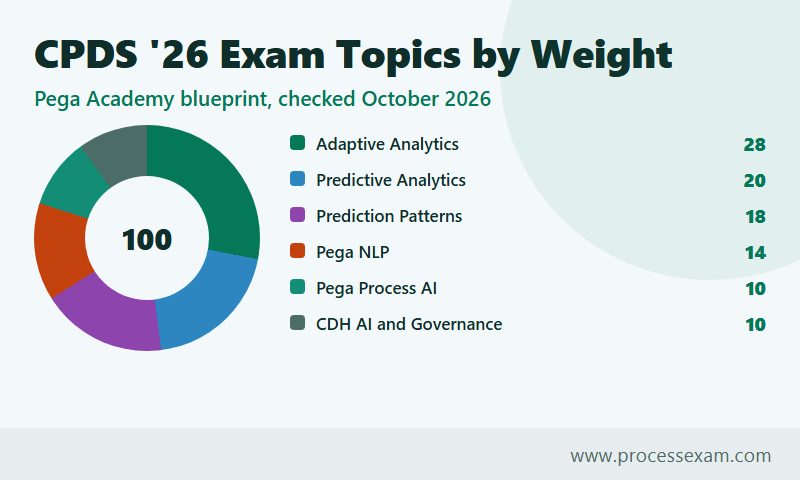
| Topic | Weight | Rough question count |
|---|---|---|
| Adaptive Analytics | 28% | about 14 |
| Predictive Analytics | 20% | about 10 |
| Prediction Patterns | 18% | about 9 |
| Pega NLP | 14% | about 7 |
| Pega Process AI | 10% | about 5 |
| AI for Customer Decision Hub | 6% | about 3 |
| Governance | 4% | about 2 |
The question counts are arithmetic, not a Pega statement: 50 questions multiplied by each weight. Pega gives percentages only, so expect a question or two of drift either way. Even so, the table shows where an evening of study pays best. Dropping Governance entirely would cost you about two questions out of 50. Skipping Adaptive Analytics would cost about fourteen, which on its own is close to half of the 30% you can afford to lose.
The chart above groups the 6% and 4% topics into one slice so that it stays readable. The table keeps all seven separate, as Pega lists them.
Why does Adaptive Analytics carry more than a quarter of the paper?
Adaptive Analytics is 28% of the exam, the largest block by a wide margin. Pega lists three things under it: adaptive models, monitoring adaptive models, and exporting adaptive model data. Those three describe a working life cycle rather than a definition to memorise.
Adaptive models
An adaptive model learns from the responses customers give, so it keeps changing as behaviour changes. That is the opposite of a model trained once on historical data and then frozen. Expect questions that ask what an adaptive model needs in order to learn, what happens to a brand-new model with no responses behind it, and why it behaves differently from a predictive model that was built offline. When you read the Customer Decision Hub material, keep asking which inputs an adaptive model uses and where its outcomes come from.
Monitoring adaptive models
Monitoring is where a data scientist spends the time after launch. Prediction Studio, which Pega's own mission page calls the dedicated workspace for data scientists, is where you look at how models are performing. Practise reading what the monitoring screens tell you: whether a model has gathered enough responses to be trusted, whether its predictors are doing useful work, and what a poor performance figure should lead you to do next. Scenario questions in this area usually hand you a symptom and ask for the sensible next step.
Exporting adaptive model data
The third item is the shortest line in the blueprint and still deserves a pass through the hands-on material. Exporting model data lets you analyse the results outside the tool. Be ready to say why a data scientist would export, what the exported data lets them check, and who might need to see it.
A good test of readiness: close your notes and explain, in four sentences, how an adaptive model goes from no data to a trusted model, and how you would know it had drifted. If you stumble, that is the gap to fix before anything else.
A worked scenario to practise on
Picture a retention offer in Customer Decision Hub that has been live for two weeks. Responses are coming in, but the model's performance figure is barely above random and the business asks whether the model is broken. A candidate who has studied the blueprint line by line would work through the checks in order. First, how many responses has the model actually collected? A figure based on a few hundred responses says little. Second, are the predictors giving the model anything to separate customers with, or is most of its input empty? Third, has the situation changed, for example a new channel or a new customer segment, so that the model is learning from a mix it has not seen before? The exam will not phrase it this way, but questions in this topic reward exactly this habit of asking what the evidence supports before changing anything.
Write two or three scenarios like this one for yourself, covering a new model, a drifting model and an exported dataset. Answering your own scenarios out loud is a faster check than rereading notes, and it exposes weak spots that recognition-style revision hides.
What separates predictive analytics from prediction patterns on the exam?
These two topics sit side by side in the blueprint, 20% and 18%, and candidates often merge them. They test different skills.
Predictive Analytics (20%)
Pega lists two items here: creating predictions and MLOps. Creating a prediction is the act of defining what outcome you want to predict and attaching the model that produces the score. The exam wants the sequence: what you decide first, what you configure, and where the result is used. MLOps is about running models responsibly over time, which means bringing a model in, checking it, replacing it and keeping a record. Questions on it tend to test judgement about when and how to change a model that is already live, so read about that life cycle rather than just the names of the screens.
Prediction Patterns (18%)
The two items are creating and understanding decision strategies, and defining prediction patterns. A decision strategy is where model output meets business logic. Understanding one means reading a strategy and saying what it returns and why. Creating one means assembling it so that the right model scores feed the right decision. Defining prediction patterns is the part that ties a prediction to the way it is used. Read the strategy material slowly and rebuild a small strategy by hand if you have access to a Pega environment, because strategy questions often hinge on the order in which things are evaluated.
A short way to keep the two apart: Predictive Analytics asks how a prediction comes to exist and stays healthy; Prediction Patterns asks how its result is used in a decision. Together they are 38% of the paper, so a candidate who understands the strategy side of decisioning is already well placed on Customer Decision Hub questions elsewhere.
Three confusions worth clearing up
- A model is not a decision. A model produces a score or a propensity. The decision, which action to show or which case to flag, comes from the strategy and the rules around it. When a question asks what produces the final outcome, look for the strategy, not the model.
- Adaptive and predictive are not rivals. One keeps learning from live responses; the other is built from data you supply. A question may ask which suits a situation with plenty of fresh responses and no history, and the answer follows from how each one gets its knowledge.
- Monitoring is not governance. Watching how models perform is part of Adaptive Analytics and MLOps. Governance is its own small topic. Keep the two lists separate when you revise.
Are Process AI and NLP worth studying hard at 10% and 14%?
Yes, because together they are 24%, which is nearly a quarter of the paper, and because both are narrow enough to learn in a few evenings. Each lists concrete items, and each item names a use case you can picture.
Pega Process AI (10%)
The items are an overview, predicting fraud, and predicting missing the service-level agreement. This is where predictions leave customer engagement and go into case work. A fraud prediction scores a case as it moves through a process. An SLA prediction estimates whether a case will miss its deadline so that someone can act early. Learn what data each prediction needs, where the score is used in the case, and what a business user sees as a result.
Pega NLP (14%)
Beyond an overview, the blueprint lists text analytics for email routing and entity extraction with the chatbot channel. Text analytics for email routing is about reading an incoming message and deciding where it should go, which involves topics and sentiment. Entity extraction picks out specific pieces of information, such as a name or an account reference, from what a customer types. The classic scenario question gives you a customer message and asks which text-analysis capability handles it.
AI for Customer Decision Hub (6%) and Governance (4%)
These two small blocks are easy to neglect. AI for Customer Decision Hub covers an overview of the hub and the predictions used in it. Governance has a single item, also called Governance. At 10% together they are worth about five questions. Read each blueprint line once, make sure you can say in a sentence what it is for, and move on.
Which Academy missions and study order fit the weightings?
Pega's Data Scientist mission page bundles three missions for Customer Decision Hub '26. Their listed lengths are:
- AI for 1:1 Customer Engagement: 9 modules, 13 challenges, 9 hours 50 minutes.
- Pega Process AI Essentials: 4 modules, 3 challenges, 3 hours 30 minutes.
- Pega NLP Essentials: 3 modules, 4 challenges, 3 hours.
The mission names echo the Process AI and NLP topics directly. The first one, on one-to-one customer engagement, is the large mission and presumably carries the adaptive, predictive and strategy material. Pega's pages do not publish a module-by-topic map, so check the module titles against the blueprint yourself and note any topic that no module obviously covers.
An order that follows the marks
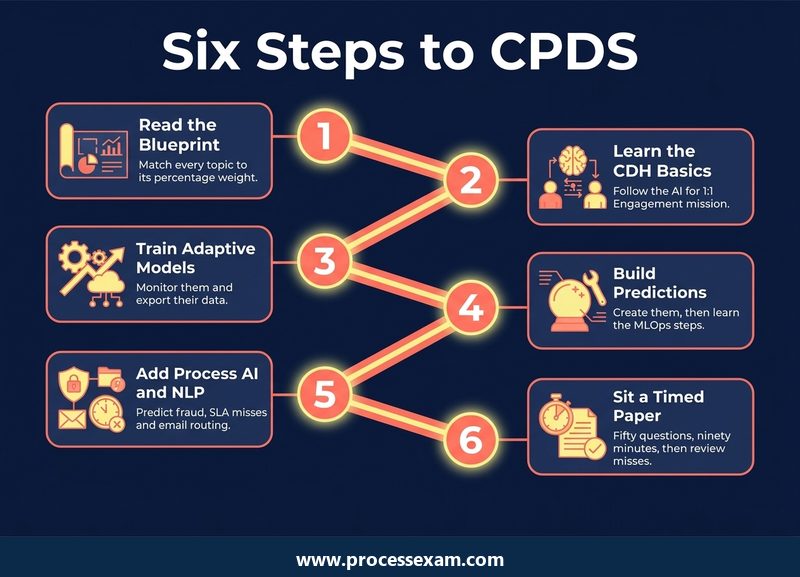
- Start with the blueprint. Copy the seven topics and their items onto one page and rate yourself on each line as strong, shaky or unseen.
- Do the big mission first. Work through AI for 1:1 Customer Engagement and pay attention to adaptive models, because they are 28%.
- Take Predictive Analytics and strategies next. Combined they are 38%. Build or read a decision strategy and a prediction from start to finish.
- Add the Process AI and NLP missions. They are short, and the use cases are concrete enough to remember.
- Finish with a timed paper. Ninety minutes for 50 questions leaves 1.8 minutes per question. Time yourself, mark the questions you guessed, and go back to the blueprint line each miss belongs to.
Finishing the missions tells you that you have seen the material. A CPDS mock exam tells you whether you can answer under the clock, and the topic of each miss shows which weighting you misjudged.
Pacing the 90 minutes
At 1.8 minutes a question, there is no room to agonise. A workable habit is to answer what you know on a first pass, flag anything that needs a second read, and keep the last ten minutes for flagged items. Scenario questions that describe a model symptom take longer to read than definition questions, so expect the clock to run unevenly. Practise this rhythm on timed attempts, because the habit has to be in place before the real paper.
After each timed attempt, sort your misses into three piles: topics you had not studied, topics you studied but confused, and questions you simply misread. Each pile needs a different fix. Unstudied topics go back on the plan, confusions need a worked example, and misreads need slower reading of the last line of the question, where the actual ask usually sits.
Spread over a few weeks, the same order fits most schedules. Candidates with data-science experience from outside Pega will usually move quickly through the general modelling ideas and slow down on the Pega-specific screens. Candidates who know Pega but have never worked on prediction tend to find the reverse.
What are the rules for booking and sitting CPDS?
Pega's exam page says the exam is proctored by Pearson VUE. You create a Pearson VUE account if you do not have one and register through Pearson VUE's site, using Pearson VUE's Pega page. There are two delivery options: a test center, or online proctored delivery, where you sit the exam in a quiet, uninterrupted room at home or at the office while a proctor watches through your webcam.
The figures to carry into the day are these: 50 questions, 90 minutes, a 70% pass mark, and USD $190. A 70% pass mark on 50 questions means you need roughly 35 correct answers, assuming every question counts equally. Pega's page does not say that, so treat 35 as an estimate and not a rule.
The exam page does not set out retake, cancellation or discount rules, so this article leaves them out. Check the terms on Pearson VUE when you book, because rules of that kind can change between checks.
Before test day:
- Create the Pearson VUE account early, so that name matching and identity details are settled before you need a slot.
- If you choose online delivery, test your webcam, connection and room, and clear the desk.
- Decide whether you prefer a test center, where the equipment is not your problem, or the convenience of home.
Who gains from the CPDS credential, and when should you wait?
Pega describes the audience as data scientists who want the skills to apply AI in Pega Process AI and Pega Customer Decision Hub. It says the certification validates that you know Pega's next-best-action paradigm, can build predictions that use predictive, adaptive and text analytics models, and have used those predictions in case management and in one-to-one customer engagement.
That description fits three kinds of reader well.
- Data scientists moving onto a Pega project. You already know modelling, and the credential shows you can apply it inside Prediction Studio and Customer Decision Hub rather than only in a notebook.
- Decisioning and hub practitioners. If you configure strategies and engagement rules, the exam gives you a structured way to learn what happens behind the scores you already use.
- Case-management developers adding AI. The Process AI topic, with its fraud and SLA predictions, speaks to anyone who wants predictions inside case work.
You may want to wait if you have never used a Pega environment and the terms above are new. In that case, the Academy missions are a gentler start than the exam, and a first pass through them will tell you quickly whether the topic suits you. For a feel of how questions are asked, the CPDS sample questions page shows the style before you commit to a date.
The certificate proves exposure to Pega's decisioning tooling at a given version. It does not replace project experience, and Pega's blueprint is written for the '26 release, so keep your knowledge current as the platform moves on.
Frequently Asked Questions
What does CPDS stand for in Pega?
CPDS stands for Certified Pega Data Scientist. It is Pega's certification for data scientists who apply AI in Pega Process AI and Pega Customer Decision Hub, building predictive, adaptive and text analytics models and using their predictions in case management and in one-to-one customer engagement.
Which version of the CPDS exam is current?
Pega Academy lists the Certified Pega Data Scientist exam as PEGACPDS26V1, which applies to Pega Customer Decision Hub '26, with no retirement date shown when checked in October 2026. Study material still labelled PEGACPDS25V1 was written for the earlier paper, so check the label before relying on it.
How many questions are on the CPDS exam and what is the pass mark?
The CPDS exam has 50 questions, you get 90 minutes, and the passing score is 70%. The three heaviest topics carry most of the paper: Adaptive Analytics 28%, Predictive Analytics 20% and Prediction Patterns 18%, so those three decide most of your result.
How much does the Pega Data Scientist certification cost?
The CPDS exam fee is USD $190 for the current version. You book and pay through Pearson VUE. Check the checkout page for taxes or regional pricing, since Pega's exam page does not break down extra charges, retake terms or discounts, and this article does not guess at them.
Can you take the CPDS exam online?
Yes. Pega's exam page says the exam is proctored by Pearson VUE and offers two delivery options: a test center, or online proctored delivery from a quiet, uninterrupted room at home or in an office, watched by a proctor through your webcam. You register through a Pearson VUE account.


