
ServiceNow Discovery Certification: What the CIS-Discovery Exam Tests
A Discovery schedule that runs all night and still returns bad data is the exact problem this credential is built around: devices that never get classified, the same server arriving twice under two names, patterns that stop at the connection step. The ServiceNow CIS-Discovery exam asks whether you can trace that back to a cause and fix it, across 60 questions in 90 minutes.

CIS-Discovery, exam code CIS-DISCO, is the ServiceNow Certified Implementation Specialist - Discovery credential. It sits inside IT Operations Management and it is deliberately practical. The questions describe a schedule, an error message, a pattern step or a MID Server condition, and ask what you would change. Reading about Discovery is not enough; the exam is written for people who have watched a discovery run and read its logs.
This guide walks through what the blueprint weights, how a probe turns into a configuration item, what the MID Server has to do with all of it, and which experiments in a personal developer instance teach the rest.
What goes wrong when a Discovery schedule returns bad data?
Almost every scenario on the exam starts from a symptom an implementer would actually see. Learning to read those symptoms backwards is the single most useful preparation habit, because the answer options are usually all plausible and only one matches the real cause.
Here are the ones that come up most, and the part of the platform each belongs to:
- A device is found but never classified. The port scan saw it, yet no classifier matched. That points at IP services and port probes, or at a device the classification criteria do not cover.
- The same physical server appears as two configuration items. The identification stage could not match the incoming payload to the existing record, so the Identification and Reconciliation Engine created a new one. Serial numbers, correlation identifiers and identification rules decide this.
- Attributes are blank on otherwise healthy CIs. Exploration ran without the rights it needed, or the pattern took a branch that skipped the step that fills those attributes.
- An authentication failure on a device that worked last week. Credentials, credential affinity and the order in which they are tried explain most of these.
- A schedule completes far too quickly. The range never reached the MID Server that can see it, or the behavior sent the work to a MID Server in the wrong network segment.
- Everything works in one data centre and nothing works in another. This is a MID Server capability, validation or cluster question, not a Discovery question.
Notice how often the answer is not in Discovery at all, but in the MID Server or the CMDB underneath it. That is why the blueprint gives real weight to both, and why candidates who study only Pattern Designer lose marks in places they never expected.
How many questions, how long, and what does CIS-Discovery cost?
The logistics are simple, and worth fixing in your head before you build a study routine around them.
| Exam detail | CIS-Discovery |
|---|---|
| Full name | ServiceNow Certified Implementation Specialist - Discovery |
| Exam code | CIS-DISCO |
| Vendor | ServiceNow |
| Number of questions | 60 |
| Duration | 90 minutes |
| Exam fee | USD $450 |
| Passing score | Pass / Fail |
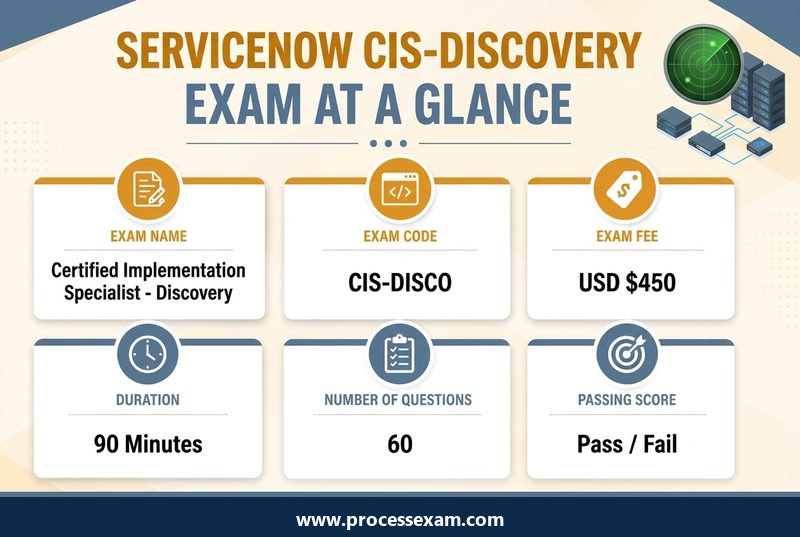
Ninety minutes for 60 questions is a minute and a half each, which is generous by ServiceNow standards but not unlimited: the pattern and troubleshooting scenarios carry several lines of setup before the question itself arrives. A first pass that leaves ten minutes spare is a comfortable target.
Results are reported as Pass or Fail. ServiceNow does not publish a percentage you have to reach, so there is no pass mark to aim at and no published pass rate to compare yourself against. Readiness has to be measured a different way, which the practice section below deals with.
Booking runs through ServiceNow's certification pages and the exam is delivered by its testing partner; Pearson VUE's ServiceNow programme page covers test centre and online proctored options, identification requirements and rescheduling. Check prerequisites on ServiceNow's own pages before you pay, because implementation specialist exams sit on top of the Certified System Administrator credential and ServiceNow lists its required and recommended training alongside each exam.
Why do pattern design and configuration carry 70 percent of the marks?
The blueprint splits into four areas, and two of them together decide almost three quarters of your result.
| Exam area | Weight | What it covers |
|---|---|---|
| Discovery Pattern Design | 35% | Pattern Designer, steps and sections, operations such as match and parse, variables, attributes and regular expressions, identification and connection sections |
| Discovery Configuration | 35% | Behaviors, clusters, IP services and schedules, the discovery process flow, the ECC Queue, statuses and discovered devices, troubleshooting errors, duplicates and credentials |
| Configuration Management Database | 15% | CI Class Manager, CMDB tables and relationships, reclassification, CMDB health, identification and reconciliation, data source precedence, de-duplication |
| Discovery Engagement Readiness | 15% | MID Server requirements and sizing, MID Server and Discovery dashboards, the business case for Discovery and how it is positioned |
The weighting tells you where the hours go. Pattern design and configuration are the two halves of the same job: one builds the logic that collects data, the other controls when, where and with what credentials that logic runs. Everything else in the exam supports them. The full topic list behind this table is published on the ServiceNow CIS-Discovery exam syllabus, and ServiceNow's own official CIS-Discovery exam blueprint is the version to check before you book, since the mainline blueprint is revised as the platform changes.
One warning about the smaller areas. Fifteen percent of 60 questions is around nine questions, and the CMDB area is where those nine are easiest to get right if you have prepared and easiest to lose if you assumed Discovery was only about scanning. Reclassification, identification rules and data source precedence are quick wins.
How does a probe become a configuration item?
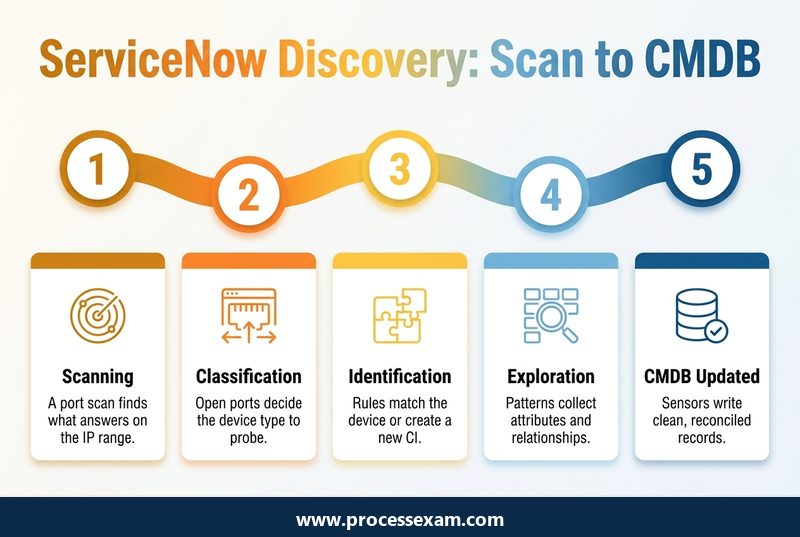
Horizontal discovery runs in four phases, and most of the exam's troubleshooting questions are really asking which phase failed. Learn the phases as a chain where each one hands something to the next.
Scanning: the port scan that starts everything
A schedule hands a range of IP addresses to a MID Server, which runs the Shazzam probe against them. Shazzam does not log in to anything. It checks which of the ports defined in your IP services are open and reports back what answered. If a device is quiet on every port you scan for, Discovery cannot proceed past this phase, and the device is recorded as active with no open ports or not recorded at all.
Classification: deciding what kind of thing it is
The open ports and the responses steer the platform toward a device type: a Windows host, a Linux host, a network device, a printer, a storage array. Classification uses the matching protocol, so a device answering on the Windows management port is probed differently from one answering on SSH or SNMP. A wrong or missing classification means the wrong pattern runs next, or none at all.
Identification: match an existing CI or create one
This is where Discovery hands its payload to the Identification and Reconciliation Engine. Identification rules look at the attributes that make a device unique, typically a serial number, a correlation identifier or a name plus domain. If the engine finds a match, the existing configuration item is updated. If it does not, a new one appears, and that is how duplicates are born. Reconciliation rules then decide whether this data source is allowed to write the attributes it is offering, and data source precedence settles disagreements between two authorised sources.
Exploration: collecting the detail
Once the CI exists, exploration gathers the attributes that make it useful: installed software, running processes, file systems, network adapters, and the relationships that connect this CI to others. This is the phase that fills a CMDB rather than just populating it, and it is also the phase most affected by insufficient credentials, because reading process tables and registry keys needs more rights than answering a port.
Probes and sensors, patterns and the ECC Queue
Two collection mechanisms coexist, and the exam expects you to know both. The older one is a probe and sensor pair: the probe is the instruction sent out to the MID Server, the sensor is the script that parses the result and writes it to the CMDB. The newer one is the pattern, a sequence of steps executed by the pattern engine on the MID Server, built and debugged in Pattern Designer rather than in script.
Both travel through the ECC Queue, the platform's external communication channel. An output record is an instruction waiting for a MID Server to collect it; an input record is the result coming back. When a scenario describes a discovery that is stuck, the ECC Queue is where an implementer looks first: output records that are never picked up point at a MID Server that is down or lacks the capability, while input records that error point at what happened on the target device.
Where horizontal discovery stops and Service Mapping starts
Horizontal discovery works bottom up. It sweeps IP ranges, finds everything that answers, and builds infrastructure relationships from what it observed. Top-down discovery, used by Service Mapping, works the other way: it starts from a known entry point for a business service and follows the connections outward to map only what that service touches.
The exam tests the boundary, not Service Mapping itself. Know that horizontal discovery gives you breadth and populates the CMDB, that top-down mapping gives you a service view built on that data, and that connection sections inside patterns are the piece the two approaches share.
What do credentialed and credential-less discovery each give you?
Credentials are the difference between knowing a device exists and knowing what is on it, and the exam returns to them repeatedly.
Credentialed discovery logs in. On Windows that is usually a Windows credential used over the management protocol, on Linux and Unix an SSH credential, on network gear SNMP community strings or SNMPv3 credentials, and on storage, cloud and virtualisation platforms the relevant API credential. The platform stores these centrally, tries them against a target until one succeeds, and then remembers which worked so it does not start from scratch next time. That memory is credential affinity, and it explains both why a second run is faster and why a changed password can produce failures on devices that were fine before.
Credential-less discovery fills the gap where no login is available. It builds a configuration item from what the scan and the device's own responses reveal, so you get a record with an IP address, a rough device type and very little else. It is genuinely useful for coverage, particularly for network appliances and unmanaged devices, and genuinely limited: you cannot build software relationships from a fingerprint. Agent-based collection is the third option, where an agent installed on the host reports in rather than being polled.
The exam-relevant point is the trade-off. When a scenario asks how to bring an isolated segment into the CMDB without opening firewall rules or handing out service accounts, credential-less or agent-based collection is the answer. When a scenario needs software, processes or detailed attributes, only a credentialed run gets there. Expect at least one question that hangs on knowing which of the two a described outcome requires.
Why does the MID Server decide whether Discovery works at all?
The MID Server is the piece of software that stands between the instance and the network being discovered. It runs inside the customer's network, it opens the connection outward to the instance rather than accepting one inward, and it executes every probe and pattern on the platform's behalf. Nothing is discovered without one, which is why an entire blueprint area concerns readiness.
For the exam, work through these in order:
- Requirements and sizing. What the host needs, how many MID Servers a network of a given shape and size needs, and where they have to sit to see the ranges they are responsible for.
- Capabilities and applications. A MID Server advertises what it can do and which applications it serves. When work is not being collected, a missing capability is a common reason.
- Validation. A new MID Server must be validated by an administrator before it will process anything. Scenarios about a MID Server that appears in the list but does nothing often end here.
- Clusters. MID Servers can be grouped for load balancing, so work spreads across the members, or for failover, so a second takes over when the first stops. Knowing which cluster type solves which described problem is a fair question.
- Behaviors. A behavior decides which MID Server and which protocols handle a given phase for a given range. They matter most where IP ranges overlap between network segments or where different segments need different MID Servers.
- Dashboards. The MID Server and Discovery dashboards are how an implementer reports health and progress, and they belong to the engagement readiness area alongside the business case.
A practical way to hold this together: the schedule says when and what, the behavior says who and how, the MID Server does the work, and the ECC Queue carries the conversation between them. Most configuration questions become easy once you can place the symptom in one of those four boxes.
Which Discovery experiments should you run in a developer instance?
Discovery is a subject where an hour at the keyboard beats a day of reading, and a no-cost developer instance will run nearly every experiment below. Rather than a day-by-day calendar, work through a short list of experiments and do not move on until each one has produced a result you can explain.
- Run a schedule and read its status record end to end. Follow it into the discovered devices, then into the ECC Queue, and match each phase in the log to the four phases above. Do this once and the process flow questions stop being abstract.
- Break it deliberately. Point a schedule at a range with nothing in it. Remove a credential and rerun. Note the exact error each mistake produces, because the exam describes errors in those words.
- Open a shipped pattern in Pattern Designer. Read its identification section, then its connection sections, then step through the operations: where it matches, where it parses a variable, where it parses a file. Use debug and watch the variable values change as each step runs.
- Write one small pattern step yourself. Parse a value out of a file or a command result into a variable and set it on the CI. The regular expression practice alone is worth the time, since pattern questions lean on syntax.
- Create the duplicate on purpose. Feed the same device from two sources with different identifying attributes and watch the engine create a second CI. Then adjust the identification rule and the data source precedence until it does not.
- Reclassify a CI and see what follows. Reclassification questions are easy marks once you have moved a record between classes and seen which attributes survive.
Once those experiments feel routine, shift to timed questions. Working against the clock is a separate skill from knowing the platform, and it is the one candidates leave until too late. A full-length CIS-Discovery practice test under real timing will tell you two things quickly: which of the four blueprint areas is still weak, and whether 90 minutes actually feels like enough for you. Repeat it until your score on unseen questions stops climbing, and treat every wrong answer as a pointer back to the experiment list rather than a fact to memorise.
ServiceNow also publishes its own learning path for the credential. The ServiceNow Discovery certification course page lists the training it recommends before the exam, which is worth reading alongside the blueprint so your study covers the same ground in the same language.
What happens after you pass, and what is the credential worth?
CIS-Discovery is a mainline ServiceNow certification, which means it is maintained rather than merely earned. As the platform moves through its release cycle, ServiceNow asks mainline certification holders to take a delta assessment during an announced window to carry the credential forward, along with the maintenance terms it publishes for its certification programme. Budget for that upkeep when you plan, and check the current window and terms on ServiceNow's certification pages rather than assuming last year's schedule still applies.
The value of the credential comes from where Discovery sits. It is the supply line for the CMDB, and the CMDB is what incident correlation, change risk assessment, service mapping, software asset management and security operations all read from. An organisation with unreliable configuration data has an expensive problem in every one of those areas, and the person who can make discovery return clean data is the person who fixes it.
In practice the credential helps in three ways. It is evidence for ITOM implementation work, where clients ask what you have configured rather than what you have read. It separates you from administrators who can run a schedule but cannot explain why it missed a subnet. And it pairs naturally with the other ITOM credentials, because Service Mapping, Event Management and the data foundations work all assume the discovery layer beneath them is sound.
The job titles where it lands hardest are ITOM consultant and discovery lead, followed by anyone responsible for infrastructure data quality. If your organisation is starting an ITOM Visibility programme, or repairing one that produced disappointing data, this is the knowledge that project is short of.
Frequently Asked Questions
How many questions are on the CIS-Discovery exam?
The ServiceNow CIS-Discovery exam has 60 questions and a time limit of 90 minutes, which works out at about a minute and a half each. Pattern and troubleshooting scenarios carry several lines of setup, so practise reading a scenario once and answering rather than rereading it.
What is the passing score for CIS-DISCO?
ServiceNow reports the CIS-DISCO result as Pass or Fail and publishes no percentage to reach and no pass rate. The practical measure of readiness is a stable score on timed questions you have not seen before, plus being able to say why each wrong option is wrong.
How much does the CIS-Discovery exam cost?
The exam fee is USD $450. ServiceNow can change prices and sometimes issues vouchers through its learning programmes and partner schemes, so confirm the current fee on ServiceNow's certification pages before you book a seat or a proctored slot.
What is the difference between a probe and a pattern?
A probe is an instruction sent to the MID Server and paired with a sensor script that writes the result to the CMDB. A pattern is a sequence of steps run by the pattern engine and built in Pattern Designer, so it is changed without scripting. Both travel through the ECC Queue.
Do you need credentials for ServiceNow Discovery to work?
Not to find a device, but yes to learn anything detailed about it. Credential-less discovery creates a configuration item from scan responses alone, with few attributes. Software, processes and most relationships need a credentialed run, or an agent installed on the host.
- ServiceNow Discovery Implementation Specialist Test Questions |
- CIS-Discovery |
- CIS-Discovery Certification |
- ServiceNow Discovery Implementation Specialist Book |
- Discovery Implementation Specialist Certification Cost |
- Discovery Implementation Specialist Certification Requirements |
- ServiceNow Discovery Implementation Specialist Sample Questions |
- Discovery Implementation Specialist PDF |
- CIS-Discovery Simulator |
- CIS-Discovery Mock Exam |
- ServiceNow CIS-Discovery Question Bank |
- ServiceNow CIS-Discovery Book |
- ServiceNow CIS-Discovery Study Guide |
- CIS-Discovery Certification Cost |
- CIS-Discovery Certification Requirements |
- ServiceNow CIS-Discovery Exam Questions |
- ServiceNow CIS-Discovery Sample Questions |
- CIS-Discovery PDF |
- CIS-DISCO Question Bank |
- CIS-DISCO Exam Questions Download |
- CIS-DISCO Test Questions |
- Technology


