
DevOps Foundation Exam (DOFD): Syllabus, Format and Three-Week Study Plan
A common assumption is that anyone who works with pipelines every day can walk through DevOps Foundation without study. The paper tests something else: whether you can explain the Three Ways, CALMS, CI/CD, metrics and culture in DevOps Institute's own terms. It is 40 multiple-choice questions in 60 minutes, open book, with 65% needed to pass and a fee of USD $257, so knowing where each idea sits matters more than memorising it.
Most people who search for the devops foundation exam are trying to settle three things: how hard it is, what it actually covers, and how long they need before they book. This guide answers all three from the exam's own numbers and the topic list the vendor publishes, then turns them into a three-week plan you can start today.
DevOps Institute, which created the credential, is now part of the PeopleCert group, and the exam is bought and booked through PeopleCert. We checked the vendor's current DevOps Foundation pages in October 2026. The format, pass mark and open-book rule below match what both pages say.
What is the DOFD exam, and who is it for?
DOFD is the entry-level credential in the DevOps Institute range. It sits underneath the DevSecOps, Site Reliability Engineering, Observability, AIOps, Continuous Testing and Value Stream Management foundation exams, and it is the one most candidates take first because the others assume its vocabulary.
The vendor aims it at a deliberately wide audience: developers, operations staff, testers and QA specialists, consultants, architects, system integrators, tool providers and IT managers. That mix matters for how you study. A developer usually knows pipelines but has never had to explain flow metrics to a director. An operations engineer knows incident handling but may not have met the Three Ways. A manager knows the business case but may not be able to describe what a deployment pipeline does. The paper is written so that each of them has something to learn.
DevOps Institute's own course material recommends some familiarity with IT terminology and IT work experience, but it does not describe a formal prerequisite certificate. The vendor lists instructor-led training, online learning and self-study as ways to prepare, so you can sit the exam without attending a course.
Is it a technical exam?
Not in the sense of tool commands. You will not be asked to write a pipeline file or recall the flags of a container command. You will be asked what a practice is for, which problem it solves, which principle a described team is breaking, or which metric would show that a change worked. Tool names appear as examples, but the questions test concepts.
What are the DOFD exam facts: format, fee and passing score?
The figures below are the ones we hold for the exam. The vendor's current page agrees on the question count, duration, pass mark and open-book format; check it again before you pay, because fees and delivery details change.
| Exam detail | DevOps Foundation |
|---|---|
| Exam code | DOFD |
| Vendor | DevOps Institute (PeopleCert group) |
| Certification | DevOps Institute Certified DevOps Foundation (DOFD) |
| Questions | 40 |
| Duration | 60 minutes |
| Passing score | 65% |
| Exam fee | USD $257 |
| Question type | Multiple choice, open book |
A 65% pass mark on 40 questions means 26 correct answers. That is a comfortable target for someone who has studied properly, and a hard one for someone relying on the open book alone. The vendor's pages also say the certification stays valid for three years before it must be renewed, which we cover at the end.
The exam is offered in eight languages according to the vendor: English, Chinese, French, German, Japanese, Polish, Portuguese (Brazil) and Spanish. If English is not your first language, take your practice tests in the language you will sit, because DevOps terms are sometimes translated in ways that differ from the English glossary you may have studied.
Which version is current?
The vendor's current exam pages do not print a version number for the exam. Its older course description was labelled version 3.4 (June 2022), and the topic list on the current page has grown since then to mention platform engineering and generative AI use cases. Treat the vendor's current page and blueprint as the reference, and be wary of study notes that stop at the 2022 topic list.
What does the DevOps Foundation syllabus cover, module by module?
The vendor organises the content into eight areas, which follow the course structure. The pages we checked give no percentage per area, so do not plan your time around invented weightings; spread it according to your own weak spots.
1. Exploring DevOps
This area covers what DevOps is, why it became significant, and the vocabulary everything else builds on. Expect questions that ask you to separate DevOps from Agile, from ITSM and from plain automation. The safe reading is that DevOps is a cultural and professional movement that improves the flow of work between development and operations, using automation as a means rather than the goal.
2. Core DevOps principles
Here you meet the Three Ways, the Theory of Constraints, chaos engineering and learning organisations. The Three Ways are flow of work from development to operations, fast feedback from operations back to development, and a culture of continual experimentation and learning. The Theory of Constraints says a system can only move as fast as its slowest step, so improving anywhere other than the bottleneck changes little.
3. Key DevOps practices
The practice list is the longest one: continuous testing, continuous integration, continuous delivery, continuous deployment, site reliability and resilience engineering, DevSecOps, ChatOps, monitoring and observability, value stream management and platform engineering. For each, learn the one-sentence purpose and the problem it removes. The difference between continuous delivery (every change is releasable, release is a business decision) and continuous deployment (every passing change goes live automatically) is a classic distinction.
4. Business and technology frameworks
This area places DevOps next to the methods organisations already use: Agile and Lean, ITSM, value stream management, SRE, safety culture, learning organisations and continuous funding. Questions often ask how a framework complements DevOps instead of competing with it, for example how change management in ITSM can be lightened by automated testing and small releases.
5. Culture, behaviours and operating models
Culture gets its own area because it is where most DevOps adoptions stall. Learn how to define organisational culture, what cultural debt means, how behavioural models describe teams and how maturity models help you decide what to improve next. Blameless reviews, psychological safety and shared ownership of outcomes are the recurring ideas.
6. Automation and architecting DevOps toolchains
This is the most technical area, but it is still conceptual. It covers CI/CD, infrastructure as code, cloud, containers, microservices, machine learning, toolchains, value stream management platforms, platform engineering and generative AI use cases. Know what each technology contributes to a toolchain and what risk it brings; do not memorise product names.
7. Measurement, metrics and reporting
Expect questions on speed, quality, stability and culture measures, change lead time and cycle time, value-driven metrics, dashboards and AIOps. The common trap here is choosing a vanity measure, such as lines of code or number of deployments alone, over one that links to customer value.
8. Sharing, shadowing and evolving
The last area looks at DevOps in the enterprise: leadership, common challenges, risks, critical success factors and how to get started. Read it as the practical close of the course: how a real organisation begins, what typically goes wrong and what leaders must do differently.
You can read the vendor's one-page DevOps Foundation blueprint, which summarises the Three Ways, the CALMS values and the related frameworks on a single sheet. It is worth printing, because the open-book rule makes a good summary sheet far more useful than a thick set of notes.
Which ideas keep coming back in DOFD questions?
Reading the topic list tells you what is in scope. Working out which ideas repeat is what turns a topic list into marks. Six themes tie the whole syllabus together, and a question from almost any area can be answered by one of them.
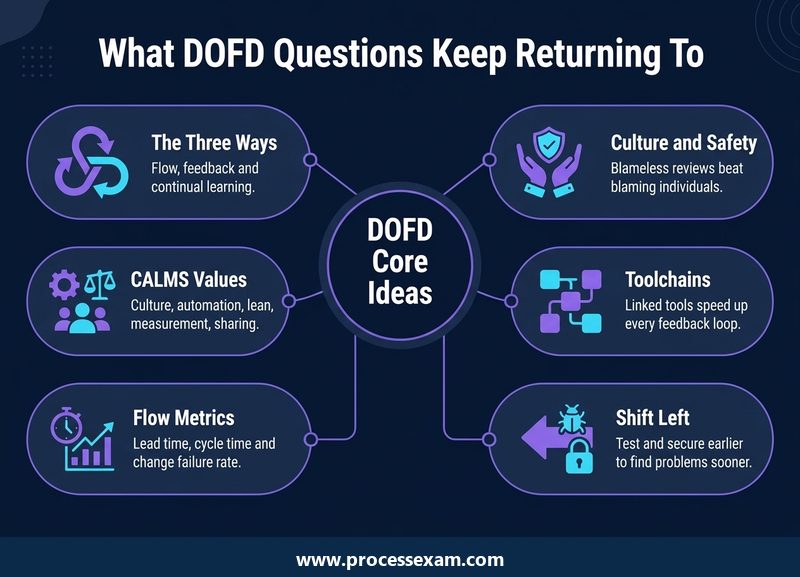
The Three Ways
When a scenario describes work piling up between teams, think flow. When it describes problems found late in production, think feedback. When it describes a team that fixes incidents but never changes the process, think continual learning. A large share of scenario questions are one of these three in disguise.
CALMS
CALMS stands for Culture, Automation, Lean, Measurement and Sharing. Its value is as a checklist: if a team has automated everything but still blames individuals for failures, it is strong on A and weak on C. Practise naming which letter a scenario is missing.
Flow metrics and pipelines
You should be able to describe a deployment pipeline in plain words (code is built, tested and promoted through environments by automation) and to say what lead time, cycle time and change failure rate each tell you. Lead time measures how long a change takes from idea or commit to running in production; cycle time measures how long the active work takes. Confusing the two is a frequent slip.
Culture and safety
Blameless post-incident reviews, shared goals between development and operations and a safe place to raise problems recur throughout the paper. If an option rewards finding the person responsible, it is almost never the best answer.
Toolchains
A toolchain links planning, source control, build, test, release, deployment, monitoring and feedback tools. Questions ask what integrating them achieves, usually traceability and faster feedback, rather than which product to buy.
Shift left
Moving testing, security and operational concerns earlier in the delivery process comes up under continuous testing, DevSecOps and infrastructure as code. It is a useful lens for choosing between two plausible answers: the one that finds the problem sooner is usually preferred.
How do you handle an open-book paper of 40 questions in 60 minutes?
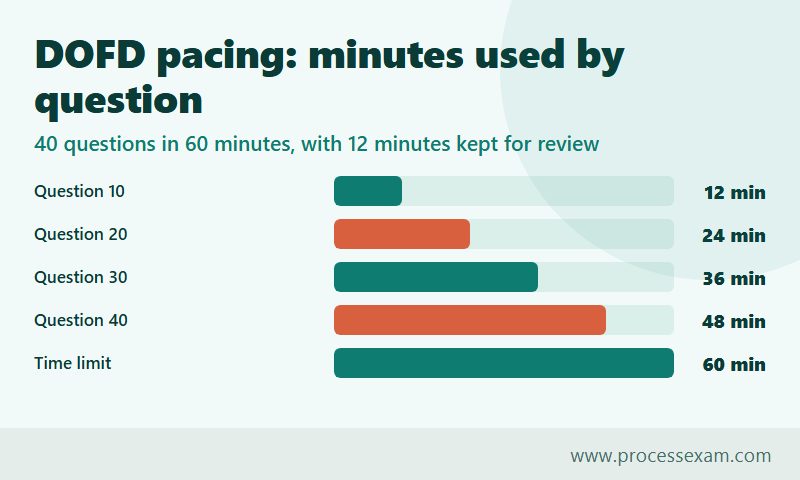
Open book sounds like a gift and often turns into a trap. Sixty minutes for forty questions is 90 seconds each, which is barely enough to read a scenario and four options, let alone search a manual. Anyone who intends to look every answer up tends to be short of time by about question thirty.
A better approach is to treat your reference material as a safety net for the few terms you cannot place. Prepare a one-page summary of the Three Ways, CALMS, the metric definitions and the practice purposes before you start, and only open anything larger for a question you have flagged. The checkpoints below are a pacing plan of our own, not a vendor rule: they keep about twelve minutes in hand at the end for flagged questions.
A simple routine for each question
- Read the last sentence first so you know what is being asked.
- Remove the options that contradict a principle you know, such as blaming individuals or releasing less often to be safe.
- Pick the best remaining answer, and flag it if you are still torn.
- Move on at the checkpoint even if a flagged question remains.
Practise this under the same limit before the real day. The DOFD sample questions are a quick way to feel how a scenario is worded and how short the time really is.
How do you prepare for the DevOps Foundation exam in three weeks?
Three weeks suits most working IT people at about five hours a week. If you are completely new to the vocabulary, stretch it to four. The plan alternates reading with recall, because recognition alone is what the open book tempts you into.
Week 1: build the vocabulary
Read the vendor's blueprint and the first three areas: exploring DevOps, core principles and key practices. After each topic write a one-line definition and one example in your own words. By the end of the week you should be able to explain the Three Ways to a colleague without notes and tell continuous delivery from continuous deployment.
Week 2: frameworks, culture and tools
Cover the business and technology frameworks, culture and operating models, and toolchains. Draw a deployment pipeline from memory, then label where testing, security checks and monitoring fit. Write down three examples of cultural debt and what you would change first. Take a short practice set at the end of the week and log every question you missed.
Week 3: metrics, enterprise adoption and timed practice
Finish with measurement, sharing and the enterprise view, then spend most of the week on timed practice. Sit two full 40-question papers at a strict 60 minutes, review every answer and sort the mistakes by syllabus area. The area with most misses gets the last two study sessions. If you want a larger pool to rehearse against, the DOFD practice exam gives you timed sets in the exam's format.
The day before
Finish your one-page summary, confirm your booking time and the technical checks for an online sitting, and stop studying early. Sleep helps more than another hour of notes, because scenario wording is easy to misread when you are tired.
Why do hands-on engineers still fail a foundation paper?
The paper is short and the concepts are not deep, which tempts experienced practitioners to skip preparation. That is the usual reason they miss. Five habits account for most lost marks.
- Answering from your own company. Your team may deploy twice a year with a heavy approval board. The exam wants the answer a DevOps practitioner would give, not the one your workplace happens to follow.
- Choosing a tool answer for a concept question. If a question asks why a practice exists, a product name is rarely right. Pick the option that states the purpose.
- Mixing up near-twins. Continuous delivery and continuous deployment, lead time and cycle time, monitoring and observability, and DevOps and SRE are pairs that the exam uses to separate careful candidates from rushed ones.
- Trusting the open book too much. Searching a manual for every doubtful question eats your clock. Search only for a term you cannot place, and do it once.
- Ignoring culture questions. They look soft and are easy to dismiss, yet one area of the syllabus and part of CALMS are about them. Blame-free learning, shared ownership and cultural debt are tested as seriously as pipelines.
Reviewing every option in a practice test, not just the ones you got wrong, helps with all five. For each question, say why the three rejected options are weaker than the one you chose.
Is the DevOps Foundation certification worth it, and how long does it last?
For someone starting in DevOps, DOFD is a low-cost way to show a shared vocabulary and a sound grasp of principles. It does not prove tool skill, and no employer should treat it that way. What it does is signal that you can take part in a conversation about flow, feedback, automation and culture, which matters most for people moving into DevOps, platform, SRE or release roles from development, testing or operations.
It also works as the gateway to the rest of the vendor's range. The vendor lists specialist exams on DevSecOps, SRE, observability, continuous testing, AIOps and value stream management, and the vocabulary from DOFD carries across all of them. If you already know which direction you want, taking Foundation first usually saves time on the next exam.
On the vendor's current PeopleCert DevOps Foundation page, the certification is valid for three years and renewal is by continuing professional development: 60 CPD points, or by passing a different exam from the same product suite before the renewal date. The older DevOps Institute exam page also states a three-year validity, and it still carries a 2023 notice about moving exam platforms, so book through the PeopleCert route and not from an old bookmark.
To summarise the plan: know the 40 questions, 60 minutes and 65% target, study the eight areas the vendor lists, learn the six recurring ideas, practise under the clock and keep a one-page summary for the open book. That combination is what turns a short exam into a pass on the first attempt.
Frequently Asked Questions
How many questions and how much time does the DevOps Foundation exam have?
The DOFD exam has 40 multiple-choice questions and a 60-minute time limit, which is about 90 seconds per question. It is open book, but the clock leaves little time to search, so practise under the same limit and keep a one-page summary for the few terms you cannot place.
What is the passing score for the DOFD exam?
The passing score is 65%. On a 40-question paper that means 26 correct answers. Aim for consistently higher on timed practice papers before you book, because the open-book format tempts candidates to rely on lookup and run out of time.
How much does the DevOps Foundation certification exam cost?
The exam fee we hold for DOFD is USD $257. DevOps Institute is part of the PeopleCert group and the exam is booked through PeopleCert, so confirm the current price, any training bundle and the exam voucher terms on the vendor's page before you pay.
Is the DOFD exam open book, and does it need a training course?
Yes, the exam is open book. The vendor lists instructor-led training, online learning and self-study as ways to prepare, so a course is not the only route. DevOps Institute's course material recommends familiarity with IT terminology and some IT work experience.
How long is the DevOps Foundation certification valid?
The vendor states that the certification is valid for three years. PeopleCert's current page describes renewal through 60 continuing professional development points or by passing a different exam from the same product suite before the renewal date.
- DevOps Institute DevOps Foundation Test Questions |
- DOFD Question Bank |
- DevOps Institute DevOps Foundation Book |
- DevOps Foundation Certification Cost |
- DevOps Foundation Certification Requirements |
- DevOps Institute DevOps Foundation Sample Questions |
- DOFD Exam Questions Download |
- DOFD Test Questions |
- DevOps Foundation PDF |
- DevOps


