
PfMP Certification: Panel Review, Exam Domains and Ten-Week Study Plan
Updated on 3 October 2026. What’s new: corrected the five exam domains to Strategic Alignment, Governance, Portfolio Performance, Portfolio Risk Management and Communications Management
You cannot simply book the PfMP and sit it next week. PMI first asks a panel of reviewers to read how you have managed portfolios, and only then do you face the exam: 170 multiple-choice questions in 240 minutes. Most candidates lose their first month to the application, not the study. This guide covers both halves, the five weighted domains and a ten-week plan.
The Portfolio Management Professional (PfMP) is PMI's credential for people who decide which programs and projects an organisation should fund, delay or stop. It is not a bigger version of the PMP. A project manager asks whether the work is being done well; a portfolio manager asks whether it is the right work at all. Every domain in the exam is built around that second question.
Why does the PfMP start with a panel review instead of the exam?
PMI treats the PfMP as a credential for people who already hold portfolio responsibility, so the application is a screening stage in its own right. After your experience is checked against the eligibility rules, a panel of PMI-appointed reviewers reads the way you have described your portfolio work. Only candidates the panel accepts go on to the exam. Training providers put the review at roughly two to three months, so plan the calendar before you plan the study sessions.
What does the panel actually want to see? Not a list of job titles. It wants evidence that you have made portfolio-level decisions: how components were prioritised against strategy, who approved the mix, what happened when priorities changed, and how you reported results to the people who govern the portfolio. A candidate who writes only about running a large programme usually has to rework the submission, because programme delivery is not the same job as portfolio selection and balancing.
Write the experience in portfolio language
Draft each experience entry using the vocabulary of the exam: strategic goals, prioritisation criteria, scenarios, capacity, governance board, benefits, risk appetite. Writing in those words does two things at once. It makes the panel's job easier, and it forces you to revise the concepts you will be tested on later, so the application doubles as the first week of study.
Keep the application and the study separate in your head
Panel feedback arrives on PMI's schedule, not yours. Candidates who put their whole study plan on hold until the panel replies lose weeks; candidates who study the domains during the wait arrive at the exam booking already prepared. The ten-week plan later in this guide is written to run while the review is under way.
Which experience route fits you, and what does it ask for?
Every route requires at least 96 months (eight years) of professional business experience within the past 15 years. On top of that, PMI asks for portfolio management experience, and the amount depends on your education.
| Your education | Business experience | Portfolio management experience |
|---|---|---|
| Secondary diploma or equivalent | 96 months in the past 15 years | 84 months |
| Four-year degree or equivalent | 96 months in the past 15 years | 48 months |
PMI's PfMP page (checked October 2026) also lists a third, shorter route for graduates of a degree programme accredited by PMI's Global Accreditation Center (GAC): the same 96 months of business experience plus 36 months of portfolio management experience. PMI changes its eligibility sets from time to time, so confirm them on the PfMP page before you count months.
Two things trip people up. First, portfolio management experience means experience managing, or directly supporting decisions on, a portfolio: not time spent as a project manager inside someone else's portfolio. Second, the months have to be real and documented, so start collecting dates, employers and portfolio sizes now, while colleagues who can confirm them are still reachable.
Neither the PMP nor the PgMP is a prerequisite. A director with a strong portfolio record and no other PMI credential can apply directly, which is one reason the PfMP attracts people from finance, strategy, PMO and operations rather than only from project management.
What does the PfMP exam look like on the day?
The exam is delivered through Pearson VUE, and you can find the scheduling arrangements on Pearson VUE's PMI page. You answer 170 multiple-choice questions in 240 minutes, which works out at about 85 seconds per question. That is slower than most professional exams, because the questions are long. A typical item gives a paragraph about an organisation, a portfolio and a competing set of pressures, then offers four answers that all sound like reasonable management.
| Exam detail | PfMP |
|---|---|
| Full name | PMI Portfolio Management Professional |
| Exam code | PfMP |
| Number of questions | 170 |
| Duration | 240 minutes |
| Exam fee | PMI member price: USD $800; full price: USD $1000 |
| Result bands | Above Target / Target / Below Target / Needs Improvement |
| Delivery | Pearson VUE |
PMI does not publish a percentage pass mark for the PfMP, and your result is reported in the bands shown above rather than as a score out of 100. For that reason, ignore any forum claim that you need a particular percentage. What you can measure is whether you reach consistent, explained correct answers on fresh scenario questions across every domain, including the smallest ones.
Four hours is a stamina test
Most candidates have not concentrated for four straight hours since university. Practise one full-length sitting before exam week so you know when your attention drops. People usually slip in the third hour, when the scenarios start to blur together, and that is exactly when a calm routine of reading the final sentence first, then the scenario, then the options, pays off.
How do the five domains share the paper, and what does each one ask?
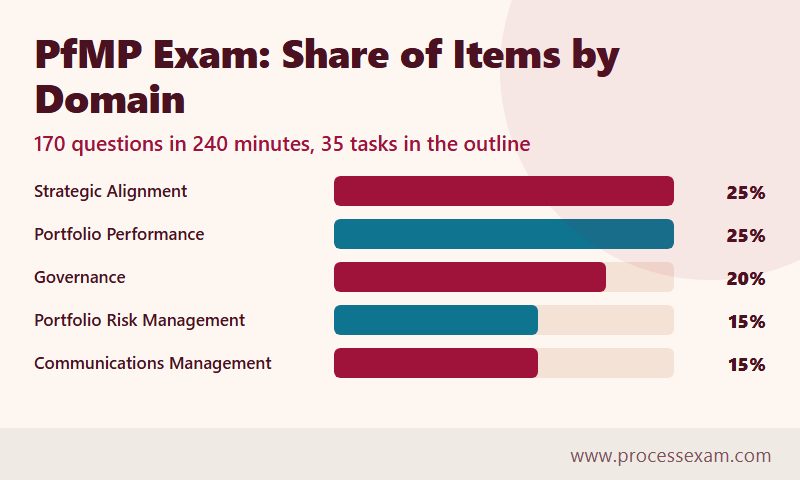
PMI's PfMP examination content outline splits the exam into five domains. The copy PMI hosts, which we checked in October 2026, still lists these five, and PMI notes on the document that its website always holds the current version. Task counts below come from that outline. The study areas it names line up with the topics on our PfMP syllabus page.
| Domain | Share of exam items | Tasks in the outline |
|---|---|---|
| Strategic Alignment | 25% | 8 |
| Governance | 20% | 5 |
| Portfolio Performance | 25% | 10 |
| Portfolio Risk Management | 15% | 6 |
| Communications Management | 15% | 6 |
Strategic Alignment, 25%
This domain is about connecting the portfolio to the organisation's goals. You evaluate strategic objectives, set prioritisation criteria (return on investment, legislative demands, dependencies, stakeholder expectations, strategic fit), rank priorities with stakeholders, and build what-if scenarios using options, risk, SWOT and financial analysis. You then recommend a scenario to governance and draw a high-level roadmap that sequences the components. Expect questions where strategy changes mid-year and you must judge how much of the portfolio that change touches.
Governance, 20%
Governance covers the structure that lets decisions be made: steering committees and boards, decision rights, escalation procedures, portfolio standards, processes and the portfolio management plan. It also covers the act of obtaining approval for portfolio decisions from the people authorised to give it. The trap here is answering as a doer. If a question asks who should decide, the correct answer is nearly always the body the governance model names, not the portfolio manager acting alone.
Portfolio Performance, 25%
Ten tasks make this the largest domain by task count. It begins with initiating the portfolio from the roadmap, then moves through collecting and consolidating metrics, monitoring health, managing issues and changes, balancing and prioritising components, and optimising how capacity (people, tools, money, facilities) is allocated using supply and demand analysis. It ends with measuring aggregated results against strategic goals and keeping records that satisfy policy and regulation. Balancing is the idea to master: the best portfolio is not the one in which every component is on track, but the one in which the mix still serves the strategy.
Portfolio Risk Management, 15%
Here the unit of analysis is the whole portfolio. You decide an acceptable level of risk from organisational and stakeholder tolerance, write a portfolio risk plan, analyse dependencies between and within components, keep a portfolio-level risk register, build shared understanding of risk among stakeholders, and recommend a management reserve based on aggregate exposure. Candidates from project backgrounds often over-answer at component level; ask yourself whether the risk, or the response, belongs to one project or to the portfolio.
Communications Management, 15%
The smallest slice still covers six tasks: analysing stakeholders, building the aggregate communication plan, engaging stakeholders, maintaining the plan, helping people understand portfolio processes, and verifying that what you communicate is accurate, consistent and complete. These items are usually the most readable, and the wrong options tend to fail on audience: too much detail for executives, or too little for the board that must decide.
Behind the domains sits a list of 75 knowledge and skill statements, from scenario planning and capacity analysis to negotiation and the PMI Code of Ethics and Professional Conduct. Read the whole list once; the items you cannot explain in a sentence are your reading list.
What portfolio-level judgement do the scenario questions test?
Definitions rarely score marks on this exam. The questions describe a situation and ask what a portfolio manager does next, so the skill is recognising the level at which a problem sits. Read these five patterns until they feel natural.
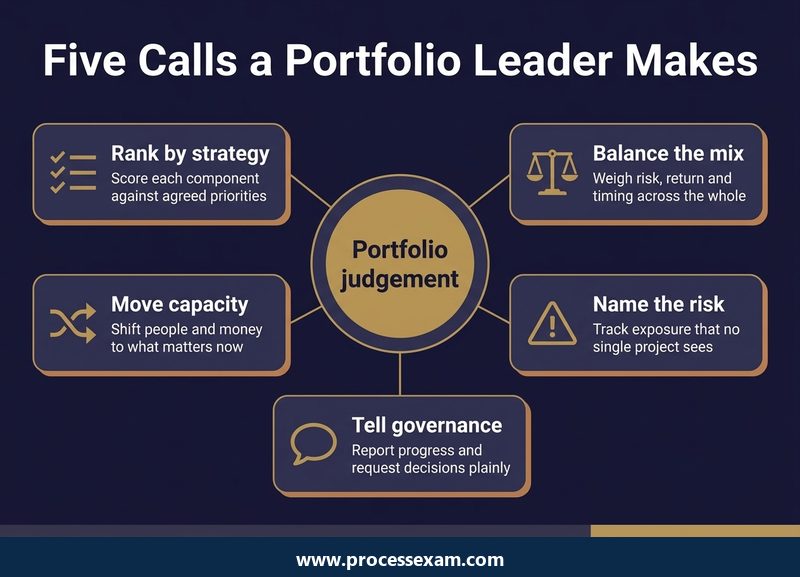
Prioritise against strategy, not against enthusiasm
Imagine a sponsor lobbying for a pet project that scores poorly against the agreed criteria. The correct response uses the prioritisation model and takes the result to governance; it does not quietly squeeze the project in because the sponsor is senior. Questions of this kind test whether you will defend the process.
Balance the mix, not the individual component
A component can be green on schedule and budget and still deserve to be stopped, because the strategy has moved. The reverse also appears: a late component may be exactly the one to protect. Ask what the whole portfolio needs, then decide.
Treat capacity as the scarce resource
Many scenarios turn on people or money that cannot be in two places. The right answer analyses supply against demand and reallocates across components, rather than adding hours to the team that is already overloaded.
Escalate what the portfolio cannot decide
Authority levels and escalation paths appear in governance and performance questions alike. If a change breaches a threshold in the portfolio management plan, the answer is to take a recommendation to the decision makers named in the plan.
Report in the audience's terms
Executives want progress against strategic goals and the decisions you need from them. A dashboard of task-level detail may be accurate and still the wrong answer to a question about stakeholder communication.
If you want background on the discipline itself, the overview of project portfolio management on Wikipedia gives a neutral outline of how selection, balancing and reporting fit together.
How would you spend ten weeks preparing while a full-time portfolio job continues?
Ten weeks suits a working portfolio professional who can give six to eight hours a week. If you are new to formal portfolio language, add two weeks. The plan assumes your application is already in, but nothing in it depends on the panel's reply.
| Weeks | Focus | What to finish |
|---|---|---|
| 1 | Orientation | Read the whole content outline, then list every one of the 75 knowledge and skill statements you cannot explain aloud |
| 2-3 | Strategic Alignment | Prioritisation criteria, scenario analysis, roadmap; write one what-if scenario from your own organisation |
| 4 | Governance | Decision rights, escalation, the portfolio management plan; sketch your employer's governance model |
| 5-6 | Portfolio Performance | Metrics, balancing, capacity and change; rebalance a real portfolio on paper |
| 7 | Portfolio Risk Management | Risk appetite, dependency analysis, management reserve |
| 8 | Communications Management | Stakeholder analysis, aggregate communication plan, verification |
| 9 | Timed practice | One full 170-question sitting in 240 minutes, then review every wrong or guessed item |
| 10 | Gap repair | Second timed sitting on fresh items, then rest the final two days |
Which sources to read in what order
Start with the content outline, because it tells you what counts. Then read PMI's The Standard for Portfolio Management, Fourth Edition, which is the reading-list title paired with the exam, and keep the PMBOK Guide beside it for terms shared with project and programme work. The Standard is short on worked examples, so turn each principle into an example from your own organisation. Training that includes case studies helps, but it does not replace reading the outline task by task.
Where practice questions earn their keep
Practice questions are most valuable in weeks nine and ten, once you have the domains in your head. A PfMP practice exam lets you rehearse the 170-question, 240-minute sitting before the real one, and its explanations show which of the two sensible-sounding options the exam prefers. Review every miss by asking whether your error was knowledge, reading or level: was this a portfolio problem you answered as a project manager?
What to do in the last week
Stop adding material. Re-read your list of weak statements, finish one last timed sitting early in the week, and then protect your sleep. On the day, bring a plan for breaks: with 240 minutes on the clock, a short pause at the one-third mark costs less than the lost concentration of pushing through.
What does the PfMP cost in total, and what keeps it valid?
The exam fee is USD $800 for PMI members and USD $1000 at full price, and PMI asks for it only after the panel has accepted your application and you are ready to schedule. PMI shows the price in your local currency, so the figure on your screen may differ. Treat the exam fee as the floor, then add the items below.
- Training or books. Optional, but most candidates buy at least a preparation course or a set of the standards.
- Membership. The member price is lower, so compare the membership fee with the saving.
- Practice material. A timed question set for weeks nine and ten is usually the cheapest insurance against a repeat attempt.
- Your time. The review, the study and a four-hour sitting all come out of working weeks.
Once certified, you keep the PfMP active by earning 60 professional development units in every three-year cycle, focused on portfolio management topics. A candidate who plans to move jobs should note which activities at work already count, because most portfolio responsibilities are recognised by PMI as professional activity.
What does the PfMP change for a portfolio leader's career?
The PfMP is one of the few credentials that speak to the group that decides which work is funded. Its audience is senior: portfolio managers, heads of a PMO, strategy and transformation directors and executives who oversee a collection of programs and projects. For them it works as an independent statement that their prioritisation and balancing practice follows a recognised standard.
It also changes the conversations you can have. PMI's 2015 research report, Delivering on Strategy, linked well-developed portfolio management practices with a 35 percent higher success rate in completing programs, and the credential gives you the language to argue for those practices inside your organisation. Treat that figure as PMI's finding for the organisations it studied, not a promise about any single employer.
Within PMI's range, the PfMP sits next to the PgMP rather than above it: the PgMP is about delivering benefits through programs, the PfMP about choosing and balancing what the organisation invests in. Many senior people hold both, but neither is a prerequisite for the other. If you are still deciding between them, the question to ask is simply whether your daily decisions are about delivering a programme's benefits or about which programmes deserve to exist.
The credential will not substitute for the track record behind it. The panel review makes sure of that before you ever sit the exam, which is why a PfMP carries more weight with employers than its small candidate pool might suggest.
Frequently Asked Questions
How many questions are on the PfMP exam?
The PfMP exam has 170 multiple-choice questions to be answered in 240 minutes, which is about 85 seconds each. The questions are scenario based and fairly long, so practise at least one complete timed sitting before exam day to build the stamina four hours demands.
What are the five PfMP exam domains?
PMI's content outline lists Strategic Alignment (25%), Governance (20%), Portfolio Performance (25%), Portfolio Risk Management (15%) and Communications Management (15%). Between them they contain 35 tasks, with Portfolio Performance holding the most at ten. Check PMI's page for the current outline before you start studying.
What are the PfMP eligibility requirements?
Every route needs at least 96 months of professional business experience within the past 15 years. Candidates with a secondary diploma then need 84 months of portfolio management experience, and those with a four-year degree need 48 months. Graduates of a GAC-accredited degree programme need 36 months of portfolio management experience.
How much does the PfMP exam cost?
PMI lists USD $800 for PMI members and USD $1000 at full price. Training, books and practice material are extra, and PMI can change fees, so check its current price list before you pay. Membership is worth costing, because the member price is the lower of the two.
How do I keep the PfMP certification active?
You earn 60 professional development units in each three-year cycle, focused on portfolio management topics, and report them to PMI. Activities such as teaching, volunteering and structured learning can count, so keep a simple log from the first day instead of reconstructing it at renewal time.
- PMI Portfolio Management Exam Questions |
- PMI Portfolio Management Question Bank |
- PMI Portfolio Management Questions |
- PMI Portfolio Management Study Guide |
- PMI PfMP Quiz |
- PfMP Certification |
- PfMP Questions |
- PfMP Practice Test |
- PfMP Study Guide Material |
- PfMP Sample Exam |
- Portfolio Management Certification |
- PMI Portfolio Management Book |
- Portfolio Management Certification Cost |
- Portfolio Management Certification Requirements |
- PMI Portfolio Management Sample Questions |
- PfMP Exam Questions Download |
- PfMP Test Questions |
- Portfolio Management PDF |
- PMI Portfolio Management Professional


