
CSCP Certification: Exam Format, Syllabus and Cost
Updated on 29 September 2026. What’s new: the CSCP no longer has an eligibility requirement: ASCM removed it on 2 December 2022, so anyone can register without an application.
The CSCP (Certified Supply Chain Professional) syllabus has eight areas, and Internal Operations and Inventory is the heaviest at 19 percent. The exam is 150 multiple-choice questions in 210 minutes, costs USD 1,450 and needs a scaled score of 300 out of 350 to pass. Since December 2022 nobody has to prove eligibility first. Below: every area, the format, a study plan and the mistakes that cost marks.
What is the CSCP certification, and what does the exam test?
CSCP stands for Certified Supply Chain Professional, the ASCM credential (ASCM is the body formerly known as APICS) for people who manage or influence the whole flow from supplier to end customer. Search results often show the full form as "APICS CSCP"; the two names refer to the same certification. Unlike a specialist credential that goes deep on one function, CSCP is deliberately wide: it asks whether you can see how demand, sourcing, production, logistics, relationships, risk and sustainability fit together.
ASCM's own exam content manual describes the scope as concepts, strategies, processes, tools and technologies for managing the end-to-end forward and backward flow of materials, information and value. It also expects a working grasp of three business ideas that run underneath everything: business acumen (including maths and statistics), ethics and leadership. So the questions are not trivia. Most give a short business situation, or a small calculation, and ask for the best of four answers.
The manual says more than 30,000 professionals in over 100 countries had earned the designation when the current edition was written, and the credential is commonly held by planners, buyers, logistics and operations managers, analysts and consultants. If your job touches only one link of the chain, the narrower ASCM credentials may fit better; if you need to talk to every function in the same language, CSCP is the one built for that.
What does the CSCP exam look like: format, fee and scoring?
The exam is one paper, taken on a computer. Of the 150 questions, 130 are scored and 20 are pretest items that ASCM is trialling for future forms. You cannot tell which are which, so treat every question as live. Each question has four choices and only one is correct, and there is no penalty for a wrong answer, so leaving a blank is always worse than guessing. Here are the figures we hold for the current version:
| Exam detail | CSCP |
|---|---|
| Exam code | CSCP |
| Full name | ASCM APICS Certified Supply Chain Professional |
| Vendor | ASCM |
| Version | Version 5.0 |
| Number of questions | 150 |
| Duration | 210 minutes |
| Exam fee | USD 1,450 |
| Passing score | 300 / 350 |
The score is scaled between 200 and 350. Anything from 200 to 299 is a fail and 300 to 350 is a pass. Scaling exists because different exam forms vary slightly in difficulty; it means the pass mark is not a fixed count of correct answers, so do not try to work out a magic number of questions to get right. You receive a final score plus a breakdown by topic area, which is useful if you have to retake.
ASCM delivers the exam through Pearson VUE, either at a test centre or online with remote supervision. On fees, the official ASCM CSCP page lists the exam from USD 1,450. A higher price applies to non-members and to members without the certification upgrade, because a one-year membership is added, and ASCM also sells a bundle with the learning system and a second-chance exam. Prices and bundle terms change, so read the current page before you pay.
Which version of the CSCP exam is current?
We checked ASCM's pages in September 2026. The exam follows the CSCP Exam Content Manual version 5.0, and ASCM's module outline says the 2026 CSCP Learning System is built on that same version. The manual's job task analysis dates from 2020 and 2021, so when a guide mentions an older eligibility route or an older module list, treat it as out of date. Our syllabus page also shows version 5.0, so the two agree.
What is inside the CSCP syllabus, and how much does each area weigh?
The manual divides the exam into eight areas, each with a percentage of the exam. The three heaviest areas, Internal Operations and Inventory, Source Products and Services, and Customer and Supplier Relationships, add up to 53 percent between them. That is the single most useful fact for planning your time: more than half the marks sit in three areas, and the two smallest, Logistics and Evaluate and Optimize, together carry 17 percent. Our CSCP syllabus page lists the topics in the same order.
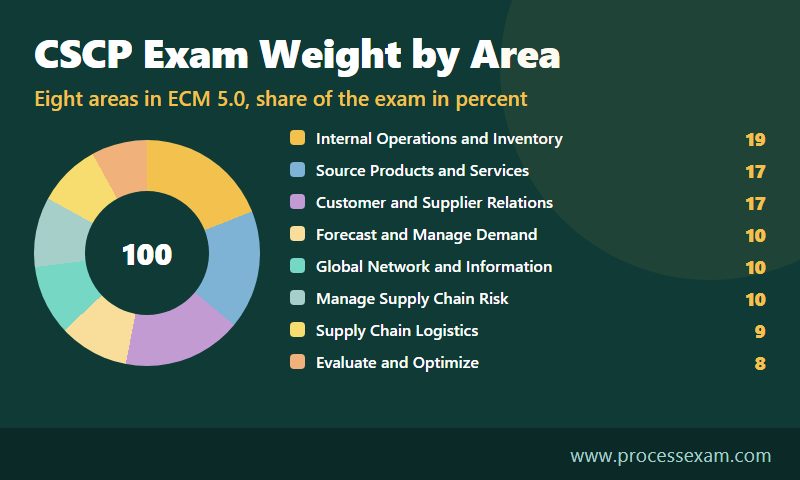
One point trips up candidates who buy the learning system: ASCM groups the same material into eight modules with slightly different names (for example "Supply Chains, Demand Management, and Forecasting" and "Optimization, Sustainability, and Technology"). The percentages belong to the eight exam areas in the manual, which is what the questions are written from. The manual itself states that no CSCP exam question is taken from the learning system, so the manual, not the courseware chapter list, is your checklist.
Forecast and Manage Demand (10 percent)
This area starts with collecting demand data, both historical and from outside the company: competitive environment, demand patterns, environmental scans and product assessments. It then covers how marketing shapes demand through the four Ps and product life cycles, how to build a forecast with qualitative, quantitative, extrinsic and intrinsic methods, and how to measure forecast error and bias. The last piece is sales and operations planning: running the process, managing its inputs and outputs and reconciling the plan.
Manage the Global Supply Chain Network and Information (10 percent)
Here you design the network so it supports the business strategy: business requirements, IT strategy, cyber security, and the flow of product, information and funds. You also cover end-to-end connectivity and visibility, information sharing, and legal requirements. Two further topics are easy to underrate: master data (creating, updating, cleansing and retiring customer, supplier, item, engineering and logistics data) and reporting, where you define financial and operational metrics, dashboards, balanced scorecards and SCOR metrics.
Source Products and Services (17 percent)
Sourcing begins with a make-or-buy analysis built on manufacturing capability, core competencies and total cost of ownership, then defines what is needed and when. Next comes category management: a segmented sourcing strategy, supply base analysis, savings opportunities, right-sizing the supply base and influencing product design. Supplier evaluation and selection, contract negotiation of terms, pricing and delivery, and purchase order handling through to invoice reconciliation and automation finish the area.
Manage Internal Operations and Inventory (19 percent)
The largest area covers planning operations (master schedule, material requirements, capacity), managing inventory (replenishment, disposition and obsolescence, traceability, physical counts and cycle counting, maintenance, repair and operating supplies) and measuring performance against plan, financially and operationally. It closes with continuous improvement philosophies such as lean, six sigma, total quality management and the theory of constraints. Candidates who have never worked in planning should give this area the most hours.
Manage Supply Chain Logistics (9 percent)
The logistics area covers the warehousing, transportation and logistics-information strategies that make up a distribution network, then the daily services: receiving, put-away, picking, packing, shipping, choosing modes and carriers, and value-added services such as postponement or final assembly. It includes trade considerations (import and export rules, Incoterms, free trade zones and documentation) and the reverse flow, where you weigh costs and benefits, warranties and disposition using the reduce, reuse, recycle and recover hierarchy.
Manage Customer and Supplier Relationships (17 percent)
This area is about the people and companies on either side of you. On the customer side you interpret the voice of the customer, design service offerings, agree measures and resolve issues. On the supplier side you cultivate partnerships, agree KPIs such as quality, delivery, sustainability and cost, audit and evaluate performance, run development and remediation plans and manage quality cases or claims.
Manage Supply Chain Risk (10 percent)
Risk is treated as a four-step cycle: identify (supply disruption, supplier compliance, financial, intellectual and cyber risks are named examples), assess impact, timing and probability, decide a response, then execute and evaluate it. The response choices are contingency planning to limit impact, eliminating avoidable risks and accepting the unavoidable ones. Expect scenario questions that ask which response fits a described risk.
Evaluate and Optimize the Supply Chain (8 percent)
The smallest area is the most forward-looking. You evaluate and redesign strategy, network and processes, embed sustainability through the triple bottom line, the United Nations Global Compact, Global Reporting Initiative standards and accreditations, and consider emerging trends such as intelligent supply chains, the Internet of Things, quantum computing, control towers and blockchain. You do not need to be a technologist, only to judge the impact of a trend on current practice.
The exam content manual is a free download and the authoritative outline. Read it with the CSCP Exam Content Manual on ASCM's site open beside this article, because it also lists the key terminology and the reference books the question writers use.
How does one customer order travel through the eight CSCP areas?
The quickest way to feel how the eight areas connect is to follow one order. Imagine a company that makes cycling helmets and has just won a large retail order. Every step below lands in a different syllabus area, and a good scenario question usually asks you to pick the step that fixes the real problem.
- Demand. Sales expects strong orders, but the forecast has to be tested against history. This is where forecast error and bias come in (worked below).
- Network. The order ships from a plant in one region to a distribution centre in another. The design question is whether that network still fits the strategy, and whether the systems show the order's status end to end.
- Sourcing. The foam liner comes from outside. Buying is compared with making in house on total cost, not price alone (worked below).
- Operations and inventory. The master schedule, material plan and capacity check decide whether the plant can build the volume, and safety stock decides whether it can survive a late delivery.
- Logistics. Mode, carrier, Incoterms and paperwork decide how and when the goods reach the customer, and where the buyer's risk begins.
- Relationships. The retailer's service measures and the supplier's delivery record are reviewed together, and problems are resolved with agreed KPIs.
- Risk. A single-source foam supplier is a supply disruption risk. The response might be a second source, extra buffer stock or, if the cost is high, acceptance.
- Optimise. After delivery, the team asks whether the design of the network or process should change, and whether any emission or packaging goals are affected.
Worked example 1: is the forecast biased?
Four months of actual demand and forecast for the helmet:
| Month | Actual | Forecast | Error (actual minus forecast) |
|---|---|---|---|
| January | 100 | 110 | -10 |
| February | 110 | 115 | -5 |
| March | 95 | 105 | -10 |
| April | 105 | 120 | -15 |
The errors add up to -40, so the running sum of forecast errors is -40. The mean absolute deviation is (10 + 5 + 10 + 15) divided by 4, which is 10. Dividing the running sum by the mean absolute deviation gives a tracking signal of -4. Every error has the same sign, so the forecast is not merely inaccurate, it is biased high. A good answer is to correct the bias at its source, not to add more safety stock to absorb it. Each company sets its own limit for when a tracking signal triggers a review.
Worked example 2: which supplier is cheaper?
Supplier A quotes the lower price. Total cost of ownership adds the costs that follow the purchase:
| Cost per unit | Supplier A | Supplier B |
|---|---|---|
| Purchase price | 10.50 | 11.60 |
| Freight | 1.20 | 0.40 |
| Rework and returns allowance | 0.80 | 0.20 |
| Inventory carrying cost | 0.70 | 0.30 |
| Total cost of ownership | 13.20 | 12.50 |
Supplier B is dearer on price but cheaper by 0.70 a unit once freight, quality and holding are counted. Exam questions on make-or-buy and supplier selection reward this habit: ask which costs the quoted number leaves out. The figures here are invented for the illustration and are not exam questions.
Who can take the CSCP exam, and is there an eligibility requirement?
Anyone can. ASCM removed the eligibility requirement for CSCP with effect from 2 December 2022, so you no longer submit an application or wait for approval before you buy and schedule the exam. Older articles, including earlier versions of this one, describe routes based on a degree plus experience, another certification plus experience, or years of work; those routes no longer apply.
That does not mean the exam suits everyone equally. Candidates with at least a couple of years in planning, purchasing, logistics or operations find the scenarios familiar. If you are moving in from another field, plan for more study time in the Internal Operations and Inventory area, where the vocabulary (master schedule, safety stock, cycle counting) is specific and heavily tested. Work experience helps, but it is a study advantage, not a rule.
How should you study for the CSCP exam?
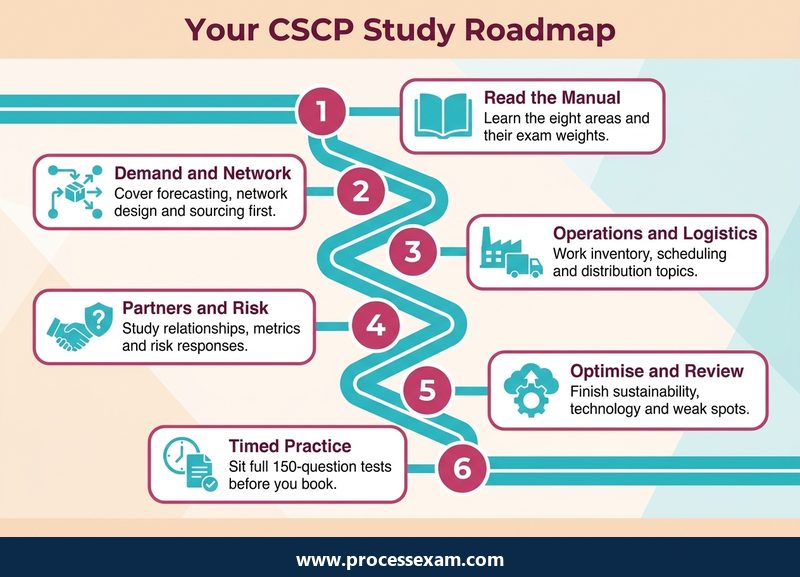
ASCM's exam-details page recommends on average 100 hours of study for each certification exam, and suggests scheduling the exam soon after you finish so that the material is still fresh. A steady 12 hours a week for eight weeks comes to 96 hours, which fits neatly. If you have less time, keep the order but stretch the weeks rather than dropping areas.
| Week | Focus | What to finish |
|---|---|---|
| 1 | Manual and baseline | Read the content outline, note the weights and take a short diagnostic to find your gaps |
| 2 | Demand and forecasting | Demand patterns, forecast methods, error, bias, and the S&OP cycle |
| 3 | Network and sourcing | Network design, master data, metrics, make-or-buy, total cost of ownership, contracts |
| 4 | Operations and inventory | Master scheduling, material and capacity planning, inventory policy, continuous improvement |
| 5 | Logistics and trade | Warehousing, transport modes, Incoterms, documentation, reverse flow |
| 6 | Relationships and risk | Customer and supplier KPIs, remediation, risk assessment and response |
| 7 | Optimisation and revision | Sustainability standards, emerging technology, then your weakest area again |
| 8 | Timed practice | Two full 150-question tests in 210 minutes, error log review, rest before exam day |
Which materials should you use?
Start with the free manual, then choose one main course of study: ASCM's self-study learning system, an instructor-led class, or an instructor-supported online course. Use the APICS Supply Chain Dictionary for terminology, because the exam uses the dictionary's definitions and a synonym in your textbook can cost you a question. ASCM also offers a free 30-day trial of one learning-system module, which is a low-risk way to test the style before you buy.
Practice questions are how you turn knowledge into exam skill. Try our free CSCP sample questions early, so you see the format before week one is over, and save the full timed tests for the last week. After each set, write down why the right answer is right and why your choice was not. That error log, not the score, is what improves the next attempt.
How should you handle 150 questions in 210 minutes?
The time works out to about 84 seconds per question. Read the last sentence first so you know what is asked, then the scenario. Answer what you can, flag what you cannot, and never leave an answer blank, because unanswered and wrong score the same. The manual advises against changing an answer unless you are certain your first choice was wrong. If a calculation looks long, check whether you can eliminate two choices and estimate.
What do CSCP candidates most often get wrong?
- Studying by chapter, not by weight. Spending equal time on all areas leaves the 19 percent area thin and the 8 percent area over-studied.
- Treating the learning system as the exam. The exam is written from the manual and its listed references, and courseware can cover extras or skip items. Tick topics off against the manual.
- Memorising definitions without applying them. Questions ask for the best action in a situation. Practise choosing between two plausible answers.
- Ignoring the calculations. Forecast error, tracking signals, total cost and inventory formulas show up as small computations. Practise them by hand until they are routine.
- Mixing terminology. The manual notes that several terms mean the same thing, for example aggregate planning and production planning. Learn the preferred term from the dictionary.
- Over-thinking. The manual tells candidates not to hunt for hidden tricks and to pick the best answer of the four given.
- Booking too late or too early. Book once your timed practice scores are steady, then sit the exam soon afterwards.
- Relying on old guides. A guide that lists eligibility routes or an old module list was written before the current manual.
Which roles does the CSCP support, and how do you keep it?
For anyone whose role crosses functions, CSCP gives a shared vocabulary and a credential that hiring managers recognise. The roles it supports include supply chain analyst, planner, buyer or category manager, logistics or operations manager and supply chain consultant. We do not quote salary figures here, because pay differs by country and industry and a reliable number needs a named salary survey. Compare postings for your target role and see whether CSCP is listed.
The cost is real: an exam fee of USD 1,450 plus study materials and roughly a hundred hours of your own time. The return depends on how you use it. Candidates who are already in a supply chain job can often apply what they learn at once, for example by challenging a forecast, quoting total cost, or writing a risk register, which makes the effort easier to justify to an employer who may reimburse the fee.
How long does the certification last?
ASCM requires certification maintenance every five years, and the first five-year cycle begins on the date you earn the credential. CSCP holders need 75 maintenance points in each cycle (100 for CSCP Fellows). If you do not submit them by the due date, the certification lapses into suspension. Points come from many activities, so plan them from the start instead of the last few months. Fellow status is a separate route for holders who share knowledge through teaching, presenting, publishing or volunteering.
If you want more information before committing, ASCM's exam details and process page covers scoring, scheduling and accommodation requests. When you are ready to test yourself, work through the free sample questions first, then a full timed practice exam.
Frequently Asked Questions
What does CSCP stand for?
CSCP stands for Certified Supply Chain Professional, an ASCM credential also written as APICS CSCP. It shows that a candidate understands the end-to-end supply chain, from suppliers to customers, including demand, sourcing, operations, logistics, relationships, risk and sustainability, rather than expertise in a single function.
How many questions and how much time does the CSCP exam have?
The CSCP exam has 150 multiple-choice questions and a 210-minute limit, which is 3.5 hours. Of the 150, 130 are scored and 20 are unscored pretest questions. Each question has four choices with one correct answer, and wrong answers are not penalised.
What is the passing score for the CSCP exam?
Scores are scaled from 200 to 350, and 300 is the minimum passing score. A result of 299 or lower is a fail. Because the scale adjusts for differences between exam forms, the pass mark is not a fixed number of correct answers.
How much does the CSCP exam cost?
Our figure for the CSCP exam fee is USD 1,450. ASCM adds a one-year membership to the price for non-members and members without the certification upgrade, and sells a bundle with the learning system and a second-chance exam, so check ASCM's current page before you pay.
Do you need experience or a degree to take the CSCP exam?
No. ASCM removed the CSCP eligibility requirement on 2 December 2022, so candidates no longer submit an application or wait for approval before registering. Experience is not required, although it makes the scenario questions easier, especially in the operations and inventory area.
- Supply Chain Management |
- CSCP Question Bank |
- CSCP Body of Knowledge (BOK) |
- APICS CSCP Simulator |
- APICS CSCP Mock Exam |
- APICS CSCP Certification |
- APICS CSCP Certification Cost |
- APICS CSCP Certification Requirements |
- CSCP Exam Questions Download |
- APICS CSCP |
- APICS CSCP PDF |
- ASCM CSCP BOK PDF |
- ASCM APICS CSCP Question Bank |
- ASCM APICS CSCP Book |
- ASCM APICS CSCP Study Guide |
- ASCM APICS CSCP Exam Questions |
- ASCM APICS CSCP Sample Questions |
- ASCM APICS Certified Supply Chain Professional Test Questions |
- ASCM APICS Certified Supply Chain Professional Book |
- ASCM APICS Certified Supply Chain Professional Sample Questions |
- APICS Certified Supply Chain Professional Certification Cost |
- APICS Certified Supply Chain Professional Certification Requirements |
- APICS Certified Supply Chain Professional PDF


