IASSC Lean Six Sigma Green Belt Book

Explore 8 resources related to IASSC Lean Six Sigma Green Belt Book on ProcessExam. These resources help certification candidates understand key aspects of exam preparation, including exam structure, study strategies, and expectations for scenario-based or applied assessments. Reviewing these materials can help improve readiness and confidence before attempting the certification exam.

Certified and Chuckling

Who knew preparing for the Lean Six Sigma Green Belt could be such a riot? Those interactive exams truly smoothed out the bumps on the road to certification, absolutely loved the practice sessions.

Why Conventional ICGB Prep Fails: A New Expert Blueprint

Image titled “ICGB Success Blueprint” with a checklist blueprint, target icon, green certification belt badge, and rising

The IASSC Certified Lean Six Sigma Green Belt (ICGB) certification validates a professional’s competence in applying Lean Six Sigma methodologies, tools, and practices to improve processes and reduce defects within an organization. Achieving this credential signifies a deep understanding of problem-solving techniques and a commitment to operational excellence. Many aspiring Green Belts approach the ICGB exam with traditional study methods, often finding themselves unprepared for the nuanced application of concepts required. This article delves into the inherent shortcomings of conventional preparation and outlines an expert blueprint designed for authentic mastery and successful certification, distinguishing itself from typical study guides by emphasizing a strategic, holistic approach.

ICGB Certification: IASSC Green Belt Exam Fee, Topics and Study Plan

Updated on 29 September 2026. What’s new: iassc lists the green belt exam at usd $350 and needs no work experience to sit it or to hold the certificate

The ICGB is the IASSC Certified Lean Six Sigma Green Belt exam: 100 closed-book questions in 180 minutes, a 70% pass mark and a USD $350 fee, with no prerequisites to sit it. About 20 questions come from each of five sections, Define, Measure, Analyze, Improve and Control, so no phase can be skipped. This guide sets out the paper, the topics inside every section, how to choose the right hypothesis test and a six-week study plan.

Smiling professional at a laptop beside the words Green Belt Certification IASSC for Lean Six Sigma

People searching for the ICGB meaning are usually asking two things at once. The letters stand for the IASSC Certified Lean Six Sigma Green Belt, and IASSC is the International Association for Six Sigma Certification, an independent body that certifies knowledge rather than training. It does not run courses. It sets a Body of Knowledge, writes the exam and issues the certificate, which is why the same exam can be reached after a classroom course, a company programme or plain self-study.

IASSC ICGB Certification Exam Syllabus

ICGB dumps PDF, IASSC ICGB Braindumps

To achieve the professional designation of IASSC Certified Lean Six Sigma Green Belt from the IASSC, candidates must clear the ICGB Exam with the minimum cut-off score. For those who wish to pass the IASSC ICGB certification exam with good percentage, please take a look at the following reference document detailing what should be included in IASSC Lean Six Sigma Green Belt Exam preparation.

The IASSC ICGB Exam Summary, Body of Knowledge (BOK), Sample Question Bank and Practice Exam provide the basis for the real IASSC Certified Lean Six Sigma Green Belt (ICGB) exam. We have designed these resources to help you get ready to take IASSC Certified Lean Six Sigma Green Belt (ICGB) exam. If you have made the decision to become a certified professional, we suggest you take authorized training and prepare with our online premium IASSC Lean Six Sigma Green Belt Practice Exam to achieve the best result.

Get Six Sigma Certified And Go to the Top-Notch of Your Career

American Society of Quality, ASQ Certified Six Sigma Black Belt, ASQ Certified Six Sigma Green Belt, ASQ Certified Six Sigma

Six Sigma is a top quality management method that seeks to attenuate or eradicate defects or errors in products and enterprise companies. Initially developed to enhance manufacturing processes, the instruments and methods utilized in Six Sigma are thought of industry-agnostic, which suggests they've been efficiently utilized in such sectors as aeronautics, electronics, prescription drugs, retail and more.

The "sigma" a part of Six Sigma refers to the knowledge evaluation portion of the method. Following Six Sigma strategies, a crew gathers, and analyzes information about product manufacture or service creation/supply to find out the usual deviation (sigma) of the mean and the closest customer specification limit. The aim is to restrict defects or errors to a maximum of 3.4 per million opportunities.

Organizations which have adopted Six Sigma processes may see improved customer support, shorter cycle times and higher compliance with laws and enterprise growth standardization. Nevertheless, the trials of Six Sigma make its operations considerably tough to implement, and it usually takes months or years earlier than all related staff is on board, following the procedures carefully and persistently sufficient to comprehend such advantages and worth.

Frequently Asked Questions On Six Sigma Methodology

Six Sigma (6σ) is a set of techniques and tools for process improvement. This data-driven and disciplined methodology can be used in any processes from manufacturing to transactional and from product to service. It was first introduced by Bill Smith while he was working in Motorola in 1986 and over the years it has gained popularity in different industries and sectors for business improvement.

Six Sigma Levels, Six Sigma Questions, Six sigma Techniques, Six Sigma Terminology

There are a lot of advantages in using Six Sigma and its positive effects have been the driving force in the effective functioning of many businesses. This is the reason why Six Sigma professionals are still in great demand in various industries.

Often times, Six Sigma terminology can be extremely difficult for people who are newly introduced to the concept to comprehend. Some of the most common terms used in the strategy are a champion, black belt, green belt, change agent, and Big Y. These terms may sound foreign to individuals who have not completed training utilizing the strategy, however, as an individual completes their training for this strategic method, the terms used in the course will become more clear.

A person who is referred to as a champion, is the individual in charge of a specific project, most likely the senior manager. Their job is to ensure that whatever the task is, that it is completed properly. This individual is in charge of leading a team of employees.

Six Sigma Belts: Which One Fits Your Role?

A Six Sigma belt is a bill before it is a promotion: sitting the Yellow, Green and Black exams in turn costs $1,050 in IASSC vouchers, or $1,502 at ASQ's non-member rates, before any training or project time. So the useful question is not which colour sounds best but which rung your job will actually use. Yellow supports a project, Green runs one part-time, Black leads them full-time, and Master Black coaches the people who do.
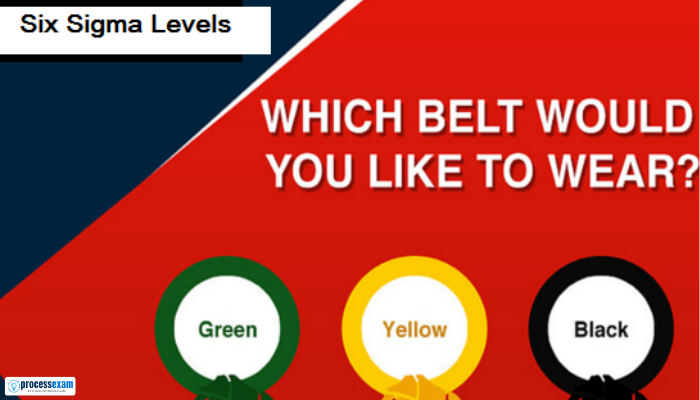
Which belt would you like to wear, with Green, Yellow and Black Six Sigma belt circles

How many Six Sigma belts are there, and what does each one do on a project?

The ladder borrows its colours from martial arts, and the working version has four rungs that vendors certify: Yellow, Green, Black and Master Black. Two more colours turn up in job adverts and training catalogues. White usually means an awareness course of a few hours with no exam behind it, and Brown is a label some training providers place between Green and Black. ASQ's and IASSC's exam lists start at Yellow and build no exam around White or Brown, so treat those two as course names, not credentials.

What separates the real rungs is not how much statistics you can recite. It is how much of a project you are trusted with, and how much of your working week it takes.

Improve Presentation Skills for Six Sigma Project Reviews

Nobody has ever approved a project phase because the numbers spoke for themselves. Numbers need a speaker who says what changed, how sure the team is and what the room must decide. This guide shows how to present a Six Sigma project at tollgate reviews, on an A3 or storyboard, with charts a non-statistician can read, and at the final report-out. It closes with what the IASSC Green Belt exam expects you to know.

Six Sigma project lead presenting a process chart to managers in a meeting room

Why do the numbers never speak for themselves in a project review?

The sentence "the data speaks for itself" feels modern and rigorous, and it is the quickest way to lose a sponsor. A chart is evidence for a claim. If you do not state the claim, each person in the room invents one, and they will not all invent the same one. The finance manager sees a cost, the process owner sees criticism of her team, and the sponsor sees a delay.

Most Six Sigma people have a strong analytical habit and a weak telling habit, because the training is full of tools and thin on talking. That is why a Green Belt can run a flawless hypothesis test and still leave a review with the phase unapproved. The test answered a question the team had. The audience had a different question.

Three facts about the audience explain most of what follows.

Syndicate content