
Why Conventional ICGB Prep Fails: A New Expert Blueprint
The IASSC Certified Lean Six Sigma Green Belt (ICGB) certification validates a professional’s competence in applying Lean Six Sigma methodologies, tools, and practices to improve processes and reduce defects within an organization. Achieving this credential signifies a deep understanding of problem-solving techniques and a commitment to operational excellence. Many aspiring Green Belts approach the ICGB exam with traditional study methods, often finding themselves unprepared for the nuanced application of concepts required. This article delves into the inherent shortcomings of conventional preparation and outlines an expert blueprint designed for authentic mastery and successful certification, distinguishing itself from typical study guides by emphasizing a strategic, holistic approach.
Recognizing the Flaws in Standard Study Approaches
Conventional preparation for the IASSC Certified Lean Six Sigma Green Belt exam frequently relies on rote memorization of definitions and formulas, often neglecting the practical application and interrelation of concepts. Candidates might immerse themselves in voluminous textbooks or generic practice questions, believing that sheer volume of study will guarantee success. However, the IASSC ICGB exam is designed to assess not just recall, but also the ability to interpret data, analyze scenarios, and make informed decisions using the Lean Six Sigma framework. This reliance on surface-level knowledge, without true conceptual integration, is a primary reason why many candidates struggle despite significant study hours. The disconnect between theoretical knowledge and real-world problem-solving becomes evident in the exam's scenario-based questions, which demand a deeper analytical capacity than simple memorization can provide.
Over-Reliance on Memorization and Generic Practice
Many candidates prepare by focusing heavily on flashcards or re-reading material, hoping to commit terms like 'Kaizen', 'DMAIC phases', or 'control charts' to memory without grasping their underlying purpose or how they fit into a larger process improvement project. This approach can create a false sense of security. While knowing definitions is fundamental, the exam moves beyond this, asking candidates to identify the correct tool for a specific problem or interpret graphical outputs. Generic practice exams, particularly those lacking detailed explanations or an accurate reflection of the IASSC ICGB exam format, further compound this issue, failing to adequately train candidates for the critical thinking required.
Ignoring the Interconnectedness of Six Sigma Principles
Lean Six Sigma is a cohesive methodology, where each tool and phase builds upon the last. Conventional prep often treats syllabus topics as isolated modules rather than interconnected components of a holistic system. For instance, understanding 'Measurement System Analysis' in isolation is less effective than recognizing its critical role in ensuring data integrity before 'Process Capability' analysis, which then informs 'Statistical Process Control'. A segmented study approach prevents candidates from developing the comprehensive process improvement mindset that the certification seeks to validate. This fragmented understanding can lead to incorrect problem identification or solution selection during the exam.
Dissecting the IASSC ICGB Certification Exam Structure
Understanding the specific architecture of the IASSC Certified Lean Six Sigma Green Belt exam is crucial for tailoring an effective preparation strategy. The exam, identified by the code ICGB, is administered by the IASSC (International Association for Six Sigma Certification) and is designed to rigorously test a candidate's practical grasp of Lean Six Sigma principles. It's not merely a test of knowledge but an evaluation of analytical and problem-solving skills within a structured framework.
The IASSC ICGB examination details are as follows:
-
Exam Name: IASSC Certified Lean Six Sigma Green Belt
-
Exam Code: ICGB
-
Exam Price: USD $350
-
Duration: 180 Minutes
-
Number of Questions: 100
-
Passing Score: 70%
This structure indicates a fast-paced exam where candidates must efficiently process information and apply their knowledge under timed conditions. The 100 questions within 180 minutes mean approximately 1.8 minutes per question, emphasizing quick, accurate decision-making rather than lengthy deliberation. A passing score of 70% requires a strong command across all tested domains, leaving little room for weakness in any major area. This detailed overview of the exam's mechanics is a fundamental starting point for any successful preparation blueprint, informing how study time should be allocated and what level of proficiency is expected.
Mastering the Core IASSC ICGB Exam Syllabus
A deep and integrated understanding of the IASSC ICGB exam syllabus is the bedrock of effective preparation. The topics covered are comprehensive, ranging from foundational Six Sigma concepts to advanced statistical analysis and control mechanisms. Unlike conventional methods that might skim over areas, an expert blueprint mandates a thorough grasp of each component, understanding its practical relevance and its relationship to other topics within the Lean Six Sigma framework.
The IASSC ICGB exam syllabus encompasses:
-
The Basics of Six Sigma
-
The Fundamentals of Six Sigma
-
Selecting Lean Six Sigma Projects
-
The Lean Enterprise
-
Process Definition
-
Six Sigma Statistics
-
Measurement System Analysis
-
Process Capability
-
Patterns of Variation
-
Inferential Statistics
-
Hypothesis Testing
-
Hypothesis Testing with Normal Data
-
Hypothesis Testing with Non-Normal Data
-
Simple Linear Regression
-
Multiple Regression Analysis
-
Lean Controls
-
Statistical Process Control (SPC)
-
Six Sigma Control Plans
This comprehensive list moves from conceptual understanding to specific analytical techniques and control strategies. For instance, 'The Basics of Six Sigma' sets the stage for 'Selecting Lean Six Sigma Projects', which then leads into specific phases like 'Process Definition'. Statistical topics such as 'Six Sigma Statistics' and 'Measurement System Analysis' are foundational for subsequent analytical methods like 'Hypothesis Testing' and 'Regression Analysis'. Finally, 'Lean Controls' and 'Statistical Process Control (SPC)' focus on sustaining improvements. This progression highlights the need for a sequential yet interconnected study approach.
Integrating Foundational Concepts for ICGB Success
The initial phases of the IASSC Certified Lean Six Sigma Green Belt syllabus establish the conceptual and organizational bedrock upon which all subsequent analytical and improvement activities are built. Simply memorizing these concepts is insufficient; true mastery involves understanding their purpose, interdependencies, and practical application in project initiation and definition. A successful candidate can articulate not just what these concepts are, but why they are essential for effective process improvement.
The Essence of Six Sigma and Project Selection
Topics such as 'The Basics of Six Sigma' and 'The Fundamentals of Six Sigma' introduce the core philosophy, history, and key metrics like DPMO and Sigma levels. These aren't just definitions; they represent a fundamental shift in how organizations approach quality and efficiency. Following this, 'Selecting Lean Six Sigma Projects' teaches how to identify and prioritize projects that align with business objectives and possess a clear scope. This involves understanding project charters, stakeholder analysis, and recognizing the financial impact of potential improvements. An expert approach integrates these concepts by envisioning how a problem identified in 'The Basics' might lead to a project proposal through effective 'Project Selection'.
Understanding Lean Enterprise and Process Definition
The 'Lean Enterprise' concept focuses on eliminating waste and maximizing value from the customer's perspective. It introduces tools like Value Stream Mapping (VSM) and concepts such as flow and pull systems. Simultaneously, 'Process Definition' delves into systematically outlining and understanding current processes. This involves creating process maps, SIPOC diagrams, and identifying process inputs and outputs. An expert studies these areas not as separate entities but as complementary elements: Lean principles help identify waste within a 'Process Definition', while accurate process mapping is essential for applying Lean tools within a 'Lean Enterprise' framework. This integrated view helps solidify a comprehensive grasp, enabling candidates to connect theoretical knowledge to practical scenarios, which is vital for the ICGB exam. More resources on mastering Lean Six Sigma principles can be found by visiting comprehensive ICGB preparation guides.
Navigating Statistical Acumen in Lean Six Sigma
The IASSC ICGB exam significantly tests a candidate's proficiency in statistical analysis, moving beyond basic arithmetic to inferential statistics and hypothesis testing. Conventional preparation often falters here, treating statistical tools as isolated formulas rather than integrated components of data-driven decision-making. An expert blueprint emphasizes not just the mechanics of calculations but also the contextual application and interpretation of statistical outputs in process improvement scenarios.
Foundational Statistical Concepts and Measurement Systems
'Six Sigma Statistics' introduces descriptive statistics, probability distributions, and the central limit theorem, which are essential for understanding data behavior. This leads directly into 'Measurement System Analysis (MSA)', a critical topic for ensuring the accuracy and reliability of data collection. MSA involves assessing measurement variation to determine if a system is capable of producing valid data for analysis. Without reliable data, any subsequent statistical analysis is flawed. An expert prepares by understanding how to perform Gauge R&R studies and interpret their results, ensuring that the data collected for process analysis is trustworthy and actionable.
Analyzing Process Capability and Patterns of Variation
Once data reliability is established, 'Process Capability' analysis allows Green Belts to assess whether a process is capable of meeting customer specifications. This involves calculating indices like Cp, Cpk, Pp, and Ppk and interpreting control charts. Concurrently, 'Patterns of Variation' explores common causes (random) and special causes (assignable) of variation, which are fundamental to understanding process stability and predictability. An expert studies these topics together, recognizing that capable processes are typically in statistical control, exhibiting only common cause variation. Identifying and addressing special causes is a prerequisite for improving process capability, underscoring the iterative nature of Six Sigma.
Leveraging Inferential Statistics and Hypothesis Testing
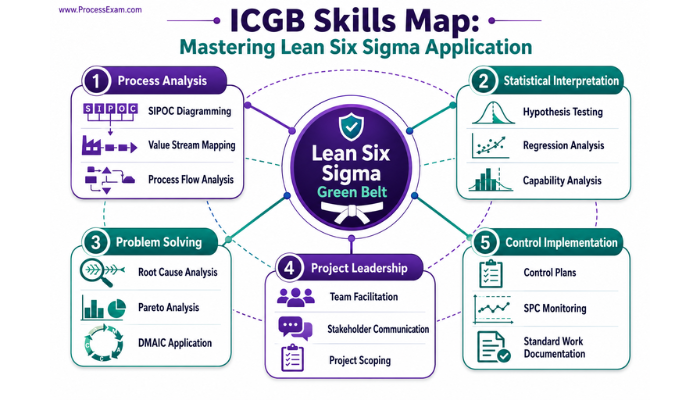
A critical aspect of the IASSC Certified Lean Six Sigma Green Belt curriculum, and a common point of difficulty for many, is the application of inferential statistics and hypothesis testing. These advanced analytical tools enable Green Belts to draw conclusions about a population based on sample data, providing a scientific basis for identifying root causes and validating solutions. Expert preparation goes beyond merely knowing the steps of a test; it focuses on choosing the correct test for a given data type and business question, and interpreting the results within a practical context.
Implementing Hypothesis Testing with Data Variability
'Inferential Statistics' sets the stage by introducing concepts like sampling, confidence intervals, and the logic behind hypothesis testing. This is immediately followed by specialized applications: 'Hypothesis Testing with Normal Data' and 'Hypothesis Testing with Non-Normal Data'. These sections cover various parametric and non-parametric tests, such as t-tests, ANOVA, Chi-square tests, and Mood's Median test, which are used depending on whether the data follows a normal distribution and the type of variables being analyzed. A deep dive into these topics is crucial. Candidates must learn to:
-
Formulate null and alternative hypotheses.
-
Select the appropriate statistical test based on data type and objective.
-
Calculate test statistics and p-values (often with software output).
-
Interpret statistical results to make data-driven decisions.
Understanding the nuances of each test, its assumptions, and its output is essential for interpreting scenarios on the ICGB exam.
Applying Regression Analysis for Predictive Insights
Beyond comparing means or distributions, 'Simple Linear Regression' and 'Multiple Regression Analysis' empower Green Belts to understand and model the relationships between variables. Simple linear regression examines the relationship between one dependent variable and one independent variable, while multiple regression extends this to multiple independent variables. These tools are invaluable for prediction and optimization within a process. An expert approach involves not just understanding the regression equations but also:
-
Interpreting regression coefficients and R-squared values.
-
Identifying significant predictors.
-
Recognizing the assumptions and limitations of regression models.
This predictive capability allows Green Belts to forecast outcomes and optimize process settings, moving from reactive problem-solving to proactive improvement. For sample questions to solidify this analytical understanding, explore ICGB certification exam sample questions.
Implementing Lean Controls and Six Sigma Sustainability
The final stages of the IASSC Certified Lean Six Sigma Green Belt syllabus emphasize sustaining the improvements achieved through the Define, Measure, Analyze, and Improve (DMAI) phases. This involves establishing robust control mechanisms that monitor process performance and prevent regression to previous, less efficient states. Conventional prep often treats these topics as an afterthought, but an expert blueprint recognizes their critical role in realizing long-term benefits and ensuring the return on investment for improvement projects.
Developing Effective Lean Controls
'Lean Controls' focuses on implementing strategies to maintain the gains from Lean improvements. This includes standard work procedures, visual management systems (like Andon or Kanban), and regular audits to ensure adherence to new processes. The emphasis is on simplicity and empowerment, allowing frontline employees to quickly identify and address deviations. A key aspect of expert preparation is understanding how to integrate these controls seamlessly into daily operations, making them part of the organizational culture rather than just an additional task.
Establishing Statistical Process Control and Control Plans
'Statistical Process Control (SPC)' is a cornerstone of Six Sigma for monitoring processes over time and detecting special cause variation. It involves constructing and interpreting various types of control charts (e.g., X-bar and R charts, p-charts, c-charts) based on the type of data being collected. Following this, 'Six Sigma Control Plans' consolidate all the monitoring and response mechanisms. A robust control plan outlines:
-
What process characteristics to monitor.
-
How, when, and where to measure them.
-
Who is responsible for monitoring.
-
What actions to take if the process goes out of control.
The integration of 'Lean Controls' and 'Statistical Process Control' within a comprehensive 'Six Sigma Control Plan' forms the ultimate strategy for process sustainability. This ensures that improved processes remain efficient and effective, continuously delivering value and preventing the reoccurrence of problems. The official IASSC page provides further insights into the certification's scope and benefits: official IASSC Green Belt details.
Crafting a Dynamic Expert ICGB Study Blueprint
Building an expert-level IASSC ICGB preparation strategy moves beyond simply covering the syllabus; it involves a dynamic, iterative approach focused on understanding, application, and critical thinking. This blueprint acknowledges that true mastery comes from active engagement with the material, simulating real-world scenarios, and continuously refining one's understanding. It's about developing the mindset of a Lean Six Sigma practitioner, not just a test-taker.
Embracing Scenario-Based Learning and Application
Instead of just memorizing definitions, focus on how each tool and concept would be applied in a specific business problem. For example, when studying 'Process Capability', don't just learn the formulas; visualize a scenario where a manufacturing line needs to reduce defects and think about how you would collect data, analyze its capability, and present your findings. This active, scenario-based learning strengthens problem-solving muscles and reinforces the practical relevance of the curriculum. Engage with case studies and think critically about the optimal application of Lean Six Sigma methodologies in various contexts.
Strategic Practice Exams and Performance Analysis
Effective practice exams are not just about getting the right answer but understanding why an answer is correct or incorrect. After completing an IASSC Certified Lean Six Sigma Green Belt practice exam, conduct a thorough performance analysis. Identify your weakest areas, review the underlying concepts, and understand the reasoning behind each question. This iterative process of test, analyze, and review is far more effective than simply taking multiple exams without introspection. Look for patterns in your errors – are you consistently misinterpreting control charts? Struggling with non-normal data hypothesis tests? Tailor your subsequent study to address these specific gaps, turning weaknesses into strengths.
Conclusion
The IASSC Certified Lean Six Sigma Green Belt (ICGB) certification demands more than surface-level knowledge; it requires a deep, integrated understanding of Lean Six Sigma principles and their practical application. The failure of conventional preparation methods often stems from an over-reliance on memorization and a lack of focus on critical thinking and scenario-based problem-solving. By adopting an expert blueprint that emphasizes interconnected learning, strategic practice, and continuous self-assessment, candidates can cultivate the robust analytical skills necessary for success. This approach not only ensures passing the exam but also equips professionals with the real-world capabilities to drive significant process improvements.
To truly prepare for the IASSC ICGB exam and excel in your Lean Six Sigma journey, consider a preparation strategy that prioritizes deep conceptual understanding and practical application over rote memorization. Explore tailored resources and practice exams that mirror the rigor and format of the actual certification test, designed to build genuine proficiency. Elevate your preparation to an expert level and achieve lasting mastery of Lean Six Sigma. For trusted and comprehensive exam preparation materials and practice tests, visit ProcessExam.
Frequently Asked Questions
1. What is the IASSC Certified Lean Six Sigma Green Belt (ICGB) certification?
The IASSC Certified Lean Six Sigma Green Belt (ICGB) certification validates an individual's proficiency in applying Lean Six Sigma methodologies to improve processes and reduce defects within an organization. It demonstrates a solid understanding of problem-solving tools and practices.
2. How does the ICGB certification benefit my career?
Earning the ICGB certification can significantly enhance career prospects by demonstrating a commitment to operational excellence and process improvement. It often leads to increased job opportunities, higher earning potential, and leadership roles in quality management and efficiency initiatives.
3. What are the prerequisites for taking the IASSC ICGB exam?
IASSC does not impose any prerequisites regarding prior education or work experience for its certification exams. However, candidates are expected to have a foundational understanding of Lean Six Sigma principles and sufficient training or project experience to be successful.
4. What is the typical salary for an IASSC Certified Lean Six Sigma Green Belt?
Salaries for IASSC Certified Lean Six Sigma Green Belts can vary widely based on industry, location, experience, and specific job responsibilities. Generally, professionals with this certification command competitive salaries, often ranging from mid to high five figures, with potential for six figures in senior roles.
5. Why is a strategic approach to ICGB exam preparation crucial?
A strategic approach is crucial because the ICGB exam assesses not just memorization but also the practical application, interpretation, and analysis of Lean Six Sigma concepts in real-world scenarios. It ensures candidates develop critical thinking skills necessary to pass the exam and effectively apply the methodologies in their professional roles.
- Lean Six Sigma |
- IASSC Lean Six Sigma Green Belt Sample Questions |
- ICGB Exam Questions Download |
- ICGB Test Questions |
- Lean Six Sigma Green Belt PDF |
- IASSC Lean Six Sigma Green Belt Book |
- IASSC ICGB BOK PDF |
- Lean Six Sigma Green Belt Certification Cost |
- Lean Six Sigma Green Belt Certification Requirements |
- IASSC Lean Six Sigma Green Belt Test Questions |
- ICGB Question Bank |
- ICGB Body of Knowledge (BOK)


