
Secure Your Ops Future: Pass FINRA Series 99 Now
The FINRA Series 99, officially known as the FINRA Operations Professional Exam, validates the essential knowledge required for professionals involved in the securities industry's operational aspects. This crucial certification is designed for individuals who manage and supervise mission-critical broker-dealer functions, ensuring compliance and efficiency in a highly regulated environment. Aspiring operations professionals aiming to solidify their understanding of back-office procedures, regulatory frameworks, and ethical conduct will find this examination a vital step in their career trajectory. This comprehensive article delves into the intricacies of the Series 99 exam, its core topics, preparation strategies, and how earning this credential can significantly advance an individual's career in financial operations.
FINRA Series 99 Operations Professional Exam Overview
The FINRA Series 99 exam is a qualification examination developed by the Financial Industry Regulatory Authority (FINRA) to establish a baseline of competence for individuals working in various operational roles within broker-dealers. This includes professionals involved in functions such as clearance and settlement, custody, treasury, and other critical back-office operations. Passing this exam demonstrates a candidate's understanding of the regulatory landscape, ethical standards, and operational processes vital for maintaining the integrity and efficiency of the securities markets. Gaining this certification signifies a commitment to professional excellence and regulatory adherence.
Essential FINRA Series 99 Exam Details
Understanding the structure of any professional qualification exam is the first step towards effective preparation. The FINRA Series 99 exam is structured to comprehensively assess a candidate's operational knowledge within a fixed timeframe and question count. Knowing these specifics helps candidates manage their study plan and expectations for the actual testing environment. The examination is designed to be challenging but fair, ensuring that only qualified individuals earn the credential.
-
Exam Name: FINRA Operations Professional Exam
-
Exam Code: Series 99
-
Exam Price: USD $100
-
Duration: 90 Minutes
-
Number of Questions: 50
-
Passing Score: 68%
These details provide a clear outline of what to expect on exam day, from the financial commitment to the performance threshold required for certification. For further details on the examination, including registration procedures and eligibility, candidates should refer to the official Series 99 information provided by FINRA.
Evaluating the FINRA Series 99 Exam Format and Content
The content of the FINRA Series 99 exam is meticulously designed to cover the breadth of knowledge an Operations Professional needs to navigate the complex world of broker-dealer operations. The exam's weightings reflect the importance of different subject areas, with a significant emphasis placed on the practical aspects of securities industry operations. Candidates must understand how these topics translate into daily responsibilities and regulatory compliance, ensuring they are prepared for real-world scenarios. This careful structuring guarantees that the certification truly validates job-relevant skills.
Detailed Syllabus Domains for Series 99
The FINRA Operations Professional Exam topics are divided into two main categories, each with a specific percentage weighting, indicating their relative importance on the exam. A thorough understanding of each domain is critical for success, as questions are distributed to test proficiency across these areas. Candidates must not only memorize facts but also grasp the underlying principles and implications of each topic for operational functions. This balanced approach ensures a holistic assessment of an individual’s capabilities within the operational landscape.
-
Knowledge Associated with the Securities Industry and Broker-dealer Operations - 70%: This section constitutes the majority of the exam, focusing on the practical and regulatory aspects of operating a broker-dealer. It encompasses a wide range of topics from trade processing and settlement to recordkeeping and financial reporting. Professionals must demonstrate a robust understanding of how trades are executed, cleared, and settled, as well as the various systems and regulations that govern these processes. It also includes knowledge of different securities products and their operational characteristics.
-
Professional Conduct and Ethical Considerations - 30%: Although a smaller percentage, this domain is crucial as it addresses the ethical responsibilities and professional standards expected of an operations professional. This includes FINRA rules, anti-money laundering (AML) regulations, privacy concerns, and general ethical behavior. Maintaining high standards of conduct is paramount in the financial industry, and this section ensures candidates understand their obligations to clients, firms, and the regulatory bodies.
Focusing study efforts proportionally to these weightings will optimize preparation. Candidates should delve deeply into the operational knowledge, while not neglecting the critical ethical components that underpin all financial activities. Comprehensive resources are available for detailed detailed Series 99 exam insights and preparation.
Mastering Securities Industry Operations Knowledge (70%)
The largest portion of the FINRA Series 99 exam content outline is dedicated to the intricacies of securities industry and broker-dealer operations. This domain requires candidates to possess a deep understanding of the lifecycle of a trade, from execution to settlement, and the various operational functions that support these activities. It covers the mechanics of different types of securities, the infrastructure that facilitates their trading, and the regulatory safeguards in place to protect market integrity and investor interests. Effective operations professionals are the backbone of financial firms, ensuring smooth and compliant transactions.
Understanding Trade and Transaction Processing
At the heart of broker-dealer operations is the processing of trades. This involves a series of critical steps that must be executed accurately and efficiently to minimize risk and ensure timely settlement. Candidates for the Series 99 must be proficient in the terminology and procedures associated with order handling, execution, and confirmation. They also need to understand the various types of orders, their impact on the market, and the operational responsibilities at each stage of the trade lifecycle. This foundational knowledge is non-negotiable for anyone in an operations role.
-
Order Entry and Execution: This covers the different types of orders such as market, limit, stop, and stop-limit, along with order routing systems and regulatory requirements for best execution. It also includes procedures for handling order modifications, cancellations, and errors.
-
Trade Confirmation and Allocation: Focuses on the content and delivery requirements for trade confirmations (e.g., Rule 10b-10), as well as the allocation processes for block trades across various client accounts.
-
Clearance and Settlement: Examines the T+2 settlement cycle, the roles of clearing corporations (like DTCC, NSCC, FICC), matching and reconciliation processes, and specific settlement methods such as DVP and RVP. It also addresses implications of failed settlements.
Safeguarding Client Assets and Securities Lending
Protecting client assets is a paramount responsibility for broker-dealers, heavily regulated by FINRA and the SEC. Operations professionals play a vital role in ensuring compliance with rules concerning custody, segregation, and recordkeeping of client funds and securities. This also extends to understanding the mechanics and risks associated with securities lending. The FINRA Operations Professional Exam study guide emphasizes these areas to ensure candidates grasp the gravity of their role in maintaining investor trust and firm stability.
-
Customer Accounts: Includes various account types like cash, margin, options, and retirement accounts, along with their respective opening procedures and required documentation (e.g., CIP, options agreements). It also covers maintaining customer records and privacy under Regulation S-P and account transfers (ACATS).
-
Custody and Segregation of Client Funds and Securities: Details SEC Rule 15c3-3 requirements, proper segregation of customer fully-paid and excess margin securities, and the calculation of reserve requirements.
-
Securities Lending and Borrowing: Covers the purpose and mechanics of securities lending, collateral requirements, mark-to-market processes, and the associated operational risks.
Navigating Financial and Operational Reporting
Broker-dealers are subject to extensive financial and operational reporting requirements designed to ensure transparency, solvency, and compliance with regulatory capital rules. Operations professionals are often instrumental in gathering and preparing the data for these reports. Candidates must understand the purpose and content of key financial statements and regulatory filings, including net capital computations. Accuracy in these reports is not just a matter of compliance; it is fundamental to the firm's existence. Knowledge of these critical processes is a core component of the FINRA Operations Professional Exam topics.
-
Broker-Dealer Financial Statements: Focuses on the Balance Sheet, Income Statement, and Statement of Cash Flows, specifically highlighting broker-dealer-specific assets and liabilities.
-
Net Capital Rule (SEC Rule 15c3-1): Addresses the importance of maintaining adequate net capital, its components (net capital and aggregate indebtedness), the application of haircuts to various securities positions, and early warning reporting requirements.
-
Regulatory Filings: Covers the requirements for Form X-17A-5 (FOCUS Reports) and other necessary regulatory submissions.
Understanding Business Continuity and Risk Management
In today's complex and interconnected financial markets, robust business continuity planning and effective risk management are paramount. Operations professionals must understand how to identify, assess, and mitigate various operational risks, including cyber security threats, system failures, and natural disasters. This section of the syllabus highlights the importance of maintaining resilience and ensuring the continuous functioning of critical operations. Candidates should also be aware of the FINRA compliance vendor directory as a resource for risk management tools and services.
-
Business Continuity Planning (BCP): Examines FINRA Rule 4370 requirements for BCP, including components like data backup and alternate communication, and the importance of regular testing and review.
-
Operational Risk Management: Involves identifying various operational risks (e.g., system failures, human error, fraud), implementing controls and mitigation strategies, and addressing cybersecurity threats and data protection.
Upholding Professional Conduct and Ethics (30%)
While operational efficiency is critical, the financial services industry also demands unwavering commitment to ethical conduct and regulatory compliance. This 30% portion of the FINRA Series 99 exam content outline focuses on the rules and principles that govern the behavior of operations professionals. It covers everything from FINRA's broad regulatory framework to specific anti-money laundering (AML) obligations and client privacy protection. A strong ethical foundation ensures that operational activities support the firm's reputation and protect market integrity, which is why this section is indispensable for any candidate.
Adhering to FINRA and SEC Rules
Operations professionals must have a solid grasp of the regulatory framework imposed by FINRA and the Securities and Exchange Commission (SEC). This includes understanding general principles of securities regulation, specific FINRA rules that impact operations, and the overall purpose of these regulations in preventing fraud and ensuring fair markets. Knowledge of these rules is not merely academic; it dictates daily operational procedures and risk mitigation. This domain ensures that operations staff are not just process executors but also regulatory guardians.
-
General FINRA Rules: Covers membership and registration requirements, supervisory and compliance obligations (e.g., FINRA Rule 3110), advertising rules, and disciplinary actions.
-
SEC Regulations Impacting Operations: Focuses on key acts like the Securities Act of 1933 and the Securities Exchange Act of 1934, the Investment Advisers Act of 1940, Regulation T for margin requirements, and specific SEC rules related to recordkeeping and reporting.
Combating Financial Crimes and Protecting Privacy
The role of an operations professional extends to being a frontline defense against financial crimes, most notably money laundering. Understanding the requirements of the Bank Secrecy Act (BSA) and its implementing regulations, along with the Patriot Act, is essential. Furthermore, protecting client information is a legal and ethical imperative, covered by regulations like Regulation S-P. The FINRA Series 99 stresses these areas to ensure professionals are vigilant and compliant in their daily tasks. Firms also often utilize tools like FINRA's BrokerCheck tool for public transparency and due diligence.
-
Anti-Money Laundering (AML) Compliance: Includes requirements from the Bank Secrecy Act (BSA) and USA Patriot Act, Customer Identification Programs (CIP), Suspicious Activity Report (SAR) filing obligations, and general AML compliance program components.
-
Privacy and Data Protection: Covers Regulation S-P requirements for privacy of consumer financial information, safeguarding non-public personal information, and procedures for handling data breaches and cybersecurity incidents.
Professional Standards and Ethical Considerations
Beyond specific rules, operations professionals are expected to uphold a high standard of ethics and integrity. This involves understanding conflicts of interest, appropriate use of confidential information, and the responsibility to escalate suspicious activities or concerns. Ethical behavior forms the bedrock of trust in the financial industry, and the Series 99 exam rigorously tests a candidate's grasp of these fundamental principles. Maintaining these standards is crucial for individual reputation and the integrity of the firm.
-
Conflicts of Interest: Addresses identifying and managing potential conflicts (e.g., personal trading, outside business activities) and firm policies for their resolution.
-
Confidentiality: Focuses on the proper handling of sensitive client and firm information, including insider trading prevention under SEC Rule 10b-5.
-
Ethical Decision-Making: Covers frameworks for resolving ethical dilemmas and procedures for reporting violations and whistle-blower protections.
Career Advantages of FINRA Series 99 Certification
Earning the FINRA Series 99 certification offers significant advantages for professionals in the financial services sector. It is more than just a regulatory hurdle; it's a strategic career move that demonstrates specialized knowledge and commitment to the operational integrity of a broker-dealer. The certification signals to employers and peers that an individual possesses a validated understanding of the complex back-office functions and regulatory landscape. This can open doors to new responsibilities, promotions, and enhanced career stability within various financial institutions, from investment banks to brokerage firms. The FINRA Series 99 salary expectations for certified professionals often reflect this elevated expertise and responsibility.
Expanded Role and Enhanced Responsibilities
Holding the Series 99 designation typically leads to an expansion of an individual's role and responsibilities. It qualifies professionals for a broader range of operational functions, allowing them to take on more complex tasks and contribute strategically to a firm's success. This often includes supervising teams, managing critical operational workflows, and ensuring adherence to an ever-evolving regulatory environment. The FINRA Series 99 job functions are diverse, encompassing areas like trade support, treasury operations, client service support, and regulatory reporting, all of which benefit from this specialized credential. The designation proves a readiness for greater accountability and leadership.
-
Supervisory Roles: Qualifies individuals to oversee and manage operational teams, ensuring compliance and efficiency in daily tasks.
-
Compliance Oversight: Provides the foundational knowledge to contribute to or lead compliance initiatives related to operational processes.
-
Risk Management: Equips professionals with the understanding to identify, assess, and mitigate operational risks within the firm.
-
Strategic Contributions: Allows for participation in developing and implementing operational strategies that align with business goals and regulatory requirements.
Professional Credibility and Industry Recognition
The FINRA Series 99 enhances a professional’s credibility within the highly competitive financial industry. It is a widely recognized standard that attests to a candidate’s specialized knowledge in operations. This recognition can distinguish individuals in a crowded job market, signaling their expertise to potential employers and clients alike. The certification is a tangible testament to one's commitment to professional development and continuous learning within the financial regulatory framework. This recognition often translates into improved networking opportunities and a stronger professional brand.
Potential for Career Advancement and Compensation
Obtaining the FINRA Series 99 can significantly impact career trajectory and earning potential. Certified professionals are often prioritized for promotions to senior operational roles, given their comprehensive understanding of compliance and risk management. While salaries vary by firm, location, and experience, the Series 99 is generally associated with higher earning potential compared to uncertified peers in similar operational functions. It’s an investment in one’s future, offering a strong return through increased opportunities and financial reward. Moreover, understanding the Web CRD system and its operational links can further enhance career prospects by providing insight into the registration process.
Mapping Your FINRA Series 99 Preparation Strategy
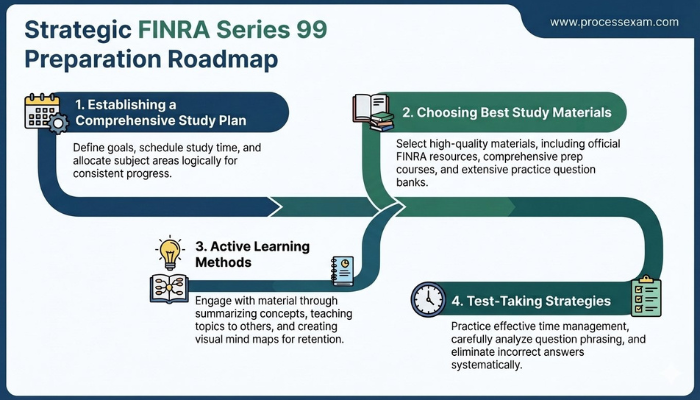
Effective preparation for the FINRA Series 99 exam is crucial for success, given its comprehensive syllabus and the detailed operational knowledge required. A well-structured study plan not only ensures all topics are covered but also helps manage time efficiently and reduces exam-day anxiety. Candidates should approach their preparation methodically, leveraging a variety of resources and techniques to build a robust understanding of the material. This strategic approach is the difference between struggling and confidently passing the examination. Many resources, including those for broader FINRA qualification exams, can provide a solid foundation.
Establishing a Comprehensive Study Plan
A successful study journey begins with a detailed plan that outlines objectives, allocates time for each subject area, and incorporates regular review sessions. Given the FINRA Series 99 exam difficulty, it is advisable to dedicate a significant amount of time to preparation, often several weeks to a few months, depending on prior experience. Start by familiarizing yourself with the entire syllabus and then break it down into manageable daily or weekly study blocks. Prioritize areas weighted more heavily on the exam, but ensure all topics receive adequate attention. Consider using a study calendar to track progress and maintain accountability.
-
Review the Official Content Outline: Begin by thoroughly understanding the FINRA Series 99 content outline to identify all examinable topics and their weightings.
-
Set Realistic Goals: Allocate specific hours each week for study, balancing it with your other commitments. Consistency is key to building knowledge.
-
Break Down Complex Topics: Divide larger subjects into smaller, digestible chunks to prevent information overload and improve comprehension.
-
Schedule Regular Reviews: Integrate daily or weekly review sessions to reinforce learned material and identify areas needing more attention.
-
Track Progress: Use practice questions and mock exams to gauge understanding and adjust your study plan accordingly, ensuring consistent improvement.
Choosing Best FINRA Series 99 Study Materials
Selecting high-quality study materials is paramount for effective preparation. The market offers a range of options, from official FINRA resources to third-party prep courses and study guides. It's essential to choose materials that are current, comprehensive, and align with the official FINRA Series 99 exam content outline. Diversifying your resources can provide different perspectives and help solidify understanding of complex topics. Look for materials that include clear explanations, examples, and practice questions. Many candidates find that a combination of a primary textbook, supplemental notes, and an extensive question bank yields the best results. The best FINRA Series 99 study materials are those that cater to your learning style and offer rigorous content.
-
Official FINRA Resources: Always consult FINRA's official website for the most accurate and up-to-date information regarding the exam, including candidate handbooks and regulatory notices.
-
Study Guides and Textbooks: Invest in a reputable study guide that covers all syllabus topics in detail. Look for clear explanations, real-world examples, and concise summaries.
-
Practice Question Banks: Utilize extensive banks of FINRA Series 99 practice questions to test your knowledge, identify weak areas, and become familiar with the exam format.
-
Online Courses and Prep Providers: Consider enrolling in a FINRA Operations Professional Exam prep course offered by established providers. These often include video lectures, interactive modules, and instructor support.
-
Flashcards and Mnemonics: Create your own flashcards for key terms, rules, and concepts, or use pre-made sets. Mnemonics can aid in memorizing complex lists or regulations effectively.
Effective Techniques for Series 99 Exam Success
Beyond simply studying the material, employing effective techniques for retaining information and managing exam-day pressure is vital for passing the FINRA Series 99 exam. This includes strategies for active learning, time management during the test, and maintaining mental and physical well-being throughout the preparation period. Success is often a result of both diligent study and smart test-taking approaches. Candidates who adopt these methods typically perform better, even when faced with challenging questions or time constraints. The exam requires not just knowledge recall but also the ability to apply concepts to practical scenarios.
Active Learning and Practice Question Immersion
Passive reading of study materials is often insufficient for mastering the depth of information required for the Series 99. Active learning techniques, such as summarizing, teaching concepts to others, and creating mind maps, enhance comprehension and retention. Crucially, regularly engaging with FINRA Series 99 practice questions is indispensable. These questions not only test your knowledge but also familiarize you with the question style, format, and common pitfalls. After answering questions, thoroughly review both correct and incorrect answers to understand the underlying principles and identify areas for improvement. This iterative process refines your understanding and builds confidence.
-
Summarize and Paraphrase: After reading a section, try to explain it in your own words without referring to the text. This reinforces understanding and memory.
-
Teach the Concepts: Explain complex topics to a study partner or even an imaginary audience to solidify your understanding and expose gaps.
-
Create Mind Maps: Visually organize information, connecting related concepts to see the bigger picture and improve recall during the exam.
-
Regularly Practice Questions: Work through as many practice questions as possible, simulating exam conditions to build stamina and speed.
-
Analyze Explanations: Don't just check answers; understand why each option is correct or incorrect. This is where significant learning occurs, reinforcing concepts.
Managing Exam Day and Test-Taking Strategies
The 90-minute duration of the FINRA Operations Professional Exam means time management is critical on exam day. Develop a strategy for tackling the 50 questions efficiently, ensuring you have enough time to review your answers. Read each question carefully, paying attention to keywords and nuances, before selecting the best possible answer. If unsure, eliminate obviously incorrect options to increase your chances. Furthermore, maintaining a positive mindset and being well-rested can significantly impact your performance. The difficulty level of the exam necessitates a calm and focused approach. Remember, the FINRA Series 99 pass rate is influenced by diligent preparation and effective test-taking skills.
-
Time Allocation: Practice allocating approximately 1.5-2 minutes per question to ensure you complete the exam within the 90-minute limit.
-
Read Questions Carefully: Avoid rushing. Understand precisely what each question is asking before attempting to answer, paying attention to details.
-
Eliminate Distractors: For challenging questions, systematically rule out obviously incorrect answers to narrow down your choices and improve accuracy.
-
Flag for Review: If you're stuck on a question, make an educated guess, flag it, and return to it later if time permits for re-evaluation.
-
Stay Calm and Focused: Practice mindfulness techniques or deep breathing exercises to manage stress on exam day and maintain mental clarity.
-
Prioritize Well-being: Ensure you get adequate sleep, eat a nutritious meal, and avoid cramming the night before the exam for optimal performance.
Post-Certification: Maintaining Your Operations Professional Credential
Passing the FINRA Series 99 exam is a significant achievement, but it marks the beginning of a continuous journey of professional development in the securities industry. To maintain the validity of your qualification, FINRA requires ongoing compliance with its Continuing Education (CE) requirements. This ensures that operations professionals remain knowledgeable about current regulations, industry best practices, and evolving ethical standards. Staying updated is not just a regulatory obligation; it’s a professional imperative in a dynamic financial landscape. Understanding these requirements from the outset helps in long-term career planning and commitment to excellence.
Fulfilling Continuing Education Requirements
FINRA's CE program is designed to keep registered individuals abreast of regulatory and industry changes. Operations professionals holding the Series 99 must fulfill both a Regulatory Element and a Firm Element component of the CE requirements. The Regulatory Element typically involves a computer-based training session assigned by FINRA, focusing on relevant regulatory topics. The Firm Element requires broker-dealers to provide training to their covered registered persons on topics relevant to their business, products, and services. Adherence to these requirements is crucial for keeping your license active and maintaining your ability to perform FINRA Series 99 job functions. Failure to complete CE can lead to an inactive status, preventing you from performing registered duties.
-
Regulatory Element: Typically completed every three years, this focuses on compliance, regulatory, ethical, and sales practice standards. It is administered through the FINRA Learning Management System (LMS).
-
Firm Element: Administered annually by the employing broker-dealer, this training covers products, services, and compliance procedures relevant to the firm's business, updating professionals on new regulations.
Staying Current with Industry Developments
Beyond formal CE requirements, successful operations professionals actively engage in continuous learning to stay ahead in a rapidly evolving industry. This includes subscribing to industry publications, attending webinars, participating in professional associations, and networking with peers. Regulatory changes, technological advancements, and new financial products constantly reshape the operational landscape. Proactively seeking out new knowledge and understanding how these developments impact your role and your firm's operations is vital. This proactive approach not only benefits your career but also strengthens your firm's overall compliance and risk management framework.
-
Industry Publications: Regularly read trade journals, financial news outlets, and regulatory updates to stay informed about market changes.
-
Webinars and Seminars: Participate in industry events, both online and in-person, to learn about emerging trends and network with experts.
-
Professional Associations: Join relevant industry groups to share knowledge and insights with peers, fostering collaborative learning.
-
Internal Firm Training: Actively participate in all internal training sessions offered by your firm, as they often address specific operational challenges and new directives.
Conclusion
The FINRA Series 99 Operations Professional Exam is an indispensable credential for anyone serious about a career in broker-dealer operations. It rigorously tests knowledge crucial for managing back-office functions, ensuring compliance, and upholding ethical standards within the securities industry. By understanding the exam structure, mastering the comprehensive syllabus, and implementing a strategic preparation plan, candidates can confidently navigate the challenges and emerge certified. This certification not only validates expertise but also unlocks significant career opportunities, enhances professional credibility, and positions individuals for leadership roles in a dynamic financial environment.
Embrace the challenge of the Series 99 and invest in your future. Begin your preparation today to secure your place among elite operations professionals. For a deeper dive into preparation and to test your readiness, access FINRA Series 99 practice questions and comprehensive study materials provided by ProcessExam.
FAQs
1. What does the FINRA Series 99 Operations Professional Exam cover?
The FINRA Series 99 exam primarily covers two main areas: Knowledge Associated with the Securities Industry and Broker-dealer Operations (70%) and Professional Conduct and Ethical Considerations (30%). It assesses understanding of trade processing, settlement, client asset protection, regulatory reporting, FINRA rules, AML compliance, and ethical standards.
2. Who should consider taking the FINRA Series 99 exam?
The FINRA Series 99 is ideal for professionals involved in various back-office and operational functions within broker-dealers. This includes individuals in roles such as trade support, treasury, clearance and settlement, custody, recordkeeping, and other related operational management or supervisory positions.
3. How difficult is the FINRA Series 99 exam?
The FINRA Series 99 exam is considered moderately difficult. It requires a comprehensive understanding of both complex operational procedures and regulatory compliance. Success depends on diligent study, thorough review of the syllabus, and extensive practice with question banks to apply theoretical knowledge to practical scenarios.
4. What are the prerequisites for taking the FINRA Series 99?
While there are no specific academic prerequisites, candidates typically need to be associated with a FINRA member firm to take the exam. Additionally, while not mandatory, possessing foundational knowledge of the securities industry or having experience in an operational role can be highly beneficial for preparation.
5. What career benefits does the Series 99 certification offer?
The Series 99 certification enhances professional credibility, validates specialized operational expertise, and can lead to expanded responsibilities and career advancement opportunities within broker-dealers. It often correlates with higher earning potential and qualifies individuals for supervisory or management roles in operations.
- FINRA Exam |
- Representative-level |
- FINRA Operations Professional Exam Questions |
- FINRA Operations Professional Exam Question Bank |
- FINRA Operations Professional Exam Test Questions |
- FINRA Operations Professional Exam Study Guide |
- FINRA Series 99 Quiz |
- FINRA Series 99 Exam |
- Series 99 |
- Series 99 Question Bank |
- Series 99 Certification |
- Series 99 Questions |
- Series 99 Body of Knowledge (BOK) |
- Series 99 Practice Test |
- Series 99 Study Guide Material |
- Series 99 Sample Exam |
- Operations Professional Exam |
- Operations Professional Exam Certification |
- FINRA Operations Professional Exam |
- OS Simulator |
- OS Mock Exam |
- FINRA OS Questions |
- FINRA Operations Professional Exam Book |
- FINRA Series 99 BOK PDF |
- Series 99 Exam |
- Series 99 Study Guide PDF |
- Operations Professional Exam Certification Cost |
- Operations Professional Exam Certification Requirements |
- FINRA OS Question Bank |
- FINRA OS Book |
- FINRA OS Study Guide |
- OS Certification |
- OS Certification Cost |
- OS Certification Requirements


