
Six Sigma Belts: Which One Fits Your Role?
A Six Sigma belt is a bill before it is a promotion: sitting the Yellow, Green and Black exams in turn costs $1,050 in IASSC vouchers, or $1,502 at ASQ's non-member rates, before any training or project time. So the useful question is not which colour sounds best but which rung your job will actually use. Yellow supports a project, Green runs one part-time, Black leads them full-time, and Master Black coaches the people who do.
How many Six Sigma belts are there, and what does each one do on a project?
The ladder borrows its colours from martial arts, and the working version has four rungs that vendors certify: Yellow, Green, Black and Master Black. Two more colours turn up in job adverts and training catalogues. White usually means an awareness course of a few hours with no exam behind it, and Brown is a label some training providers place between Green and Black. ASQ's and IASSC's exam lists start at Yellow and build no exam around White or Brown, so treat those two as course names, not credentials.
What separates the real rungs is not how much statistics you can recite. It is how much of a project you are trusted with, and how much of your working week it takes.
| Belt | Place in a project | Share of your week | Who it usually suits |
|---|---|---|---|
| White (course name) | Knows what the project is for and why data is being collected | None; the project is not yours | Everyone in an affected department |
| Yellow | Collects data, maps the current process, supports a team led by someone else | A few hours around the day job | Operators, coordinators, analysts, support staff |
| Green | Runs a project inside their own area, or owns a work package in a larger one | Part-time, alongside a normal role | Engineers, supervisors, project coordinators, quality staff |
| Black | Leads complex projects across functions and coaches Greens | Often most or all of the working week | Full-time improvement specialists |
| Master Black | Chooses which projects matter, coaches Black Belts, shapes the programme | Programme level, not project level | Heads of continuous improvement, internal consultants |
The vendors' own wording lines up with this. IASSC describes its Yellow Belt as a part-time professional who leads small projects or supports larger ones run by a Green or Black Belt, and its Green Belt as part-time too, leading projects or joining bigger ones under a Black Belt. Its Black Belt, in contrast, leads complex improvement projects, typically full-time. ASQ describes a Master Black Belt as a high-level expert who leads strategic initiatives and mentors Black Belts and Green Belts.
Why the part-time and full-time split matters
Green Belts are the most numerous belt in most companies for a plain reason: a firm can train fifty people who each give a fraction of their time without hiring anyone. Black Belts are the opposite bet, a few people released from other duties. If your manager cannot spare you from your normal job, a Black Belt credential describes a role you will not be given, however well you pass the exam.
Why the colours are not a pay scale
It is tempting to read the ladder as a salary grid, and plenty of web pages print a survey salary beside each colour. Pay depends on the country, the industry and whether the belt came with a project slot, so a single figure per colour misleads. Treat the colour as a statement of responsibility, then look at advertised salaries for the specific job title you want.
What does a project team look like with every belt in it?
Imagine a hospital where patients wait too long between the doctor's discharge decision and actually leaving the ward. The sponsor, a director, wants the delay cut and does not care about colours. Here is who does what.
- Master Black Belt. Decides, with the director, that discharge delay deserves a project at all, compared with ten other complaints. Checks that the measurement plan is sound and that the benefit claimed can be believed by finance.
- Black Belt. Leads the work across pharmacy, transport, nursing and records, because the delay crosses all four. Chooses the statistical tests and keeps the five phases of DMAIC moving to a calendar.
- Green Belt. A ward sister who owns the work package inside her own ward: how discharge paperwork is prepared, how often it is rechecked, where it waits. She runs her slice with guidance from the Black Belt.
- Yellow Belt. A ward clerk and a porter who time handoffs for two weeks, record why each patient waited, and flag when a fix is slipping back to the old habit.
- White Belt awareness. The rest of the ward knows why clerks are stopwatching and why the new checklist exists, so nobody quietly works around it.
Every person in that list is useful, and the work breaks if any one is missing. A team of five Black Belts would argue about method while nobody timed a handoff. A team of Yellows would collect good data and have no one to analyse it. The belts are a division of labour, which is why the sensible choice depends on the role you hold or want, not on the highest colour on offer.
How work flows down and up the ladder
Questions travel upward and results travel downward. The Yellow Belt notices that discharge letters wait for a signature and tells the Green Belt. The Green Belt cannot fix a pharmacy delay from inside the ward, so she raises it with the Black Belt, who has authority across both. The Master Black Belt makes sure the pharmacy change does not push the delay into another hospital department. Each handoff is a conversation between neighbouring colours, which is also how people usually learn the next belt: by working beside it.
What does each rung cost, and what does the vendor require first?
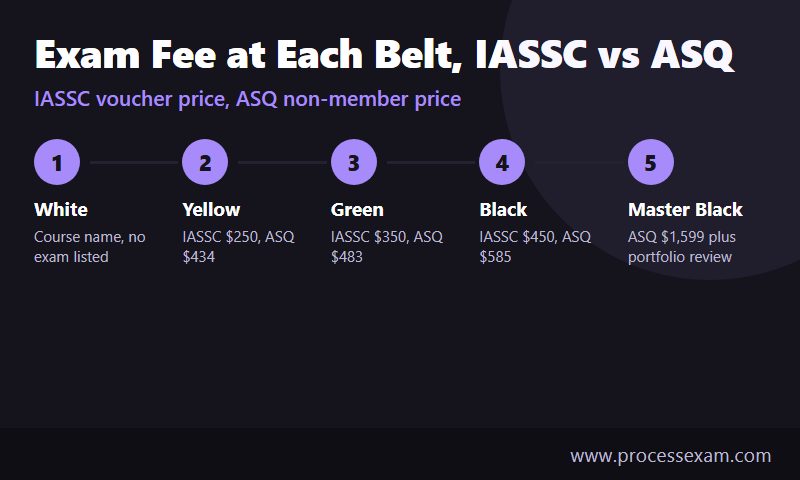
Fees and entry rules differ more than the colour names suggest. IASSC sells exam vouchers with no prerequisites, while ASQ asks for work experience or completed projects at some rungs. Figures below are the vendors' current listings.
| Belt | IASSC exam fee | ASQ exam fee (non-member) | What must come first |
|---|---|---|---|
| Yellow | $250 | $434 | IASSC: none. ASQ: no experience or education requirement |
| Green | $350 | $483 | IASSC: none required. ASQ: three years of paid, full-time work in the Body of Knowledge areas |
| Black | $450 | $585 | IASSC: none required. ASQ: three years of experience plus one signed project, or two signed projects |
| Master Black | Not on the IASSC pages checked | $1,599, plus an $800 portfolio review | ASQ: a current Black Belt certification, then a portfolio showing five years as a Black Belt or ten Black Belt projects |
ASQ members pay $100 less on each exam, which brings its Yellow, Green and Black fees to $334, $383 and $485, a ladder of $1,202 before the cost of membership itself. Lean Six Sigma Academy, a European body, sells its Yellow and Green Belt exams in its web shop at €260 and €532. The cheapest route to a credential is rarely the best route to the job, so read the next sections before choosing on price.
Where the real cost hides
Exam fees are the small number. The larger ones are the hours of preparation and, for a Black Belt, the project itself. A project that saves a department money is also the best line on any later application, and ASQ's project affidavit means a Black Belt there is certified partly on work done, not only on answers given. If you are budgeting, count project time as both a cost and the benefit.
What the Master Black Belt route adds
The top rung is priced and built differently. ASQ's exam is 110 multiple-choice items plus a performance-based assessment, taken over five hours and twenty minutes, and the application starts with a portfolio review. The route is a way of confirming experience you already have, not of acquiring it, which is why it sits beyond the reach of anyone who has not already led several Black Belt projects.
Which belt fits the job you have now?
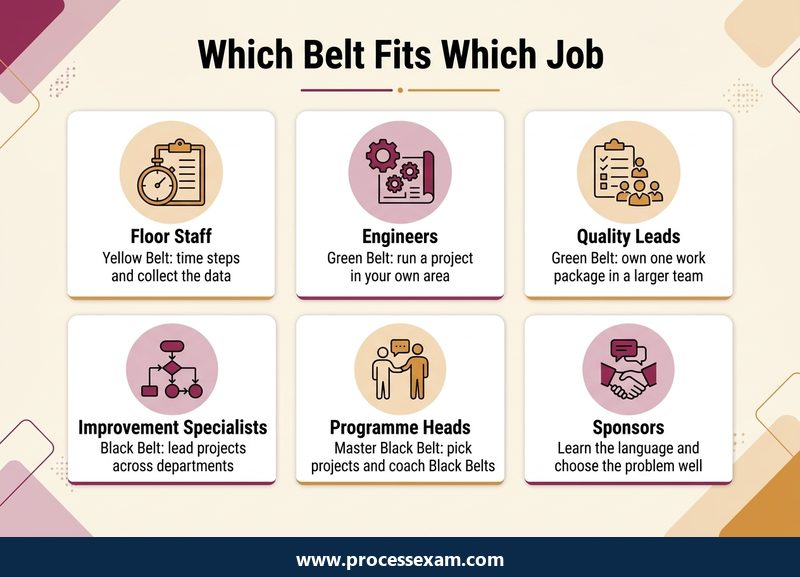
Start from your calendar, not your ambition. Ask what share of your week your employer will give to improvement work, and whether you will be the person running the project or a person in it.
Operators, coordinators, analysts and support staff
Yellow is the match. You will not run projects, but you will be asked for data and ideas by people who do. ASQ's page describes the Yellow Belt as someone who supports projects by collecting data, identifying issues and contributing to quality initiatives, and that is a fair description of the daily work. A Yellow credential also lets you speak the vocabulary when a Black Belt walks onto your floor.
Engineers, supervisors, project coordinators and quality staff
Green is the sweet spot for most working professionals. You hold a normal job, you own a process, and you are the person who ought to be fixing it. ASQ says a Green Belt works alongside or under the guidance of a Black Belt, which matches IASSC's description of part-time project leadership. If you are choosing only one belt, this is usually it.
People whose job is improvement itself
Black is for those who will lead complex, cross-department projects and coach others, ideally with the project time to prove it. ASQ presents its Black Belt credential for professionals who want to lead quality improvement initiatives and drive organizational excellence. Without a role that lets you lead such projects, you can collect the credential but not the experience that makes it credible.
Heads of improvement and internal consultants
Master Black is a role more than an exam. It rewards years of Black Belt work, and the ASQ portfolio review checks exactly that. Few readers of a belt guide are ready for this rung, and that is expected.
Managers and executives who sponsor projects
You may need no belt at all, or a Yellow or Green for the vocabulary. The sponsor's skill is choosing the right problem, removing blockers and asking the right question about the data. A short Green Belt course gives you enough method to spot a weak benefit claim when one is placed in front of you.
Can you skip a belt, or must you climb in order?
You can skip, and neither vendor above forces the order. IASSC states that no prerequisites are required for its Yellow, Green or Black exams, though it recommends training and project experience. ASQ does not make a Yellow Belt a condition of its Green Belt; its Green and Black exams ask for work experience and, for Black, completed projects instead. The only hard chain is at the top, where ASQ wants a current Black Belt certification before it will review a Master Black Belt portfolio.
Skipping is still a trade-off. Someone who goes straight to Green without ever having collected data on a live process tends to find the measurement phase abstract. A reasonable rule is to skip a rung only when your daily work already covers it. A quality technician who times and charts processes every week has done the Yellow Belt's job for years, and a certificate at that level would add little.
When climbing one rung at a time makes sense
Climb in order if your employer pays per course and values visible progress, if you have no data work in your current role, or if you are changing careers and want a low-cost first credential before committing to a larger one. Skip a rung if you already lead part of a project, or if the next belt is the one named in the job advertisement you are aiming at.
What a certificate does not change by itself
A belt is evidence that you passed a body of knowledge. It does not give you project access. In many companies the promotion follows the first completed project, not the exam, so ask early whether a project slot is waiting after you pass.
How people really move from Green to Black
The usual path is a first Green Belt project that lands a measurable result, then a second one that crosses a departmental boundary, then a conversation with a Black Belt who is willing to mentor. By the time the Black Belt exam is booked, the candidate has often already behaved like one for a year. The credential then records a change that has happened rather than promising one that might.
How do you list a Six Sigma belt on a résumé?
Many readers arrive here by searching for exactly this, and it is where weak entries are common. A line reading "Six Sigma Green Belt" says little. A strong line carries the issuer, the exact credential name and a date, so a recruiter can look it up.
- Certifications section. Write the credential as the vendor names it, such as ASQ Certified Six Sigma Green Belt (CSSGB) or IASSC Certified Lean Six Sigma Green Belt (ICGB), then the year you passed.
- Validity. IASSC treats a certification as current for three years under its recertification policy, so a date helps a reader judge it.
- Work history. Put one measurable project under the job where you did it, with the metric you really measured: cycle time, defect count, rework hours. Do not round up.
- White Belt and course completions. List these under training, not certifications. They show interest, but a reader may assume a proctored exam stands behind any item in a certifications list.
- In progress. If you have booked but not sat the exam, say "exam scheduled" with the month. Never list a belt you have not earned.
The project line matters more than the belt line. A reviewer is looking for evidence that you used the method on something real, and a one-line result under a job title does that better than a bare credential.
A short before-and-after
Weak: "Six Sigma Green Belt." Stronger: "IASSC Certified Lean Six Sigma Green Belt (ICGB), 2026. Led a ward-level project that cut median discharge wait; sustained for two quarters." The second version names the issuer, the exam, the year and a result a hiring manager can ask about, using only a figure you can defend in an interview.
Where does the IASSC Green Belt exam sit on the ladder?
Most people settle on the middle rung, so here is what you would sit for at Green Belt with IASSC. It is also a useful yardstick for how the other belts compare.
| Fact | IASSC Certified Lean Six Sigma Green Belt (ICGB) |
|---|---|
| Exam code | ICGB |
| Vendor | IASSC |
| Exam fee | $350 |
| Questions | 100 |
| Time allowed | 180 minutes |
| Passing score | 70% |
IASSC's page calls the exam closed book and proctored, and says some forms add up to ten non-graded questions to the 100 that count. The topics are laid out in the ICGB exam syllabus. Compared with the Yellow Belt at 60 questions in two hours, the Green Belt is a step up in length, and the Black Belt, at 150 questions in four hours, is a bigger one still.
Before paying the $350 fee, sit the ICGB practice exam to find the topics that need another week of study.
How the three IASSC rungs compare on length
Yellow: 60 questions, two hours, $250. Green: 100 questions, three hours, $350. Black: 150 questions, four hours, $450. Each exam carries the same 70% pass mark, so what rises is breadth and the number of items you must hold together, not the bar itself. That uniform bar suits people planning to move up the ladder step by step.
Which belt should you choose?
Work through these four questions in order and stop at the first honest answer.
- Will you run a project in the next twelve months? If not, choose Yellow, or nothing yet.
- Will it be part of a normal job? Then Green.
- Will it be your job, across departments? Then Black, and check that your employer will release you for it.
- Do you already coach Black Belts and shape the programme? Then a Master Black portfolio is worth the effort.
If you are a career changer with no improvement job yet, Green is the strongest first purchase for the money: it can be studied around a day job, it is named in job advertisements, and it costs less than Black. If you are already a Green Belt wondering about Black, test the question that matters most: does your employer have a full-time improvement role open or planned? If yes, the Black Belt exam is worth the money. If not, a second Green Belt project may serve your career better than a bigger credential nobody can yet use.
Frequently Asked Questions
How many belts are there in Six Sigma?
Four are certified by vendors such as ASQ and IASSC: Yellow, Green, Black and Master Black. White and Brown also appear in training catalogues, but they are course names, not exam-backed credentials. Each rung adds responsibility: Yellow supports projects, Green leads them part-time, Black leads them full-time and Master Black coaches the programme.
Which Six Sigma belt should a beginner start with?
Start with the belt that matches the project work you will really be given. For most working professionals that is Green, because it can be studied around a normal job and it is named in job advertisements. Choose Yellow if you will only support projects, and leave Black until a full-time improvement role is on offer.
Do you need a Yellow Belt before a Green Belt?
No. IASSC states that none of its Yellow, Green or Black exams has a prerequisite, and ASQ does not make a Yellow Belt a condition of its Green Belt. ASQ does ask for three years of paid work experience at Green, and for experience plus signed projects at Black, so check the entry rules first.
Is a White Belt worth listing on a résumé?
List it under training, not under certifications. White Belt usually means a short awareness course with no proctored exam, so a reader who sees it in a certifications list may assume more than it proves. It shows interest, and it is more convincing when it sits next to a measured result from real work.
What is the IASSC Green Belt exam format and pass mark?
The IASSC Certified Lean Six Sigma Green Belt (ICGB) exam costs $350 and has 100 questions in 180 minutes, with a 70% passing score. IASSC describes it as closed book and proctored, and says some forms add up to ten non-graded questions to the 100 that count.
- Lean Six Sigma |
- IASSC Lean Six Sigma Green Belt Sample Questions |
- ICGB Exam Questions Download |
- ICGB Test Questions |
- Lean Six Sigma Green Belt PDF |
- IASSC Lean Six Sigma Green Belt Book |
- IASSC ICGB BOK PDF |
- Lean Six Sigma Green Belt Certification Cost |
- Lean Six Sigma Green Belt Certification Requirements |
- IASSC Lean Six Sigma Green Belt Test Questions |
- ICGB Question Bank |
- ICGB Body of Knowledge (BOK)


