
ICGB Certification: IASSC Green Belt Exam Fee, Topics and Study Plan
Updated on 29 September 2026. What’s new: iassc lists the green belt exam at usd $350 and needs no work experience to sit it or to hold the certificate
The ICGB is the IASSC Certified Lean Six Sigma Green Belt exam: 100 closed-book questions in 180 minutes, a 70% pass mark and a USD $350 fee, with no prerequisites to sit it. About 20 questions come from each of five sections, Define, Measure, Analyze, Improve and Control, so no phase can be skipped. This guide sets out the paper, the topics inside every section, how to choose the right hypothesis test and a six-week study plan.
People searching for the ICGB meaning are usually asking two things at once. The letters stand for the IASSC Certified Lean Six Sigma Green Belt, and IASSC is the International Association for Six Sigma Certification, an independent body that certifies knowledge rather than training. It does not run courses. It sets a Body of Knowledge, writes the exam and issues the certificate, which is why the same exam can be reached after a classroom course, a company programme or plain self-study.
The description IASSC gives of a certified Green Belt is a person who leads improvement projects, or serves as a team member on larger ones led by a Black Belt, typically in a part-time role. The exam does not watch you run a project. It tests whether you understand the methods well enough to choose the right tool, run it and read the result. The sections below take that in the order a candidate needs it: what you pay and sit, where the marks are, what each section asks, the statistics that decide most borderline scores, and how to prepare.
What does the ICGB involve, and what do you pay for it?
The ICGB is a single proctored paper with no separate application, no portfolio and no project submission. You buy an exam voucher, book a sitting, pass with at least 70% and receive the certificate. The figures below are the ones we hold for the exam, and IASSC's Green Belt page lists the same fee and format.
| Item | ICGB detail |
|---|---|
| Exam code | ICGB |
| Full name | IASSC Certified Lean Six Sigma Green Belt |
| Exam fee | USD $350 |
| Duration | 180 minutes |
| Questions | 100 |
| Passing score | 70% |
| Prerequisites | None to sit the exam |
What does the paper look like on the day?
Every question is multiple choice or true/false, the paper is closed book and it is proctored. IASSC also says that some forms carry up to ten additional questions that are not graded. Because those are not marked in the paper you see, you cannot tell which ones they are, so answer all of them as if each counted. Three hours for 100 questions gives you 1.8 minutes a question on average, which is generous for recall questions and tight for anything that needs a calculation.
Do you need work experience before you sit?
No. IASSC's Green Belt page confirms that nobody has to meet a prerequisite before booking, and the only condition for the designation is a score of 70% or more. Some older guides describe a work-experience rule for the certificate itself, and you may still see that repeated on other sites, but IASSC's own page does not include one. What IASSC does say is that training from a qualified institution, trainer or company programme is recommended but not required, and so is some real-world project experience. Treat that as advice about how hard the paper will feel, not as a gate.
Where and how can you take it?
IASSC delivers the exam through testing centres (it cites more than 8,000 of them across 165 countries), through PeopleCert Online Proctoring from your own desk, and through its accredited training providers. The voucher sold on the IASSC site is an on-demand, web-based one. Whichever route you pick, run the technical or venue check a few days ahead rather than on the morning, because a closed-book proctored paper leaves no room to fix a webcam problem mid-sitting. You can read the full description on the IASSC Green Belt certification page before you pay.
How long does the certificate stay current?
IASSC recognises certified professionals indefinitely, but since March 2017 it has given each certification a status. A certificate is Current for three years from the date you receive it and then shows as Elapsed unless you recertify. The recertification paper for the Green Belt is shorter than the original: 50 questions in 90 minutes, a 70% pass mark and a fee of USD $175, and you have until the elapse date, plus a 90-day grace period, to sit it. The current terms are on IASSC's recertification policy page, so check them when your date approaches rather than trusting a figure copied months earlier.
How are the ICGB marks spread across the five sections?
Evenly, at least by question count. IASSC says the exam draws approximately 20 multiple-choice and true/false questions from each major section of the Green Belt Body of Knowledge. That is five sections at about 20 questions each, which makes 100. The sections are equal in marks but not in difficulty, and that gap is where most study plans go wrong.
| Section | Approximate questions | What the questions lean on |
|---|---|---|
| Define | 20 | Definitions, project selection, metrics such as DPMO and RTY, and the seven wastes |
| Measure | 20 | Process tools, descriptive statistics, measurement system analysis and capability |
| Analyze | 20 | Variation patterns, sampling and a long list of hypothesis tests |
| Improve | 20 | Correlation, simple and multiple regression, residuals and transformations |
| Control | 20 | Lean controls, control charts and the elements of a control plan |
Read the last column as a warning about the kind of thinking each section asks for. Define rewards vocabulary and tidy reasoning, so it is the cheapest place to bank marks. Measure and Control mix recall with chart or table reading. Analyze and Improve are where a candidate without a statistics background loses points, because the questions expect you to interpret output, for instance what a p-value or a residual plot is telling you, and not only to name the test.
Two consequences follow. First, a candidate who is comfortable with tools and weak in statistics can still fail, because 40 of the 100 questions sit in the two most statistical sections. Second, a strong statistician who never studied the Lean vocabulary can lose an easy 20 marks in Define. Your study time should follow your gaps, not the equal split of the paper.
What sits inside each ICGB section, and how deep does it go?
IASSC publishes the topic list in its Green Belt Body of Knowledge, and our ICGB syllabus page lays the same headings out as a checklist. The notes below say what each heading means for the questions you will meet.
Section 1: Define, or choosing and chartering the project
Define opens with the basics: what Six Sigma means, where it came from, what a project must hand over, the Y = f(X) way of thinking about problems, whose voice counts (customer, business and employee) and who does what on a team. The fundamentals follow: how to define a process, what customers count as critical to quality, what poor quality costs the business, an 80:20 Pareto view of defects, and the yield and defect measures DPU, DPMO, FTY and RTY alongside cycle time.
Expect to be asked to derive those metrics from a short data set, not just define them. Define also covers selecting projects (the business case, the charter, project metrics, financial evaluation and benefits capture) and the Lean enterprise: the seven wastes, which IASSC lists as overproduction, correction, inventory, motion, overprocessing, conveyance and waiting, and the five S steps of sort, straighten, shine, standardize and self-discipline. A useful test of readiness is whether you can look at a described workplace and name which waste is being shown.
Section 2: Measure, or knowing what the process really does
Measure starts with describing the process: fishbone diagrams, maps of several kinds (SIPOC and value stream among them), the X-Y matrix and FMEA. Next comes the statistics block: summarising data numerically, judging whether a distribution is normal, and reading graphs. The third block is measurement system analysis: how precise and accurate a gage is, whether it drifts or reads differently across its range, how much of the variation comes from the gage and the operators, and how that differs for measured and counted data. The last block is process capability: how well a stable process fits its limits, how that works for pass/fail data, and how to keep watching it.
The idea that ties the section together is trust. Before you calculate capability you must be sure the process is stable, and before you trust any number you must be sure the gage measuring it is sound. Questions often hide that order. A scenario might give a capability figure and ask what should have been checked first, and the answer is the stability of the process or the measurement system, not a different formula.
Section 3: Analyze, or proving which factors matter
Analyze covers patterns of variation (multi-vari analysis and the classes of distributions), inferential statistics (understanding inference, sampling techniques and the central limit theorem) and hypothesis testing in three parts: the general concepts, tests for normal data and tests for non-normal data. The general concepts include what significance means, why a result can be statistically clear yet unimportant in practice, and the two risks of a wrong call, alpha and beta. The next section of this guide works through how to choose among the tests, because that decision is the heart of the phase.
Section 4: Improve, or modelling how inputs drive the result
The Green Belt Improve section is regression rather than experiments. Simple linear regression covers correlation, the regression equation and residuals analysis. Multiple regression analysis extends it with non-linear regression, multiple linear regression, confidence and prediction intervals, further residuals analysis and data transformation including Box-Cox. The questions typically show a fitted equation or a residual plot and ask what it means: whether the model form is wrong, whether a transformation is needed, or how much of the variation an input explains.
Two habits pay off here. Distinguish a confidence interval, which describes where the average response lies, from a prediction interval, which describes where a single new observation may fall and is always wider. And remember that a strong correlation does not establish that one variable causes the other, an idea the exam likes to test with a short story rather than a formula.
Section 5: Control, or keeping the improvement in place
Control begins with the Lean side: how 5S is kept up, how kanban regulates flow and how poka-yoke, or mistake proofing, blocks errors. It continues with statistical process control: data collection for SPC, then the I-MR, Xbar-R, Xbar-S, U, P and NP charts, plus the CuSum and EWMA charts and the control methods that go with them. It closes with control plans: weighing cost against benefit, then writing down what is monitored and what happens when a signal appears.
Chart selection is the skill to rehearse. Individual measurements point to an I-MR chart, subgroups of continuous data to Xbar-R or, for larger subgroups, Xbar-S. Counts of defectives use P or NP, and defects per unit use U. CuSum and EWMA are the charts that respond to small, sustained shifts that a standard chart is slow to flag. If you can name the chart from a two-line description of the data, you have this section covered.
How do you choose the right hypothesis test on the paper?
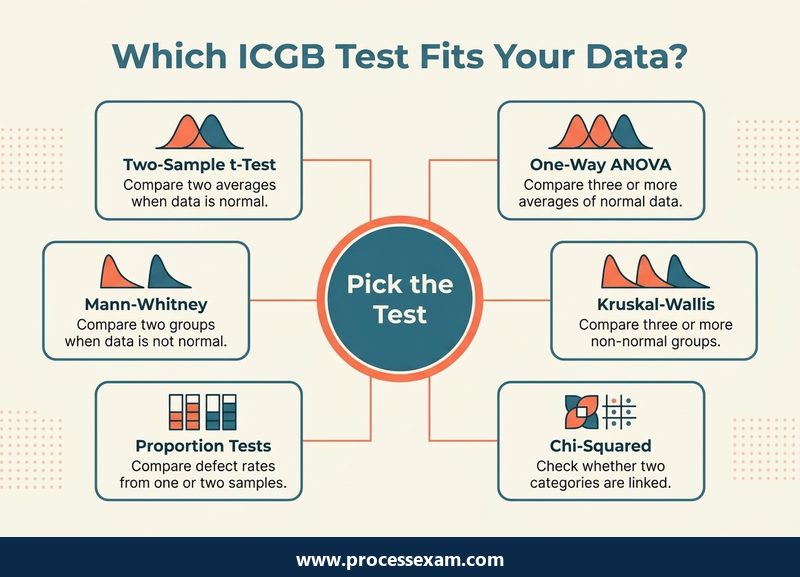
This is the decision that separates candidates who memorised the list from those who can use it. IASSC names the tests in two groups, one for normal data and one for non-normal data, and it expects you to run tests of equal variance, normality tests and sample size calculations, then perform the test and interpret the result. The table pairs the question being asked with the test in each group.
| What are you asking? | Data is normal | Data is not normal |
|---|---|---|
| Is one average different from a target? | 1-sample t-test | 1-sample sign or 1-sample Wilcoxon |
| Do two groups have different averages? | 2-sample t-test | Mann-Whitney |
| Do three or more groups differ? | One-way ANOVA | Kruskal-Wallis or Mood's median |
| Do measurements from the same blocks or subjects differ across treatments? | Not in the list | Friedman |
| Do defect rates or proportions differ? | Not applicable | 1 and 2 sample proportion tests |
| Are two categories linked? | Not applicable | Chi-squared on a contingency table |
A worked example: two filling lines
Suppose a plant fills bottles on two lines and the target is 500 ml. A sample of 10 bottles from line A averages 502.4 ml with a standard deviation of 3.1 ml. A sample of 10 from line B averages 499.8 ml with a standard deviation of 3.4 ml. Is line A really filling more?
- State the hypotheses. The null says the two line averages are equal, and the alternative says they differ.
- Set the risk. Choose alpha of 0.05, meaning you accept a 5% chance of declaring a difference that is not there.
- Check the assumptions. Assume normality tests pass for both samples, and run a test of equal variance to decide which form of the t-test to use.
- Calculate. The standard error is the square root of (3.1 squared over 10 plus 3.4 squared over 10), which is the square root of 2.117, about 1.455. The gap between averages is 2.6 ml, so t = 2.6 / 1.455, about 1.79.
- Read the result. With about 18 degrees of freedom, a t of 1.79 gives a p-value near 0.09. That is above 0.05, so you fail to reject the null.
The wording of that conclusion is what the exam checks. Failing to reject does not prove the lines are identical. It says the data do not give enough evidence at a 5% risk. The gap of 2.6 ml may be real, and this small sample may simply be too small to show it, which is a beta risk problem, the chance of missing a real difference.
That is why sample size calculations sit in the syllabus. If the same averages and standard deviations had come from 40 bottles per line, the standard error would fall to about 0.73, t would rise to about 3.6 and the p-value would drop well below 0.01. The process had not changed, only the amount of evidence. A question built on this idea will usually give you a p-value and an alpha and ask for the decision, or give you a non-significant result from a small sample and ask what a practical next step is.
Statistical significance versus practical significance
One more distinction is examined in its own right. A very large sample can make a tiny difference statistically significant, and a 0.1 ml gap between filling lines may be irrelevant to the customer even if the p-value is small. Practical significance asks whether the difference is big enough to matter for cost, safety or the specification. When an answer option talks only about the p-value and another weighs the size of the gap against what the business cares about, the second is usually the more complete reading.
How should you spread six weeks of ICGB study?
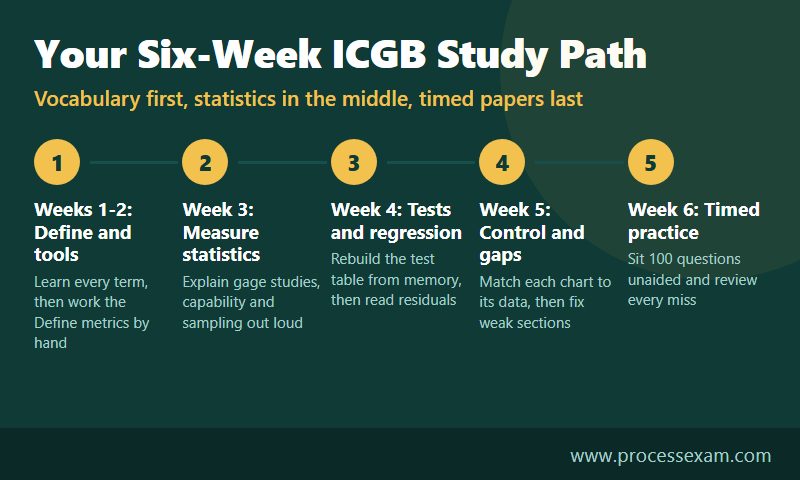
Six weeks suits a working candidate who has met Lean Six Sigma before and can give about six to eight hours a week. Stretch it if statistics is new to you, and shorten it if you already run projects. The order matters more than the length: vocabulary first, statistics in the middle and mixed timed practice last.
Weeks one and two: vocabulary, metrics and process tools
Work through Define and the first half of Measure. Write a one-line definition for each term in the Body of Knowledge in your own words, and calculate every Define metric by hand until DPMO, first time yield and rolled throughput yield need no notes. Draw a SIPOC, a fishbone and a simple value stream map for a process you know, so the tools attach to something real.
Week three: statistics you can explain aloud
Finish Measure with measurement system analysis and capability, then start Analyze with sampling and the central limit theorem. Explain each idea aloud as if to a colleague. If you cannot explain why the sample mean behaves more predictably than a single value, the idea is not yet yours.
Week four: hypothesis tests and regression
This is the heaviest week. Rebuild the decision table from the previous section from memory, then run two or three tests from raw numbers. Move to simple and multiple regression, and practise reading residual plots. IASSC also offers a non-proctored Green Belt Evaluation Exam, which is a sensible way to measure where you stand at this point rather than at the end.
Week five: control, Lean controls and weak spots
Study control charts by matching each chart to a description of the data, then the control plan and response plan. Spend the rest of the week on whichever section your evaluation results showed as weakest. Early in this week, start a log of every question you miss, with a note on whether the cause was vocabulary, arithmetic or a misread stem.
Week six: timed practice and review
Take at least one full-length timed paper of 100 questions in one sitting, with no notes, because the exam is closed book and stamina is part of it. A full ICGB practice exam is useful for exactly this rehearsal. Review every wrong or guessed answer in your log, and in the last two days revisit only the log and your one-page summary of tests and charts. New material at that stage does more harm than good.
Which slips cost prepared candidates marks on the ICGB?
Most failed attempts trace back to a handful of habits, not to a lack of intelligence or effort.
- Treating the paper as five equal reading tasks. Equal marks do not mean equal effort. Analyze and Improve need practice with numbers and output, while Define needs repetition of vocabulary.
- Memorising test names without the conditions. Knowing that Mann-Whitney exists is not the same as knowing it is the answer when two groups of non-normal data are compared.
- Reading a non-significant result as proof of no difference. The correct wording is that there is insufficient evidence at the chosen risk.
- Skipping the stability and gage checks. Capability figures and test results are only trustworthy if the process is stable and the measurement system is sound, and scenario questions exploit that.
- Confusing similar charts. P and NP charts both handle defectives, and U handles defects per unit. Mixing up which count each one plots costs easy marks in Control.
- Never rehearsing three hours without notes. A candidate used to open-book work often underestimates how tiring 100 closed-book questions are.
- Leaving formulas to memory on exam day only. If a calculation needs a formula, write it out in each practice session until it is automatic, since you cannot bring a reference sheet.
Another trap is going too far the other way and studying until midnight the night before. The exam rewards clear reading of the stem, and a tired candidate skims past words such as "not" or "except" that reverse the answer. Read every stem twice, mark it for review if a calculation is heavy, and return to it after you have banked the quick questions.
What does a certified Green Belt do differently at work?
The credential describes a role, and it helps to be exact about which one. In IASSC's description a Green Belt leads improvement projects or serves on more complex ones led by a Certified Black Belt, and does so typically part-time alongside another job. That matches how Green Belts work in practice: an engineer, analyst, nurse manager or operations supervisor who spends a share of the week on a defined problem.
What changes after passing is largely the language and the discipline. A Green Belt frames a problem with a charter, measures it with a checked gage, tests a cause with a proper hypothesis test and proposes a control plan that outlasts the project. That sequence is the one the exam follows, so the certificate is a fair signal that you know it, though it does not by itself prove you have delivered savings. Employers who care about delivery often ask to hear about a project as well, so keep one worked example ready alongside the certificate.
Roles where the knowledge is used include process improvement analyst, quality engineer, operations or production supervisor, business analyst and continuous improvement coordinator. We do not quote salary figures here, because pay depends heavily on country, industry and seniority and we would rather send you to a current salary survey than to a number that goes out of date.
The natural next step for some candidates is the IASSC Certified Lean Six Sigma Black Belt, which builds on the same five phases with deeper statistics and experimental design. Others move from the Green Belt into a role leading a small programme. Either way, the Green Belt is a knowledge credential that stays visible in the IASSC register, and the three-year Current status is a reminder to keep the methods in use.
Frequently Asked Questions
What does ICGB stand for?
ICGB stands for the IASSC Certified Lean Six Sigma Green Belt. IASSC is the International Association for Six Sigma Certification, an independent body that writes the Body of Knowledge, sets the exam and issues the certificate. It certifies what you know and does not run the training courses itself.
How many questions are on the ICGB exam, and what is the pass mark?
The ICGB has 100 closed-book, proctored questions to answer in 180 minutes, and you need 70% to pass. About 20 come from each of the five sections: Define, Measure, Analyze, Improve and Control. Some forms add up to ten extra questions that are not graded.
How much does the ICGB certification cost?
The ICGB exam voucher costs USD $350. That covers the exam only, not training. If your certificate later shows as Elapsed after three years, the shorter Green Belt recertification exam is a separate fee of USD $175, so budget for both if you plan to keep it Current.
Do you need work experience to take the ICGB?
No. Nobody has to meet a prerequisite before booking the Green Belt exam, and the only requirement for the designation is a minimum score of 70%. Training and some real project experience are recommended, not required, and they mainly make the statistics sections easier.
How long is the ICGB certificate valid?
IASSC recognises certified professionals indefinitely, but each certificate is Current for three years and then shows as Elapsed unless you recertify. The Green Belt recertification exam has 50 questions in 90 minutes with a 70% pass mark, and it must be taken before the elapse date or within 90 days after.
- Lean Six Sigma |
- IASSC Lean Six Sigma Green Belt Sample Questions |
- ICGB Exam Questions Download |
- ICGB Test Questions |
- Lean Six Sigma Green Belt PDF |
- IASSC Lean Six Sigma Green Belt Book |
- IASSC ICGB BOK PDF |
- Lean Six Sigma Green Belt Certification Cost |
- Lean Six Sigma Green Belt Certification Requirements |
- IASSC Lean Six Sigma Green Belt Test Questions |
- ICGB Question Bank |
- ICGB Body of Knowledge (BOK)


