
IIBA CCBA Certification: Boost Your BA Career Growth
Picture the analyst who joined a project team two years ago. At first every template, meeting and sign-off came from someone more senior. Now the same analyst is asked to run a stakeholder workshop alone, judge whether a late change request is worth taking, and explain the answer to a sponsor. That shift is the career stage IIBA's Certification of Capability in Business Analysis (CCBA) is built for.

The CCBA is the middle of IIBA's three core business analysis credentials. The Entry Certificate in Business Analysis (ECBA) comes before it and the Certified Business Analysis Professional (CBAP) after it. It asks for roughly two to three years of logged practice and tests whether you can apply the BABOK Guide to real situations. It also tells an employer something specific: that you can be handed a well-scoped piece of analysis and trusted to run it.
This article is about that career step rather than the paperwork. It covers where the credential sits on the IIBA ladder, what the work looks like at two to three years, how the scope of your job tends to change, who the credential suits, what it costs over a full cycle, how you keep it and when the senior credential becomes the sensible next move. If you are after the application rules in detail, our separate guide walks through counting hours, references and deadlines step by step.
Where does the CCBA sit between the ECBA and the CBAP?
IIBA arranges its core credentials as three levels, and the level numbers matter more than most candidates realise. IIBA's recertification rules refer to the Level 2 CCBA and the Level 3 CBAP, and its competency material defines what each level means in terms of behaviour on the job. The ECBA sits underneath as the foundation.
Level 1: the ECBA, knowledge before experience
The ECBA is a certificate rather than a professional certification. IIBA describes it as the first step for aspiring business analysis professionals, and it never needs renewing. It proves you understand the concepts and vocabulary of the BABOK Guide. It does not claim that anyone has watched you use them on a live project, which is exactly the gap the next level fills. IIBA lists ECBA holders as one of the groups the CCBA is designed for, so the two are meant to connect.
Level 2: the CCBA, practice that has been checked
The CCBA is the first IIBA credential that looks at your working history. According to the IIBA CCBA certification page, you document 3,750 hours of business analysis work within the last seven years, 21 hours of professional development within the last four years and two professional references before you may buy the exam. Then you sit a single 130-question paper built from the BABOK Guide. In career terms it certifies a practitioner: someone who does the work competently and with growing independence.
Level 3: the CBAP, accountability for the approach
The CBAP raises the experience bar to 7,500 hours within the last ten years, which IIBA equates to five or more years, plus 35 hours of professional development. IIBA's CBAP page pitches it at experienced professionals ready to lead, and names lead, principal and enterprise business analysts, business analysis managers and business architects among its audience. The table below shows what changes when you climb from the middle rung to the top one.
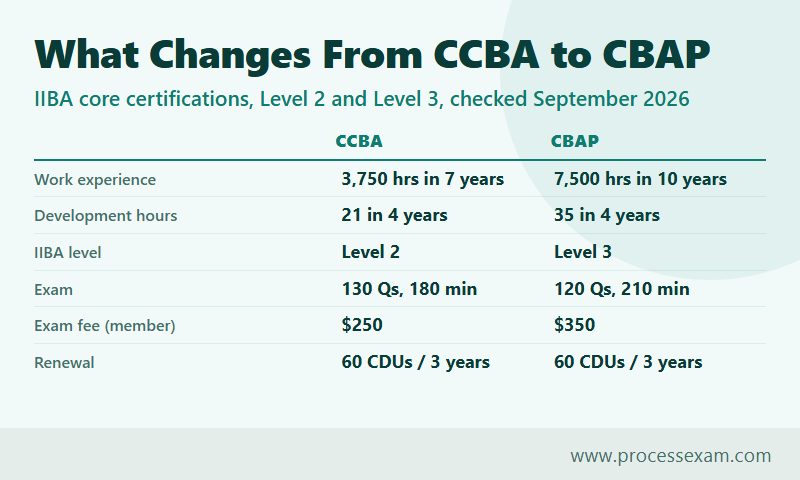
Two points about the ladder are easy to miss. First, it is not compulsory to climb every rung: IIBA's CBAP eligibility list names hours, professional development and references, not a prior CCBA. Second, skipping a rung is rarely the quickest route in practice. Most analysts reach 3,750 hours years before they reach 7,500, and a credential held during that gap does real work on a CV while the senior bar is still out of reach.
What does business analysis work look like two to three years in?
IIBA publishes a set of CCBA competencies that describe the level in plain behavioural language, and it is worth reading them as a job description rather than an exam outline. The CCBA competencies page calls Level 2 "Skilled" and defines it with three phrases.
- Modifies rules. You meet situations where you are confident enough to adapt the guidance you were given, instead of following a template to the letter.
- Recommends actions. You generally work independently on smaller, well-scoped challenges, and you can identify the right action yourself, while still leaning on expert help for the most complex work.
- Applied knowledge. Your skills have grown on small, less complex challenges, or on larger work where someone more experienced guides you.
Read those three phrases against a typical week and the picture becomes concrete. A Level 2 analyst is not the person who designs the analysis approach for a whole transformation programme. That remains the senior analyst's call. But the Level 2 analyst is also no longer the person who takes notes while someone else runs the workshop.
A week in the life at this level
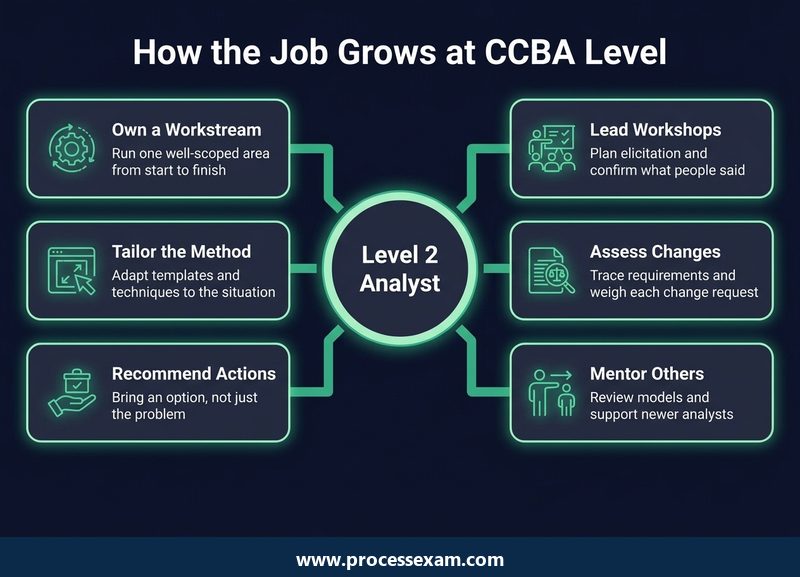
Take an analyst on a claims-processing replacement at an insurer. On Monday they plan the elicitation for the payments workstream: who needs to be in the room, what to send ahead, which questions will expose the exceptions. On Tuesday they run the session and afterwards confirm the results with the attendees, because a workshop that nobody has confirmed is only a set of opinions. Midweek they trace the new payment requirements back to the business objective they serve. When the finance team asks for an extra approval step, they assess what the change touches before anyone agrees to it. By Friday they are modelling the future-state process and recommending which of two options fits the constraints better, and the senior analyst reviews the recommendation rather than writing it.
Every one of those activities maps to a BABOK knowledge area, and that is no coincidence. The CCBA exam blueprint weights the same six knowledge areas, with requirements analysis and design definition carrying the largest share at 32%. The competency page also names the behaviours IIBA expects alongside the tasks: adapting your communication style to the person in front of you, active listening that gets past the stated request to the real need, and an understanding of how things actually get done in your organisation.
What still sits above this level
Being honest about the limits helps you use the credential well. At two to three years, most analysts have not yet owned the business analysis approach for a large initiative, set governance for how decisions and changes will be made across a programme, or defended an unpopular recommendation to an executive sponsor with no one senior in the room. Those are the responsibilities the CBAP assumes. Knowing that boundary lets you describe your CCBA truthfully in an interview, and it points you to the experience you need to collect next.
How does the CCBA change the work you are trusted with?
A credential does not change your skills on the day you pass. What it changes is how much evidence other people have about those skills, and that evidence is what moves the scope of your role. IIBA's own wording on the CCBA page is that the certification recognises your expertise and prepares you to take on larger, more complex initiatives. In practice the shift tends to show up in four places.
From assigned tasks to an owned workstream
Managers staffing a project look for people they can leave alone with a defined scope. The CCBA is an independent signal that you have handled well-scoped analysis before, backed by audited hours and references, so it makes the conversation about owning a workstream easier to start. It is common for this to be the first visible change: one module, one process area or one integration that is yours from elicitation through to acceptance.
From following the template to tailoring it
"Modifies rules" is the phrase that separates Level 2 from entry level. Once colleagues know you understand why a template or technique exists, you are allowed to adapt it: a lighter requirements document for a small change, a different elicitation technique for a stakeholder who will not attend workshops, a decision table instead of a long list of business rules. That freedom is where analysts start to become efficient rather than merely thorough.
From reporting problems to recommending actions
Junior analysts tend to escalate. Skilled analysts arrive with an option. The exam itself rewards this. IIBA's published sample questions ask what the business analyst should do first or which technique would help, not what a term means. Working at that level of judgement is what moves you from reporting issues in a stand-up to being asked for your view before the decision is made.
From one project to the wider practice
Organisations that employ several analysts often use IIBA credentials to agree a shared vocabulary and a consistent set of deliverables. Holding the CCBA puts you in a position to contribute to that practice, reviewing a newer colleague's model, helping set up a requirements repository or mentoring an ECBA holder, and those contributions are exactly the experience a CBAP application later asks you to document.
Who is the CCBA meant for on a real team?
IIBA lists the professionals it expects to get strong value from the CCBA, and the list is broader than the job title "business analyst" suggests:
- holders of the ECBA who have since built up practical experience;
- business analysis professionals and IT business analysts;
- systems analysts and business systems analysts;
- business process analysts and technical business analysts;
- requirements analysts and product analysts.
What those roles share is that a significant part of the week goes on the tasks the BABOK Guide describes, even when the title says something else. A product analyst who writes acceptance criteria and traces them to outcomes is doing requirements analysis and design definition. A process analyst mapping current and future state is doing strategy analysis. If your role looks like that, the CCBA describes your work accurately, and the hours you log for it will come naturally from the job.
What the credential signals, and what it does not
For a hiring manager, the useful message is that another organisation has checked your experience and tested your judgement against a global standard. IIBA also points to its Global State of Business Analysis reports as evidence that CCBA-certified professionals earn more than non-certified peers. The actual figures sit in the member reports and vary by country, industry and role, so treat any single number you see quoted with care.
The CCBA will not make up for missing experience in a specific domain, and it will not on its own move you into a senior title. Pay and promotion follow the scope you actually carry. The credential's job is to make it easier for someone to give you that scope, and easier for you to show that you handled it.
Three people for whom the timing is right
The career changer from testing or support. Two or three years of writing test cases or triaging defects often involved more requirements work than the title admitted. Once those hours are mapped honestly to the knowledge areas, the CCBA turns that sideways experience into a recognised analysis credential.
The ECBA holder who kept going. The entry certificate opened the door. Now the log has filled up, and the CCBA replaces "knows the concepts" with "has applied them and been checked", which matters most when you apply outside your current employer.
The consultant who needs a standard behind the name. Clients buying analysis time want to know what they are getting. A current Level 2 credential, listed in IIBA's directory, answers that question before the first meeting.
How much does the CCBA step cost, and who usually pays?
Seen as a career investment, the CCBA has a one-off cost to earn it and a smaller recurring cost to keep it. These are the figures from our exam data, which match the fees shown on IIBA's CCBA page when we checked in September 2026:
| Item | CCBA figure | What it means for your plan |
|---|---|---|
| Application fee | Application Fee: $145 USD | Paid once, before you can buy the exam; non-refundable |
| Exam fee | Member - $250 USD, Non-Member - $405 USD | IIBA says the non-member fee now includes a first year of membership |
| Exam rewrite fee | Member - $195 USD, Non-Member - $350 USD | Only if a first attempt does not pass |
| Recertification fee | Member - $85 USD, Non-Member - $120 USD | Due every three years, together with 60 CDUs |
| Questions | 130 | Multiple-choice and scenario-based, drawn from the BABOK Guide |
| Duration | 180 minutes | One sitting, online with a remote proctor or at a PSI test centre |
| Passing score | 70% | The result itself is shown on screen as pass or fail |
| Body of knowledge | BABOK Guide Version 3 | The same guide the CBAP is built on, so study carries forward |
For a first-time pass, then, the cost of earning the credential is the application fee plus one exam fee, and the cost of holding it is the recertification fee once every three years. Add whatever you spend on the 21 professional development hours, which ranges from a chapter study group to a full training course.
Making the case to your employer
Many organisations have a professional development budget that business analysts never ask for. The strongest request ties the CCBA to the scope you want to carry, not to your CV. Name the workstream or process area you want to own next. Show that the credential covers the knowledge areas that work depends on, and offer to share what you learn through the team's templates or a lunchtime session. It also helps to point out that the recertification cost is small and that the CDUs will largely come from work you already do for them. IIBA publishes material on its CCBA page aimed at exactly this conversation.
Before you ask anyone to fund the exam, it helps to know how close you already are. Working through a timed CCBA mock exam shows whether your judgement on scenario questions is already at Level 2, and turns "I think I am ready" into a result you can show a manager.
What does it take to keep the CCBA active once you hold it?
The CCBA is a three-year credential. According to IIBA's recertification page, holders must earn at least 60 Continuing Development Units (CDUs) every three years, counted from the date of certification, log them in the BA Development Log, pay the recertification fee and submit the application by the due date. The detail lives in the CCBA Recertification Handbook, and it rewards anyone who plans the cycle rather than scrambling in the final month.
Where the 60 CDUs can come from
In general one CDU equals one hour of a planned, structured activity aligned to the BABOK knowledge areas. The handbook sets a ceiling on each category, and you must record CDUs in more than one of them:
- Professional development, up to 30 CDUs: courses, chapter events, study groups, conference workshops and live webinars.
- Work history, up to 25 CDUs: business analysis work itself, at one CDU for every 200 hours, with a supervisor's work email.
- Professional activities, up to 30 CDUs: writing articles, speaking at a conference or chapter, sitting on a panel, or developing course content.
- Volunteer service, up to 30 CDUs: IIBA or chapter board and committee roles, item writing, and mentoring through an official chapter programme.
- Self-directed learning, up to 15 CDUs: books, articles, archived webinars and structured study you design yourself.
- Formal academic education, up to 30 CDUs: accredited courses started after you were certified.
Notice how closely those categories track the career growth this article describes. Mentoring a newer analyst, presenting a lessons-learned session at a chapter meeting or writing up a technique for the team's knowledge base all count. Recertification is designed to reward the Level 2 analyst who is starting to contribute to the profession, not just consume training.
What happens if a deadline slips
Missing the recertification date does not wipe out the credential at once, but it does stop you calling yourself certified. The handbook describes a one-year grace period in suspended status, during which you can still log CDUs, pay and submit without penalty, and your next term keeps its original dates. After that you become uncertified, your badge and directory listing are removed, and reinstatement is possible only within five years of your original certification or last recertification. Beyond that, the route back is a new application and a new exam.
When CBAP takes over the renewal
One rule links the two levels neatly. If you go on to earn the CBAP, IIBA recertifies the CCBA automatically each time you recertify the CBAP, and the CCBA follows the CBAP's term dates. So climbing the ladder never leaves you running two separate renewal clocks.
When is the right time to move from the CCBA to the CBAP?
IIBA's CCBA page suggests considering the CBAP after five years of experience, and the CBAP's own eligibility matches that: 7,500 hours of business analysis work within the last ten years and 35 hours of professional development within the last four. But the hours are a floor, not a signal. The better test is whether your work has started to look like the CBAP's list of roles.
Signs your role has outgrown Level 2
- You decide the business analysis approach for an initiative, rather than working within one someone else set.
- You set or change how requirements decisions, changes and approvals are governed across several teams.
- Stakeholders at sponsor level ask for your recommendation directly, and you are accountable for whether the change delivered its value.
- Other analysts bring their models and trade-offs to you for review.
If two or more of those describe your normal week and your log is approaching 7,500 hours, the senior credential will describe you more accurately than the CCBA does. Its exam is a different kind of test, built from case studies, and our guide to what the senior exam actually tests explains how the preparation changes.
What carries across
Very little of the CCBA effort is wasted when you move up. The habit of logging hours against knowledge areas, the relationships with references who have already vouched for you and your working knowledge of the BABOK Guide Version 3 all carry straight into a CBAP application. Your professional development record carries across too, as long as it falls within the four-year window. The analysts who find the CBAP application painful are usually the ones who stopped recording their work the day they passed the CCBA.
Is the CCBA the right next step for your career?
It is the right step if three things are true. First, your work genuinely involves the BABOK knowledge areas for a large part of the week. Second, you have, or will soon have, the 3,750 hours to show for it. Third, you want the scope of your role to grow into owning well-defined analysis work. For analysts in that position, the CCBA is the credential that matches where they are now, rather than where they started or where they hope to be in five years.
It is the wrong step if you are new to the field, when the ECBA is the honest starting point. It is also the wrong step if your log is already close to 7,500 hours and you are leading analysis approaches, because then the CBAP fits your work better.
If you decide to go ahead, start with the scenario style of the exam rather than the syllabus, because it tells you most about the judgement IIBA expects. IIBA publishes its own sample items on the CCBA page, and our CCBA sample questions page adds more worked examples. After that, keep logging your hours and CDUs as you go. Every credential on the IIBA ladder rewards the analyst who records the work as they do it.
Frequently Asked Questions
What is the CCBA certification?
The Certification of Capability in Business Analysis is IIBA's Level 2 credential, sitting between the entry-level ECBA and the senior CBAP. It is aimed at analysts with two to three years of practice, and it confirms through audited hours, references and a 130-question exam that you can apply the BABOK Guide on real work.
How much does the CCBA certification cost?
Earning it means an application fee of $145 USD and an exam fee of Member - $250 USD, Non-Member - $405 USD. A second attempt costs Member - $195 USD, Non-Member - $350 USD. Keeping it costs Member - $85 USD, Non-Member - $120 USD every three years, alongside 60 CDUs.
Do I need the CCBA before I can apply for the CBAP?
No. IIBA's CBAP eligibility asks for 7,500 hours of business analysis work in the last ten years, 35 professional development hours and two references, without requiring a prior CCBA. Many analysts still take the CCBA first because it recognises their experience years before they reach the senior threshold.
Can I take the CCBA certification exam from India?
Yes. IIBA runs the CCBA as a computer-based exam that you can take online with a remote proctor or at a PSI test centre, and the eligibility rules are the same worldwide. IIBA lists the fees in US dollars, so check your card's currency conversion before you pay.
Does the CCBA certification expire?
It must be renewed every three years from your certification date. You earn at least 60 Continuing Development Units, log them in the BA Development Log and pay the recertification fee. Miss the date and you have a one-year grace period in suspended status before the credential lapses.
- CCBA Question Bank |
- CCBA Exam Questions Download |
- CCBA Test Questions |
- IIBA Business Analysis Capability Test Questions |
- IIBA Business Analysis Capability Sample Questions |
- Business Analysis Capability PDF |
- IIBA Business Analysis Capability Book |
- Business Analysis Capability Certification Cost |
- Business Analysis Capability Certification Requirements |
- Business Analysis Capability Simulator |
- Business Analysis Capability Mock Exam |
- Core Business Analysis


