
CBAP Certification: What the Exam Tests and the Career It Opens
The step from business analyst to senior business analyst is not a longer requirements list. It is being the person who decides which requirements survive the trade-off meeting, who tells a vice president that the objective itself is wrong, and who is still answerable months later for whether the change delivered the value it promised. That judgement is what the CBAP exam is built to measure: 120 case-study and scenario questions in 210 minutes, weighted across the six knowledge areas of the BABOK Guide.

IIBA positions the Certified Business Analysis Professional as the senior credential in its core stream, above the entry-level ECBA and the mid-level CCBA. This article stays on two questions and leaves the paperwork to one side: what the exam actually asks you to do, and what the credential maps to once you hold it. Eligibility in one sentence is 7,500 hours of business analysis work in the last ten years, 35 professional development hours in the last four, and two references; if that is the part you are stuck on, our checklist for qualifying takes each requirement in turn.
What does the CBAP exam actually ask you to do?
It asks you to decide. The questions are competency-based rather than recall-based, which in practice means almost every question opens with a situation, closes with a decision, and offers four options that a working analyst could defend. You are not choosing between right and wrong. You are choosing the response that the BABOK Guide would call correct for that situation, and rejecting three that are merely reasonable.
Here are the details IIBA publishes for the exam, alongside the fees:
| Exam detail | CBAP |
|---|---|
| Certification | IIBA Certified Business Analysis Professional (CBAP) |
| Exam code | CBAP |
| Vendor | IIBA |
| Body of knowledge | BABOK Guide Version 3 |
| Number of questions | 120 |
| Duration | 210 minutes |
| Question type | Case-study and scenario-based multiple choice |
| Delivery | Online remote proctored, or a PSI test centre |
| Passing score | 70% is the mark our practice exam is set to; IIBA reports the real exam only as pass or fail |
| Application fee | USD $145 |
| Exam fee | Member - $350 USD, Non-Member - $505 USD |
| Retake fee | Member - $295 USD, Non-Member - $450 USD |
| Recertification fee | Member - $85 USD, Non-Member - $120 USD |
IIBA sets out the same figures, the delivery options and the blueprint on its official CBAP certification page, and it publishes a set of sample questions there that is worth reading before anything else you study.
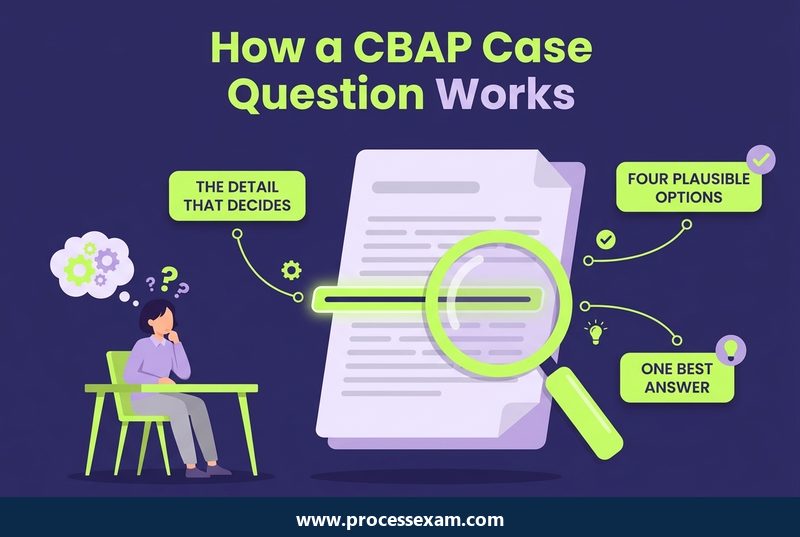
The shape of a scenario question
Those published samples show the pattern clearly. One gives you a SWOT grid and asks what a particular quadrant represents. Another shows a sketch a business analyst has drawn during a current-state discussion and asks which observation the diagram supports. A third describes a long-tenured vice president who disagrees with a project's objectives and asks how that changes the analyst's next step. A fourth has four stakeholders who are unclear about who does what, and asks what the analyst should produce. A fifth changes a record-retention regulation and asks which output lets you manage the requirements the change touches.
Read those five and the design of the paper becomes obvious. The stem carries a detail that decides the answer: the vice president's negative attitude rather than the vice president's seniority; the roles being unclear rather than the work being late. Miss the detail and all four options still look defensible.
Three habits the paper rewards
- Read the question line before the scenario. Knowing whether you are being asked for the next step, the output or the technique changes what you look for in the case.
- Name the task before you look at the options. If you can place the situation in a BABOK task, two options usually fall away on their own.
- Answer as the guide would, not as your employer would. Local practice is not the standard being tested, and the option that sounds most like your last project is a common distractor.
How are the 120 questions split across the BABOK knowledge areas?
IIBA publishes a blueprint that fixes the share of the paper each knowledge area gets, and it is not an even split. One area takes almost a third of the questions; the smallest takes a little over a tenth. Knowing the shape changes where your study hours go.
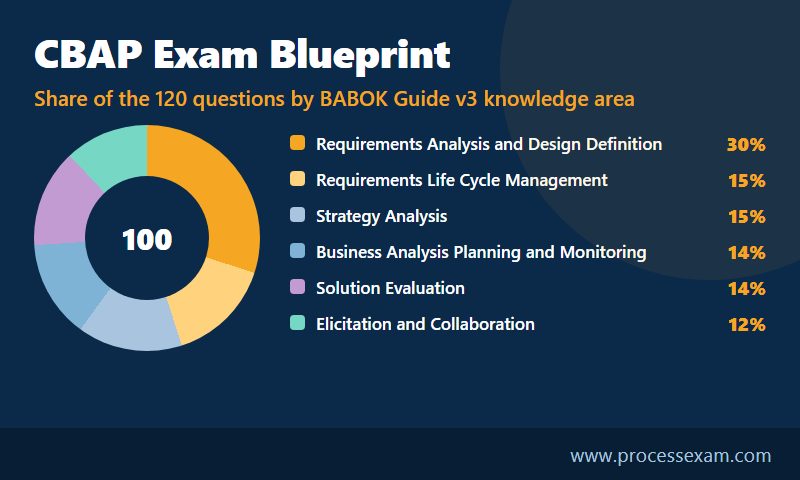
| Knowledge area | Share of the exam | What the questions ask you to do |
|---|---|---|
| Requirements analysis and design definition | 30% | Model, specify, verify and validate requirements; weigh design options and recommend one |
| Requirements life cycle management | 15% | Trace, maintain, prioritise, assess changes to and approve requirements |
| Strategy analysis | 15% | Analyse current state, define future state, assess risks, define a change strategy |
| Business analysis planning and monitoring | 14% | Plan the approach, engagement, governance and information management, then improve performance |
| Solution evaluation | 14% | Measure performance, analyse limitations, recommend action to increase value |
| Elicitation and collaboration | 12% | Prepare and conduct elicitation, confirm results, communicate information, manage collaboration |
Two things follow from that table. First, the three requirements-centred areas together carry 59% of the paper, so an analyst who is strong on modelling and traceability starts well ahead. Second, no area is small enough to skip: the difference between the largest and the smallest is wide, but 12% of 120 questions still decides pass from fail for anyone near the line. If you want the task-level detail behind each row, our CBAP syllabus breakdown lists what sits inside every knowledge area.
Why does requirements analysis and design definition carry 30%?
Because it is where business analysis produces something other people act on. Every other area feeds it or checks it. The exam gives it almost a third of the questions, and those questions are the most technical on the paper.
Modelling is tested by reading, not by drawing
You will not be asked to draw a use case diagram. You will be shown one and asked what it implies: which behaviour is common across several cases, which interface is one-directional, which sequence the diagram actually supports. The same goes for process flows, swim lanes and data models. Learn to read each notation as a statement about the business, because that is how the questions use them.
Verification and validation are not the same question
Verification asks whether a requirement is well written: unambiguous, testable, complete, consistent. Validation asks whether it is worth having: does it deliver value against the business need. Scenario questions in this area often describe a requirement that is perfectly written and useless, or valuable and impossible to test, and the answer depends on which of the two checks is failing.
Requirements architecture holds the rest together
Specifying a requirement is the easy half. The questions push on structure: how requirements relate to one another, how they roll up to the business need, and how you keep that structure viable when the change is large. Expect items where the right answer is to fix the relationships rather than to rewrite a requirement.
Design options are a business decision
Defining design options and recommending a solution puts you in the seat where you compare approaches against value, risk and constraint, then justify a recommendation. Options that quietly hand the decision to a developer or a sponsor are usually wrong; options that evaluate before recommending are usually right.
Which knowledge areas do experienced analysts underestimate?
Candidates with years of delivery behind them tend to lose marks in the same three places, and it is rarely because the material is hard. It is because the work is done informally in their organisation and formally in the guide.
Strategy analysis, at 15%
Many analysts join a project after the change strategy has been set, so current-state analysis, future-state definition, risk analysis and change strategy feel like somebody else's job. The exam treats them as yours. Questions here ask what a business need really is, how capability gaps are identified, and how much change an organisation can absorb at once.
Solution evaluation, at 14%
Work that stops at go-live never meets this area. It covers measuring solution performance, telling an enterprise limitation from a solution limitation, and recommending action that increases value, including the recommendation to retire something. If you have never been asked to prove a delivered change worked, study this area deliberately.
Business analysis planning and monitoring, at 14%
Planning the approach, the stakeholder engagement, the governance and the information management is exactly the work that separates a senior analyst from a competent one, and it is the area most often done by habit rather than by decision. The questions ask you to choose an approach and defend it against the situation in the stem: a regulated programme and a two-week discovery do not get the same answer.
The two areas most people do already
Elicitation and collaboration, at 12%, and requirements life cycle management, at 15%, are the closest to daily practice. The marks there are lost on nuance rather than on substance, mostly around confirming elicitation results and around who approves a change to an approved requirement.
How does CBAP differ from CCBA and ECBA?
The three core IIBA credentials are not the same exam at three lengths. What changes is the kind of thinking each one asks for, and that matters more than the hours on the application form.
- ECBA is the entry certificate. It tests whether you know the concepts, terms and techniques of business analysis, so the questions stay close to definition and recognition, and no work experience is required to sit it.
- CCBA is the mid-level credential for practitioners with a few years of real analysis work. It mixes knowledge questions with situational ones and expects you to apply techniques to a described task. Our guide to the mid-level route covers that exam in full.
- CBAP is the senior credential. Every question is a case or a scenario, the options are all plausible, and the paper assumes the experience rather than testing it.
The practical consequence: preparation that worked for the entry or mid-level exams transfers badly. Memorising the guide gets you a long way at ECBA level and nowhere near far enough at CBAP level, where the same technique names appear in every option list and only the situation decides between them.
How do you prepare for a case-study exam?
By practising decisions, not recall. Analysts who fail this exam rarely fail because they have not read enough; they fail because they read the BABOK Guide as prose and never converted it into judgement.
Read the guide by task, not by chapter
Every task in the guide has the same skeleton: inputs, elements, guidelines and tools, techniques, stakeholders, outputs. Learn the skeleton and you can reconstruct a task you have half-forgotten under exam pressure. Take one knowledge area a week, and for each task write down the two techniques you would actually reach for and the output it produces. That list is worth more in the last week than any amount of rereading.
Drill techniques against situations
Around fifty techniques sit in the guide, and the exam almost never asks what one is. It asks which one the situation calls for. Build yourself a two-column sheet: the situation on the left, the technique on the right, the reason in a clause. Stakeholder roles unclear, RACI matrix, because it assigns accountability. Two options with different cost profiles, decision analysis, because it makes the trade-off explicit.
Practise against the clock, and score by area
210 minutes for 120 questions is a little under two minutes each, and case questions take longer to read than they do to answer. Full-length timed practice is the only way to find out whether your reading pace survives question ninety. When you want a real read on where you stand, take a timed CBAP practice test and score it by knowledge area rather than as one number, because a weak area hidden inside a decent total is exactly what the blueprint punishes.
How to tell the preparation is working
Not by your score alone. Three signals matter more: you can say why each of the three wrong options is wrong, your weakest knowledge area is within a few points of your strongest, and your reading pace is steady from the first question to the last. When all three hold on fresh questions, book the exam.
What happens on exam day, and what if you fail?
You sit the exam either online with a remote proctor or at a PSI test centre; IIBA uses PSI to deliver it both ways. The name on your identification has to match the name on your IIBA record exactly, and scheduling, rescheduling or cancelling needs 48 hours' notice. The CBAP Handbook from IIBA sets out the identification rules, the system requirements for a remote sitting and what is allowed on the desk.
Inside the 210 minutes, pace matters more than it does on shorter papers, because a long case can absorb four or five minutes without you noticing. Answer the question you can answer, flag the one you cannot, and keep the first pass moving. Reading each case twice is the single most common way candidates run out of time.
Your result appears on the screen as pass or fail when you finish, and IIBA emails a confirmation within 48 hours. There is no percentage, no domain scorecard to negotiate with, and nothing to interpret. If it says fail, you buy a rewrite and sit the exam again inside the same approved term, at USD $295 for members and USD $450 for non-members. The sensible use of a second attempt is a month of targeted work on the areas you already know felt thin, not a fortnight of rereading everything.
Which roles does the CBAP open, and what is it worth?
IIBA aims the credential at senior business analysis professionals, lead and principal analysts, enterprise business analysts, business analysis managers, business architects, product managers, digital transformation analysts and senior business consultants. That list is a fair description of what the exam tests, because those roles share the work the paper keeps returning to: owning the approach rather than following it, governing requirements rather than writing them, and being accountable for the value of a change after delivery.
What it signals to an employer
For a hiring manager the credential answers a question interviews answer badly: can this person work to a standard that another organisation would recognise. In organisations with several analysts it often becomes the basis for a practice, a shared vocabulary and a consistent set of deliverables, which is why business analysis managers push their teams toward it. On IIBA's own account the certification is associated with pay up to 19% higher than uncertified peers, a figure IIBA publishes on its CBAP page alongside the fees.
What it does not do
It will not substitute for the hours. The eligibility bar exists because the exam assumes you have led the work it describes, and candidates who apply on borderline experience usually find the questions ask about decisions they have never had to make. It is also not a route into business analysis; that is what the entry certificate is for.
Keeping it
The credential runs on a three-year cycle and is maintained through continuing development, at a recertification fee of USD $85 for members and USD $120 for non-members. Budget for that from the start; it is a small cost next to the application and exam fees, and letting a credential lapse undoes the point of earning it.
The honest summary is this. The CBAP is not a harder version of an exam you have already passed, and it is not a reading test. It asks whether you make the decisions a senior business analyst is paid to make, using a standard the profession agrees on. Prepare for that, and the 210 minutes are far less daunting than the 7,500 hours that got you to the door.
Frequently Asked Questions
What does the CBAP exam test?
It tests applied judgement across the six BABOK Guide knowledge areas. Requirements analysis and design definition carries 30% of the questions, requirements life cycle management and strategy analysis 15% each, planning and monitoring and solution evaluation 14% each, and elicitation and collaboration 12%.
How long is the CBAP exam and what kind of questions does it ask?
The exam runs 210 minutes and holds 120 multiple-choice questions built on case studies and scenarios. Every option tends to look workable, so the deciding detail sits in the situation, and the paper allows a little under two minutes per question.
How is the CBAP exam scored?
IIBA reports the outcome as pass or fail on screen at the end of the sitting and confirms it by email within 48 hours. No percentage or knowledge-area scorecard is published, so timed practice scored by knowledge area is the only reliable readiness gauge.
What is the difference between CBAP and CCBA certification?
Both draw on the BABOK Guide, but CCBA is the mid-level credential and mixes knowledge questions with applied ones, while CBAP is the senior credential and is built entirely from case studies and scenarios. CBAP also asks for substantially more logged experience.
What does CBAP cost, and how often is it renewed?
The application fee is USD $145 and the exam fee is $350 USD for members or $505 USD for non-members. A rewrite costs $295 or $450. The credential is renewed on a three-year cycle for $85 USD for members and $120 USD for non-members.
- IIBA Business Analysis Professional Test Questions |
- CBAP Question Bank |
- IIBA Business Analysis Professional Sample Questions |
- CBAP Exam Questions Download |
- CBAP Test Questions |
- Business Analysis Professional PDF |
- IIBA Business Analysis Professional Book |
- Business Analysis Professional Certification Cost |
- Business Analysis Professional Certification Requirements |
- Business Analysis Professional Simulator |
- Business Analysis Professional Mock Exam |
- Core Business Analysis


