
CCBA Certification Requirements and How to Pass the Exam
Most people who want the CCBA never reach the exam room. IIBA asks for 3,750 hours of business analysis work in the last seven years, 21 professional development hours in the last four, and two references who have known you for at least six months. Each of those numbers carries a counting rule, and the counting rules are where applications stall. Clear them, and the 130-question paper is the straightforward half.

The Certification of Capability in Business Analysis is IIBA's mid-level credential, sitting above the entry-level ECBA and below the CBAP. It is aimed at practitioners with roughly two to three years of real business analysis work behind them, and it is assessed against A Guide to the Business Analysis Body of Knowledge, the BABOK Guide.
This article follows the route in the order you will actually walk it: the eligibility paperwork first, then the exam, then the deadlines and the preparation that turns an approved application into a pass. Every requirement below comes from IIBA's published CCBA material, and the exam figures come from our own exam data for this credential.
Why does the CCBA application stop more people than the exam does?
Because the exam is a test of judgement and the application is a test of record-keeping, and almost nobody keeps records for a credential they have not yet decided to pursue. Candidates sit down to apply, discover they must account for their working life hour by hour against six knowledge areas, and put the whole thing off for a year.
There are three eligibility requirements, and each has its own clock:
- 3,750 work history hours in business analysis, earned within the last seven years.
- 21 professional development hours, earned within the last four years.
- Two references who have known you for at least six months.
Two things about that list catch people out. The first is that the windows are different lengths, so a training course from five years ago counts for nothing even though work from six years ago still counts. The second is that none of it is taken on trust: applications can be routed to an audit, references are contacted, and professional development documents are asked for. An application built on rounded-up guesses is an application that unravels at exactly the wrong moment.
If you read the requirements and come up short, that is not the end of the road. IIBA's entry-level certificate has no work-history requirement at all, and the hours you log while holding it carry forward to a CCBA application later. It is far better to start at the level you qualify for than to inflate a log and fail an audit.
How do you count 3,750 hours the way IIBA counts them?
Start with the plain number. IIBA describes 3,750 hours as approximately two to three years of business analysis work, and it must fall inside the last seven years. Work older than that window is simply invisible to the application, however good it was.
The part that trips people up is not the total. It is the distribution. The 3,750 hours must align with the BABOK Guide knowledge areas, and they must include either:
- a minimum of 900 hours in each of two knowledge areas, or
- a minimum of 500 hours in each of four knowledge areas.
Read that twice, because it is the single most common reason a log fails. A generalist who has spread six years evenly across everything can hit 3,750 hours and still miss both patterns. So can a specialist who has 3,000 hours in one knowledge area and scraps everywhere else, because one deep area does not satisfy a rule that needs two or four. Before you write anything into the application, total your hours by knowledge area on paper and check which of the two patterns you meet.
Mapping real work to the six knowledge areas
The knowledge areas are business analysis planning and monitoring, elicitation and collaboration, requirements life cycle management, strategy analysis, requirements analysis and design definition, and solution evaluation. Your job history did not arrive labelled that way, so the mapping is yours to do.
Work backwards, project by project, rather than trying to recall a typical week. For each engagement, ask what you actually produced. Workshop notes and stakeholder interviews are elicitation and collaboration. Traceability, prioritisation and change assessment are requirements life cycle management. A current-state assessment or a business case is strategy analysis. Models, specifications and acceptance criteria are requirements analysis and design definition. Post-release measurement and recommendations are solution evaluation. The planning of the analysis effort itself, including approach and stakeholder engagement plans, is business analysis planning and monitoring.
Two practical rules keep this honest. Count only hours spent doing business analysis work aligned to those knowledge areas, not the whole of a project week that happened to include some. And be conservative rather than generous: a log that survives questioning is worth more than one that maximises a number you may be asked to defend.
The BA Development Log
Hours are not entered as a single figure. They go into IIBA's BA Development Log, broken out so the distribution rule can be checked, which is why a shoebox of half-remembered dates becomes painful at submission time. Build the log in a spreadsheet first — project, dates, role, knowledge area, hours — and transfer it once it balances. If you are still some way from the total, that same spreadsheet tells you which knowledge area to volunteer for next.
What makes a professional development hour count toward the 21?
The professional development requirement looks like the easy one and quietly is not. You need 21 hours within the last four years, aligned to the BABOK Guide knowledge areas, and the learning itself has to meet a standard. IIBA asks for education and training that enables the transfer of learning and assessment, which in practice means four things:
- a moderator or facilitator who leads you through the material;
- measurable learning objectives that apply directly to the business analysis role;
- opportunities to interact with the material and ask questions;
- opportunities to practise the task being taught and be assessed on it by the facilitator.
Hold an ordinary self-paced video course up against that list and you can see the problem. No facilitator, no questions, no assessment — three of the four criteria missing. Candidates who assemble their 21 hours from whatever was cheapest online are the ones who get an awkward email during an audit.
The safe route is a course from an IIBA Training or Academic Partner. Those have been assessed and validated by IIBA and qualify automatically, and IIBA keeps a searchable directory of them alongside the credential details on its official CCBA certification page. Chapter events and study groups are also worth checking, and they tend to cost far less than a full exam-prep course.
Whatever you choose, keep the evidence as you go: the certificate, the agenda or syllabus, the dates and the hours. Retrieving a completion certificate from a training provider two years after the fact is a task nobody enjoys.
Who can act as a CCBA reference, and why do references get rejected?
You need two, and IIBA is specific about who they can be. A reference must have known you for at least six months and must be one of the following: a credentialed CCBA or CBAP holder, a career manager, or a client — internal or external. A colleague at the next desk who is none of those things does not qualify, however well they know your work.
Then there is the detail that catches the most people out: references must supply a work email address. Personal addresses at Gmail, Hotmail and the like are not accepted. If your best reference is a former manager who has since retired or moved on, that single rule can remove them from your list, so check it before you ask rather than after.
Two habits make this step painless. Ask early, while you are still logging hours, so you are not chasing a signature against a deadline. And tell your references what is coming: they will be contacted as part of the process, and a reference who is expecting the email answers it within a week instead of letting it sit in a spam folder.
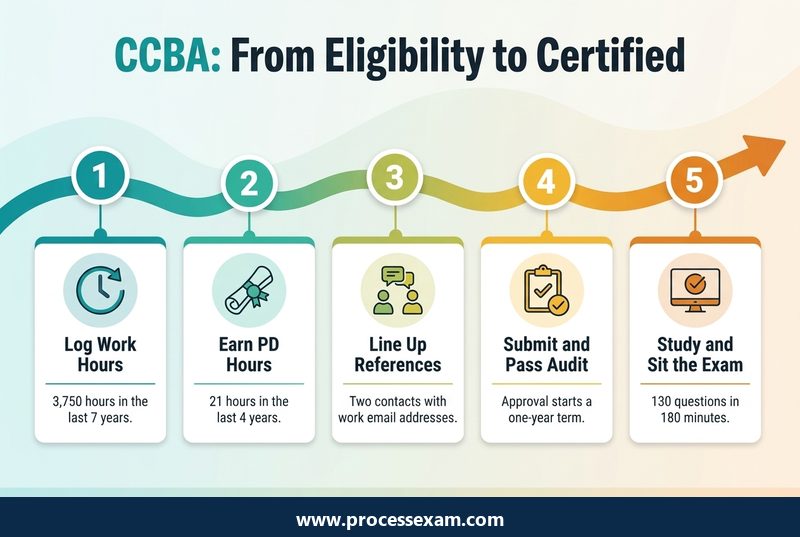
Put the three requirements together and the route from a blank log to a certificate is five steps, in this order:
What does the CCBA exam itself ask you to do?
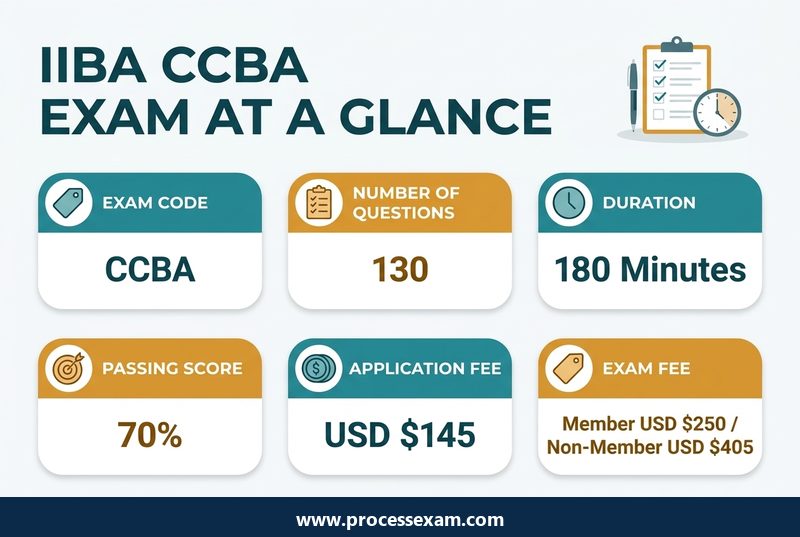
Once the application is approved, the exam is a single sitting. Here are the figures you are planning around:
| Exam detail | CCBA |
|---|---|
| Certification | IIBA Certification of Capability in Business Analysis (CCBA) |
| Exam code | CCBA |
| Vendor | IIBA |
| Body of knowledge | BABOK Guide Version 3 |
| Number of questions | 130 |
| Duration | 180 minutes |
| Passing score | 70% |
| Application fee | Application Fee: $145 USD |
| Exam fee | Member - $250 USD, Non-Member - $405 USD |
| Retake fee | Member - $195 USD, Non-Member - $350 USD |
| Recertification fee | Member - $85 USD, Non-Member - $120 USD |
The questions are multiple choice and scenario based, and the exam is competency based rather than a recall test. A typical item gives you a short situation — a stakeholder disagreement, a change request arriving late, a solution that is live but underperforming — and asks what the business analyst should do next. Several options will be things a business analyst might reasonably do. One is the best next step given what the scenario tells you.
You can sit it as an online remote proctored exam or at a PSI test centre, and either way the result appears on screen the moment you finish. That is worth saying plainly, because candidates often expect a percentage: IIBA reports CCBA as a pass or a fail, with a confirmation email following within 48 hours. Treat the 70% figure above as the standard to beat in your own timed practice, not as a number that will appear on your certificate.
Where the questions actually come from
IIBA publishes an exam blueprint, and it is not evenly spread:
| Knowledge area | Share of questions |
|---|---|
| Requirements analysis and design definition | 32% |
| Elicitation and collaboration | 20% |
| Requirements life cycle management | 18% |
| Business analysis planning and monitoring | 12% |
| Strategy analysis | 12% |
| Solution evaluation | 6% |
Three knowledge areas — requirements analysis and design definition, elicitation and collaboration, and requirements life cycle management — carry 70% of the paper between them. Solution evaluation carries 6%, which is roughly eight questions. That does not make it safe to ignore, but it does tell you where an extra week of study earns the most marks. For a task-level view of what each area contains, our CCBA exam syllabus breakdown lists the topics under each knowledge area so you can tick them off as you cover them.
Which deadlines run between application and exam day?
The CCBA runs on overlapping clocks, and missing one costs real money. The sequence works like this.
Buying the application starts a 12-month window in which you must complete and submit it. That fee is non-refundable and non-transferable, and if the application lapses you pay it again and re-verify everything. Submitting on day 360 with an unfinished log is a bad plan; the log is the slow part.
Once your application is submitted and approved, a fresh one-year term starts from the approval date. Inside that term you may purchase up to three exam attempts. Each exam purchase is valid for six months from the date of purchase or until the approved term ends, whichever comes first — so an attempt bought late in the term has less than six months on it, and the term end date always wins.
That arithmetic is the argument for booking your first attempt early. Sit it with six or seven months of term left and a failure is an inconvenience you can study around. Sit it with six weeks left and a failure is a new application fee.
Two smaller deadlines round it off. Refund requests on the exam fee must be made within 30 days of IIBA receiving payment, after which the fee is non-refundable and non-transferable. And PSI needs 48 hours' notice to schedule, reschedule or cancel — miss that and you forfeit the fee. The same goes for turning up without valid, original, government-issued photo identification whose first and last name match exactly across your ID, your IIBA profile and your PSI booking. Name corrections have to go through IIBA and must be done at least a week before the exam.
How should you study, and how do you know you are ready?
Preparation for a scenario-based exam is different from preparation for a definitions exam, and the difference shows up in how you read. Knowing that a technique exists is worth almost nothing here. Knowing when you would reach for it, and what it gives you that the alternatives do not, is worth everything.
The material worth using
The BABOK Guide is the source the exam is built on, and the Business Analysis Standard sits alongside it. IIBA members get access to both through KnowledgeHub, which is searchable — useful when a practice question sends you looking for one task's inputs. IIBA's competency and proficiency levels are worth a read too, because they describe the level of judgement the exam expects rather than the facts it expects.
Read each knowledge area in the same order every time: purpose, inputs, tasks, techniques, outputs, stakeholders. The repetition builds a mental shape you can drop a scenario into during the exam.
An eight-week plan that matches the blueprint
This assumes five to seven hours a week alongside a full-time job, and it weights time by the blueprint rather than spreading it evenly.
| Weeks | Focus | What to finish |
|---|---|---|
| 1 | Orientation | Read the blueprint, skim all six knowledge areas, fix your exam date |
| 2-3 | Requirements analysis and design definition | Every task and its techniques, plus modelling notation you would actually use |
| 4 | Elicitation and collaboration | Elicitation techniques, confirming results, managing stakeholder collaboration |
| 5 | Requirements life cycle management | Traceability, maintenance, prioritisation, change assessment, approval |
| 6 | Planning, monitoring and strategy analysis | Approach, governance, information management, performance, current and future state |
| 7 | Solution evaluation and weak spots | Measuring performance, limitations, recommendations, plus your two worst areas |
| 8 | Timed practice and review | Two full 180-minute runs, an error log, and one page of final notes |
Practising against the clock
One hundred and thirty questions in 180 minutes leaves roughly 83 seconds each, and scenario questions take longer to read than they do to answer. That is why untimed study creates false confidence: candidates who know the material well still run out of time because they read every scenario twice.
Build the habit early. Read the last line of the scenario first so you know what is being asked before you absorb the detail, then read the detail once. Eliminate options that break sequence — recommending a solution before the requirement is agreed, escalating before eliciting — because those are the usual distractors. Flag anything that takes more than two minutes and come back to it. Finishing a first pass with twenty minutes spare is the target.
Start with the free CCBA sample questions IIBA publishes to see the house style, then move to full-length practice under exam conditions. When you want an honest verdict rather than a feeling, run a full CCBA practice exam against the same 180-minute clock and look at where the blueprint-heavy areas cost you marks — that gap, not your total, is your next week's study plan.
Three signs you are ready to book
You are ready when your practice scores are comfortably clear of 70% on questions you have not seen before, not on a set you have already reviewed twice. You are ready when you can finish a full 130-question run inside the time with room to revisit flagged items. And you are ready when you can explain, for a question you got wrong, why the correct answer was better rather than merely that it was correct. If any of the three is missing, move the date rather than hoping.
The day itself
For an online remote proctored exam, complete PSI's tutorial test in advance — it takes around 30 minutes, you can run it up to three times, and it shows you the room scan and the exam interface before any of it matters. Use a personal computer rather than a work machine, because corporate firewalls and restrictions are a common reason a launch fails. Log in through the IIBA portal about half an hour before the start, never directly into PSI. If you are sitting at a test centre, arrive 30 minutes early and expect a security check, including metal-detection wanding, at check-in.
What is the CCBA worth, and what does it cost to keep?
The CCBA is a competency credential, not an attendance certificate, and that is where its value sits. Because eligibility itself requires 3,750 audited hours, holding it tells an employer two things at once: that you have done the work, and that your judgement has been tested against a global standard. For business analysts moving from delivering tasks to owning analysis on a programme, that is a useful thing to be able to point at.
It also fits a progression. ECBA suits people entering the profession, CCBA recognises two to three years of practice, and CBAP is aimed at senior practitioners with far more experience. Passing the CCBA leaves you with a log, a habit of recording hours, and a body of knowledge you already know — three of the hardest parts of a future CBAP application already done.
The practical benefits are ordinary but real: a digital badge you can share, a listing in IIBA's professional directory, a shared vocabulary with other credentialed analysts, and a credential that recruiters filter on. It is most useful to business analysts, systems analysts, requirements engineers, product owners working on requirements-heavy products, and consultants who need a recognisable standard behind their name.
Keeping it takes maintenance. CCBA holders must earn and record 60 Continuing Development Units every three years in the BA Development Log, and pay the recertification fee — Member - $85 USD, Non-Member - $120 USD. In practice that is 20 CDUs a year, which most active analysts collect through work, chapter events and reading without much effort, provided they record it as they go. The candidates who struggle at recertification are, almost always, the ones who stopped logging the day they passed. For current policy detail on any of this, the CCBA Handbook is the document IIBA expects every candidate to read in full, and it is updated more often than most people check.
Frequently Asked Questions
What are the CCBA eligibility requirements?
IIBA asks for 3,750 hours of business analysis work within the last seven years, 21 professional development hours within the last four years, and two references. The work hours must include 900 hours in each of two BABOK knowledge areas, or 500 hours in each of four.
How many questions are on the CCBA exam, and how long is it?
The CCBA exam has 130 multiple-choice, scenario-based questions and a duration of 180 minutes. That is roughly 83 seconds per question, and the scenarios take time to read, so timed full-length practice matters more than it does for a recall-based paper.
What is the passing score for the CCBA exam?
The exam is measured against a 70% standard, but IIBA does not show you a percentage. Your result appears on screen as a pass or a fail when you finish, and a confirmation email follows within 48 hours. Use 70% as your practice-test benchmark.
How much does the CCBA certification cost?
There is an application fee of $145 USD and a separate exam fee of Member - $250 USD, Non-Member - $405 USD. A rewrite costs Member - $195 USD, Non-Member - $350 USD. Recertification is Member - $85 USD, Non-Member - $120 USD every three years.
Who can be a reference for a CCBA application?
A reference must have known you for at least six months and be a credentialed CCBA or CBAP holder, a career manager, or an internal or external client. Each reference must give a work email address, as personal addresses such as Gmail or Hotmail are not accepted.
- CCBA Question Bank |
- CCBA Exam Questions Download |
- CCBA Test Questions |
- IIBA Business Analysis Capability Test Questions |
- IIBA Business Analysis Capability Sample Questions |
- Business Analysis Capability PDF |
- IIBA Business Analysis Capability Book |
- Business Analysis Capability Certification Cost |
- Business Analysis Capability Certification Requirements |
- Business Analysis Capability Simulator |
- Business Analysis Capability Mock Exam |
- Core Business Analysis


