
FINRA Series 57 Exam: Everything You Need to Know

The FINRA Series 57, officially the Securities Trader Representative Exam, is the qualification you need to trade equity, preferred or convertible debt securities for a firm's own account or to handle customer orders. Administered by the Financial Industry Regulatory Authority (FINRA), it runs 50 scored questions in 105 minutes, costs USD $105 and needs 70% to pass. This guide covers the syllabus, the cost, the study time and the strategy that gets candidates through.
What is the FINRA Series 57 exam and who needs to pass it?
The FINRA Series 57 exam is designed to ensure that securities traders possess the fundamental knowledge required to perform their duties competently and ethically within the highly regulated financial markets. This qualification is crucial for individuals who execute trades in various equity and debt securities, including those involved in market making activities. Passing this exam demonstrates a thorough grasp of the complex rules and procedures that protect market integrity and investor interests. The certification underscores a professional's commitment to compliance and excellence in the fast-paced trading environment.
Achieving this credential signifies that an individual understands the intricacies of trading operations, from order types and market access to regulatory obligations and prohibited practices. It is a benchmark for firms to assess the foundational knowledge of their trading personnel, ensuring they can navigate the market landscape effectively while adhering to strict regulatory frameworks. For many firms, the Series 57 is a mandatory requirement before an individual can actively participate in trading activities on behalf of the organization.
Professional Pathways for Series 57 Candidates
Professionals pursuing the FINRA Series 57 certification are typically aiming for roles that involve direct engagement with securities trading and market operations. This examination is particularly relevant for individuals looking to work as proprietary traders, executing trades for their firm's own account, or those who function as market makers, providing liquidity by quoting both buy and sell prices for specific securities. The qualification also extends to individuals involved in handling and executing customer orders, ensuring compliance with best execution obligations.
The Series 57 designation is crucial for roles such as securities traders, assistant traders, and compliance officers who specialize in trading activities. It prepares candidates for responsibilities that include understanding complex order routing, identifying and preventing clearly erroneous transactions, and navigating various trading systems. Furthermore, it covers essential knowledge on specific products like options, non-listed, and penny stocks, expanding a trader's versatile skillset. Obtaining this certification not only opens doors to specialized trading positions but also provides a solid foundation for career growth within the broader securities industry.
How is the FINRA Series 57 exam structured and scored?
The FINRA Series 57 exam is meticulously structured to evaluate a candidate's practical and regulatory knowledge across critical trading domains. It is a timed examination with a clear set of parameters designed to test proficiency under pressure, much like the real-world trading environment. Candidates must be prepared not only with the subject matter but also with an understanding of the exam's administrative specifics to manage their time effectively during the test.
| FINRA Series 57 at a glance | Detail |
|---|---|
| Exam code | Series 57 |
| Exam name | FINRA Securities Trader Representative Exam |
| Administered by | FINRA |
| Number of questions | 50 |
| Duration | 105 minutes |
| Passing score | 70% |
| Exam price | USD $105 |
FINRA Securities Trader Representative Exam Format Breakdown
The official name for the FINRA Series 57 is the FINRA Securities Trader Representative Exam. This exam consists of 50 scored questions that cover a wide array of topics pertinent to securities trading. The questions are multiple-choice, typically presenting scenarios that require a candidate to apply their knowledge of rules and practices. Given the comprehensive nature of the syllabus, candidates should expect questions that assess both theoretical understanding and practical application of trading regulations and procedures.
Scoring and Duration of the Series 57 Assessment
Candidates are allotted a duration of 105 minutes to complete the 50 questions on the Series 57 exam. To successfully pass, a score of 70% or higher is required. This means candidates must correctly answer at least 35 out of the 50 questions. Effective time management is critical, averaging just over two minutes per question, allowing sufficient time to read carefully and consider each option. The exam price for the Series 57 is USD $105, which covers the administrative costs associated with taking the test. These details underline the importance of thorough preparation to meet both the knowledge and performance requirements.
What does the FINRA Series 57 content outline cover?
The FINRA Series 57 exam content outline, or syllabus, is strategically divided into distinct sections, each weighted differently to reflect its importance in the daily activities of a securities trader. A deep understanding of this outline is paramount for effective preparation, guiding candidates to allocate their study time proportionally to each topic's significance. The outline provides a comprehensive overview of the knowledge areas a competent securities trader must possess, ensuring market fairness and regulatory compliance. You can review the detailed exam outline directly from FINRA.

Trading Activities: Core Responsibilities
The "Trading Activities" section accounts for a significant 82% of the exam, emphasizing its centrality to the Series 57 qualification. This broad category covers almost every aspect of active trading, from understanding market mechanics to navigating complex product-specific rules and identifying prohibited behaviors. A candidate's success hinges on their mastery of these practical and regulatory components.
The key areas within Trading Activities include:
-
Understanding General Trading Practices: This involves fundamental concepts that underpin market operations, ensuring traders understand the mechanics of buying and selling securities.
-
Achieving Market Making Status: Knowledge of the requirements and obligations for firms and individuals acting as market makers, including quoting, displaying, and executing trades.
-
Understanding Order Types: Familiarity with various order types (e.g., market, limit, stop) and their appropriate use in different market conditions.
-
Market Access: Grasping the rules and controls related to firms providing direct market access to customers or other entities, including risk management.
-
Identifying and Handling Clearly Erroneous Transactions: The ability to recognize and correctly address transactions that are clearly out of line with market conditions, which can lead to adjustments or cancellations.
-
Display, Execution and Trading Systems: Knowledge of how different trading systems operate and how orders are displayed and executed within these systems.
-
Identifying and Avoiding Prohibited Activities: Recognizing and preventing practices such as manipulative trading, insider trading, and other fraudulent schemes that undermine market integrity.
-
Disseminating Quotes and Trade Advertisements: Rules governing how firms display their quotes and advertise their trading interest to the market.
-
Trading Specific Products: Specialized knowledge for different types of securities:
-
Initial Public Offerings (IPOs), Secondary Offerings and Safe Harbor: Rules concerning the distribution and trading of newly issued and re-offered securities.
-
Non-listed and Penny Stocks: Regulations specific to the trading of less liquid and higher-risk securities.
-
Options Trading: Understanding the mechanics, risks, and regulatory requirements associated with options contracts.
-
Handling and Executing Short Sales: Rules and procedures for selling securities not owned by the seller, including locate requirements and naked short selling prohibitions.
-
Handling Customer Orders: Specific obligations to customers when executing orders, ensuring fair and prompt execution.
-
Meeting Obligations to Customers Regarding Orders: Requirements like best execution, order protection, and customer confirmation rules.
-
Identifying and Avoiding Prohibited Practices: Further deep dive into abusive practices in relation to customer orders.
-
Regulation NMS: Understanding the various rules under Regulation NMS (National Market System) designed to modernize and improve the U.S. equity markets.
Books and Records, Trade Reporting, Clearance and Settlement
The "Maintaining Books and Records, Trade Reporting and Clearance and Settlement" section constitutes 18% of the exam content. While smaller in percentage, these topics are fundamental to the operational integrity and regulatory oversight of all trading activities. Failure to comply with these rules can result in severe penalties, making them critical areas of study.
This section covers:
-
Reporting Trades to the Designated Reporting Facility: The accurate and timely reporting of transactions to ensure market transparency and regulatory surveillance.
-
Creating, Retaining and Reporting Required Records of Orders and Transactions: Detailed requirements for firms to document every aspect of an order and subsequent transaction, from initial receipt to final execution and settlement.
-
Clearance and Settlement: Understanding the processes involved after a trade is executed, including the exchange of money and securities between parties to finalize the transaction.
Mastering these areas ensures a comprehensive understanding of the entire trading lifecycle, from pre-trade analysis to post-trade compliance.
Is the Series 57 certification worth it for your trading career?
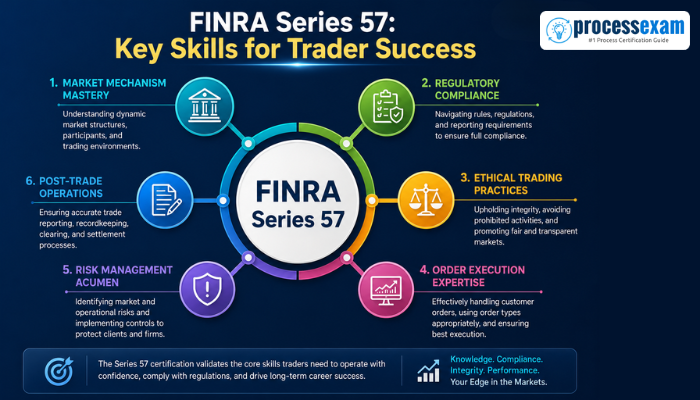
Obtaining the FINRA Series 57 certification offers significant professional advantages for individuals pursuing or advancing a career in securities trading. This credential is far more than just a regulatory hurdle; it is a testament to a trader's expertise and commitment to ethical conduct in the financial markets. The benefits extend across various dimensions of a professional's career trajectory, enhancing both personal growth and market opportunities.
Career Advancement and Market Expertise
For many financial institutions, the Series 57 is a prerequisite for roles involving active trading. Earning this certification immediately makes candidates more marketable and qualified for specialized positions within brokerage firms, investment banks, and proprietary trading operations. It signals to employers that an individual possesses a validated understanding of complex market mechanisms and regulatory compliance, reducing the need for extensive in-house training on foundational trading rules. This can often translate into quicker onboarding and faster progression into more responsible and lucrative trading roles.
Furthermore, the rigorous preparation required for the Series 57 deepens a professional's market expertise. It hones their ability to interpret and apply intricate trading rules, understand different market structures, and mitigate operational risks. This enhanced knowledge base is invaluable for making informed trading decisions and contributes directly to a firm's success and reputation. The comprehensive nature of the exam ensures that certificate holders are well-versed in a broad spectrum of trading activities and products.
Professional Credibility in Trading
In an industry built on trust and regulatory adherence, the Series 57 certification significantly boosts a professional's credibility. It demonstrates an individual’s dedication to upholding the highest standards of conduct and compliance as mandated by FINRA. This level of professional integrity is highly valued by clients, colleagues, and regulatory bodies alike, fostering a reputation for reliability and expertise.
For firms, having Series 57-certified personnel minimizes regulatory risk and demonstrates a commitment to operational excellence. Traders with this certification are better equipped to identify and avoid prohibited activities, handle clearly erroneous transactions, and ensure accurate trade reporting. This proactive approach to compliance not only safeguards the firm against potential penalties but also reinforces its standing as a responsible participant in the securities market. The certification ultimately supports a more stable, trustworthy, and efficient financial ecosystem.
How should you prepare for the Series 57, and how hard is it?
A successful outcome on the FINRA Series 57 exam is directly correlated with a well-structured and disciplined preparation plan. Given the breadth and depth of the material, a strategic approach is essential to cover all syllabus topics thoroughly and retain critical information. Candidates should consider their individual learning styles and time constraints when developing a personalized study schedule that maximizes efficiency and comprehension.
Leveraging Study Materials and Resources
To effectively prepare for the Series 57, leveraging a variety of high-quality study materials is crucial. This typically includes official FINRA resources, such as the detailed exam outline and any available study handbooks. Beyond official documentation, many candidates benefit from a structured FINRA Series 57 training course, which often provides comprehensive textbooks, video lectures, and instructor-led sessions. These courses break down complex topics into digestible modules, aiding in structured learning.
Additionally, FINRA Series 57 prep books from reputable publishers can offer alternative perspectives and supplementary explanations, often including practice questions at the end of each chapter. Combining these textual resources with visual and auditory learning aids, such as online tutorials or webinars, can reinforce understanding and cater to different learning preferences. The goal is to build a robust knowledge base through diverse and reliable educational tools.
The Role of Practice Exams in FINRA Series 57 Readiness
Perhaps one of the most critical components of any Series 57 preparation plan is the consistent use of practice exams. A FINRA Series 57 practice test serves multiple vital functions: it familiarizes candidates with the exam format, helps identify knowledge gaps, and builds confidence under timed conditions. Regularly taking full-length practice tests simulates the actual exam environment, allowing candidates to refine their time management skills and test-taking strategies.
Analyzing performance on FINRA Series 57 exam questions from practice tests is just as important as taking them. Candidates should review incorrect answers to understand the underlying concepts and re-evaluate their reasoning. This iterative process of testing, reviewing, and re-learning is highly effective for solidifying understanding and improving retention. Websites like practice exam questions can provide valuable resources for this essential part of your study. Utilizing a diverse set of practice questions from various sources can also help expose candidates to different question styles and levels of difficulty.
Once your revision notes stop turning up surprises, put a score against them. A timed Series 57 practice exam from ProcessExam runs the full 50 questions at exam pace, so you find out whether your weak spots are knowledge gaps or simply a pace problem while there is still time to fix either.
Anticipating Series 57 Exam Difficulty and Time Commitment
The FINRA Series 57 exam is widely regarded as challenging, reflecting the specialized knowledge and critical responsibilities of a securities trader. Its difficulty stems from the extensive syllabus, which encompasses intricate regulatory rules, detailed trading practices, and product-specific nuances. Successfully navigating this complexity requires not only diligent study but also a significant time commitment, often varying based on a candidate's prior experience in the financial industry.
The comprehensive nature of the "Trading Activities" section, which accounts for 82% of the exam, means candidates must master a broad spectrum of topics from market access to prohibited activities and specific product rules like options and short sales. This demands an ability to apply regulatory frameworks to practical scenarios, distinguishing between correct and incorrect trading practices. For individuals new to securities trading, the sheer volume of new information can be daunting, necessitating a longer study period. Even experienced professionals may find certain regulatory details require focused attention.
Typically, candidates dedicate several weeks to a few months for preparation, with many recommending at least 80-100 hours of focused study time. This estimate can increase significantly for those without a strong financial background. A structured study guide, consistent practice tests, and a deep dive into each topic are critical for overcoming the inherent difficulty of the FINRA Series 57. It is not an exam to be underestimated, and a realistic assessment of the required effort is the first step towards success.
What does the Series 57 exam cost and how do you register?
Understanding the practicalities of registering for the FINRA Series 57 exam and its associated costs is an important part of the preparation journey. The registration process, while straightforward, requires adherence to specific procedures set forth by FINRA. Candidates should plan ahead to ensure all requirements are met before attempting to schedule their exam, avoiding any last-minute complications.
The FINRA Series 57 exam cost is USD $105. This fee is typically paid during the registration process. It's important to note that this fee covers the examination itself and does not include the cost of study materials, training courses, or practice tests, which are additional investments candidates often make to enhance their chances of success. Firms often sponsor their employees for the Series 57 exam, covering the registration fee and sometimes providing study resources. However, individual candidates pursuing the certification independently should budget for these expenses.
To register for the exam, candidates must be sponsored by a FINRA member firm. The firm initiates the registration process through FINRA's Central Registration Depository (CRD) system, submitting a Form U4 (Uniform Application for Securities Industry Registration or Transfer). Once FINRA processes the Form U4 and the necessary fees are paid, the candidate is provided with an enrollment window, typically 120 days, to schedule and take the exam. It's crucial to refer to the official FINRA guidelines for the most current and accurate information regarding eligibility and registration procedures. Planning these administrative steps in advance allows candidates to focus solely on their study efforts as the exam date approaches.
Which trading and compliance rules does the Series 57 test hardest?
Roughly four in five questions come from the Trading Activities section, and the rules below are where that weight falls. Prohibited practices, order handling and market access, and the post-trade duties of reporting, clearance and settlement are the areas candidates most often underestimate.
Navigating Prohibited Trading Activities and Compliance
A significant portion of the FINRA Series 57 exam, particularly within the "Trading Activities" domain, is dedicated to understanding and avoiding prohibited activities. This emphasis underscores FINRA's commitment to maintaining fair, orderly, and transparent markets. For securities traders, recognizing and actively preventing these practices is not just a regulatory requirement but a fundamental ethical obligation that protects investors and market integrity.
Prohibited activities can range from various forms of market manipulation to inappropriate handling of customer orders. Examples include engaging in "wash sales" (trades that create the appearance of activity without any change in beneficial ownership), "painting the tape" (creating a misleading appearance of active trading in a security), or "front-running" (trading on non-public information about an impending customer order). The exam tests a candidate's ability to identify these sophisticated schemes and the rules designed to counteract them.
Furthermore, compliance with specific regulations, such as Regulation NMS (National Market System), is vital. Regulation NMS aims to ensure fair and liquid markets, requiring optimal execution of trades across various venues and transparent pricing. Traders must understand how these rules impact order routing, execution, and data dissemination. The Series 57 also delves into the appropriate handling of clearly erroneous transactions, outlining the procedures for identifying and requesting adjustments for trades executed at prices substantially divergent from the prevailing market. A thorough understanding of these compliance aspects is essential for any responsible securities trader.
Mastering Order Handling and Market Access Rules
Effective order handling and compliant market access are foundational competencies for any securities trader, and they form a substantial part of the FINRA Series 57 curriculum. These areas ensure that trades are executed fairly, efficiently, and in accordance with regulatory mandates, directly impacting investor trust and market efficiency. The exam challenges candidates to demonstrate a comprehensive understanding of the operational and regulatory nuances involved.
Understanding Diverse Order Types and Their Application
A core component of order handling involves a deep familiarity with various order types and their strategic application. Traders must know the difference between market orders, limit orders, stop orders, and more complex variations like stop-limit or not-held orders. Crucially, they must understand when each order type is appropriate, its potential advantages and disadvantages in different market conditions, and its impact on execution price and speed. The exam often presents scenarios requiring candidates to select the most suitable order type given specific client instructions or market parameters.
This also extends to understanding how orders interact with different trading venues and algorithms. Knowledge of order routing protocols and smart order routing systems is essential, as these systems determine where and how an order is sent for execution to achieve the best possible outcome for the customer or firm. The ability to articulate the lifecycle of an order from submission to execution and confirmation is a key skill validated by the Series 57.
Ensuring Compliant Market Access and Risk Controls
Market access rules are designed to prevent unfiltered access to the markets, which could lead to substantial financial losses, system disruptions, or regulatory violations. Firms providing market access must have robust risk management controls in place to prevent erroneous orders, manipulative trading, and exceeding pre-set credit or capital limits. The Series 57 exam assesses a candidate’s understanding of these crucial safeguards.
Key elements include the requirement for firms to establish and maintain pre-trade and post-trade controls, such as risk limits, credit checks, and capital thresholds. Traders must understand their responsibility in operating within these controls and the consequences of their failure. The exam also covers the supervision of market access, including the roles and responsibilities of supervisors in monitoring trading activity for compliance. These controls are vital for preventing systemic risks and ensuring that only authorized and vetted individuals or systems can directly interact with the national securities exchanges.
Ensuring Robust Trade Reporting and Settlement Procedures
Beyond the execution of trades, the FINRA Series 57 exam delves into the critical post-trade functions of reporting, clearance, and settlement. These processes are vital for maintaining market transparency, ensuring regulatory oversight, and facilitating the efficient transfer of ownership and funds. Errors or delays in these areas can have significant financial and regulatory repercussions, highlighting their importance in a trader’s responsibilities.
Accurate and Timely Trade Reporting Obligations
Timely and accurate reporting of trades to the appropriate designated reporting facility is a cornerstone of market integrity. This includes reporting to facilities like the Trade Reporting Facilities (TRFs) for equities. The exam requires an understanding of what information must be reported (e.g., security symbol, price, volume, time of trade), the specific timelines for reporting, and the consequences of non-compliance. Correct reporting ensures that market participants have access to real-time trade data, contributing to price discovery and fair valuation.
Furthermore, traders must understand their firm's internal record-keeping obligations related to trade reporting. Every aspect of an order and transaction, from the initial order ticket to the final execution and reporting details, must be meticulously documented and retained for specified periods. This ensures an audit trail for regulatory examinations and facilitates internal compliance reviews. Knowledge of these record-keeping requirements is essential for maintaining transparent operations and avoiding regulatory infractions.
Navigating Clearance and Settlement Processes
The final stages of a trade involve clearance and settlement, where the transfer of ownership of securities and the corresponding payment occur. The Series 57 exam covers the fundamental principles and mechanics of these processes, which typically involve central clearing agencies like the National Securities Clearing Corporation (NSCC). Understanding the roles of these entities, the settlement cycle (T+1 for most equity trades since 28 May 2024), and the implications of settlement failures is crucial.
Candidates should be familiar with the concepts of continuous net settlement, delivery versus payment (DVP), and receive versus payment (RVP), which are mechanisms designed to streamline the settlement process and reduce counterparty risk. The exam also touches upon margin requirements and the handling of customer funds and securities during the settlement phase. A solid grasp of clearance and settlement ensures that traders understand the complete lifecycle of a transaction, from initiation to its final conclusion, cementing their role in a well-functioning financial market.
How do you pass the FINRA Series 57 exam on your first attempt?
Passing the FINRA Series 57 exam requires a strategic, multifaceted approach that combines thorough content knowledge with effective test-taking skills. Beyond merely memorizing facts, candidates must develop the ability to apply complex regulatory rules to practical trading scenarios. A focused strategy, built on understanding the exam's nuances, is essential for converting study efforts into a successful outcome.
One critical step is to develop a deep conceptual understanding rather than relying on rote memorization. The Series 57 emphasizes scenario-based questions that require analytical thinking. This means internalizing the "why" behind each rule and practice, especially concerning market integrity, investor protection, and firm compliance. Engaging with case studies and real-world examples during study can significantly enhance this conceptual grasp, making it easier to apply knowledge under exam conditions.
Another key strategy involves effective time management during the exam itself. With 50 questions in 105 minutes, candidates have just over two minutes per question. Practicing with a timer during mock exams is vital to develop a comfortable pace and avoid rushing through complex questions or spending too much time on a single difficult item. If a question is particularly challenging, it's often best to make an educated guess, flag it, and move on, returning to it if time permits. Focusing on the question's core intent and eliminating obviously incorrect answers can improve accuracy even when uncertain.
Finally, maintaining a positive mindset and managing exam-day anxiety are crucial. Adequate sleep, a nutritious meal before the exam, and arriving early at the testing center can make a significant difference. Trusting in your preparation and staying calm under pressure will allow you to access your knowledge more effectively and perform at your best. The Series 57 is challenging, but with dedicated effort and smart strategies, success is well within reach.
The FINRA Series 57 exam is a demanding yet highly rewarding qualification for anyone aspiring to a career in securities trading. It validates a critical understanding of market regulations, trading practices, and compliance standards essential for navigating the complex financial landscape. By diligently studying the comprehensive syllabus, utilizing effective preparation strategies, and committing to continuous learning, candidates can successfully achieve this vital certification. This credential not only enhances professional credibility but also opens doors to specialized and impactful roles within the securities industry.
Frequently Asked Questions
What is the FINRA Series 57 exam, and who should take it?
The FINRA Series 57, or Securities Trader Representative Exam, qualifies professionals to trade equity, preferred, or convertible debt securities and engage in proprietary trading. It's ideal for aspiring securities traders, market makers, and individuals handling customer orders on behalf of a firm.
What topics are covered in the FINRA Series 57 syllabus?
The exam primarily covers Trading Activities (82%), including general practices, market making, order types, market access, prohibited activities, and product-specific rules (options, short sales). The remaining 18% focuses on Maintaining Books and Records, Trade Reporting, Clearance, and Settlement.
How difficult is the FINRA Series 57 exam, and how much time should I allocate for study?
The Series 57 is considered challenging due to its extensive regulatory content and practical application scenarios. Most candidates dedicate 80-100 hours of focused study over several weeks or months, with more time needed for those without prior industry experience.
What are the benefits of passing the FINRA Series 57 exam?
Passing the Series 57 enhances career advancement opportunities in trading roles, boosts professional credibility with employers and regulators, and validates a deep understanding of market operations and compliance, making you a more valuable asset in the financial industry.
What is the cost of the FINRA Series 57 exam, and how do I register?
The FINRA Series 57 exam costs USD $105. Registration typically requires sponsorship by a FINRA member firm, which initiates the process through the Central Registration Depository (CRD) system by submitting a Form U4. Once approved, you will receive a window to schedule your exam.
- Representative-level |
- FINRA Securities Trader Representative Exam Test Questions |
- Series 57 Question Bank |
- FINRA Securities Trader Representative Exam Book |
- FINRA Series 57 BOK PDF |
- Securities Trader Representative Exam Certification Cost |
- Securities Trader Representative Exam Certification Requirements |
- FINRA Securities Trader Representative Exam Sample Questions |
- Series 57 Test Questions |
- Securities Trader Representative Exam PDF


